Suica vs PASMO (2026): Which Tokyo IC Card Should You Get?
Contents
- 1. Suica vs PASMO: what is the difference?
- 2. Which card should you choose by airport, trip length and traveler?
- 3. Where Suica and PASMO work: trains, buses, shops and Kansai
- 4. Prices, validity and refunds
- 5. Can you still buy a regular Suica or PASMO?
- 6. Suica vs PASMO at Narita and Haneda airports
- 7. Buying and topping up a card
- 8. Suica and PASMO on your phone
- 9. Suica vs PASMO FAQ
For most Tokyo visitors, Suica and PASMO work much the same way on participating trains, subways, buses and in shops. Choose the card you can buy conveniently, then check its price, validity and refund rules: visitor products such as Welcome Suica and TOURIST PASMO have different terms.
If you are arriving at Narita or Haneda, the airport sales points can make the decision straightforward. For a smartphone card, check the official device requirements for the exact product and phone before relying on it.
An IC card is a prepaid card with a chip. Add money to it, then tap it on a reader to pay fares or make purchases at participating shops. It is not an unlimited-ride pass, and every traveler needs their own card.
Suica vs PASMO: what is the difference?
Suica is issued by JR East and other companies, while PASMO is issued by PASMO Co., Ltd. On many participating services in the Tokyo area, the cards are mutually accepted, so you do not generally need to match your card brand to the operator of every train you take. However, acceptance is not universal; check for an IC-card sign or ask staff when a line or service is unfamiliar. See PASMO’s official network information and JR East’s Suica information.
The more consequential differences are between products, not simply between the two brand names. A regular Suica or PASMO has different purchase and refund terms from a visitor card, and the visitor products have their own validity periods. The table below separates the products so you can compare like with like.
Quick comparison
| Feature | Regular Suica | Welcome Suica | Regular PASMO | TOURIST PASMO |
|---|---|---|---|---|
| Issuer | JR East and other companies | JR East | PASMO Co., Ltd. | PASMO Co., Ltd. |
| Basic purchase information | Listed amounts from ¥1,000 to ¥10,000, each including a ¥500 deposit | Listed amounts from ¥1,000 to ¥10,000; no deposit | Basic issue amount ¥1,000 including a ¥500 deposit; exceptions apply | At Narita, ¥2,000; at Haneda, listed amounts from ¥1,000 to ¥10,000 |
| Balance limit | ¥20,000 | ¥20,000 | ¥20,000 | ¥20,000 |
| Validity | Check JR East’s current terms | 28 days under the purchase information; official materials differ on the starting point | Expires after 10 years without use, top-up or exchange | 28 days including the purchase date |
| Unwanted remaining balance | Check JR East’s current terms | No ordinary refund | Refund available under PASMO rules | No refund |
| Plastic-card deposit | ¥500 included in listed purchase amounts | None | ¥500 in the basic issue amount | None |
| Phone option | Mobile Suica; check current requirements | Welcome Suica Mobile for supported Apple devices | Mobile PASMO; check current requirements | Visitor product is a plastic card |
The regular Suica amounts and Welcome Suica information are listed by JR East and in its Welcome Suica purchase guide. PASMO’s basic issue amount, deposit and other regular-card terms are set out in its terms and conditions. These amounts and terms are not interchangeable across products.
A deposit is money held against a plastic card; it is not part of the balance you can spend on fares or shopping. A top-up, sometimes labelled “Charge” on a machine, adds spendable money. A refund returns money only under the rules for that particular card.
Is Suica or PASMO better?
For an ordinary Tokyo visit, neither brand is automatically better. If you can buy either product, compare the visitor card’s end date, purchase amount, payment options and refund rules with your itinerary. The practical choice is usually the product available at a convenient sales point that suits your trip dates.
The answer can change if you want a refundable regular card, are staying longer than 28 days, are buying for a child, or plan to use a phone. Do not assume that one product’s terms also apply to another product with the same brand name. For example, TOURIST PASMO’s no-refund rule does not establish the refund terms for Welcome Suica.
Which card should you choose by airport, trip length and traveler?
Start with your arrival airport and the sales points you can reach, then consider how long you will stay. Finally, choose a suitable card for each person in your group; cards are personal, and a single card is not for several travelers to share through the gates. Prices and opening hours below were checked on 3 November 2026, but stock and sales arrangements can change.

| Your situation | Practical option to compare | Important detail |
|---|---|---|
| Arriving at Narita and taking the Keisei railway | TOURIST PASMO or Welcome Suica | TOURIST PASMO is listed at ¥2,000 at Keisei’s airport stations; Welcome Suica is also sold at JR East airport points |
| Arriving at Haneda | TOURIST PASMO or Welcome Suica | TOURIST PASMO is offered at listed amounts from ¥1,000 to ¥10,000 at Keikyu airport stations |
| Staying more than 28 days | A regular card, or another product whose current terms fit your stay | TOURIST PASMO lasts 28 days; check Welcome Suica’s date carefully because official materials differ on the starting point |
| Wanting a refund for an unwanted balance | Consider a regular PASMO or JR East-issued regular Suica | The refund process, applicable operator and fee depend on the card |
| Traveling with a child | Check the child-card product and purchase point in advance | Child-card purchase requires age verification for TOURIST PASMO; confirm Suica requirements with JR East |
| Using an iPhone or Apple Watch | Compare Mobile PASMO and Welcome Suica Mobile | Check the current model, software and payment requirements for the specific product |
| Using an Android phone bought outside Japan | A plastic card is the safer option to compare | Mobile PASMO generally does not support overseas-purchased Android devices |
For a child, do not assume that an adult card charges the correct child fare. TOURIST PASMO child-card purchases require age verification, and Suica child-card conditions should be checked with JR East rather than inferred from PASMO rules. Each traveler should have their own card for gate entry.
If you are arriving by train in central Tokyo rather than through an airport, compare the products sold at the station or service center on your route. JR East lists Welcome Suica sales at several travel service centers and other locations, but some listed sites are temporarily suspended from sales. Check the JR East Welcome Suica page before making a special trip.
Where Suica and PASMO work: trains, buses, shops and Kansai
Suica and PASMO work on many participating trains and buses and at many shops that display an IC-card sign. The exact cards accepted can vary by region, railway company, bus operator and shop. Japan’s National Tourism Organization advises travelers to check local acceptance rather than assume that every card works everywhere; see its IC-card guidance and cashless-payment information.
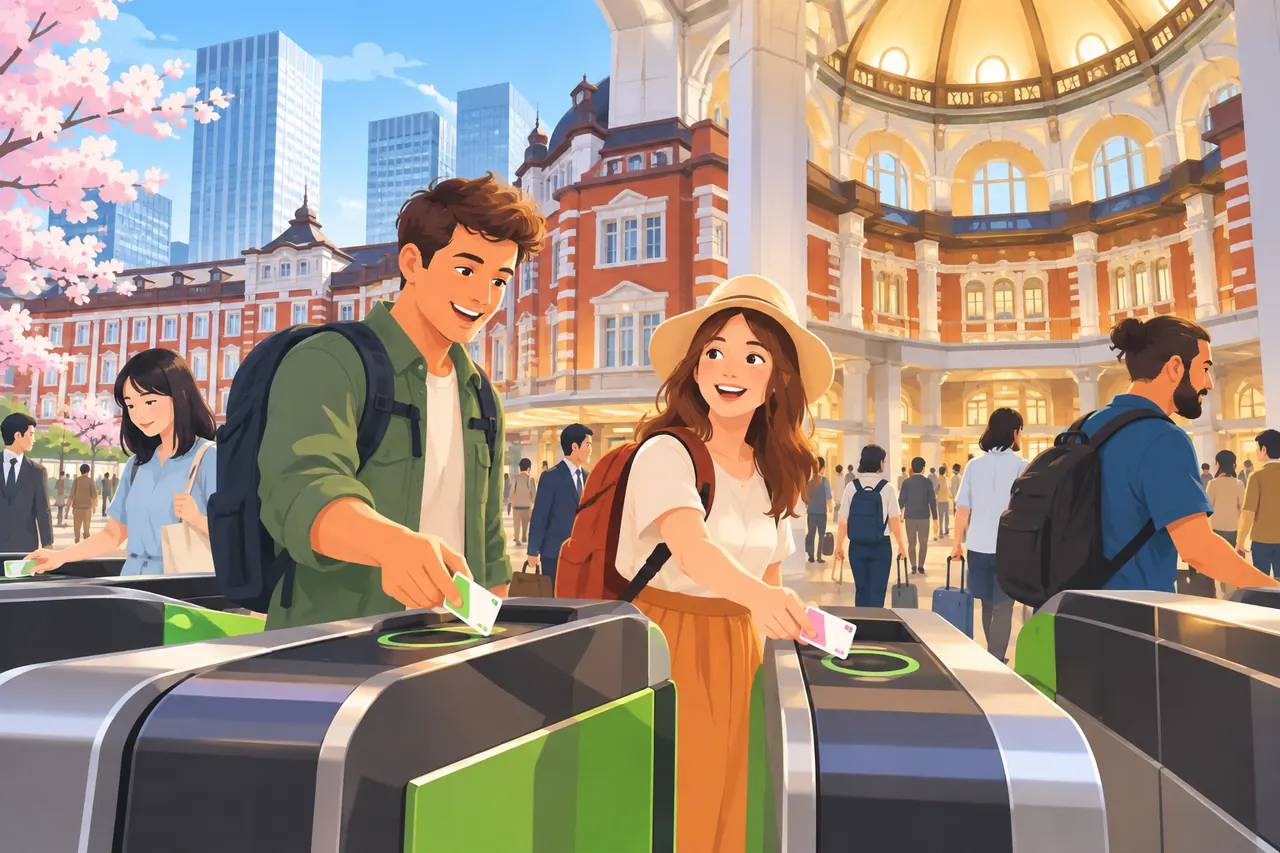
At a participating station, tap the card or phone at the entry gate and tap again when you leave. The fare is deducted from the stored balance. If the gate does not accept the card or shows an error, do not force your way through; ask station staff to check the card and fare.
Bus payment methods can differ by operator. Follow the signs inside the bus and check where the card reader is located before tapping; if the instructions are unclear, ask the driver. In shops, look for the IC-card sign or ask the cashier before attempting to pay.
Using an IC card outside Tokyo
The shared network includes ten major transport IC-card brands: Kitaca, PASMO, Suica, manaca, TOICA, ICOCA, PiTaPa, SUGOCA, nimoca and Hayakaken. This allows Suica and PASMO to work on many participating services in other regions, including parts of Kansai around Kyoto and Osaka. PASMO’s official network page describes the shared network and its limits.
There are exceptions. PiTaPa is not included in the shared network for electronic-money shop payments, and not every line or local service accepts every card. There are also restrictions on using one card for a single journey that crosses separate IC-card areas. Ask station staff before starting a long cross-area journey; JR East, for example, describes a specific exception for certain commuter passes spanning Suica and TOICA areas in its Suica-area information.
An IC card pays the fare deducted from its balance; it does not make a journey free or provide unlimited rides. If you are planning longer-distance travel, compare the card with the relevant tickets or passes for your route. For Shinkansen, limited-express trains and Green Cars, the IC-card fare and any separate ticket can follow different rules.
Shinkansen, limited express and Green Cars
A Shinkansen is a bullet train, a limited express is a faster train that generally makes fewer stops, and a Green Car is a higher-class car on certain services. These journeys can require more than the ordinary fare, so having a Suica or PASMO does not by itself mean you have the required train ticket or reservation. Check the operator’s rules for the exact service.
JR East’s e-ticket guide explains that products differ and that an IC card may need to be registered for a Shinkansen e-ticket. Each passenger needs their own registered IC card for that service. An e-ticket for a Shinkansen and a ticketless limited-express product are not the same product, so check the conditions for the one you buy.
Prices, validity and refunds
For regular PASMO, the basic issue amount in the terms is ¥1,000, including a ¥500 deposit, although exceptions apply and this should not be treated as a universal counter price. The stored-balance limit is ¥20,000. Regular PASMO expires if it goes 10 years without use, top-up or exchange; the period is counted from the day after the last such activity, according to the PASMO terms.
Regular Suica has its own purchase and refund rules. JR East lists adult and child purchase amounts of ¥1,000, ¥2,000, ¥3,000, ¥4,000, ¥5,000 and ¥10,000, each including a ¥500 deposit, with a ¥20,000 balance limit. The purchase and usage rules should be checked with JR East’s Suica information, not inferred from PASMO.
| Product | Purchase or issue amount | Ordinary refund for unwanted balance? | Main validity point |
|---|---|---|---|
| Regular PASMO | Basic ¥1,000 including ¥500 deposit; exceptions apply | Yes, under PASMO’s refund rules | 10 years without use, top-up or exchange |
| Regular Suica issued by JR East | Listed amounts from ¥1,000 to ¥10,000, each including ¥500 deposit | Yes, under JR East’s rules | Check current JR East terms |
| Welcome Suica | Listed amounts from ¥1,000 to ¥10,000; no deposit | No | Purchase page says 28 days including purchase day; other JR East materials differ on the starting point |
| TOURIST PASMO | Narita: ¥2,000; Haneda: listed amounts from ¥1,000 to ¥10,000 | No, except a separate damaged-card process | 28 days including the purchase date |
For regular PASMO, the refund fee is ¥220 when the balance is at least that amount; if the balance is less than ¥220, the remaining balance is taken as the fee. The ¥500 deposit is returned as well. For example, a PASMO with ¥1,000 remaining returns ¥780 of balance plus the ¥500 deposit, for ¥1,280 total; one with ¥100 remaining returns the ¥500 deposit only.
A JR East-issued regular Suica is returned at a JR East station under JR East’s terms. JR East deducts a fee of up to ¥220 from the balance and returns the ¥500 deposit; a balance of ¥1,000 therefore gives ¥1,280 back, while a balance of ¥100 gives ¥500 back. For a Suica issued by another company, check with that issuer about where and how to return it.
Visitor-card validity and damaged cards
TOURIST PASMO is valid for 28 days including the day it is sold. Its balance limit is ¥20,000, and it cannot be topped up from the balance on another IC card. The TOURIST PASMO terms state that unwanted or expired balances are not refunded; a damaged card follows a separate procedure.
Welcome Suica also has a 28-day period, but JR East materials do not describe its starting point consistently. The purchase guide says the purchase day is included, while JR East press materials refer to 28 days from first use. Check the expiry date on the guide paper supplied with the card and do not rely on an assumed start date. Its ordinary leftover balance is not refunded.
If TOURIST PASMO is damaged, report it to station staff and request the designated refund form. The application period begins the day after the form is issued and ends within 14 days counted from the day after the card’s expiry; you need the card, the form and the guide paper. A refund is not guaranteed in every case, including if the card number cannot be read.
For Welcome Suica that stops working, first remove it from its case and try again. If it still fails, contact staff at a station in the Suica area; if they determine the card itself is faulty, they can issue a refund certificate. JR East says to present the faulty card and certificate at an eligible “Midori no Madoguchi” ticket office between the day after applying and 14 days after the card’s expiry, and notes that a card number that cannot be read cannot be refunded.
Visitor cards cannot be reissued if lost. Keep the card and its guide paper together, and carry the paper while using the card. Do not expect a refund simply because you no longer need the card or your trip ends before its expiry.
Can you still buy a regular Suica or PASMO?
Yes, regular cards are sold again, although local exceptions and sales arrangements may apply. Sales of named cards were announced to resume on 1 September 2024, and sales of blank, unnamed cards were announced to resume on 1 March 2025. Check the sales notice or station information for the operator and location where you plan to buy; see the official named-card resumption notice and blank-card resumption notice.
A named PASMO is for its registered holder, so each traveler needs the appropriate card. Regular cards are separate from visitor products, and their purchase, validity and refund rules should not be mixed with Welcome Suica or TOURIST PASMO terms. If you see an older guide recommending PASMO PASSPORT, note that it is no longer the current visitor product: PASMO’s notice said station handling ended on 11 October 2024 and the related rules were abolished on 12 October.
TOURIST PASMO was announced on 17 April 2026 and went on sale on 20 May 2026. Its terms and airport sales information are available from the official TOURIST PASMO page. Check that page rather than relying on older travel articles for current visitor-card details.
Suica vs PASMO at Narita and Haneda airports
At Narita, TOURIST PASMO is sold at the Keisei railway stations’ SKYLINER & KEISEI INFORMATION CENTER in Terminals 1 and 2, with a listed price of ¥2,000. The centers are listed as open 7:00–21:00. Welcome Suica is also sold at JR East airport sales points; because stock and arrangements can change, verify the relevant Keisei airport information and JR East Welcome Suica information before relying on a particular counter.
At Haneda, TOURIST PASMO is sold at Keikyu airport stations in Terminals 1, 2 and 3 through traveler ticket machines, with listed amounts from ¥1,000 to ¥10,000. The Keikyu Tourist Information Center at Terminal 3 is listed as open 8:00–22:00, on the second floor of the arrival lobby near the ticket gate. The PASMO sales guide shows sales-point locations, and Keikyu provides official information about its Haneda tourist information center.
| Airport sales point | Product and listed price | Hours noted in official information |
|---|---|---|
| Narita Terminal 1, Keisei station | TOURIST PASMO, ¥2,000 | 7:00–21:00 |
| Narita Terminal 2, Keisei station | TOURIST PASMO, ¥2,000 | 7:00–21:00 |
| Haneda Terminals 1, 2 and 3, Keikyu traveler machines | TOURIST PASMO, ¥1,000–¥10,000; credit card accepted for purchase | Not listed for the machines |
| Haneda Terminal 3, Keikyu Tourist Information Center | TOURIST PASMO | 8:00–22:00 |
| Narita Terminal 1 and Terminal 2/3 JR East points | Welcome Suica | Check the JR East sales page |
Finding the sales points inside the airports
At Narita, follow the railway signs to the station in your terminal, then look for the Keisei SKYLINER & KEISEI INFORMATION CENTER. The JR East travel service centers are on B1: at Terminal 1, go down from the first-floor arrival lobby and look to the right toward the back from the North Wing, or to the left from the South Wing. At Terminal 2, go down from the first-floor arrival lobby; from Zone A turn left and look on the left, and from Zone B turn right and look on the left.
JR East lists its Narita Terminal 1 travel service center as open 8:30–19:00, and its Terminal 2/3 center as open 8:30–20:00. At Haneda Terminal 3, the JR East travel service center is near the Tokyo Monorail gates on the second floor; follow the Tokyo Monorail signs from the second-floor arrival lobby. Its listed hours are 6:45–20:00. Check the official Narita Terminal 1 service-center page, Narita Terminal 2/3 page and Haneda page for maps and current details.
For TOURIST PASMO at Haneda Terminal 3, start at the second-floor arrival lobby and head toward the Keikyu ticket gate. Look for the Keikyu Tourist Information Center or the traveler ticket machines beside it. If you need to ask for directions, show staff “京急ツーリストインフォメーションセンター.”
Welcome Suica is also listed at JR East travel service centers in Tokyo, Shibuya, Shinjuku, Ikebukuro, Ueno, Yokohama and Sendai, as well as JAPAN RAIL CAFÉ TOKYO and the Takanawa Gateway travel service center. JR East has noted that sales are suspended at some listed locations, including Kashiwa, Kawasaki, Tachikawa, Omiya, Funabashi, Fukushima and Niigata. Check the specific location’s official page before going.
If the visitor card you want is unavailable, ask staff whether the other visitor card or a regular card is available. If you need to leave before you can buy a card, you can buy a paper ticket for that ride and get an IC card later. Do not assume that a card is in stock just because a sales point is listed.
Buying and topping up a card
Buying a card and adding money to it can have different payment rules. JNTO says ticket-machine IC-card purchases are cash-only, while PASMO says its Haneda traveler machines accept credit cards when buying TOURIST PASMO. For that reason, check the specific machine or counter before paying, and do not assume that a machine’s purchase payment options also apply to top-ups.
TOURIST PASMO can be topped up with cash at station machines, but not from the balance of another IC card. Welcome Suica card top-ups use yen cash, and credit cards cannot be used for that card. For regular Suica, check JR East’s current guidance; the official Suica information says card top-ups are cash-only.
Buy a card: practical steps
- Open the relevant official sales page and choose a point in the terminal or station you will use.
- Check your trip dates against the product’s validity period. For Welcome Suica, use the expiry information on the guide paper because the official materials differ on the starting point.
- Follow the railway signs to the station, machine or counter. At an airport, confirm whether the sales point is in your terminal before walking there.
- Read the screen or counter sign for available amounts and payment methods. The listed price or payment option can differ by sales point.
- Select the product and amount, pay, and take both the card and its guide paper. Keep the two together during your trip.
Add money to a card
- Find a ticket machine displaying an IC-card sign and choose “Charge” on the screen.
- Follow the screen’s instructions to place the card in the tray or slot.
- Select an available amount and insert the required yen cash, unless the product and machine explicitly offer another payment method.
- Check the new balance on the screen before taking the card.
PASMO products have a ¥20,000 balance limit, and PASMO top-ups are generally in ¥1,000 units, though available amounts can vary by operator and machine. Welcome Suica also has a ¥20,000 limit. Avoid adding more money than you expect to use on a visitor card, since unwanted remaining balances are not ordinarily refundable.
Near the end of your stay, top up only what you need and consider spending remaining balance at a shop that accepts IC payments. Keep the card ready to tap by holding it alone against the reader, and check the balance shown at the gate. Topping up before a busy period can also prevent you from needing to stop at a machine immediately before boarding.
Suica and PASMO on your phone
Mobile PASMO is available for iPhone and Apple Watch, while Android support generally does not extend to phones bought outside Japan; the Android version’s support is in Japanese. Welcome Suica Mobile is listed for supported iPhone and Apple Watch devices, and is aimed at users aged 13 or older. Before setting up a phone card, check the exact device and payment requirements on the PASMO site or JR East’s Welcome Suica Mobile page.
Welcome Suica Mobile’s terms and product information differ in how they describe the 180-day period: one refers to the first top-up date for the balance, while other terms refer to the Suica validity period from issue. The materials also say that remaining balance is generally not refunded after expiry. Check the current app terms before adding money, and do not assume that an overseas bank card or device will be accepted; payment can depend on country and equipment.
JR East announced that Welcome Suica Mobile could be linked with JR-EAST Train Reservation from 1 October 2025 for eligible bookings, including specified Shinkansen and limited-express services. Reservation-system registration and login are required. The app route permits a reservation for one adult; for two or more people, use the browser reservation process, and check the exact ticket product’s rules before travel.
A Shinkansen e-ticket requires the passenger’s transport IC card to be registered after booking, with one card for each traveler. JR East’s ticketless limited-express products are different: some cover the limited-express charge while the ordinary fare still needs to be paid separately. See the current JR East e-ticket conditions for the service you plan to use.
Welcome Suica Mobile Green Tickets
JR East announced that Welcome Suica Mobile could be used to buy a Suica Green Ticket for qualifying ordinary trains in the Tokyo area from 1 March 2026. The additional charges listed in the February 2026 announcement were ¥750 for up to 50 km, ¥1,000 for 51–100 km, and ¥1,550 for 101 km or more; paper Green Tickets were listed at ¥1,010, ¥1,260 and ¥1,810 respectively. These are the announcement’s prices, not a guarantee of future fares, and the ordinary train fare is separate.
The Green Ticket can be bought only on the day of travel, is limited to one person per device, and requires Apple Pay; the announcement says it cannot be paid for with Suica balance. Some station pairs are not available for purchase in the app, including restrictions on certain routes involving Kannami, Mishima and Numazu. Check JR East’s Green Ticket instructions before selecting a journey.
To use an eligible ticket, select the departure and arrival stations from the app’s home screen, complete the purchase and payment, and confirm that the ticket appears in the app before boarding. Once seated in a Green Car, tap the reader above your seat. JR East has also announced a Samsung Galaxy version for the first half of 2027, with details such as eligible regions and models to be announced; whether it has launched since that announcement is not confirmed here.
Suica vs PASMO FAQ
Can I use Suica in Osaka or Kyoto?
Yes, on many participating services in Kansai, because Suica belongs to the shared network of major transport IC cards. Acceptance is not universal, and some journeys that cross IC-card areas have restrictions. Check the route with the operator or ask station staff before starting a long cross-area trip.
What should I do if TOURIST PASMO is sold out at the airport?
Ask staff whether another visitor card or a regular card is available at that sales point. You can also check the other airport railway’s sales locations, but do not assume that a particular product is in stock. If you need to depart first, buy a paper ticket for that ride and look for a card later.
Can I get my unused balance back?
It depends on the product. Regular PASMO can be returned under PASMO’s refund rules, and a JR East-issued regular Suica can be returned under JR East’s rules; both have a deposit and fee conditions. Welcome Suica and TOURIST PASMO do not refund balances simply because they are unwanted or have expired, although each has a separate process for a card found to be faulty.
Do Suica and PASMO work on all Japanese trains and buses?
No. They work on many participating services, but acceptance varies by region, company and route. Look for the IC-card sign and check with the operator if the service or journey crosses separate card areas.
Can two people share one card?
No; each traveler needs their own card to pass through the gates. A named PASMO is specifically for its registered holder, and visitor products are not reissued if lost. Check child-card requirements separately if you are traveling with a child.
Can I use PASMO on an Android phone bought overseas?
Mobile PASMO generally does not support Android phones bought outside Japan. The Android service is supported in Japanese, and compatibility depends on the exact device. If you cannot confirm support through PASMO’s official device information, use a plastic card instead.
Is Welcome Suica valid for 28 days from purchase or first use?
JR East’s purchase information says the purchase date is included in the 28-day period, while other JR East materials describe 28 days from first use. Because those official descriptions differ, check the expiry date on the guide paper provided with your card. Do not plan a later trip around an assumed start date.
Do I need a separate ticket for a Shinkansen or Green Car?
Often, yes: an IC card can cover an ordinary fare or be registered for a particular ticket product, but it does not automatically provide every required reservation or supplement. Shinkansen e-tickets and limited-express ticketless products have different conditions, and Green Car charges are separate from the ordinary fare. Check the operator’s rules for the exact train and ticket you intend to use.
Is TOURIST PASMO the same as PASMO PASSPORT?
No. PASMO PASSPORT is an older product whose handling ended in October 2024, while TOURIST PASMO went on sale on 20 May 2026. If a guide still recommends PASMO PASSPORT, use the current TOURIST PASMO product information instead.