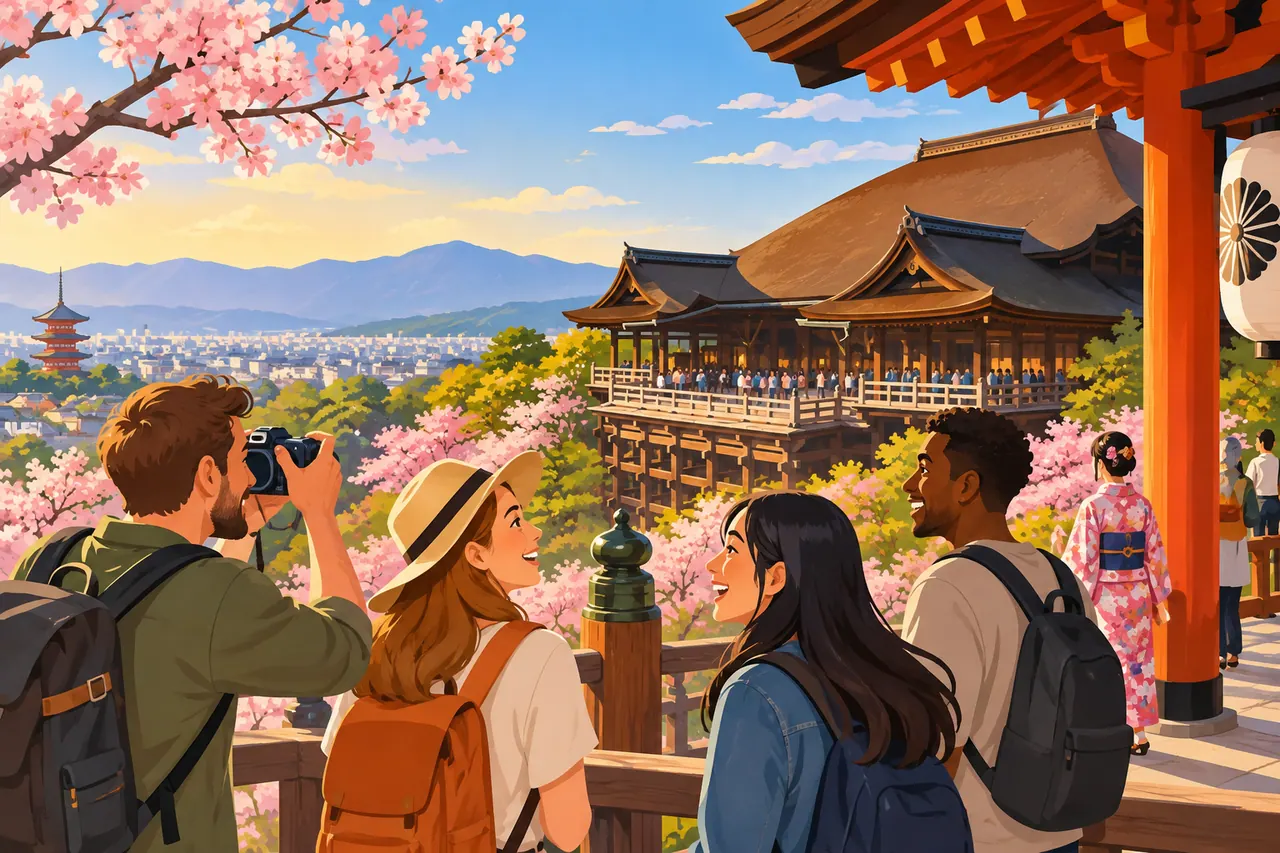
Where to Stay in Kyoto: Areas, Transport & Tax
Contents
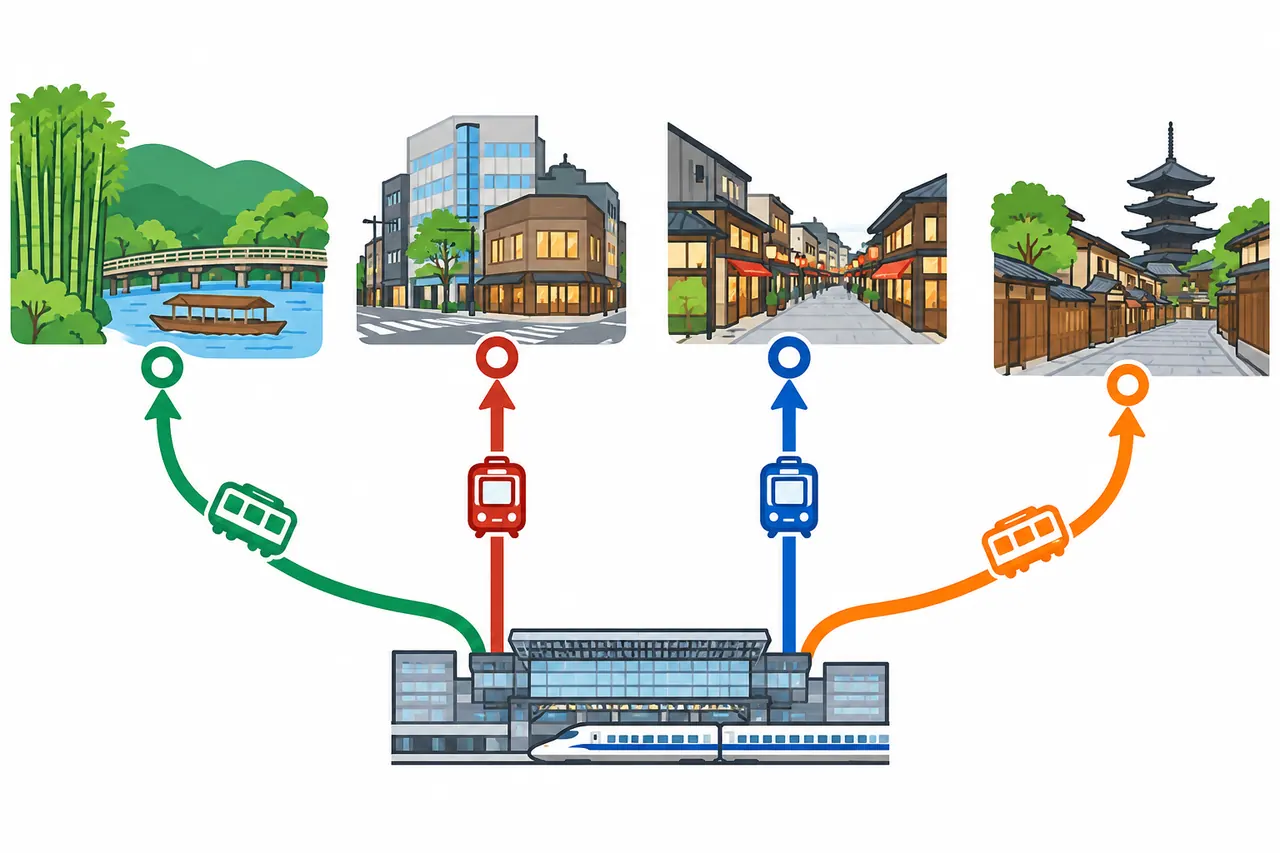
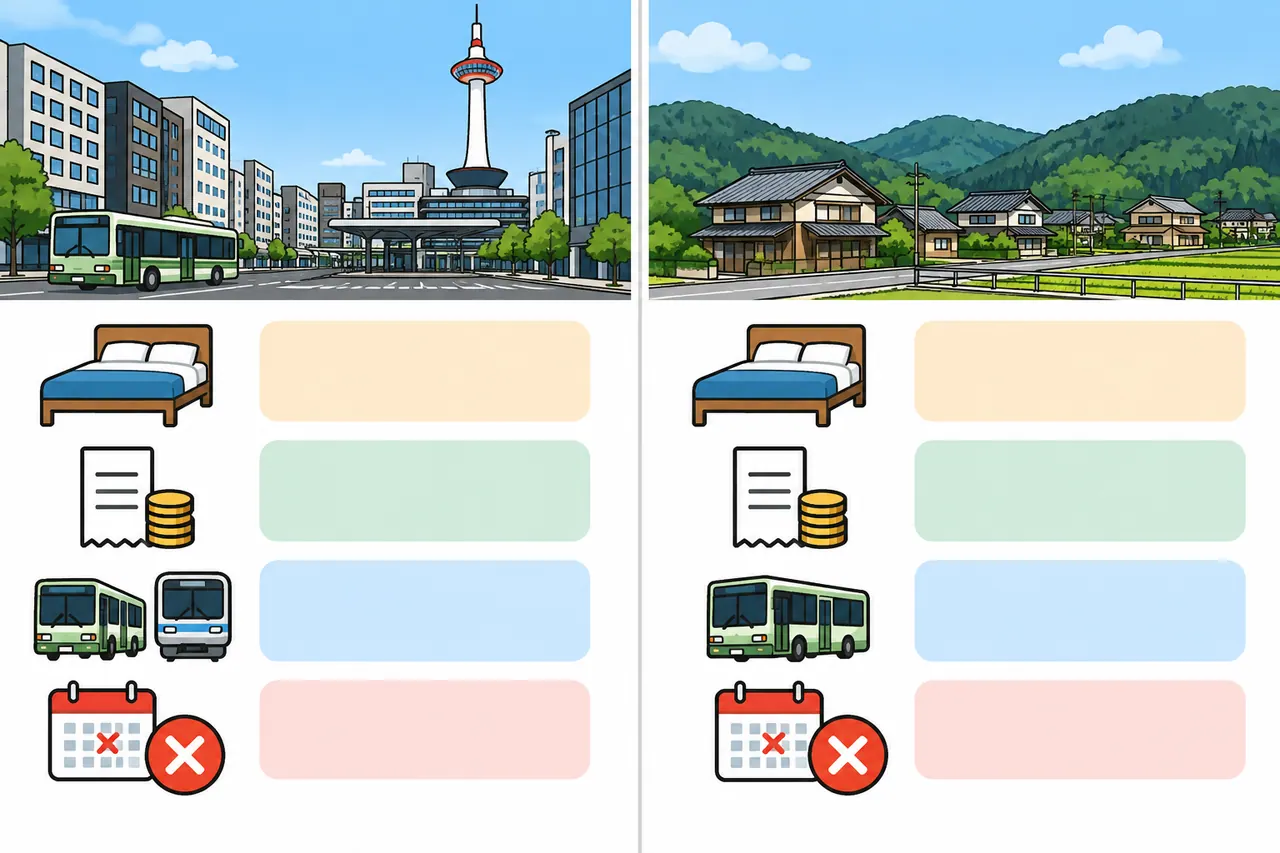
For a first visit, compare Shijo Kawaramachi if central walks toward Gion are your priority, Kyoto Station if you expect several JR journeys, and Gion–Higashiyama if historic sights shape your plans. These are starting points, not guarantees about a particular hotel’s location, room or route. Check the property’s full address and the exact room details before booking.
JR means Japan Railways. Kyoto City’s accommodation-tax rates below apply to stays on or after March 1, 2026; the stay date, not the booking date, determines which rates apply. The tax figures were checked against Kyoto City’s official information on November 3, 2026.
1. Compare Kyoto’s accommodation areas
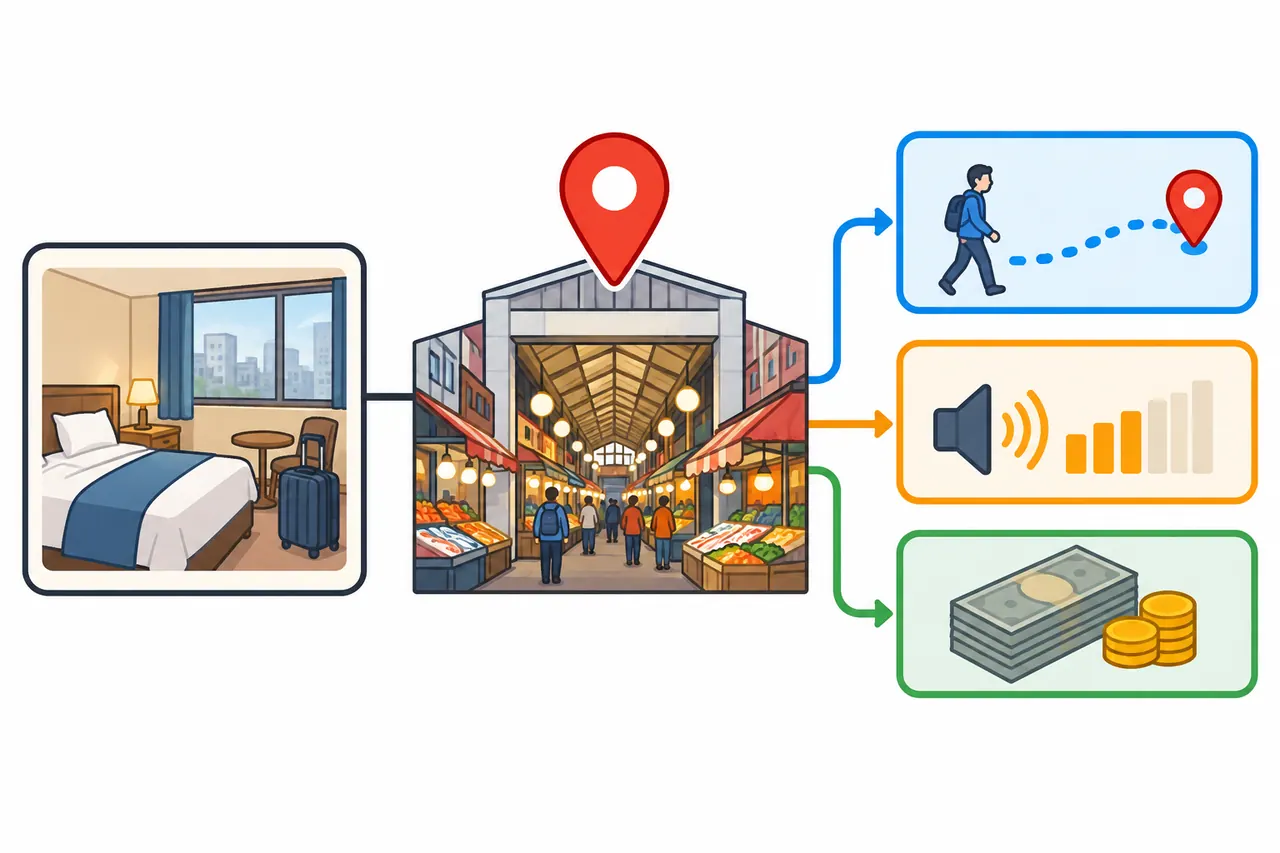
Choose a base for the journeys you expect to make most. Kyoto Station is useful for JR trips, while Shijo Kawaramachi suits central walks toward Gion and Yasaka Shrine. The official area guide describes different accommodation types and nearby places across several districts; use it as a starting point, then check the address of each property you consider. Kyoto Tourism Navi Plus: choosing accommodation

| Area | A reason to compare it | Trade-off to plan for |
|---|---|---|
| Kyoto Station | JR journeys, station-area luggage storage and coin lockers | You still need to travel to sights away from the station. |
| Shijo Karasuma | The Karasuma subway line and a business district | Check the route from the property to the places on your itinerary. |
| Shijo Kawaramachi | Central walks toward Gion and Yasaka Shrine; Nishiki Market is nearby | Plan the journey to Kyoto Station for JR trips. |
| Central Kyoto | A central destination such as Nishiki Market | A central address alone does not guarantee a quiet room or a low price. |
| Gion and southern Higashiyama | Kiyomizu-dera, Yasaka Shrine and Kodaiji | A room in this wider area may not be close to every sight. |
| Northern Higashiyama | A trip focused on a particular northern sight | Check the destination’s access and the property’s precise location. |
| Saga–Arashiyama | A western Kyoto base or an Arashiyama-focused trip | Plan journeys to other parts of Kyoto. |
Choose by your travel style
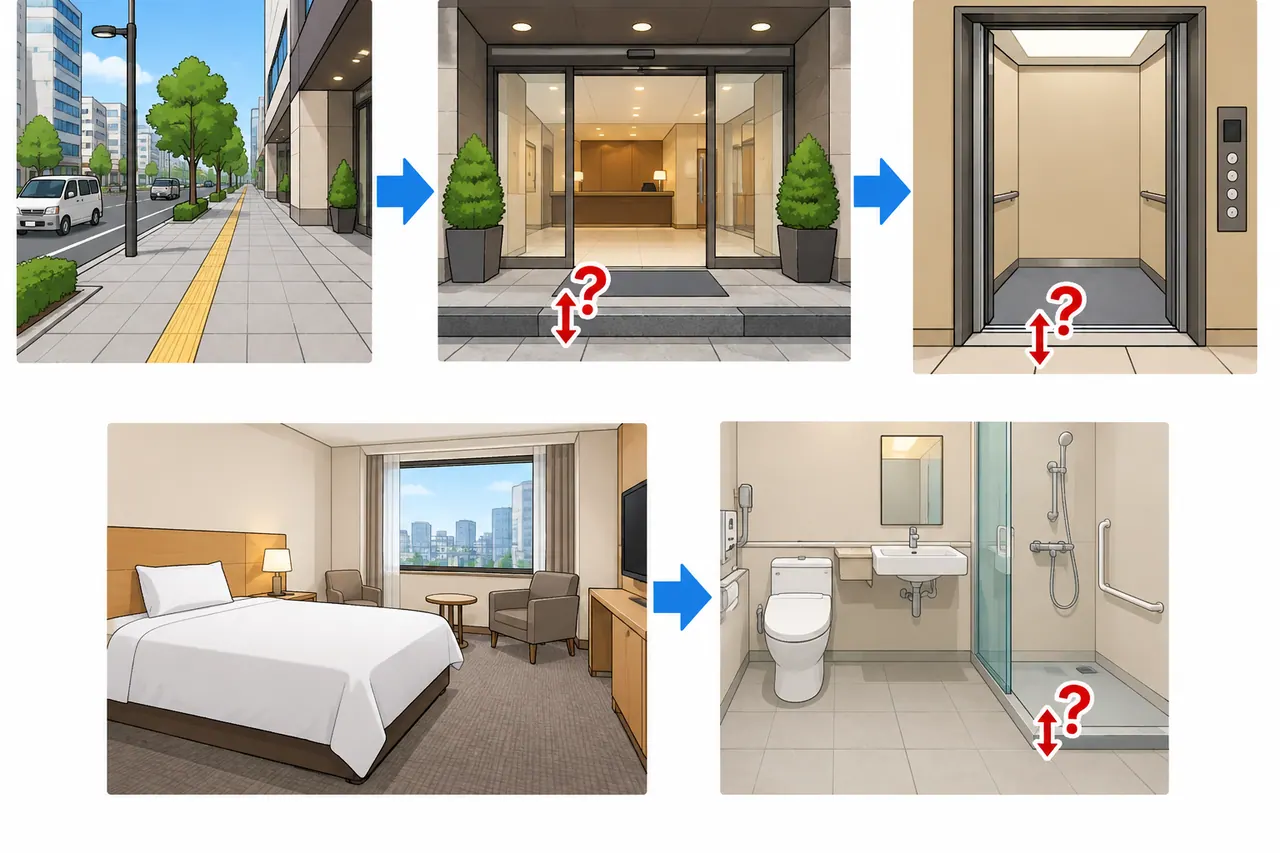
A first-time visitor who wants central walks can compare Shijo Kawaramachi with a Gion–Higashiyama room, while someone planning several JR journeys can start with Kyoto Station. Families should compare more than one area because the room’s guest limit, beds and bathroom may matter more than the district label. For step-free travel, check the complete route from street to entrance, room and bathroom: a building lift alone does not confirm that the route is step-free.
| Priority | Compare first | Why |
|---|---|---|
| Central walks on a first visit | Shijo Kawaramachi | The area is within walking distance of Gion and Yasaka Shrine. |
| Several JR journeys | Kyoto Station | JR serves directions including Fushimi Inari, Tofukuji and Arashiyama. |
| Historic sights | Gion–Higashiyama and Shijo Kawaramachi | Compare a sight-focused base with a central walking base. |
| Western Kyoto focus | Saga–Arashiyama and Kyoto Station | Compare staying west with making a JR day trip. |
| Family travel | Suitable rooms in more than one area | Beds, guest limits and bathrooms can decide the choice. |
| Lower total cost | Suitable rooms in several areas | Compare room price, tax and planned transport together. |
Kyoto Station or downtown?
Choose Kyoto Station when JR journeys and station-area luggage services matter most. Choose Shijo Kawaramachi when central walks toward Gion and Yasaka Shrine matter more. The station area has large hotels and business hotels; the Shijo Kawaramachi area has ryokan, guesthouses and designer hotels, according to Kyoto’s accommodation guide. Kyoto Tourism Navi Plus: accommodation areas
| Consideration | Kyoto Station | Shijo Kawaramachi |
|---|---|---|
| Main reason to choose it | JR travel and luggage services | Central walks toward Gion and Yasaka Shrine |
| Places named nearby in the official area guide | Toji, Higashi Honganji and Nishi Honganji | Nishiki Market |
| Lodging examples in the area guide | Large hotels and business hotels | Ryokan, guesthouses and designer hotels |
| Journey to plan | Travel to sights away from the station | Travel to Kyoto Station for JR trips |
Kyoto Station’s surrounding area has luggage storage places and coin lockers, but check each service’s current conditions before relying on it. A business hotel is a hotel type aimed at practical stays, while a ryokan is a Japanese inn; neither label confirms what a specific room includes. The property’s own room description and booking terms are the source to use for beds, bathrooms, meals and rules.
Shijo Karasuma or Shijo Kawaramachi?
These are different starting points, even though both names include “Shijo.” Shijo Karasuma is described as a business district, and the Karasuma subway line connects the Kyoto Station direction with Shijo Karasuma. Shijo Kawaramachi is a busy central district from which you can walk toward Gion and Yasaka Shrine. Kyoto Tourism Navi Plus: choosing accommodation
| Main need | Start your search in | Then check |
|---|---|---|
| Subway connection from Kyoto Station | Shijo Karasuma | The route between the subway and the property |
| Walks toward Gion | Shijo Kawaramachi | The route from the property to your chosen destination |
| Nishiki Market visit | Shijo Kawaramachi or central Kyoto | The address and your other journeys |
A listing that says only “Shijo” may not make clear which area it means. Use the written address to identify where the room is, then check the route to your priority sights. Do not assume that a central location makes every journey short.
Gion, Higashiyama and central Kyoto
Compare Gion and southern Higashiyama if Kiyomizu-dera, Yasaka Shrine or Kodaiji shapes your trip. Gion developed as a district in front of Yasaka Shrine and is a place where geiko and maiko, traditional performers, live and work. Kyoto’s official guide covers Gion and Kiyomizu, but the address of each room still determines how convenient it is for your itinerary. Kyoto Travel: Gion and Kiyomizu
| Main interest | Useful comparison |
|---|---|
| Kiyomizu-dera | Compare each room’s route to the temple. |
| Yasaka Shrine | Compare a Gion-area room with one in Shijo Kawaramachi. |
| Several historic sights | Check the route to each sight, not just the district name. |
| Arrival with bags | Check the route from your arrival point to the property entrance. |
Nishiki Market is classified as being in central Kyoto by Kyoto Travel, and Kyoto Tourism Navi Plus places it around Shijo Kawaramachi. A central address may suit a market-focused plan better than a station-focused one, but it does not prove that a room is quieter or less expensive. Compare the exact room and the final offer for the same dates and guests.
If quietness matters, ask the property about possible noise affecting the exact room you are considering, rather than judging by the district or central address.
Northern Higashiyama and Saga–Arashiyama
Northern Higashiyama is worth comparing when a specific northern sight is central to your plan. Do not assume that every room there is quiet or close to the sight you want; check the address and the destination’s current access information. Kyoto Travel’s transport information can help you plan journeys, but the particular destination and property determine the route you need. Kyoto Travel: getting around
Saga–Arashiyama is in western Kyoto, so you can stay there, visit on a day trip or split your stay between areas. Kyoto Travel describes a JR route from Kyoto Station to Saga-Arashiyama Station, as well as a Hankyu route from the Shijo Kawaramachi direction with a change at Katsura. Staying in Arashiyama can suit a western Kyoto focus, but plan journeys to other parts of the city and consider whether changing rooms with luggage is worthwhile. Kyoto Travel: access to Saga and Arashiyama
| Plan | Useful when | Trade-off |
|---|---|---|
| Day trip from Kyoto Station | You want one room and a JR journey | You travel there and back. |
| Day trip from Shijo Kawaramachi | Central walks also matter | The Hankyu route described by Kyoto Travel changes at Katsura. |
| Stay in Saga–Arashiyama | A western Kyoto base matters most | Plan journeys to other destinations. |
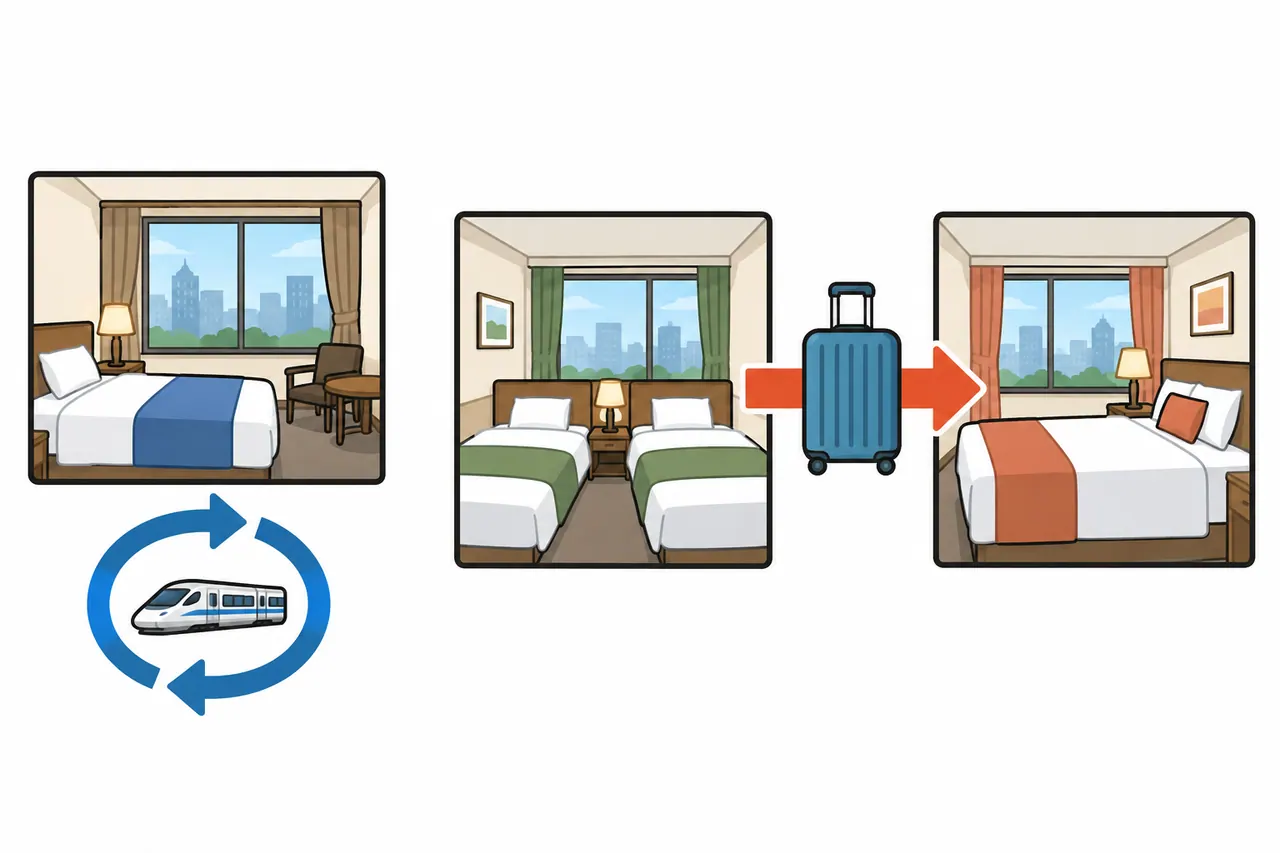
| Split your stay | A second base is worth moving for | You need to pack and move your luggage. |
2. Find and compare rooms
Choose an area that fits your journeys, then compare actual rooms and booking conditions. A well-placed district cannot guarantee the beds, bathroom, access or cancellation rules that your group needs. Enter the same dates, guests and number of nights for every offer so the comparison is fair.
Build a shortlist from official property information
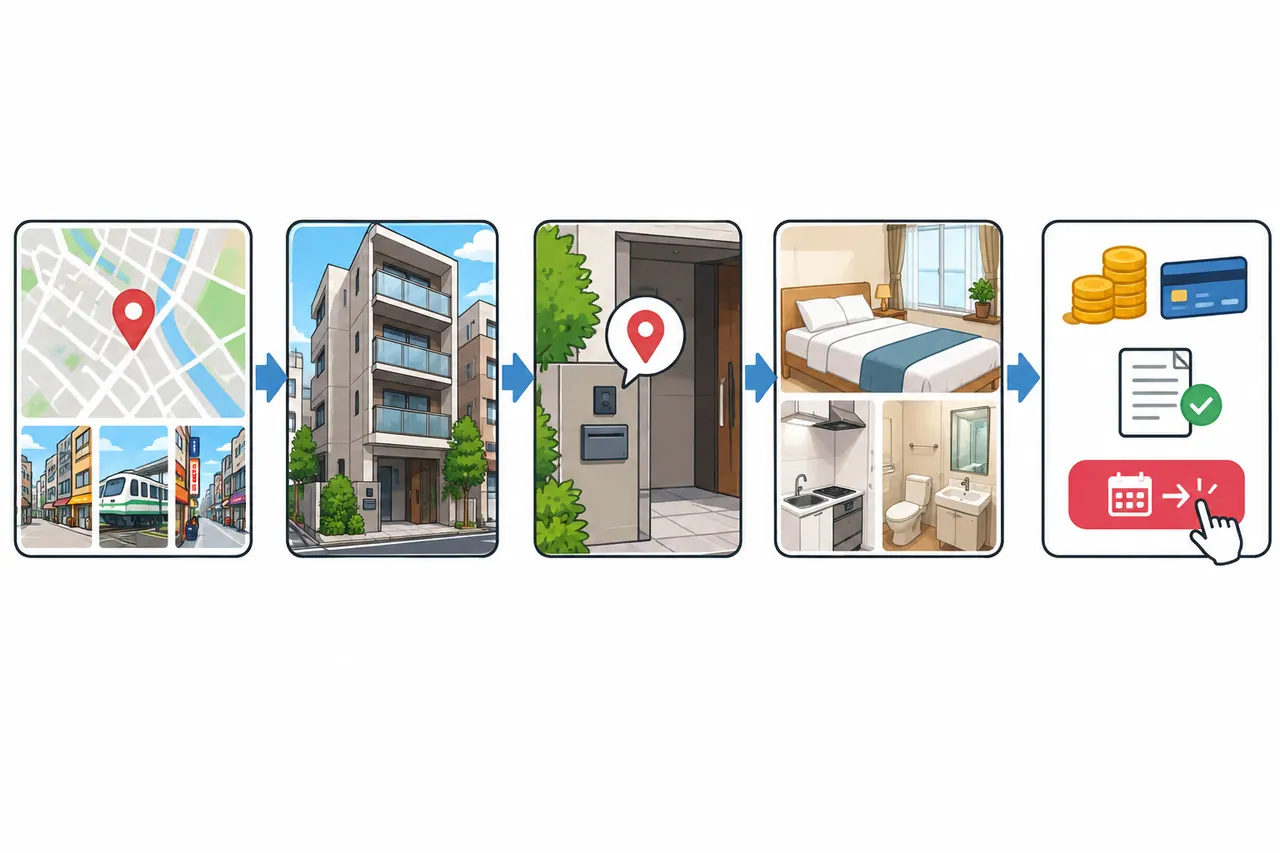
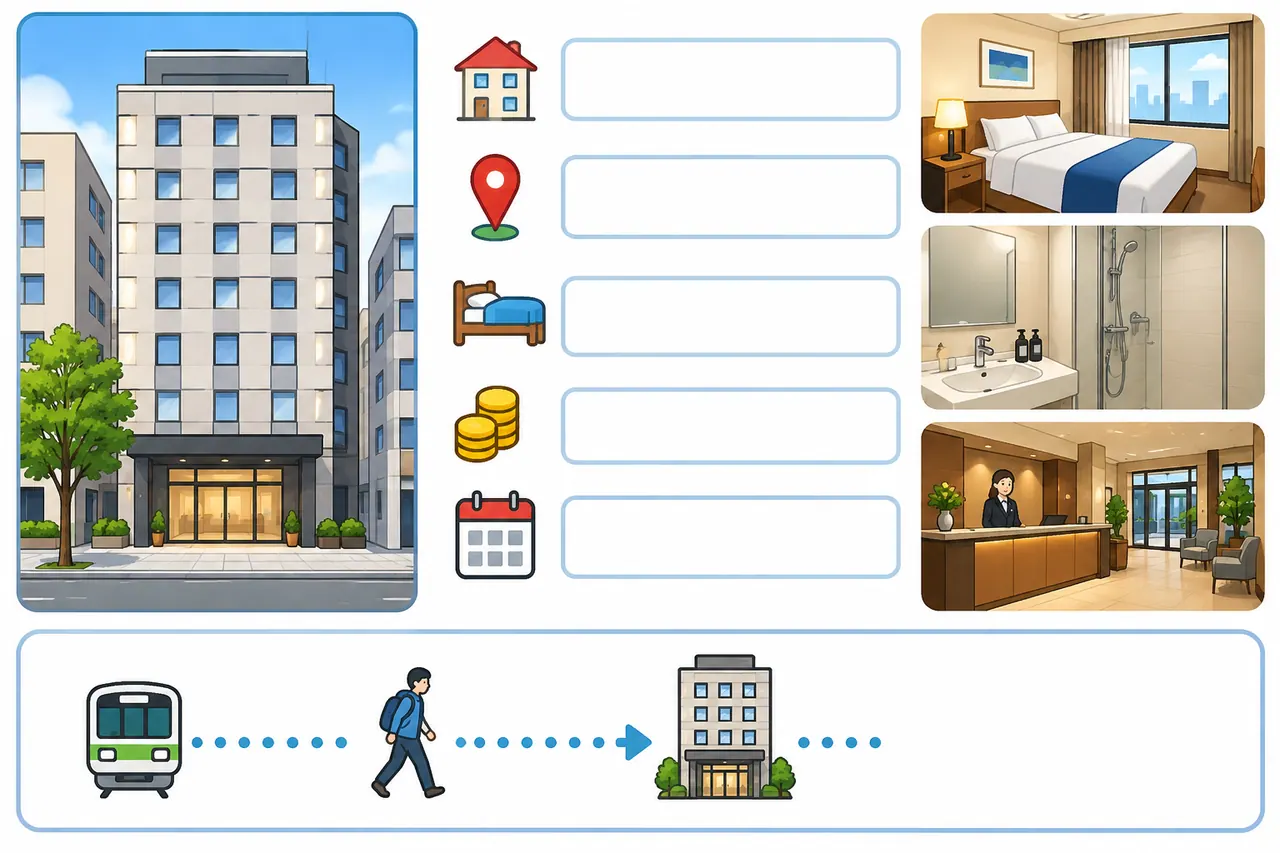
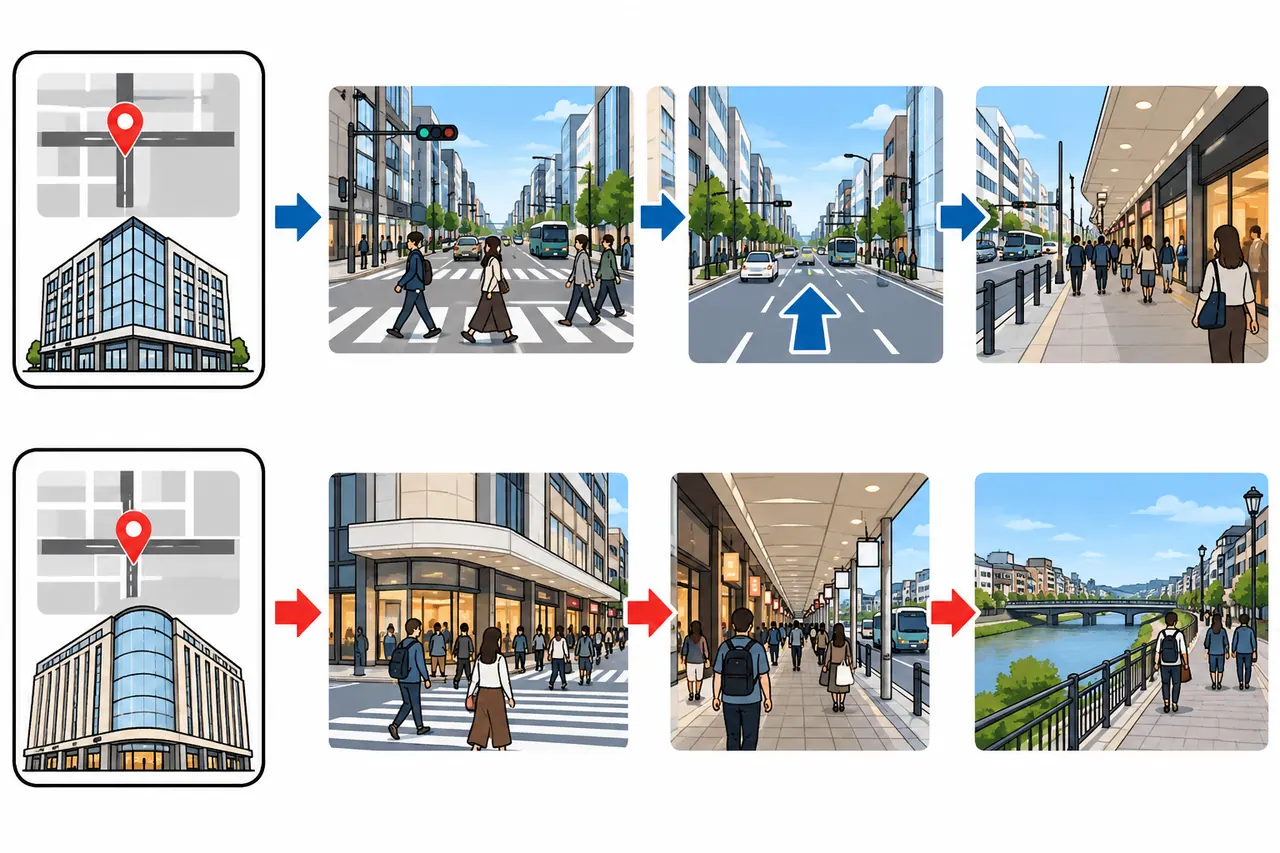
Start with Kyoto’s accommodation area guide, then search for properties in the areas that fit your plans. For each candidate, record its official name, full address, access directions and the room that could accommodate your group. If an official page does not answer a practical question, contact the property rather than treating an unknown detail as an included feature.
For one Saga–Arashiyama example, HOSHINOYA Kyoto lists 25 rooms for one to three guests, check-in at 3 p.m. and check-out at noon. It says free Wi-Fi is available in all rooms and some shared areas, and gives the address as 11-2 Arashiyama Genrokuzancho, Nishikyo-ku, Kyoto. Room prices and cancellation terms for your dates were not confirmed; the official information was checked November 4, 2026. HOSHINOYA Kyoto: official property information
| Search area | Officially identified starting point | Compare first |
|---|---|---|
| Kyoto Station | Large hotels and business hotels | Station route, room layout and luggage arrangements |
| Shijo Kawaramachi | Ryokan, guesthouses and designer hotels | Route toward Gion, sleeping places and booking terms |
| Gion–Higashiyama | Properties serving your chosen sight | Arrival route and route to that sight |
| Northern Higashiyama | Properties near your chosen destination | Destination access and other planned journeys |
| Saga–Arashiyama | Properties for a western Kyoto base | Journeys to your other destinations |
The lodging-type examples for Kyoto Station and Shijo Kawaramachi come from Kyoto Tourism Navi Plus; the other rows are search guidance, not recommendations for specific properties. A video can suggest names to investigate, but it cannot confirm availability, price or room conditions for your dates. The existing video references include Yuki’s Kyoto, which compares downtown, Kyoto Station and other places to stay, and By Kyoto Local, which presents six main areas and hotel suggestions.
Hotel, ryokan, machiya or guesthouse?
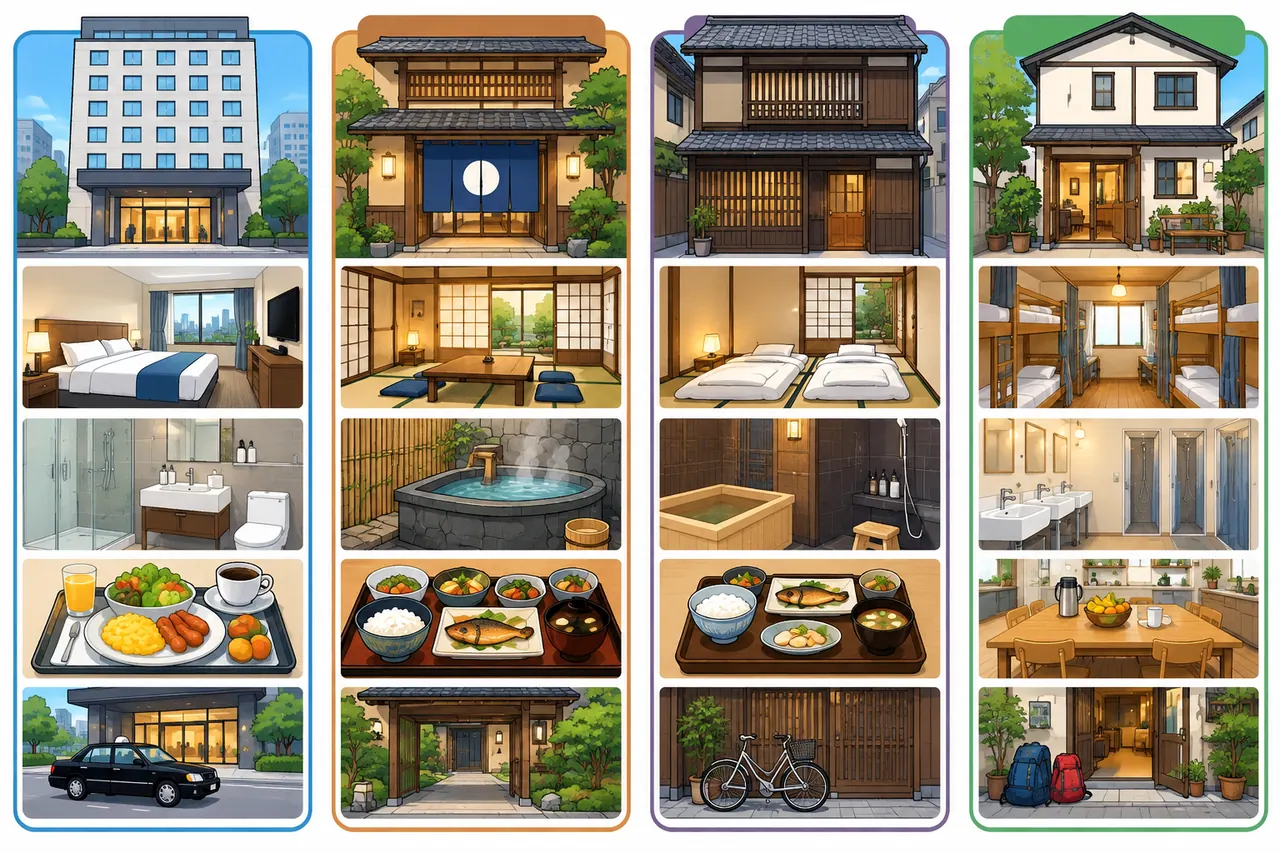
The lodging label helps you search, but the exact room matters more than the label. A machiya is a traditional Japanese town house, while a guesthouse is a type of lodging whose private and shared spaces vary by property. Check the official description and booking terms for the room you plan to reserve.
| Type | What the term helps you find | Questions to check |
|---|---|---|
| Hotel | A hotel property with rooms to compare | What beds, bathroom and meals are included? |
| Business hotel | A hotel type aimed at practical stays | Does the exact room fit your group and luggage? |
| Ryokan | A Japanese inn | What are the sleeping arrangements, and are meals included? |
| Machiya stay | A stay offered in a traditional town house | Which spaces are yours, and are there stairs? |
| Guesthouse | A guesthouse property | Which spaces are private or shared? |
| Designer hotel | A hotel described as a designer property | Do the room’s features suit your group? |
These names do not promise a particular bathroom, meal, floor plan or price. The video reference to Wandering the World presents one traveler’s ryokan stay, but it does not establish the facilities or rules of another ryokan. Base your decision on the specific property’s current room description.
Compare rooms on equal terms
Use the same dates, number of nights and guest count for every search. Compare the final offer rather than the first price displayed, and record whether tax is already included. This makes it easier to identify a genuine difference between rooms rather than a difference in the search conditions.
| Field | Record for each room | Why it matters |
|---|---|---|
| Property and address | Official name and full written address | You can match the booking to the correct location. |
| Dates and guests | All nights, adults and children | An offer for a different group is not a fair comparison. |
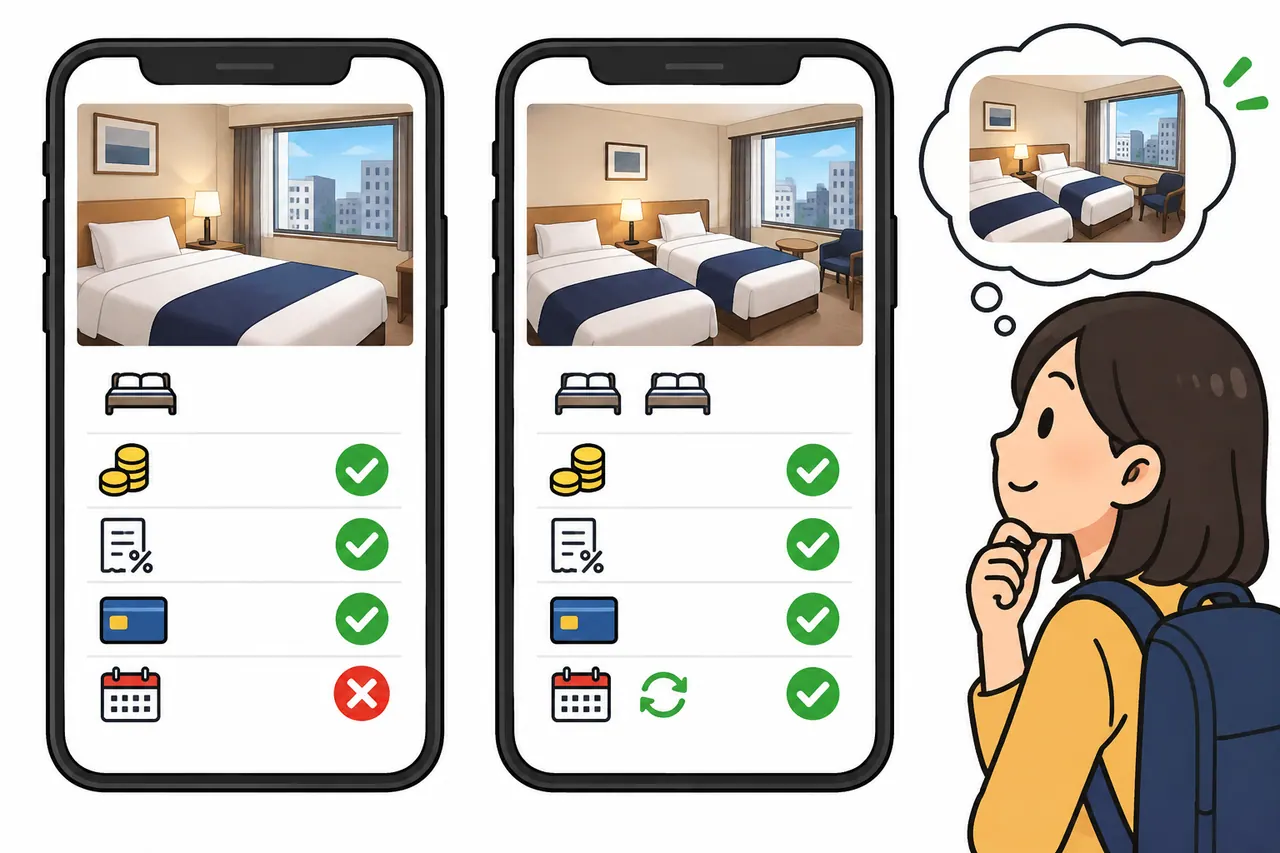
| Room | Exact room name, guest limit and sleeping places | A property may offer different layouts. |
| Bathroom | Private or shared, plus access needs | The room may not suit everyone in your group. |
| Meals | What is included, if anything | Prices may cover different things. |
| Price and tax | Final amount and whether tax is included | Avoid comparing a headline price with a total. |
| Cancellation | Deadline and any fee | A cheaper offer may have stricter rules. |
| Payment | When payment is due | This affects when you need the money. |
| Arrival | Check-in instructions and any arrival limit | The room must work with your journey. |
A cancellation deadline is the latest time allowed by the booking’s cancellation rules. Read what happens both before and after that deadline, and check the stated payment timing before you pay. If a detail is unclear, ask about the exact room, dates and guest count rather than relying on a general property description.
For example, if one offer does not state whether its bathroom is private and another confirms that it is, the second is easier to assess for a group that needs a private bathroom. If one offer mentions a lift but does not describe the street-to-room route, it does not answer a step-free access question. These are comparison examples, not live offers or claims about real room prices.
Families and step-free travel
Enter every adult and child in the booking search, then confirm that the exact room accepts the whole group. Check sleeping places, the bathroom and any access needs with the property. A room’s stated guest limit does not by itself describe how the group will sleep.
Ask whether there are steps between the street and entrance, whether the lift reaches the relevant floor, and whether there are steps on the way into the room or bathroom. If you need luggage storage before check-in or after check-out, ask about that too. When a reply says only “lift available,” request details about the entrance and route inside the room.
A useful message includes your dates, guest count and the exact room name. This gives the property a clear question about the offer you are considering rather than a general question about the building. Save the reply with your booking details.
3. Compare routes and city bases
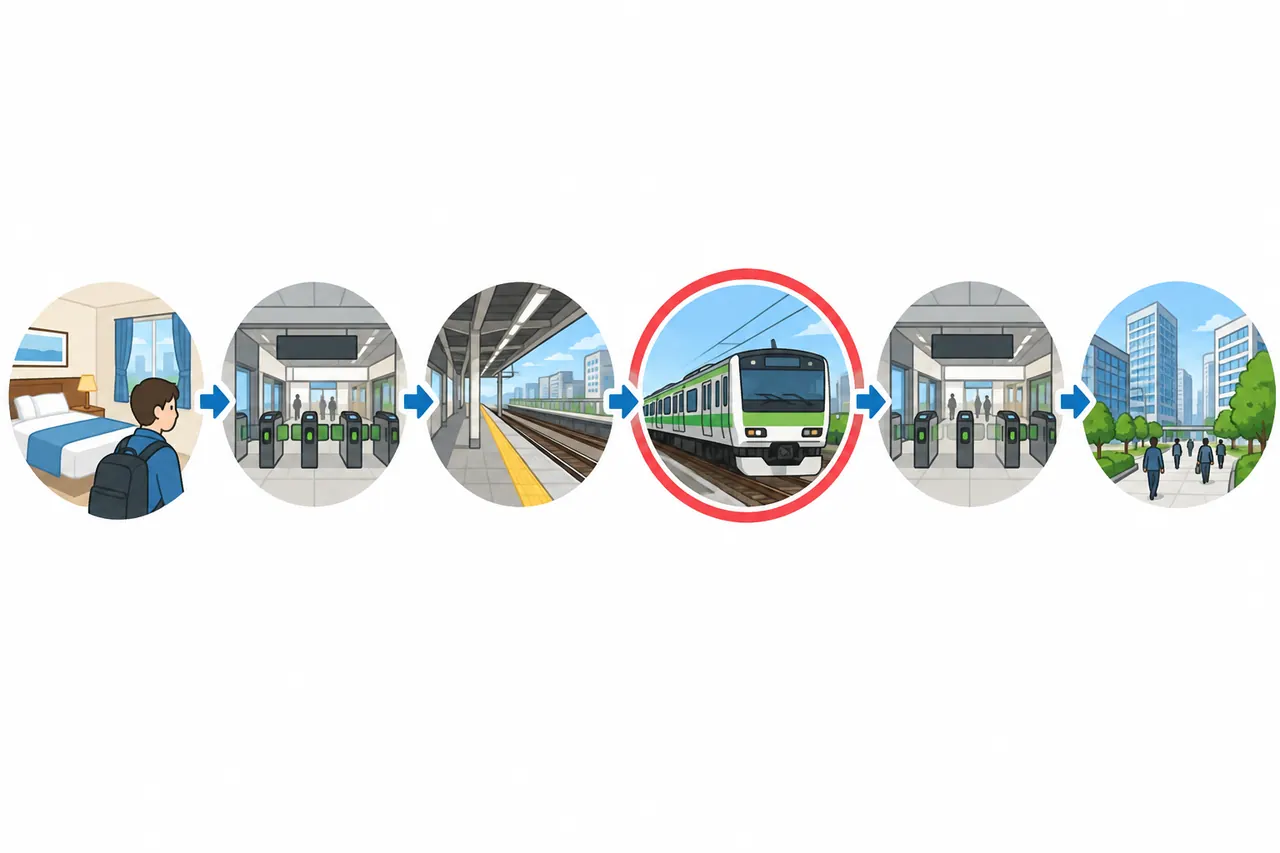
A train time is only one part of a journey. Include the route to the station, walks between platforms, transfers and the trip after you arrive. Check current service and fares with the relevant operator before choosing a route.
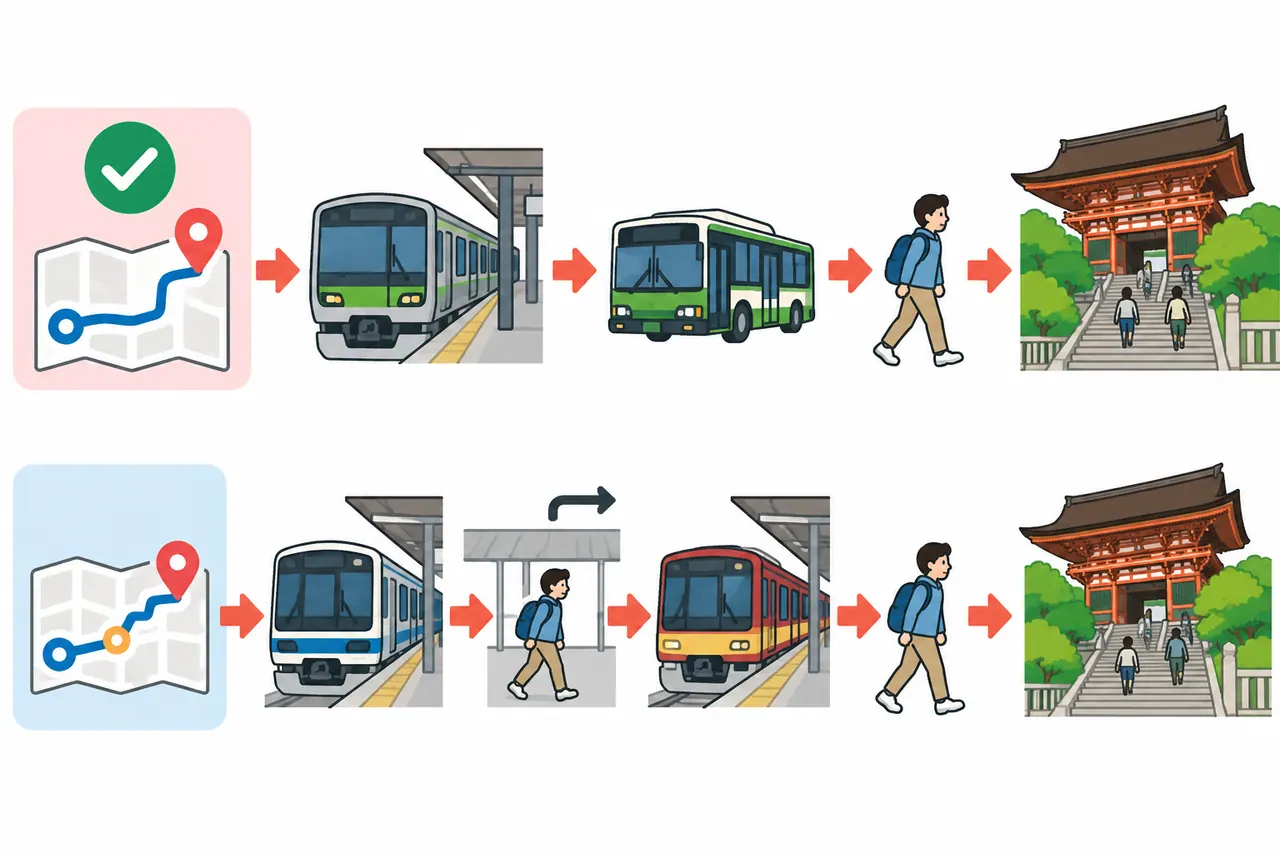
Compare the published route information
| Journey | Published route | Published time | Still to check |
|---|---|---|---|
| Kyoto Station to Saga-Arashiyama Station | JR Sagano Line rapid train | About 11 minutes | Fare, current service and routes at both ends |
| Shijo Kawaramachi direction to Arashiyama | Hankyu route with a change at Katsura | Check current service | Fare, timing and route to your destination |
| Kyoto Station to the Kiyomizu-dera direction | JR to Tofukuji, then Keihan | Check current service | Fare, change and onward route |
| Yodoyabashi to the Gion-Shijo or Sanjo direction | Keihan limited-express route | About 48 minutes in the official route description | Exact stops, fare and current service |
| Kyoto Station to the Shijo Karasuma direction | Karasuma subway line | Check current service | Fare and route to the property |
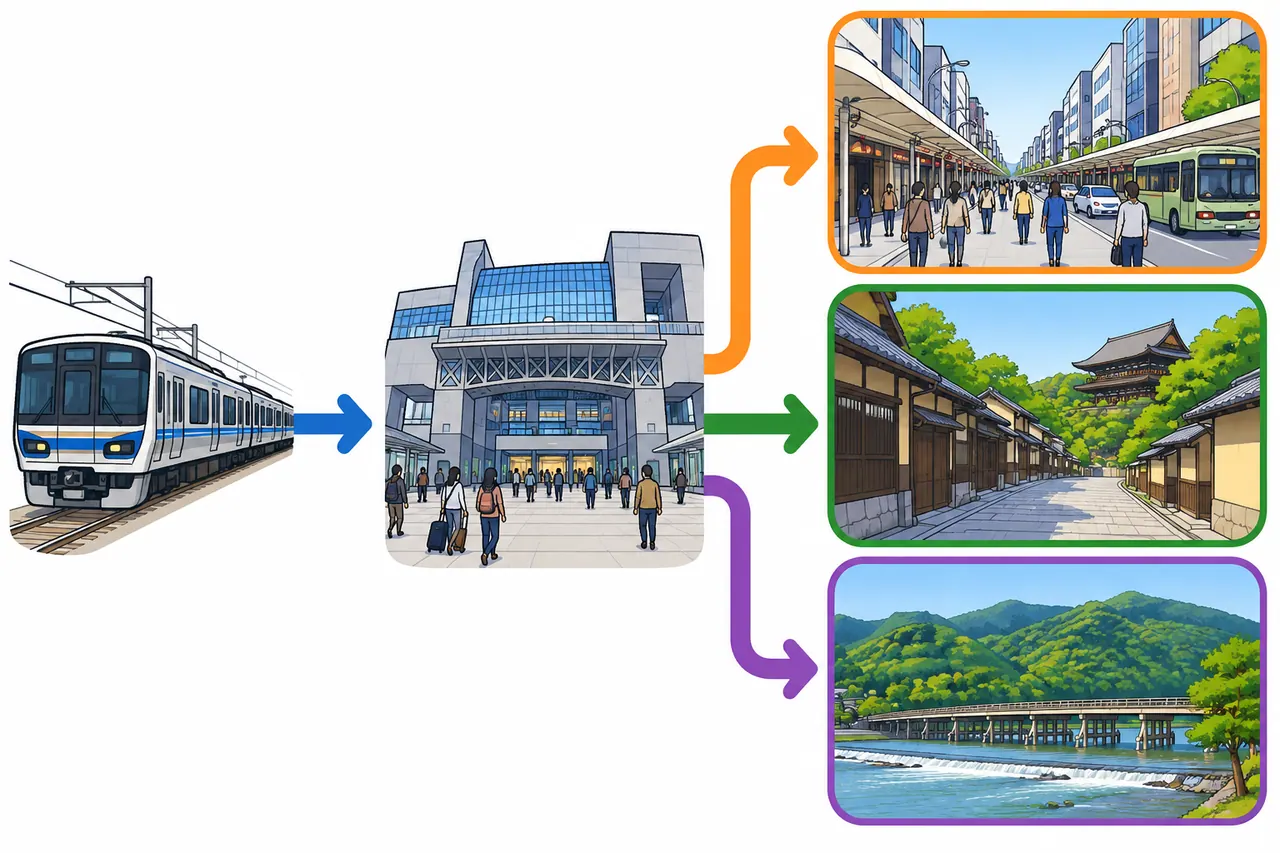
Kyoto Travel gives about 11 minutes for the JR rapid-train segment from Kyoto Station to Saga-Arashiyama Station and notes that the Sagano Line platforms are farther from the other platforms. Add that walk if you are changing trains. The 11-minute figure does not cover travel from your room to the platform or from Saga-Arashiyama Station to your chosen sight. Kyoto Travel: access to Saga and Arashiyama
Kyoto Travel describes the Keihan route from Yodoyabashi toward Gion-Shijo and Sanjo, with about 48 minutes for the limited-express route description. A limited-express train is a service type that generally stops at fewer stations than a local train, but check the operator’s information for the actual stops and current service. These times describe different routes and should not be compared as though they were room-to-sight times. Kyoto Travel: getting to Kyoto
When comparing routes for two rooms, use the same arrival point and sightseeing destination for both. Otherwise, a shorter-looking journey may simply start or end somewhere different.
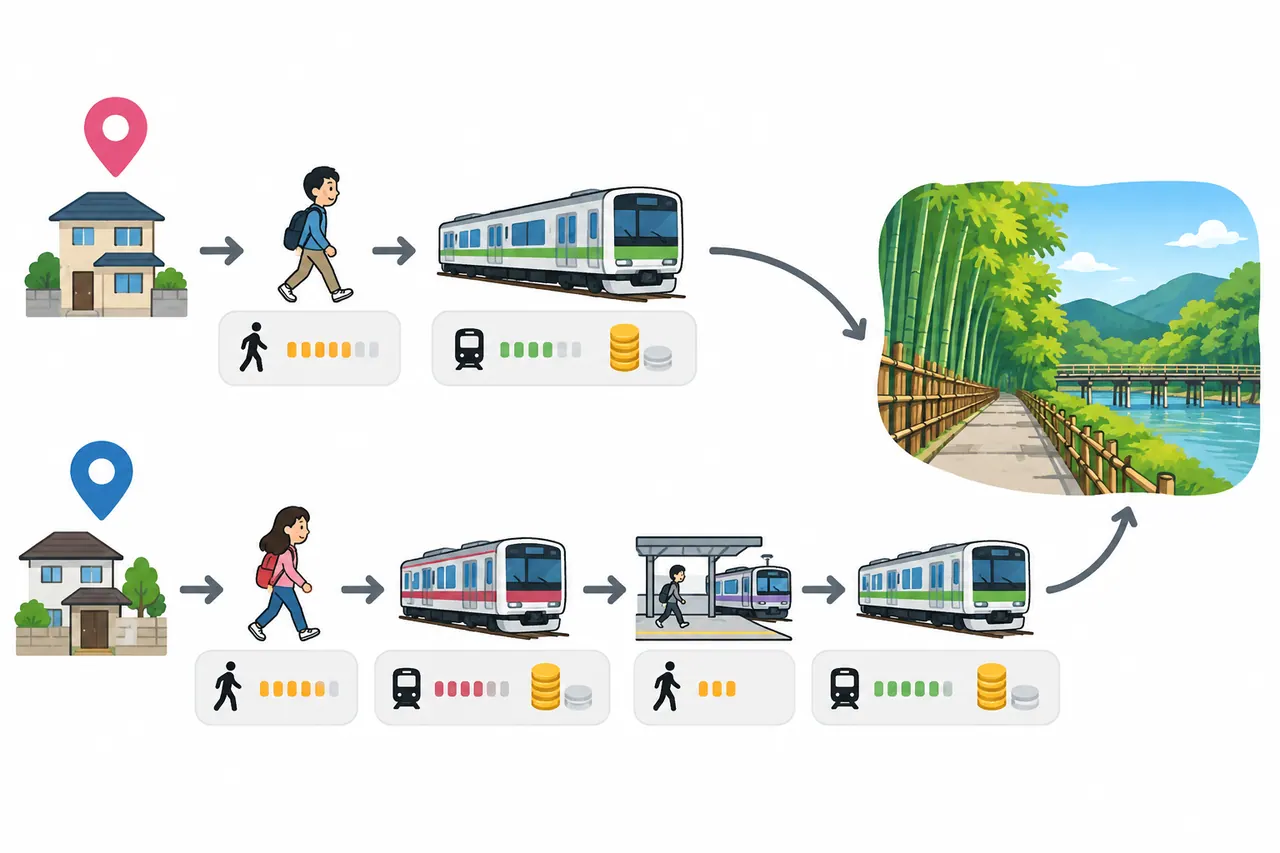
Compare Arashiyama from two bases
A Kyoto Station base gives you the JR Sagano Line route to Saga-Arashiyama Station. A Shijo Kawaramachi base can use the Hankyu route described by Kyoto Travel, changing at Katsura. Compare the route from each room to its station, the current fare and service, and the final route to the destination you plan to visit.
| Part of the journey | Kyoto Station base | Shijo Kawaramachi base |
|---|---|---|
| Rail route | JR Sagano Line to Saga-Arashiyama Station | Hankyu route with a change at Katsura |
| Published train time | About 11 minutes on a rapid train | Check the service for your date |
| Fare | Check the operator | Check the operator |
| Before the train | Add the route from room to platform | Add the route from room to station |
| After the train | Add the route to your destination | Add the route to your destination |
Arrival at Saga-Arashiyama Station is not arrival at every Arashiyama sight. Add the walk or onward transport to your actual destination, and include the distance to the Sagano Line platforms if your route starts at Kyoto Station. Kyoto Travel’s route information is a planning reference, not a guarantee of current service on your travel date. Kyoto Travel: Saga–Arashiyama access
Kyoto, Osaka or a split stay?
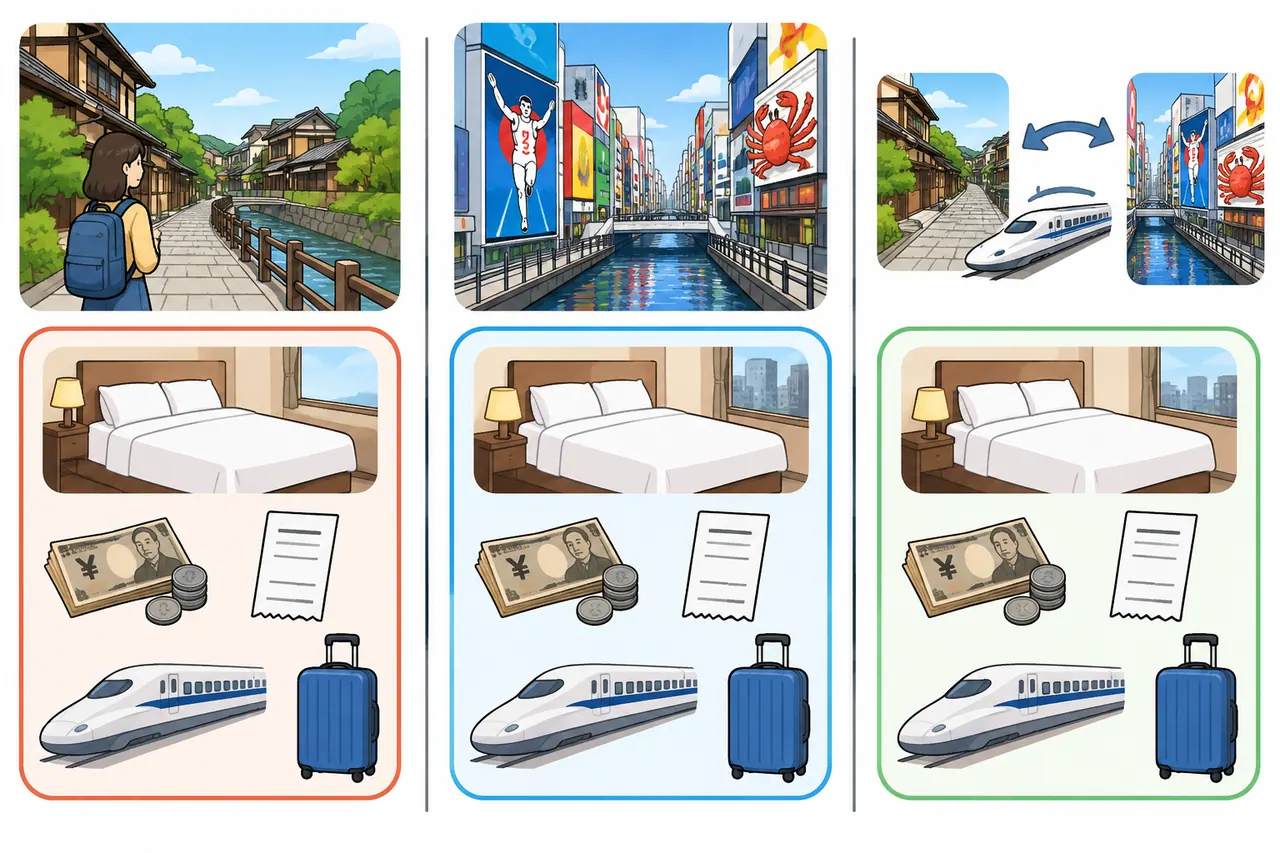
Compare an Osaka base if your trip includes both cities, but calculate the whole plan rather than choosing by room price alone. Add the repeated journeys you expect to make and the route between each room and its station. A split stay may reduce some travel for a particular itinerary, but it also means packing and moving luggage.
| Base | Add to your comparison | Trade-off |
|---|---|---|
| Kyoto | Room total and journeys to your chosen sights | A Kyoto address is not close to every sight. |
| Osaka or another city | Room total, repeated travel and any local accommodation tax | A lower room price may be offset by train fares. |
| Split stay | Both room totals and the journey between them | Packing and moving may not suit your group. |
Kyoto Travel describes a Keihan route from Yodoyabashi toward Gion-Shijo and Sanjo, with about 48 minutes for its limited-express route description. Confirm the exact stops and current service for your journey. Kyoto City’s tax rules do not establish the rules in another city or town, so check that municipality’s official information as well. Kyoto Travel: getting to Kyoto
Crowds and alternative routes
Kyoto’s Tourist Information Center says that major routes to Kyoto Station, Gojozaka, Gion and Arashiyama can be crowded in some seasons. Gojozaka is the place name used in its route advice, and the warning does not mean every route is crowded all the time. Check current information close to your trip. Kyoto Tourist Information Center: travel during busy periods
For the Kiyomizu-dera direction, the center describes an alternative using JR to Tofukuji and then Keihan. Check the onward route after the train as well as the transfer itself. An alternative is useful only if the full route works for your group, including any access needs and the journey from the final station to your destination.
4. Understand Kyoto City’s accommodation tax
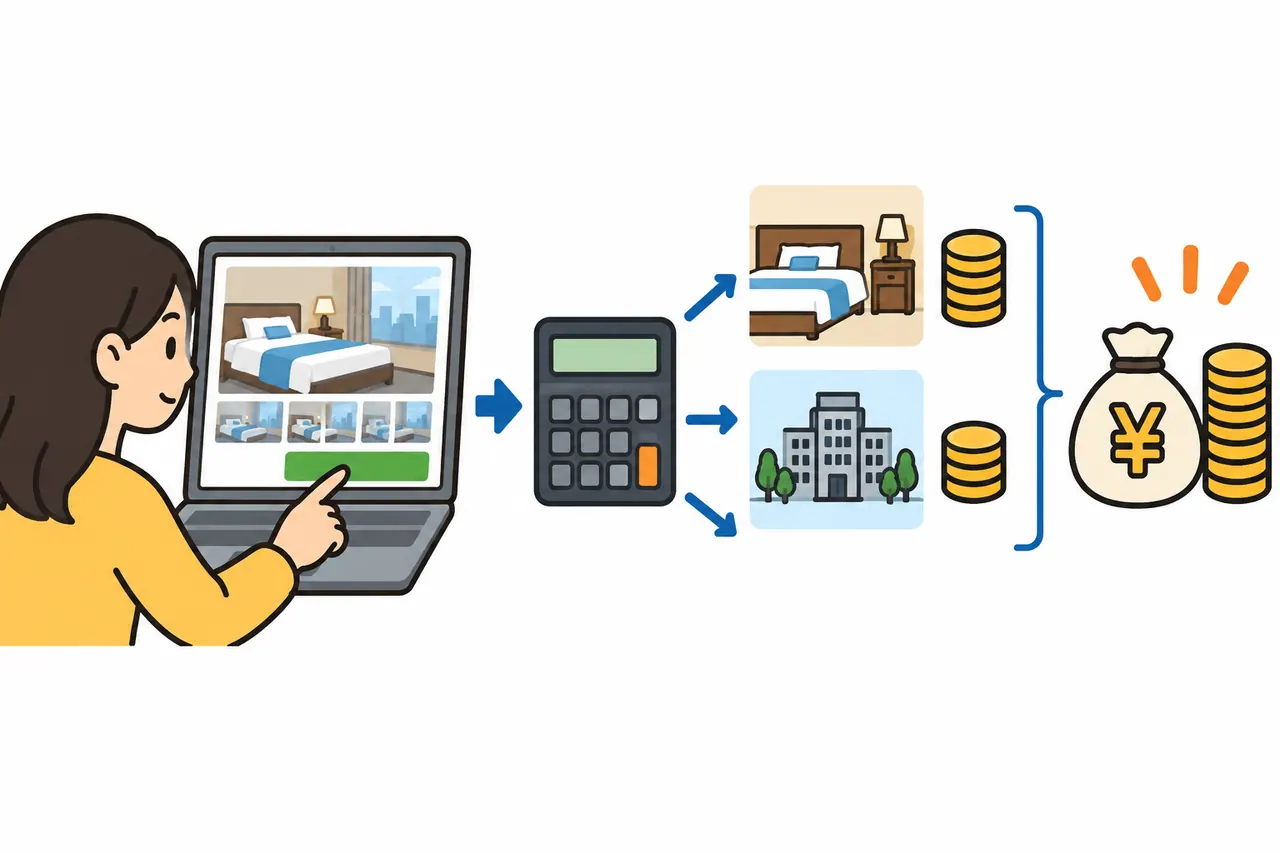
Kyoto City charges accommodation tax per person per night, with the band based on the accommodation charge for each person and night. The rates below apply to stays on or after March 1, 2026, and the stay date—not the date you book—determines the applicable rate. Ask the property which amount it uses to calculate the tax if the booking screen is unclear. Kyoto City: accommodation-tax revision FAQ
| Accommodation charge per person per night | Tax per person per night |
|---|---|
| Less than ¥6,000 | ¥200 |
| ¥6,000 to less than ¥20,000 | ¥400 |
| ¥20,000 to less than ¥50,000 | ¥1,000 |
| ¥50,000 to less than ¥100,000 | ¥4,000 |
| ¥100,000 or more | ¥10,000 |
Kyoto City’s general accommodation-tax information explains that the tax is charged according to the accommodation charge per person per night. For stays before March 1, 2026, consult the city’s accommodation-tax information for the applicable rules rather than applying the later rates to an earlier stay. Kyoto City: accommodation tax
Worked example: two adults for two nights
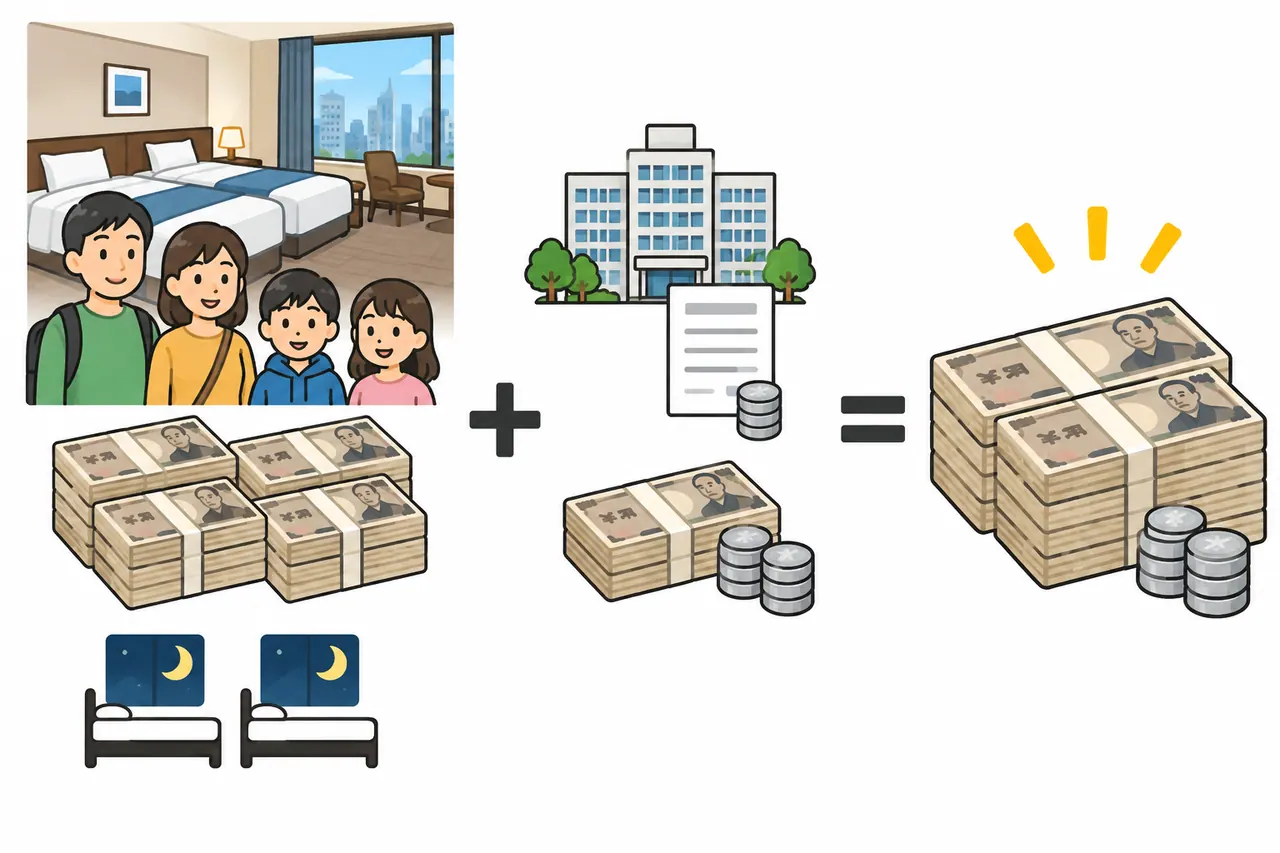
This is hypothetical arithmetic, not a hotel quote. Assume two adults stay for two nights and the accommodation charge for tax purposes is ¥15,000 per adult per night. That falls in the ¥6,000 to less than ¥20,000 band, for a tax of ¥400 per person per night under Kyoto City’s FAQ. Kyoto City: accommodation-tax revision FAQ
| Item | Calculation | Amount |
|---|---|---|
| Assumed room charge | 2 adults × 2 nights × ¥15,000 | ¥60,000 |
| Accommodation tax | 2 adults × 2 nights × ¥400 | ¥1,600 |
| Assumed room charge plus tax | ¥60,000 + ¥1,600 | ¥61,600 |
The example assumes the same accommodation charge for each adult on each night. It excludes transport, food and other possible charges, and it does not establish what amount a particular property will use for tax purposes. If the charge differs by guest or night, check each amount separately and ask the property if the calculation is unclear.
Compare the whole trip cost
A room price is not a complete trip budget. Compare offers for the same dates and guests, then add the costs required by your plan. Do not treat an unpriced item as free.
| Cost | What to compare | Where to check |
|---|---|---|
| Room | Final price for all guests and nights | Property booking page |
| Accommodation tax | Any tax not already included | Property and city or town |
| Transport | Arrival, departure and planned journeys | Transport operators |
| Food | Included meals and meals paid for separately | Property and your plans |
| Tickets | Admissions you intend to buy | Each destination’s official site |
| Other charges | Additional charges stated in the booking | Property booking terms |
A real comparison needs current offers for the same dates, guests, meals and cancellation terms. A meal-inclusive headline price is not necessarily the amount used to calculate accommodation tax. Confirm whether tax is included in the displayed total before adding it to your own estimate.
5. Book, plan for seasons and prepare for arrival
Book a room that fits your group and journeys, and read the final price, payment timing and cancellation rules before paying. A fixed booking lead time has not been confirmed, so compare live availability once your dates and group are clear. If your plans may change, pay particular attention to the cancellation deadline and any fee.
Check availability and book
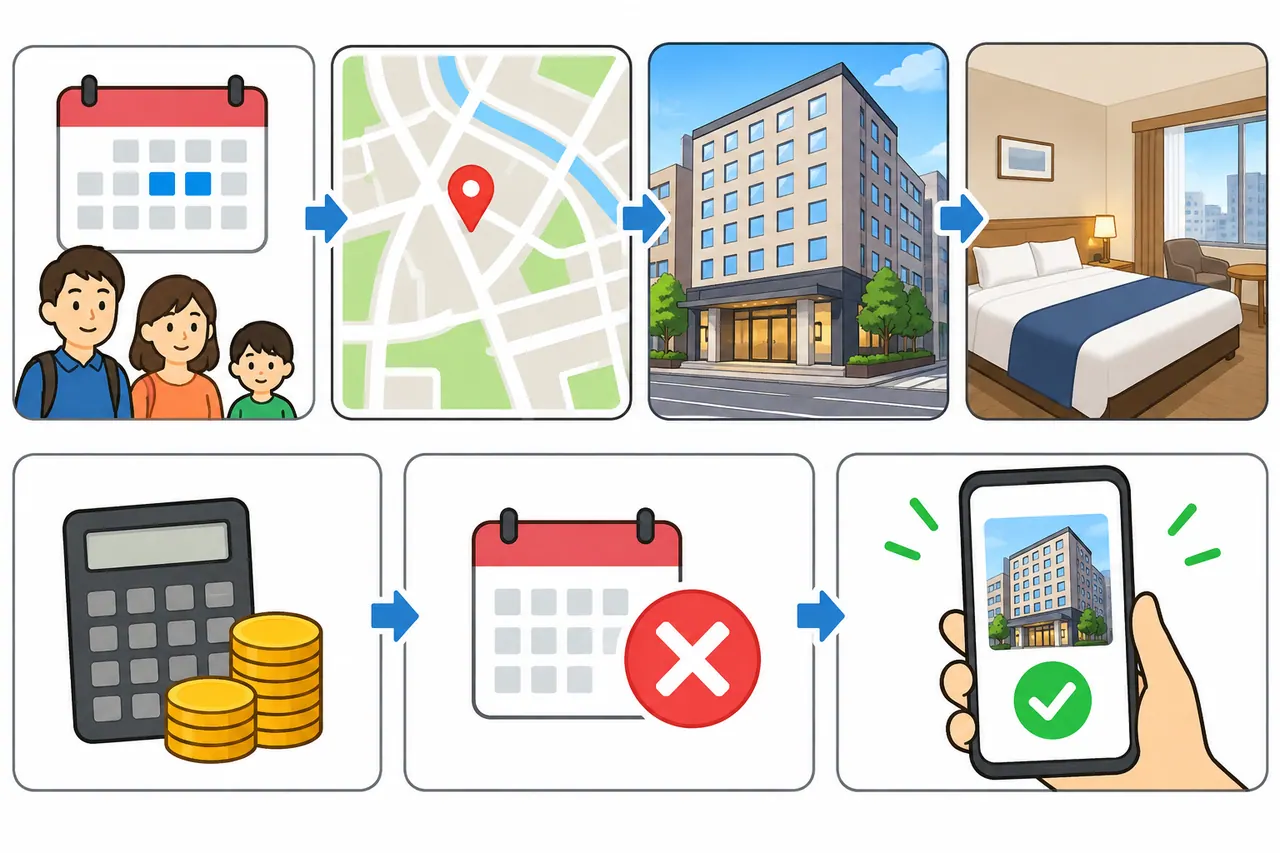
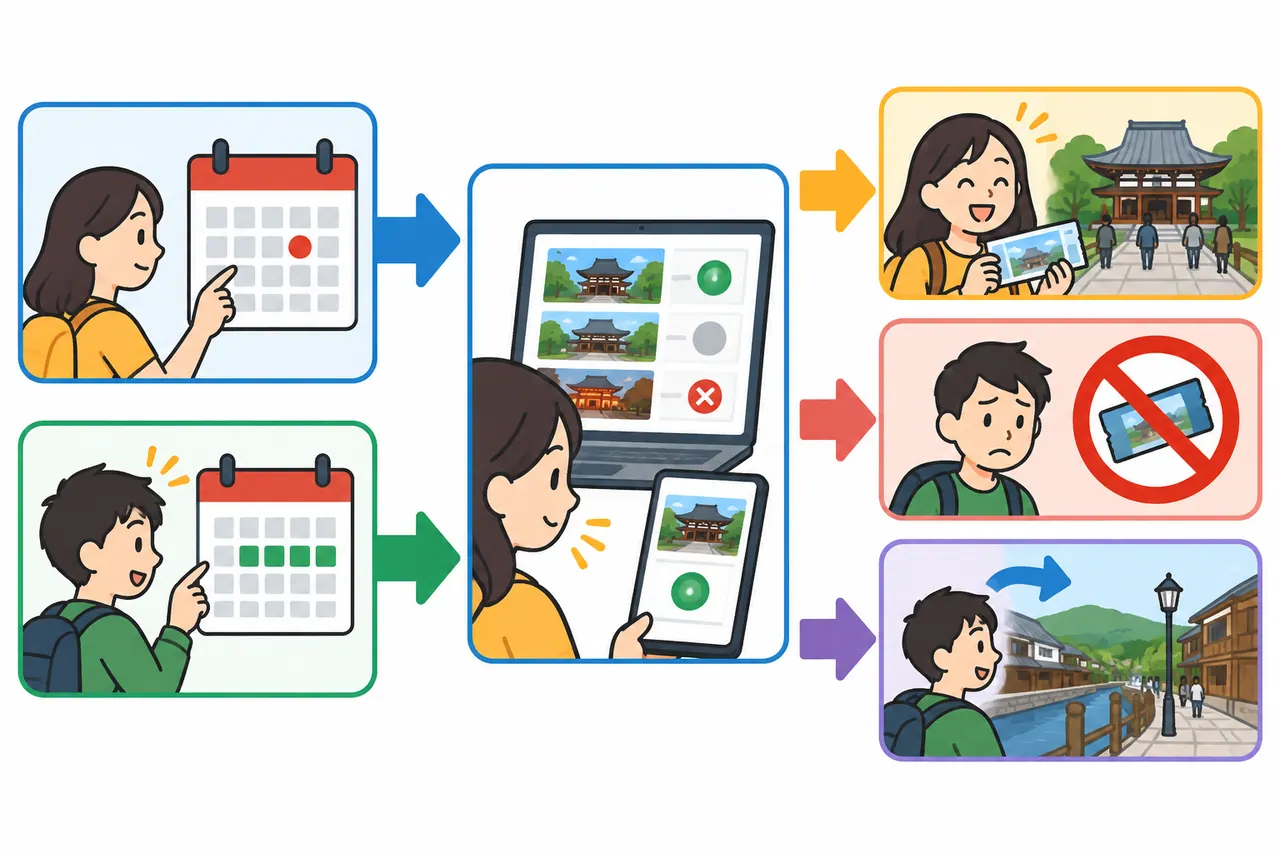
Write down your dates, all guests and the journeys that matter most, then choose areas that fit those journeys. Search each area using the same dates and guest count, and open each property’s official page to find its full address and access directions. For each suitable room, check the sleeping places, bathroom, access, meals, cancellation rules and payment timing.
Review the final price screen and confirm whether Kyoto City tax is included. Save the confirmation with the property name, address, contact details and arrival instructions. A comparison site or video can provide ideas, but compare its offer with the property’s official information using the same room, dates, guests and rules.
The video references in the existing guide include Toshi Guide from Japan, which discusses six Kyoto areas and booking hotels. They also include FOLLOW ME Creator’s autumn-leaf trip and hotel stays; these are examples of individual trips, not current evidence of room prices, availability or seasonal conditions. Publication dates for the referenced videos were not provided, so use official property and destination information for current decisions.
Plan for blossom, autumn leaves and unavailable rooms
For blossom or autumn-leaf travel, check current official information and live room availability for your dates. A past trip cannot predict the conditions you will see, and a video should not be treated as a forecast. Kyoto’s Tourist Information Center also warns that some major routes can be crowded in some seasons. Kyoto Tourist Information Center: busy-period travel
If your first choice is unavailable, keep your most important journey and change one search condition at a time. Try another room at the same property, then another property in the same area, and then a second area from the comparison table; keep the dates and guest count the same where possible. If your dates can change, check the new total and cancellation rules again because they may differ from the first offer.
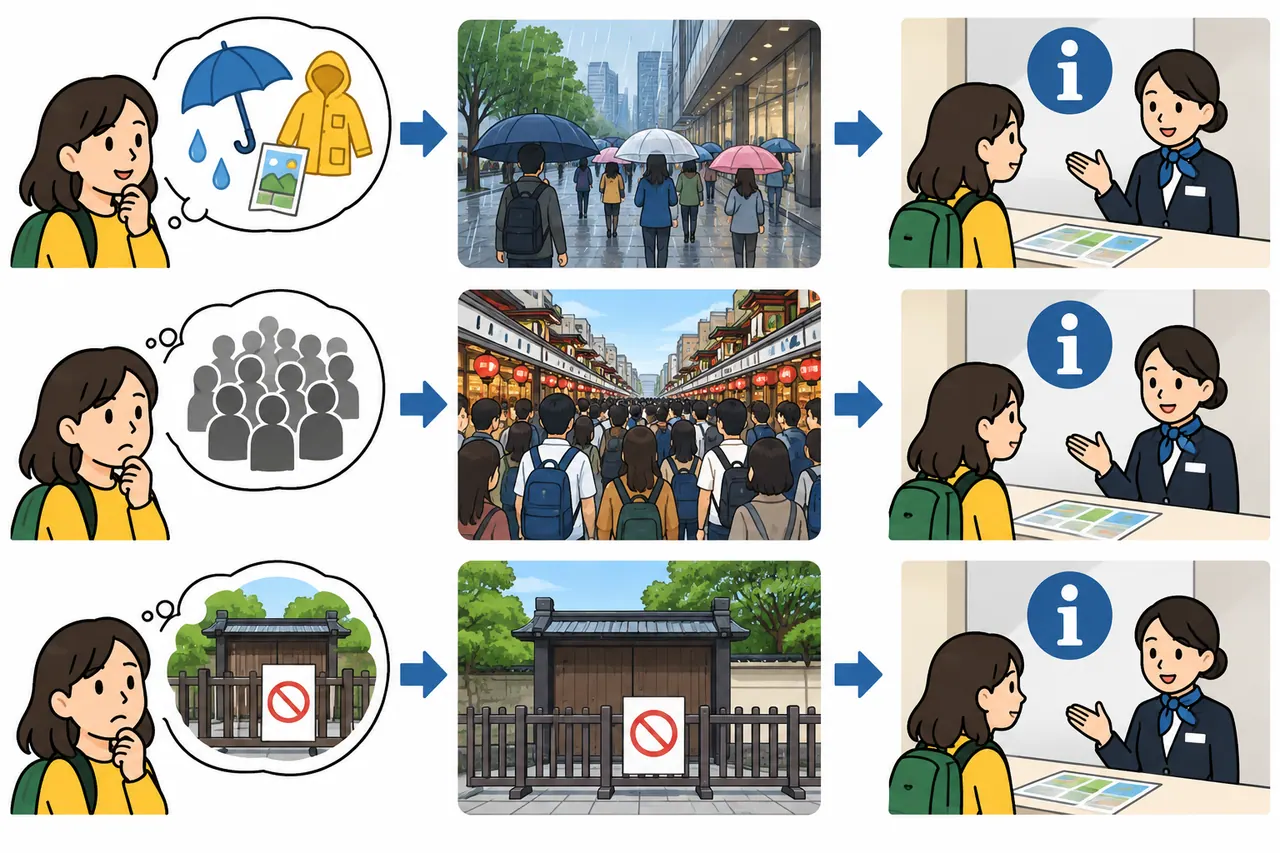
If rain, crowds or a closure changes your plan, check current opening and access information on the destination’s official site before leaving. Choose an alternative that works from your base, and check the full route rather than only the train segment. For children or anyone with limited mobility, confirm that the replacement route works for the whole group.
Make an arrival plan
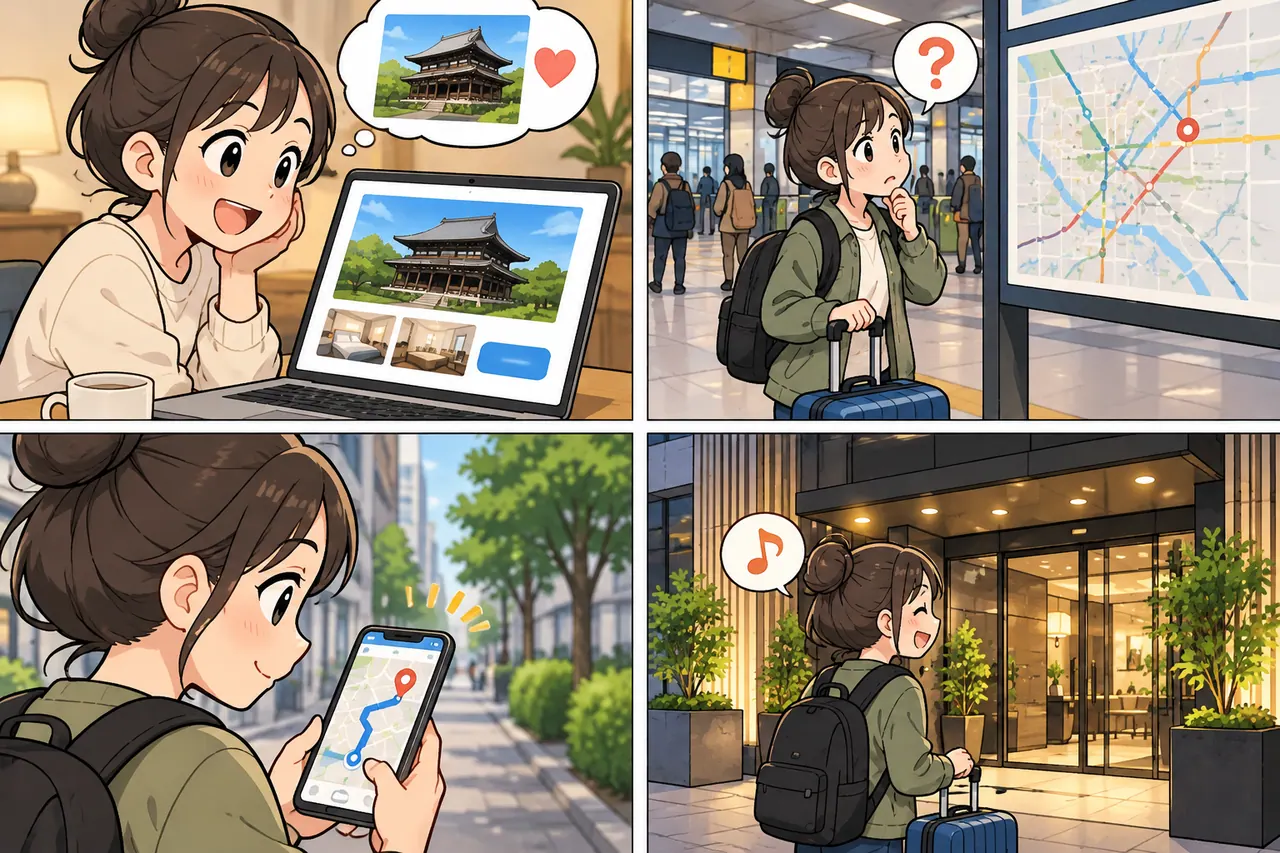
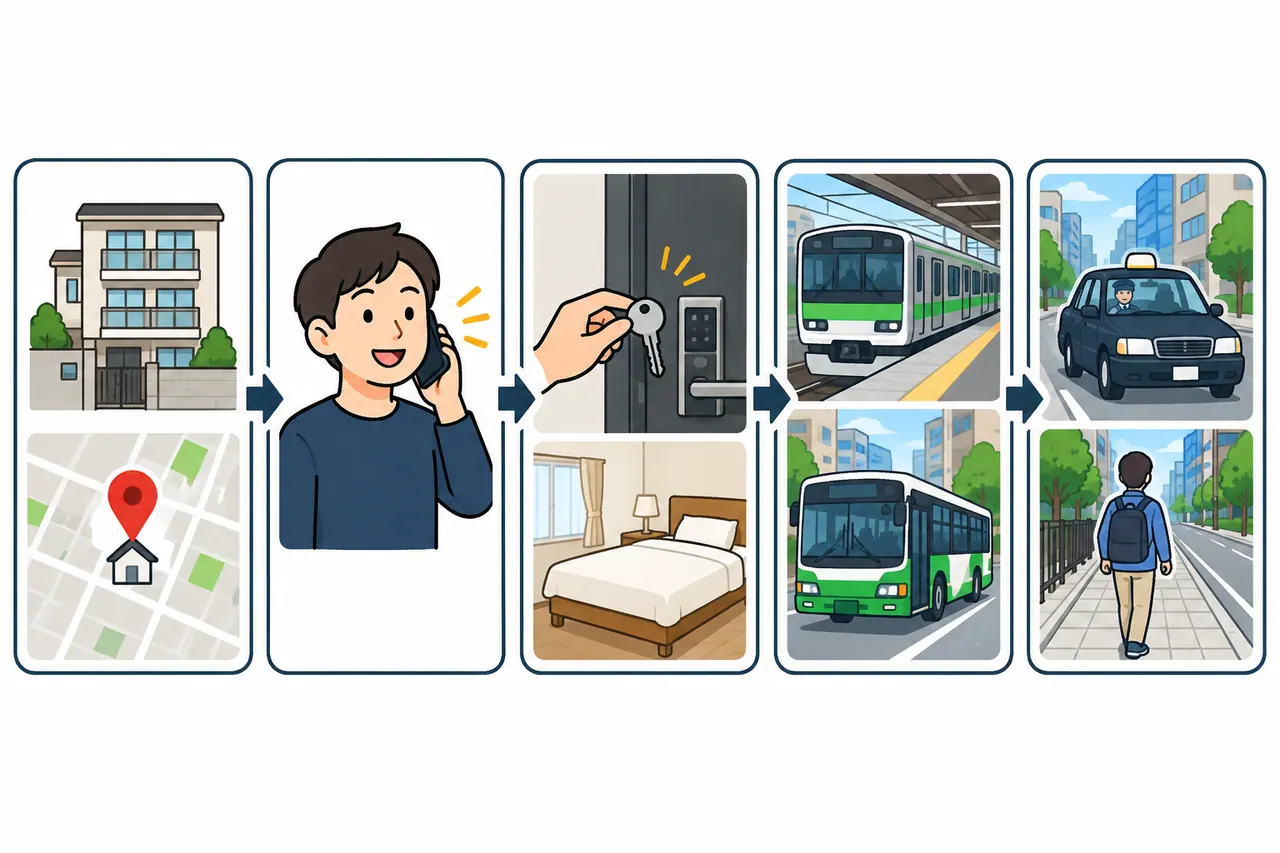
Save your full address, route, check-in instructions and property contact details together. Use the written address to check the route from your arrival point to the property entrance, and review the property’s instructions for arrival and late arrival. Do not assume that a booking covers every arrival time.
For a Saga–Arashiyama arrival, Kyoto Travel lists about 11 minutes for the JR rapid train from Kyoto Station to Saga-Arashiyama Station. Add the walk to the Sagano Line platform and the route from the arrival station to your room. Check the current service information before you travel. Kyoto Travel: access to Saga and Arashiyama
Kyoto Station’s surrounding area has luggage storage places and coin lockers, but check the current conditions of the particular service before relying on it. A luggage-forwarding service is another option to investigate; check that service’s own conditions for your trip. If you may arrive late or your planned train no longer works, contact the property using its official details and check the operator’s current information, including the last service.
Avoid common booking mistakes
| Mistake | Better action |
|---|---|
| Choosing only by an area name | Search the property’s full written address. |
| Treating Shijo Karasuma and Shijo Kawaramachi as the same place | Compare routes from the actual addresses. |
| Treating train time as the whole journey | Include platform walks and travel after arrival. |
| Assuming a room label guarantees facilities | Read the exact room description. |
| Comparing offers for different groups | Enter the same guests for every booking. |
| Adding tax without checking the total | Confirm whether tax is already included. |
| Choosing by room price alone | Include planned transport and cancellation rules. |
| Relying on one busy route | Check official transport advice and save an alternative. |
Ask the property or service operator about any practical detail you need, such as payment, Wi-Fi, toilets or luggage facilities. Save a written address and contact details in case you cannot use your map app. Before leaving, keep the exact room name, guest count, sleeping arrangements, final price, tax status, cancellation terms, check-in instructions and a backup route together.
6. Frequently asked questions
Where should I stay in Kyoto for a first visit?
Start with Shijo Kawaramachi if central walks toward Gion and Yasaka Shrine are your priority. Compare Kyoto Station if JR journeys and station-area luggage services matter more. Check the property’s exact address and route before booking, because the area name alone does not establish how close a room is to your destinations.
Is Kyoto Station or Shijo Kawaramachi better?
Kyoto Station is a useful starting point for several JR journeys, and the area has luggage storage places and coin lockers. Shijo Kawaramachi is a useful starting point for walks toward Gion and Yasaka Shrine, with Nishiki Market nearby. Choose by your planned journeys, then compare the room and route rather than assuming either base is best for every itinerary.
Which Kyoto area is best for families?
There is no single area that fits every family, because the room and the group’s planned journeys both matter. Enter every adult and child in the booking search, then confirm the guest limit, sleeping places, bathroom and access details with the property. Ask specifically about the street entrance, lift, route to the room and any steps in the bathroom if those details matter to your group.
How much is Kyoto’s accommodation tax?
For stays on or after March 1, 2026, Kyoto City’s tax ranges from ¥200 to ¥10,000 per person per night, depending on the accommodation charge per person per night. The applicable rate depends on the stay date, not the booking date. Check whether the tax is already included in your total and ask the property how it calculates the amount if the booking screen is unclear. Kyoto City: accommodation-tax revision FAQ
How far ahead should I book?
A fixed booking lead time has not been confirmed. Compare live availability as soon as your dates and group are clear, and check the current terms for the room you want. If your plans may change, read the cancellation deadline, any fee and the payment timing before paying.
Should I stay in Kyoto or Osaka?
Compare the room total and the journeys you expect to make, rather than choosing by the displayed room price alone. Kyoto Travel describes a Keihan route from Yodoyabashi toward Gion-Shijo and Sanjo, with about 48 minutes for its limited-express route description; confirm current service, exact stops and fares for your trip. If considering a split stay, include the journey between rooms and the time and effort of moving luggage.
What should I check if I need a step-free route?
Ask the property about the route from the street entrance to the room and bathroom, not just whether a lift is available. Check each transport transfer and the route from the final station to your destination as well. Save the property’s written response with your booking details so you can refer to the exact room and access information.


)](https://i.ytimg.com/vi/3J5VSdqPW4Y/mqdefault.jpg)


)](https://i.ytimg.com/vi/4NOXJydIPKk/mqdefault.jpg)