Tokyo travel guide: areas, sights, seasons and subway
Contents
For a first visit, start with three days: Asakusa and Ueno, then Yoyogi, Harajuku and Shibuya, then Shimokitazawa and Shinjuku. Choose a hotel after grouping the places you most want to see, and compare the route from its actual address to your airport and daily stops. This outline follows GO TOKYO’s official three-day route, published by the Tokyo Convention & Visitors Bureau.
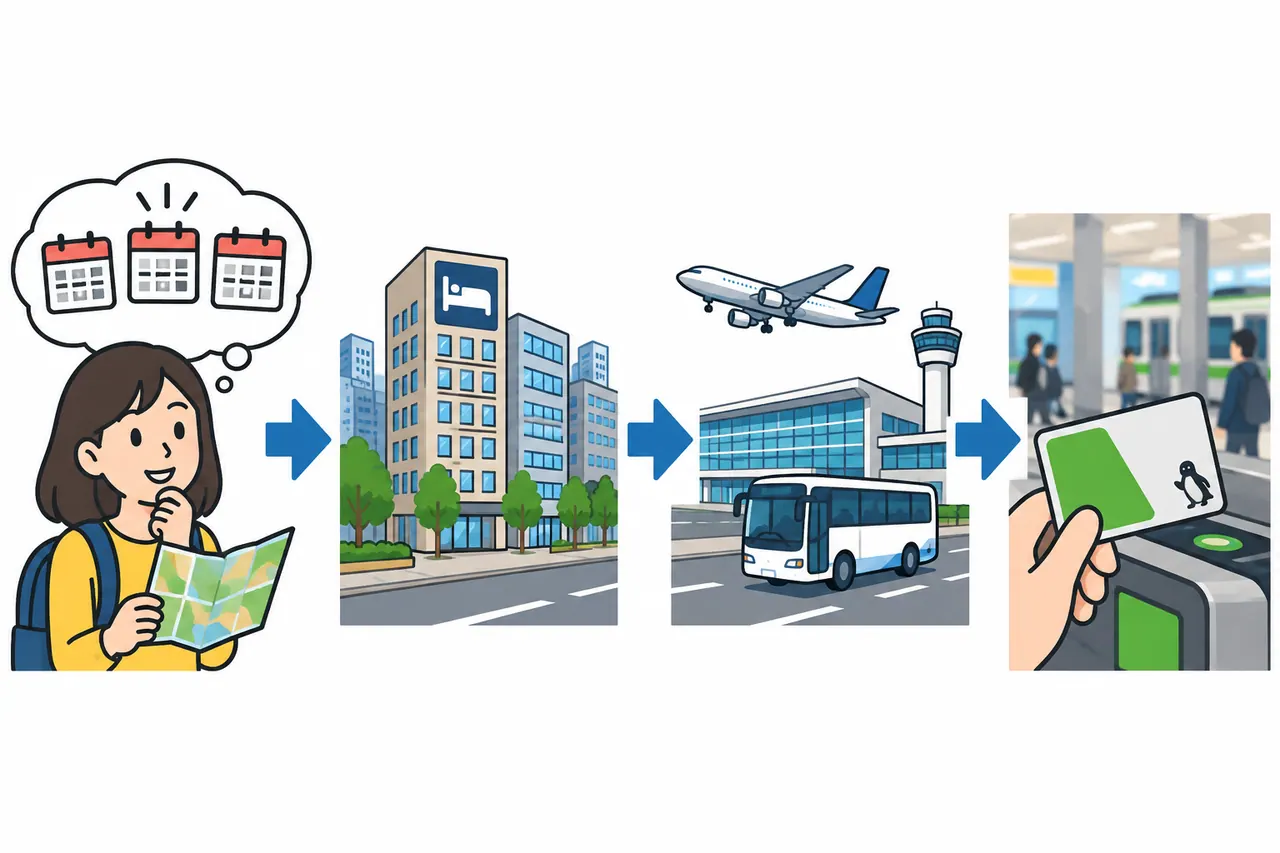
A quick way to plan: decide how many days you have, choose a hotel area that suits your route, check the airport-to-hotel journey, and then compare a rechargeable IC card with any day or multi-hour ticket you might use. Airport fares and journey times depend on the route and departure, so check the transport operator’s current timetable rather than estimating. Facts and listed prices in this guide were checked November 3, 2026, except where a different check date is stated; schedules, prices and availability can change.
Tokyo’s areas, history and places to stay
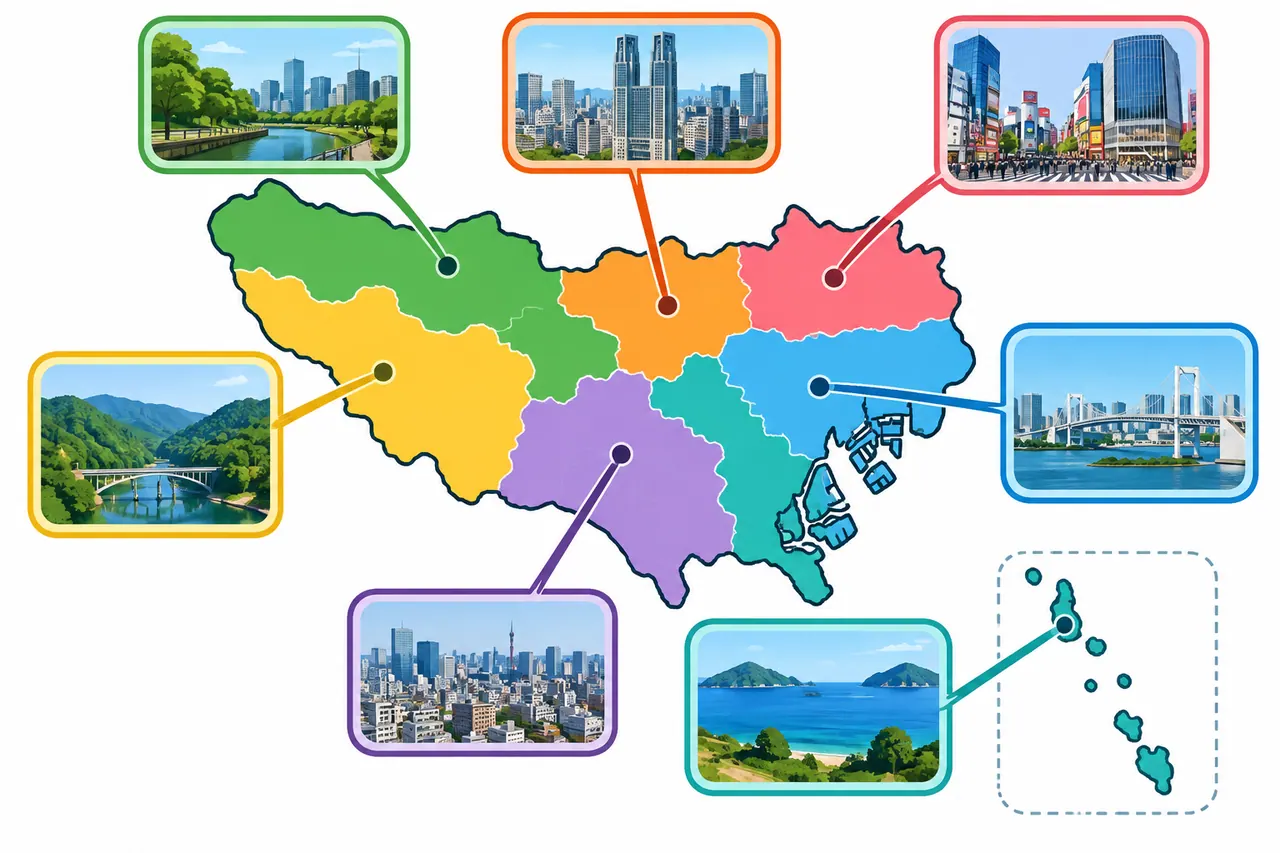
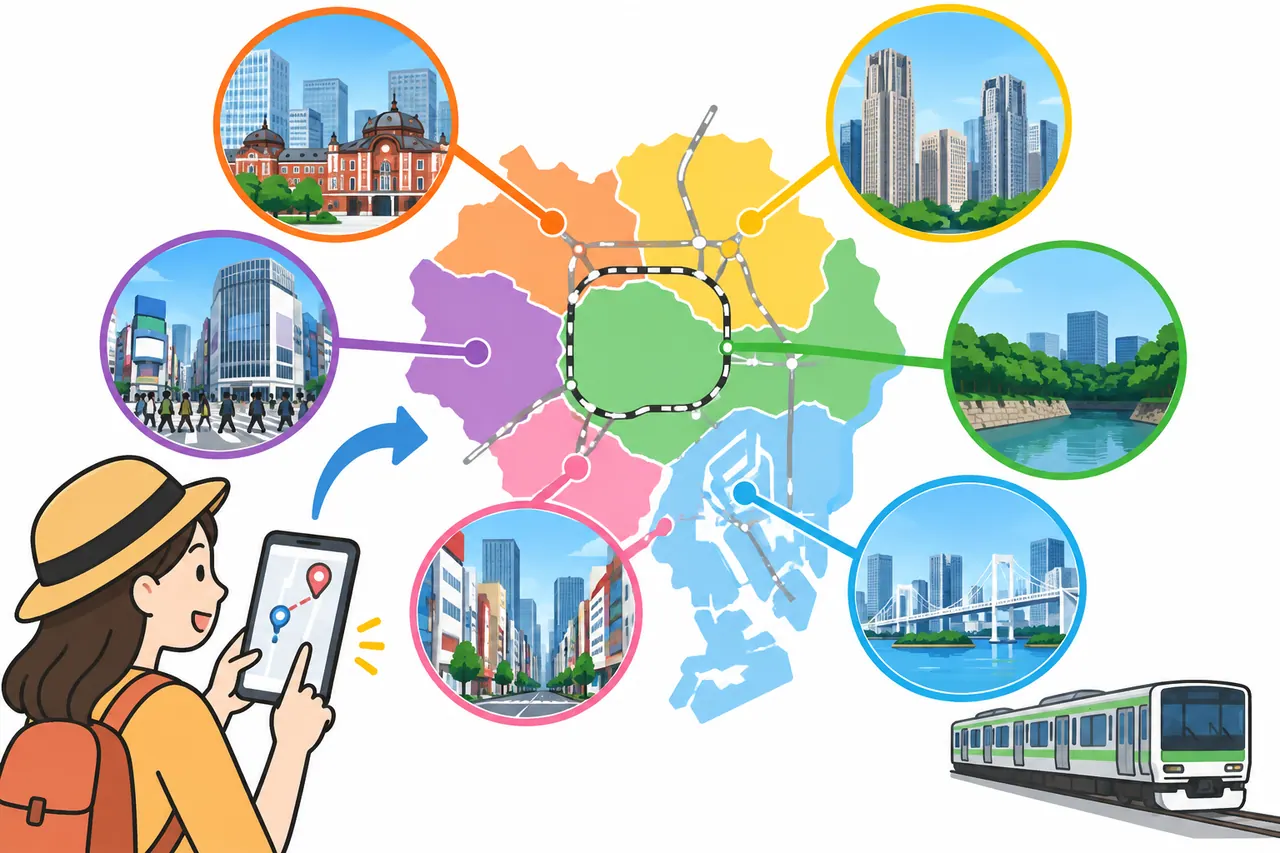
Tokyo is too large for a district name alone to tell you how convenient a hotel will be. First group your main sights by day, then check the walk from each hotel’s full address to its station and the route to those sights. GO TOKYO’s seven-area menu is a useful way to begin exploring the city, but it is a map classification, not a rating of convenience or quietness.

Seven areas to start your map
| GO TOKYO area | Examples listed by GO TOKYO | Planning use |
|---|---|---|
| Central | Ginza, Akihabara, Tokyo Station and Marunouchi; also Nihonbashi, Tsukiji, Kanda and Jimbocho | Pair central stops and check the route to the East Gardens. |
| Eastern | Asakusa, Ryogoku and the Skytree area; also Toyosu, Kiyosumi-Shirakawa, Fukagawa and Kasai | Combine an Asakusa visit with a tower view if it suits your day. |
| Western | Shinjuku, Shibuya and Harajuku; also Shimokitazawa, Daikanyama, Kichijoji, Nakano, Yoyogi and Koenji | Group parks, shopping and city views by route. |
| Southern | Odaiba, Shinagawa-Tennozu and Naka-Meguro; also Roppongi, Azabu-Juban, Ebisu, Haneda-area stops and Jiyugaoka | Consider the Meguro River for a spring blossom outing. |
| Northern | Ueno and Yanaka-Nezu; also Ikebukuro, Sugamo, Nippori, Akabane, Kita-Senju, Shibamata and Nerima | Add Ueno Park or Ameyoko to a northern-city route. |
| Tama | Mitaka-Musashino, Hachioji, Mount Takao and Okutama | Research these as outings beyond the central areas. |
| Islands | Izu Islands and Ogasawara Islands | Plan an island trip separately from a short central-Tokyo itinerary. |
GO TOKYO places Kichijoji in western Tokyo, while its Tama examples include the wider Mitaka and Musashino area. Use the GO TOKYO area menu to explore its listings, then open directions for the exact places you intend to visit. The area groupings help organize a search; they do not indicate how busy, peaceful or convenient a particular place will be on your dates.
A brief history of Tokyo
Tokyo was formerly called Edo. Tokugawa Ieyasu established the Edo shogunate, a military government, in 1603, and the city was renamed Tokyo in 1868; GO TOKYO’s history guide provides further background. A practical place to see part of this history is the Imperial Palace East Gardens, which occupy parts of the former Edo Castle grounds.
The East Gardens were opened to the public in 1968, according to the Imperial Household Agency. The Edo-Tokyo Museum opened in 1993 and reopened after repairs on March 31, 2026. For a visit, start with the museum’s GO TOKYO page and confirm current opening and ticket information before setting out.
Compare six possible hotel bases
A hotel near the stops you plan to visit can reduce unnecessary cross-city journeys, but the best base also depends on your flight, budget and room requirements. Treat the routes below as a first check, not as a claim that every hotel in a district is equally convenient. For accommodation types and planning information, see GO TOKYO’s accommodation guide.
| Base | Useful for | First route to check |
|---|---|---|
| Asakusa | Sensoji Temple and an eastern-Tokyo sightseeing day | Hotel to Sensoji Temple |
| Ueno | Ueno Park and Ameyoko, a shopping area | Hotel to your Ueno stops |
| Shibuya | Harajuku, shopping and SHIBUYA SKY | Hotel to Meiji Jingu |
| Shinjuku | Shinjuku Gyoen and city views | Hotel to the garden and the viewing rooms |
| Ginza | Central-area sightseeing | Hotel to your chosen East Gardens gate |
| Tokyo Station and Marunouchi | Tokyo Ramen Street and central stops | Hotel to your selected garden gate or station exit |
Compare the full booking total for your dates, not only the displayed nightly room rate. Tokyo accommodation includes hotels, hostels and traditional Japanese inns called ryokan; an onsen is a hot-spring bath, and facilities and services vary by property. Ask the accommodation about meals, bath rules, cancellation conditions and whether the displayed total includes accommodation tax.
Accommodation tax and choosing a hotel
As of November 3, 2026, Tokyo’s accommodation tax applies to covered hotels and inns according to the lodging charge per person, per night. The Tokyo Metropolitan Government lists no tax below ¥10,000, ¥100 for a charge of ¥10,000 to under ¥15,000, and ¥200 for ¥15,000 or more. Ask your property which charges form the taxable lodging amount and whether tax is included in its booking total.
A change is planned from April 1, 2027: stays below ¥13,000 per person per night are to be exempt, and covered lodging charges of ¥13,000 or more are to be taxed at 3 percent. The planned system adds simple lodging and private rentals to the covered types. Check the Tokyo Metropolitan Government accommodation-tax page for the rules that apply to your stay date.
To compare hotels, mark your principal sights on a map and group them by day. Enter each hotel’s full address, check its nearest station, and compare transit directions from your airport and to the main stops. Before booking, record the total, cancellation terms and address; save the address and booking confirmation somewhere accessible on arrival.
Getting around Tokyo: airports, trains and subway tickets
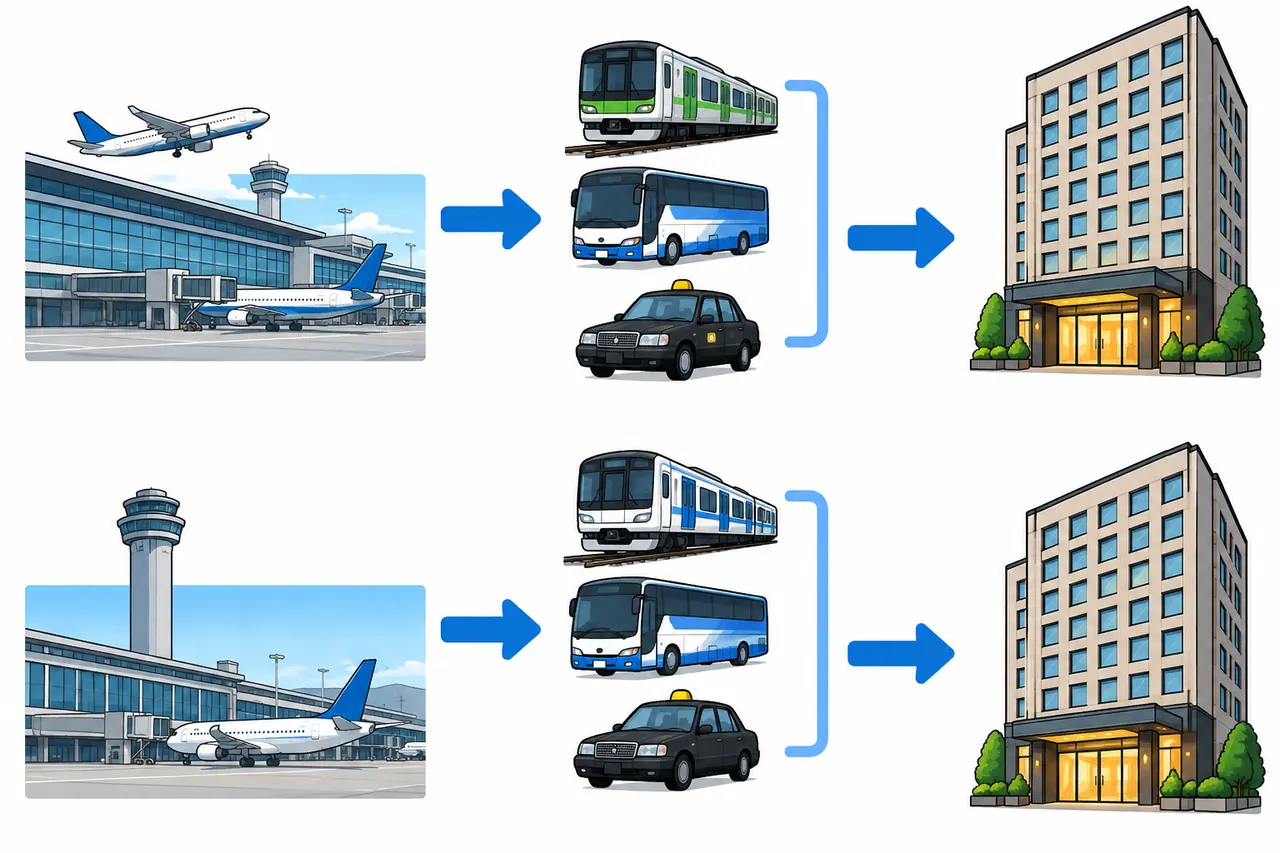
Tokyo’s transport map can look complicated, but you can make a practical first journey by checking the destination, the operator and the fare. Start with the airport shown on your flight booking, then compare routes to your hotel, including train changes and the final walk. The facts available here do not establish a single best airport route or a general airport fare, so check the relevant operator’s current timetable for your date.
Haneda and Narita airport transfers
| Airport | Transport choices to compare | Check before you travel |
|---|---|---|
| Haneda Airport | Train, bus or taxi | Departure time, total fare and the route to your hotel |
| Narita Airport | Train, bus or taxi | Departure time, total fare and the route to your hotel |
Copy your hotel address from the booking confirmation into your phone, then enter it with the airport in a map app. Check the route screen for transfers, station exits and the last walk, and verify the departure with the transport company’s timetable. See the separate Haneda-to-Tokyo guide and Narita-to-Tokyo guide for airport comparisons; your flight and hotel may make either airport more practical, so one traveler’s preference for Haneda should not be treated as a rule.
Suica and PASMO rechargeable cards
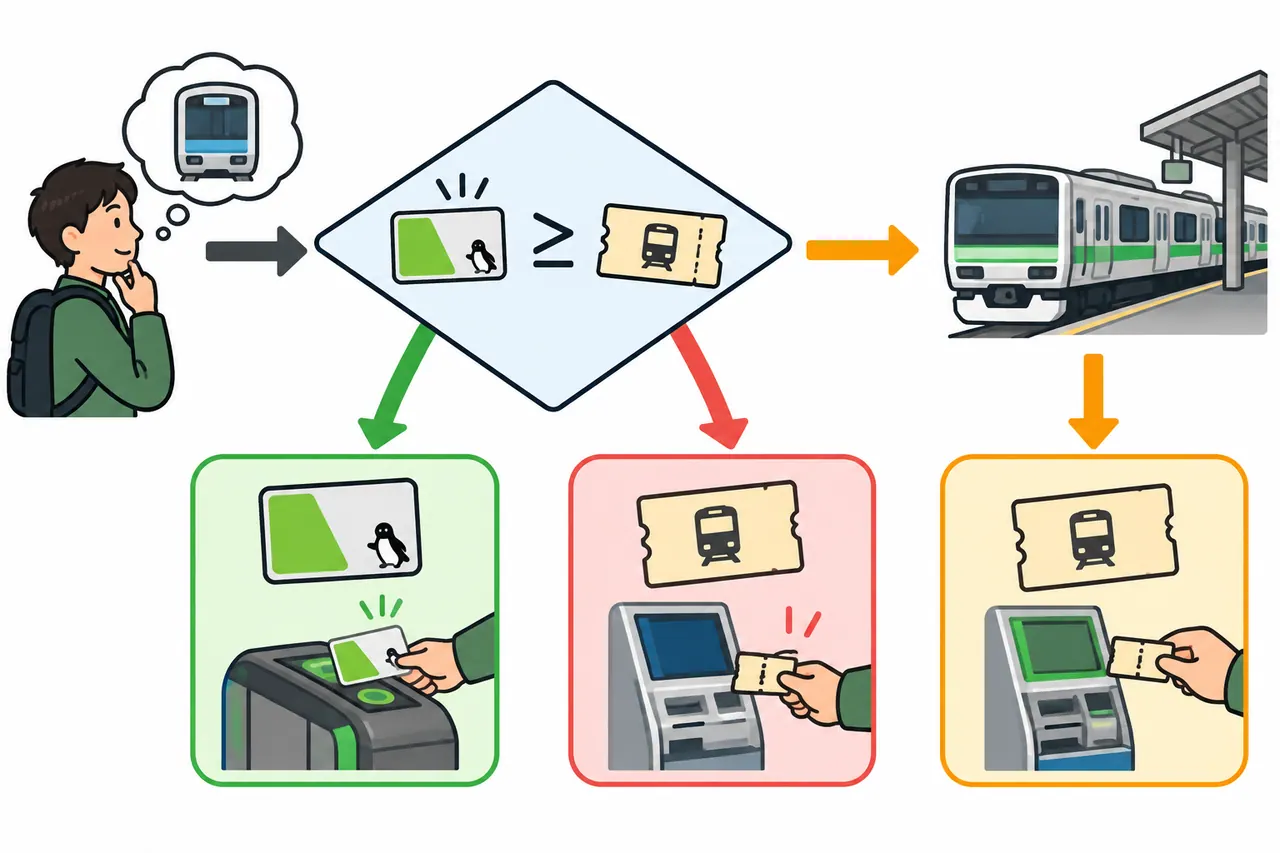
Suica and PASMO are rechargeable IC cards used to pay fares on participating transport and at participating shops. GO TOKYO recommends using either on its three-day route; it says Suica can be bought at JR station ticket machines and PASMO at stations of railway companies that handle PASMO. Regular cards require a ¥500 deposit, separate from the balance you add for journeys.
| Card | GO TOKYO’s listed purchase location | Regular-card deposit |
|---|---|---|
| Suica | JR station ticket machines | ¥500 |
| PASMO | Stations of railway companies that handle PASMO | ¥500 |
See GO TOKYO’s IC-card guide and its JR East information for purchase guidance. Check the card provider’s current availability and return conditions rather than assuming every card type is available at every station. A deposit is not journey credit, so allow for both the deposit and the amount you expect to use.
Tokyo Subway Ticket: coverage, prices and activation
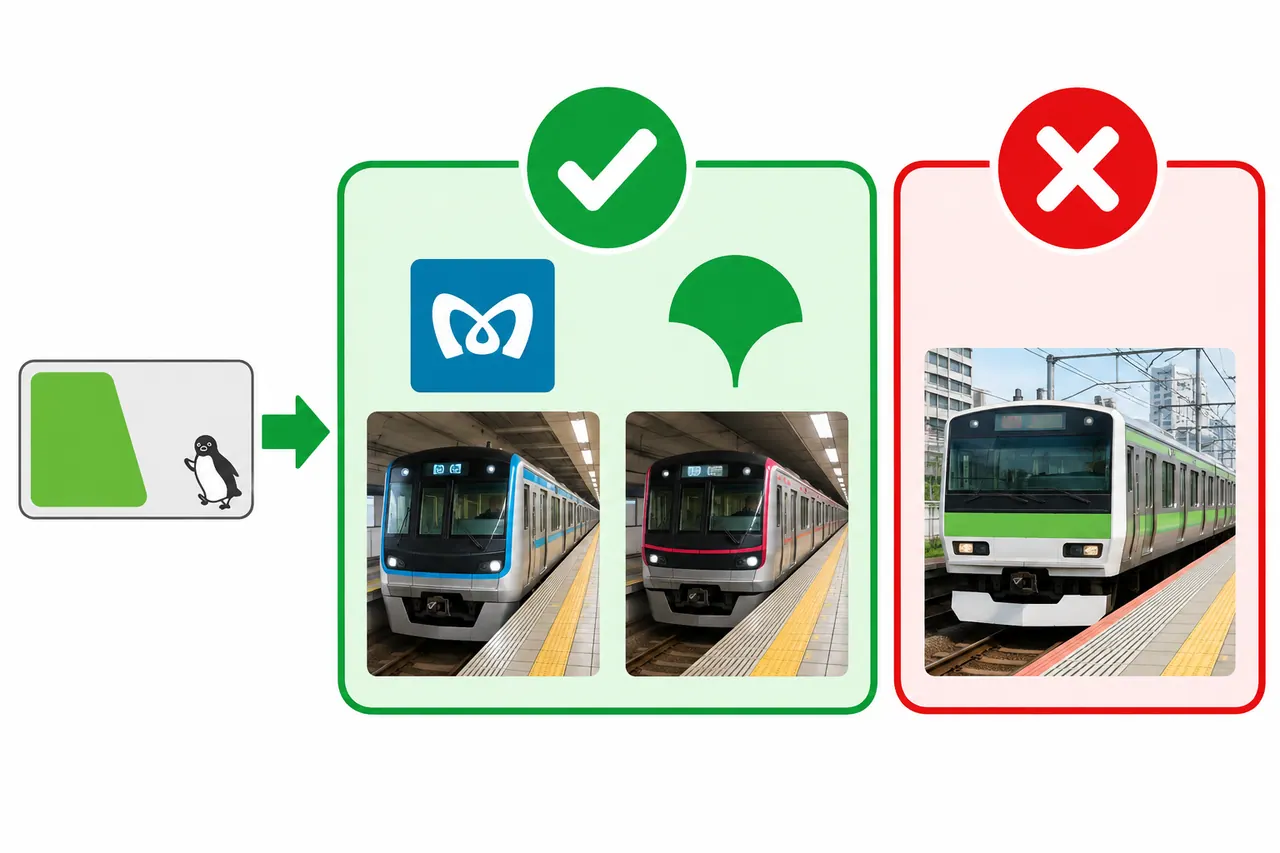
The Tokyo Subway Ticket covers all Tokyo Metro and Toei Subway lines; JR lines are not included. The adult and child prices listed in the Toei ticket guide on November 3, 2026, are:
| Ticket | Adult | Child | Validity |
|---|---|---|---|
| 24-hour | ¥1,000 | ¥500 | 24 hours from the applicable start |
| 48-hour | ¥1,500 | ¥750 | 48 hours from the applicable start |
| 72-hour | ¥2,000 | ¥1,000 | 72 hours from the applicable start |
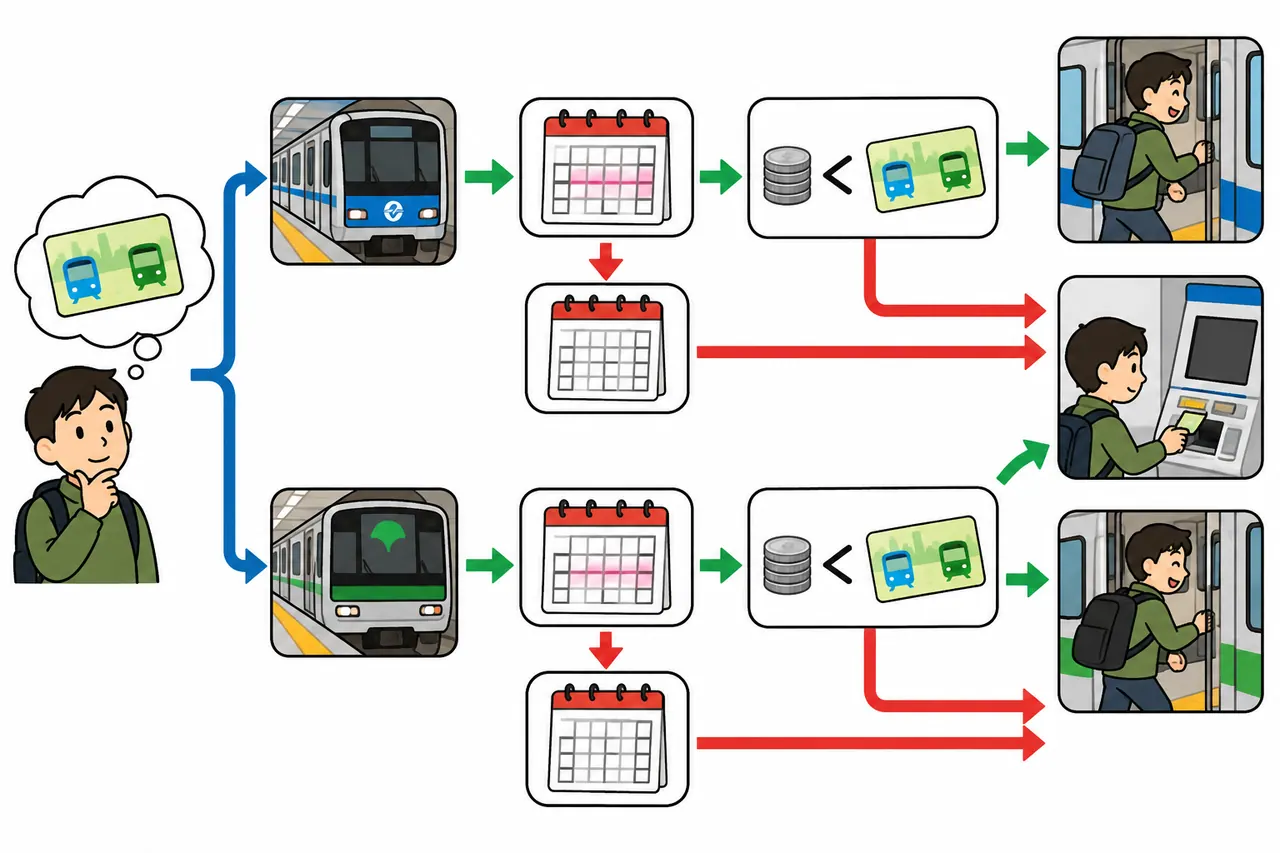
Paper and QR tickets begin their 24-, 48- or 72-hour period when first used, subject to the stated activation window; the period is not simply the remainder of a calendar day. GO TOKYO says a version loaded onto PASMO starts counting from purchase, so check the format before paying. Tokyo Metro’s information describes regular and QR-code versions, and its QR-ticket notice says multiple tickets can be sent to a smartphone; the linked official material was not accessible during fact checking, so confirm current online purchase and issuing instructions.
The ticket is listed for overseas visitors and domestic visitors who do not live in Tokyo, Kanagawa, Saitama, Chiba, Ibaraki, Tochigi, Gunma or Yamanashi. Toei lists sales at tourist information centres at Shimbashi, Shinjuku-nishiguchi and Ueno-okachimachi; these centres are listed as open 8:00 a.m.–8:00 p.m. Overseas visitors should bring a passport, and the ticket types sold may differ by location, so check the visitor-centre instructions before going.
Compare other passes and decide whether a ticket pays off
The Tokyo Subway Ticket saves money only when the fares for covered rides exceed its price. Enter your planned journeys in a map app, note which are Tokyo Metro or Toei Subway trips, add those fares for the ticket’s valid period, and compare the result with the ticket price. Count JR, airport and other journeys separately because they are not covered by this ticket.
| Pass | Listed coverage | Listed price |
|---|---|---|
| Tokyo Subway Ticket, 24 hours | All Tokyo Metro and Toei Subway lines | Adult ¥1,000; child ¥500 |
| Tokyo Subway Ticket, 48 hours | All Tokyo Metro and Toei Subway lines | Adult ¥1,500; child ¥750 |
| Tokyo Subway Ticket, 72 hours | All Tokyo Metro and Toei Subway lines | Adult ¥2,000; child ¥1,000 |
| Tokunai Pass, one day | Ordinary-class unreserved local and rapid JR trains within Tokyo’s 23 wards | Adult ¥870; child ¥430 |
| Tokyo Free Kippu, one day | JR lines, Tokyo Metro, Toei Subway and other listed services within the 23 wards | Adult ¥1,720; child ¥860 |
| Toei One-Day Pass | Toei Subway, Toei buses, Tokyo Sakura Tram and Nippori-Toneri Liner | Adult ¥700; child ¥350 |
The Tokunai Pass and Tokyo Free Kippu prices are supported by GO TOKYO’s ticket information; the linked JR page could not be opened during checking, so confirm current sale conditions with JR East before purchase. Coverage differs across these products, so match the pass to the operators on your actual route rather than choosing by price alone. Buses, taxis, water buses and rental cars are other transport choices; check each provider’s route, fare and conditions for your travel date, and treat a shinkansen or rail pass as a separate product with its own rules.
Sights, gardens and city views
A memorable day does not require a paid ticket at every stop. Meiji Jingu, the Imperial Palace East Gardens and the Tokyo Metropolitan Government viewing rooms are free, while Tokyo Skytree and SHIBUYA SKY are paid viewing options. Check opening days, last entry and any booking or weather notices before building a day around a specific attraction.
Meiji Jingu: free entry and changing gate times
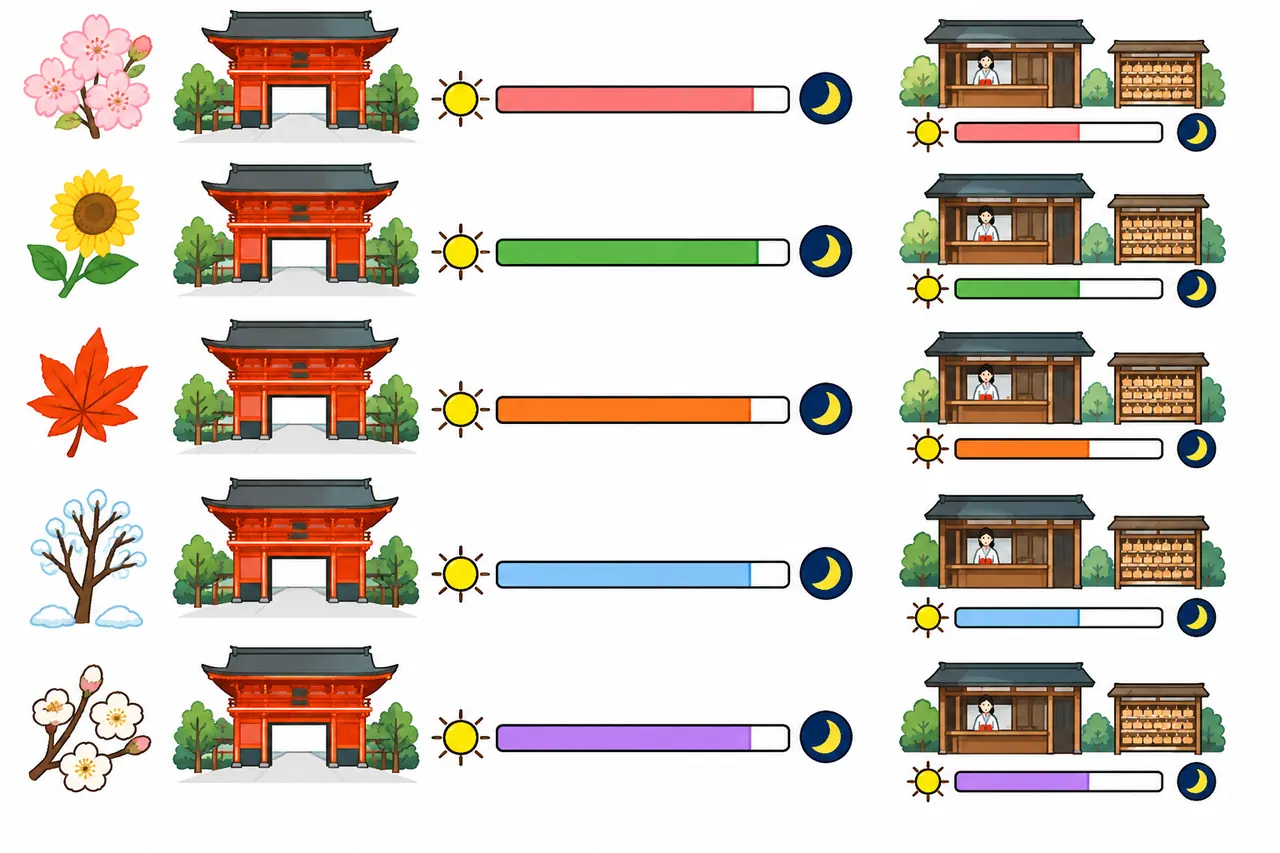
Meiji Jingu is free to visit and normally opens daily from sunrise to sunset. It is about a one-minute walk from Harajuku Station, according to GO TOKYO, but the gate times change by month; the shrine’s visitor page gives the current calendar. Selected monthly times are:
| Month | Gate opens | Gate closes |
|---|---|---|
| January | 6:40 a.m. | 4:20 p.m. |
| April | 5:10 a.m. | 5:50 p.m. |
| July | 5:00 a.m. | 6:20 p.m. |
| November | 6:10 a.m. | 4:10 p.m. |
| December | 6:40 a.m. | 4:00 p.m. |
Some facilities inside the grounds mainly open from 9:00 a.m. to 4:00 p.m., so an open gate does not mean every facility is open. Use the GO TOKYO Meiji Jingu page for its map link and check the shrine’s visitor information for your month. If you are pairing the shrine with Harajuku and Shibuya, confirm the gate closing time before leaving the hotel.
Imperial Palace East Gardens: hours, closures and gates
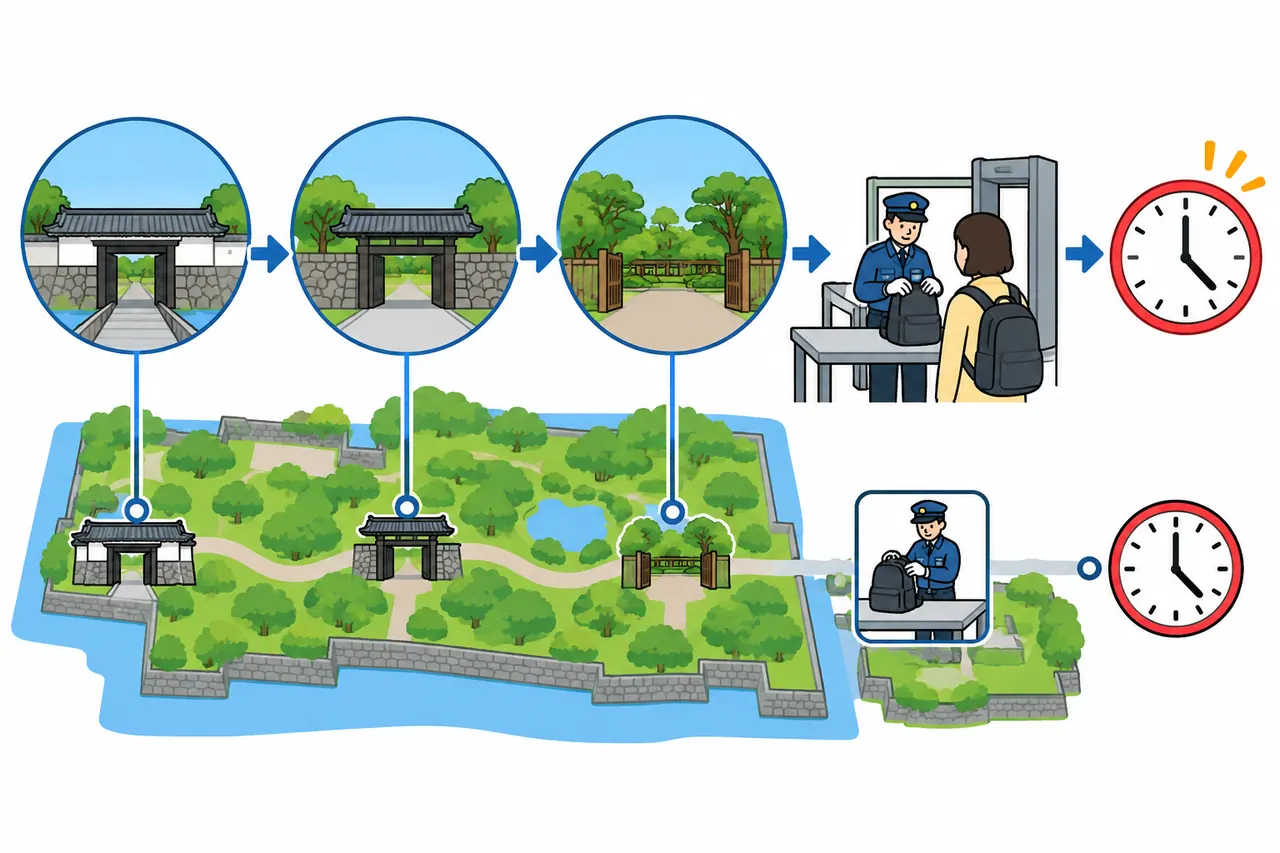
The Imperial Palace East Gardens are free and include parts of the former Edo Castle grounds. Last entry is 30 minutes before closing, and visitors undergo a bag inspection; the Imperial Household Agency page should be checked for your date. Its seasonal hours are:
| Dates | Opening hours | Last entry |
|---|---|---|
| March 1–April 14 | 9:00 a.m.–5:00 p.m. | 4:30 p.m. |
| April 15–August 31 | 9:00 a.m.–6:00 p.m. | 5:30 p.m. |
| September | 9:00 a.m.–5:00 p.m. | 4:30 p.m. |
| October | 9:00 a.m.–4:30 p.m. | 4:00 p.m. |
| November 1–end of February | 9:00 a.m.–4:00 p.m. | 3:30 p.m. |
The gardens normally close on Mondays and Fridays, open on public holidays except February 23, and close the following Tuesday when Monday is a holiday. They also close December 28–January 3, with additional closures possible for palace events. The entrances are Otemon, Hirakawamon and Kitahanebashimon; choose a gate on the map, check directions and leave time for the inspection and last-entry cutoff.
Compare three city views
| View | Adult price listed | Access and booking |
|---|---|---|
| Tokyo Skytree | Deck from ¥1,800; deck-and-gallery set from ¥3,000 | About one minute from Tokyo Skytree or Oshiage Station |
| SHIBUYA SKY | Online from ¥2,700, depending on entry time | Connected to Shibuya Station; ticket availability varies |
| Tokyo Metropolitan Government viewing rooms | Free | About one minute from Tochomae Station exit A4; no advance reservations |
Prices and conditions differ, so compare the specific view and time you want rather than treating the three as equivalent. The government viewing rooms are free but have room-specific schedules and closure days; the other two require paid tickets. Check the relevant official page before setting off, particularly if weather, a sunset entry or a sold-out time slot matters.
Tokyo Skytree: deck, gallery and ticket choices
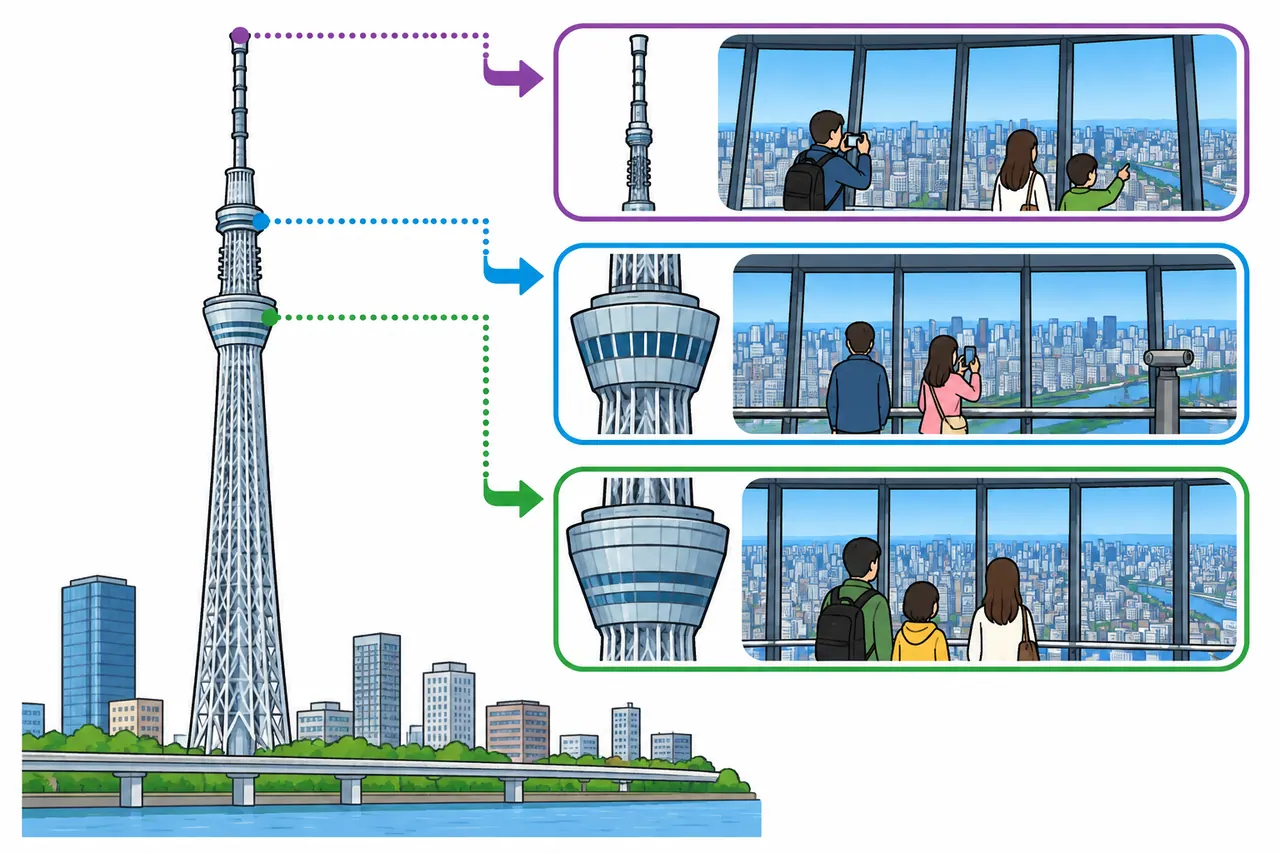
Tokyo Skytree is 634 metres tall, with its viewing deck at 350 metres and its gallery at 450 metres. GO TOKYO says the elevator to the deck takes about 50 seconds and lists hours of 10:00 a.m.–10:00 p.m. on weekdays and 9:00 a.m.–10:00 p.m. on weekends and holidays, with last entry 60 minutes before closing; hours can change by season or period. The tower is about a one-minute walk from Tokyo Skytree or Oshiage Station.
The official Skytree ticket page listed, on November 3, 2026, adult deck tickets from ¥1,800 and combined deck-and-gallery tickets from ¥3,000; child tickets started at ¥900 and ¥1,500 respectively. Prices vary by visit date. Buying a basic deck or combined ticket at the fourth-floor counter adds a ¥500 issuing fee per ticket, while the gallery add-on bought after entering the deck costs ¥1,400 for adults or ¥700 for children without that fee; check the daily calendar separately.
SHIBUYA SKY: ticket timing, weather and access
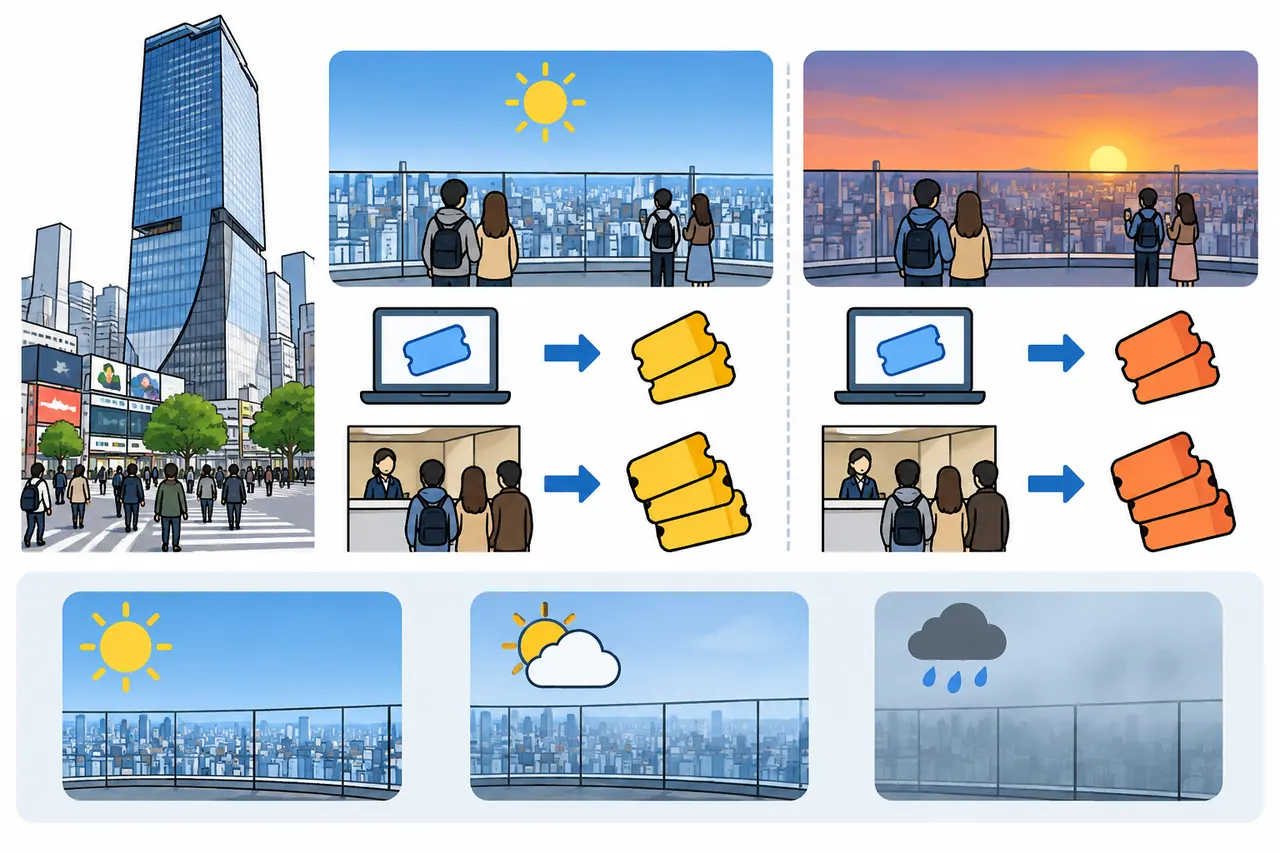
SHIBUYA SKY is connected to Shibuya Station. GO TOKYO’s page, updated April 23, 2026, lists hours of 10:00 a.m.–10:30 p.m., last entry at 9:20 p.m., and closure on New Year’s Day; temporary closures or reduced hours may also occur. The outdoor viewing area can close in bad weather, so check the attraction page and the facility’s current notice on the day.
| Adult ticket | Online | Counter |
|---|---|---|
| Entry before 3:00 p.m. | ¥2,700 | ¥3,000 |
| Entry from 3:00 p.m. | ¥3,400 | ¥3,700 |
The prices above are those listed by GO TOKYO; adult age eligibility was not confirmed there. If adult online tickets sell out, adult counter tickets are also unavailable, while children’s tickets are sold at the counter on the day and children under five are free. GO TOKYO suggests allowing about 90 minutes and arriving about 30 minutes before sunset for a sunset visit; travel luggage, food and drink, tripods and selfie sticks are not allowed in the viewing space, so plan to leave prohibited items in a locker or elsewhere before entry.
Tokyo Metropolitan Government viewing rooms
The viewing rooms are free and do not accept advance reservations; tripods are not allowed. The Tokyo Metropolitan Government’s official schedule lists the south room as open 9:30 a.m.–10:00 p.m. and the north room as normally open 9:30 a.m.–5:30 p.m.; the north room stays open until 10:00 p.m. when the south room is closed. Entry closes 30 minutes before the relevant room closes.
The south room normally closes on the first and third Tuesday, and the north room on the second and fourth Monday; holiday closures move to the next weekday. Both rooms also close December 29–31, January 2–3 and on building-inspection days. GO TOKYO lists different hours, so use the government’s room-by-room schedule for your visit; Tochomae Station exit A4 is about a one-minute walk from the building.
More neighborhoods, parks and museums
If you want to explore beyond the main three-day route, GO TOKYO also lists Yanaka-Nezu, Kiyosumi-Shirakawa, Kagurazaka, Koenji, Shibamata and Kichijoji. These are possibilities to research, not guarantees of a quiet visit; check current visitor information and map directions for your dates. The official area menu helps you locate each area within GO TOKYO’s listings.
GO TOKYO’s three-day route also includes Yoyogi Park, Shinjuku Gyoen and Ninja Trick House. Shinjuku Gyoen’s general admission is ¥500; from October 1 to March 14 it opens 9:00 a.m.–4:30 p.m., with last entry at 4:00 p.m. It normally closes on Mondays but opens on Mondays from November 1–15; check the garden’s official visitor information for your date.
For museums, performances, guided tours and Tokyo Disney Resort, use the venue’s own site to check tickets, opening hours, access and language options. A show or tour may need more planning than a park walk, so read what the ticket includes and whether advance booking is required. The Edo-Tokyo Museum’s reopening date and history are noted above; current visitor details should still be checked before a visit.
Food, shopping and evenings
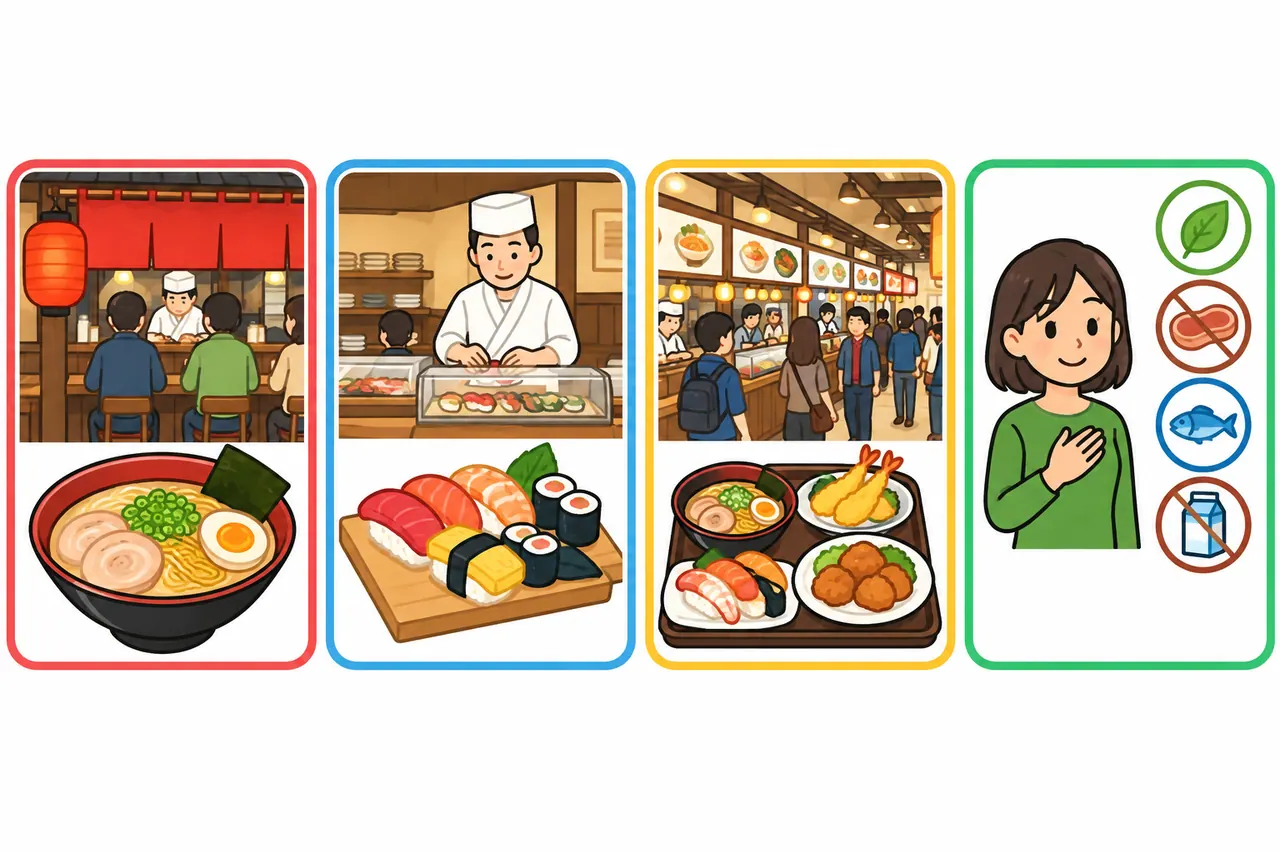
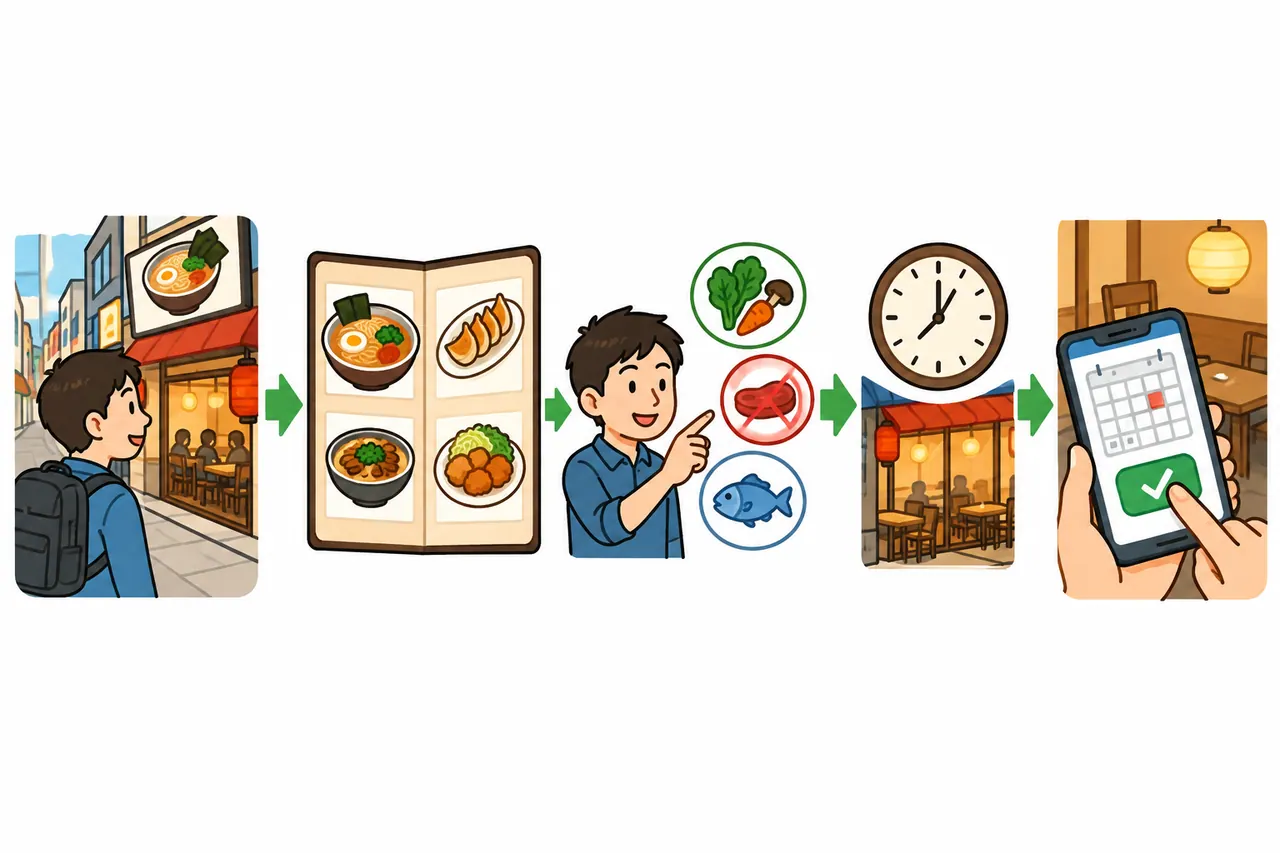
A meal near a planned stop can save an extra journey, and Tokyo has several kinds of food venues to consider. Menus and charges vary by business, so check the current menu, prices and booking terms rather than assuming a dish name tells you everything. If you have allergies or need vegetarian food, ask the restaurant directly about ingredients.
Food terms and practical checks
| Food or setting | What it means | What to check |
|---|---|---|
| Ramen | Japanese noodle dish | Bowl, ingredients and price |
| Sushi | Vinegared rice with ingredients such as fish or vegetables | Menu, ingredients and price |
| Kaiseki | Japanese meal served in several courses | What the booking includes |
| Depachika | Department-store basement food hall | Store floor map and individual shop details |
| Izakaya | Japanese place for drinks and food | Menu and any extra charges |
| Yokocho | Small side-street alley | Individual businesses’ hours and prices |
A cover charge is a set fee for a seat; ask about it if a restaurant or bar’s menu does not make charges clear. For dietary requirements, showing staff a written note can help you ask about ingredients, but do not rely on a dish label alone. Save the restaurant’s location and booking confirmation, if any, so you can find the right entrance on the day.
Tokyo Ramen Street: location, sample dishes and listed hours
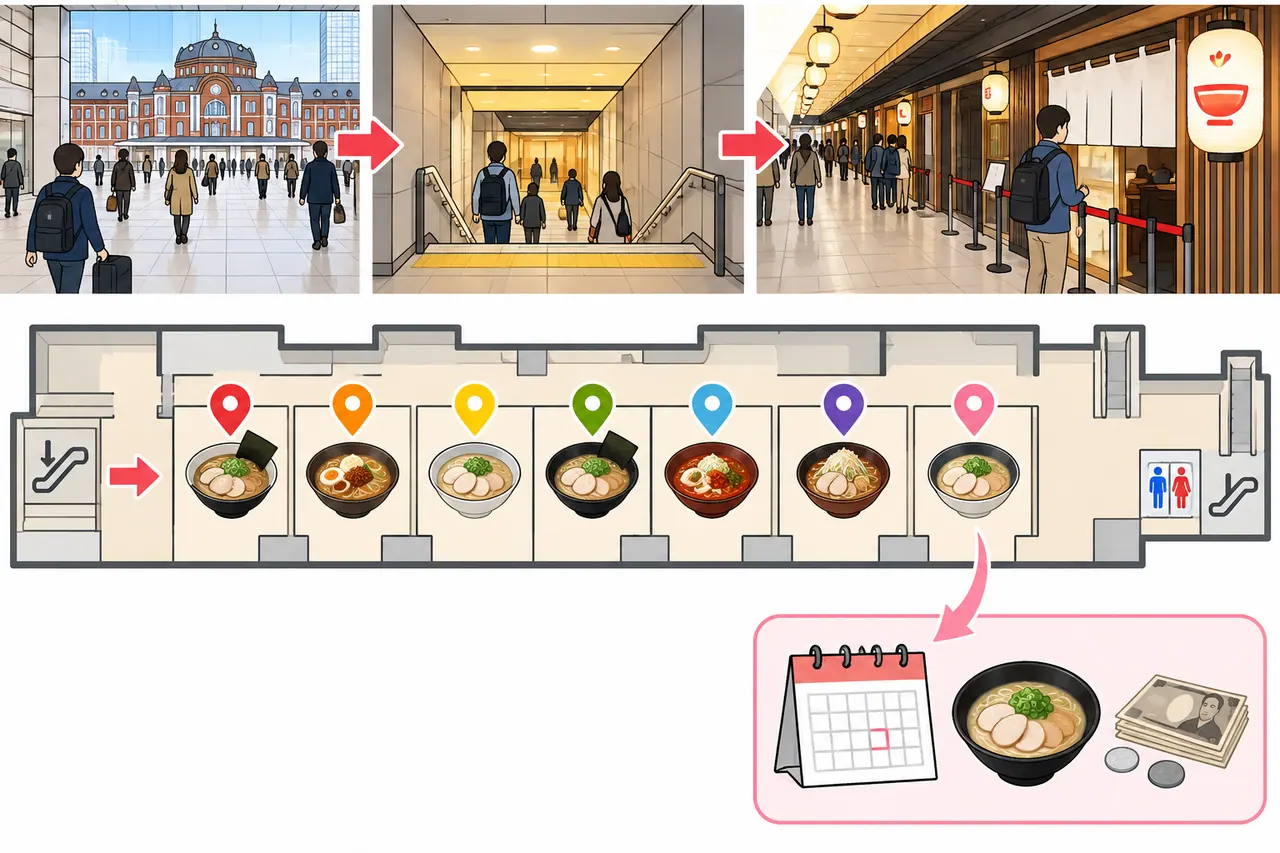
Tokyo Ramen Street is on basement level one of Tokyo Station First Avenue, near Tokyo Station’s Yaesu South Exit. The official Ramen Street page includes an area map, which can help when navigating the station complex. The prices below appeared in a February 17, 2026 release; current prices and continued availability of the specific dishes were not confirmed on November 3, 2026.
| Shop | Dish in February 2026 release | Published price | Shop-page hours displayed |
|---|---|---|---|
| Rokurinsha | Dipping noodles with seasoned egg | ¥1,100 | 7:30–9:45 a.m.; 10:00 a.m.–11:00 p.m. |
| Soranoiro NIPPON | Special chicken-broth ramen | ¥1,500 | 9:00 a.m.–11:00 p.m. |
| Hirugao | Salt ramen with extra toppings | ¥1,350 | 10:00 a.m.–11:00 p.m. |
| Oreshiki Jun | Ramen | ¥1,000 | 8:00 a.m.–11:00 p.m. |
| Tokyo Station Ikaruga | Rich Tokyo Station ramen | ¥1,250 | 10:00 a.m.–11:00 p.m. |
| Kakushinya TOKYO | Kakushinya Special | ¥1,450 | 8:00 a.m.–11:00 p.m. |
| Tokyo Niboshi Ramen Gyoku | Special rich noodle soup | ¥1,330 | 8:30 a.m.–11:00 p.m. |
Most of the listed shops show last orders at 10:30 p.m.; Rokurinsha lists last orders at 9:30 a.m. and 10:30 p.m. The details checked for Kakushinya did not give a last-order time, and shop hours can change. The February 2026 price release and the individual Rokurinsha, Soranoiro, Hirugao, Oreshiki Jun, Ikaruga, Kakushinya and Gyoku pages are useful for rechecking shop information.
The checked pages for Rokurinsha, Soranoiro NIPPON, Hirugao, Oreshiki Jun, Tokyo Station Ikaruga and Gyoku list cash and transport IC cards as payment methods. Do not assume the same payment options at Kakushinya or every other shop without checking. To choose a restaurant elsewhere, search the area and food type, open the current menu, and check the booking page for hours and terms on your date.
Shopping routes and evening stops
| Route day | Shopping and evening places |
|---|---|
| Day one | Nakamise, the street leading to Sensoji Temple; Kappabashi; Ameyoko |
| Day two | Takeshita Street in Harajuku, Cat Street and Shibuya PARCO |
| Day three | Shimokitazawa secondhand-clothing shops and cafés; Omoide Yokocho and Golden Gai |
Kappabashi fits the Asakusa route, while Cat Street is on the Harajuku–Shibuya route. Choose souvenirs that fit your luggage, and check the rules at your destination before taking food home. For evening food or drinks, check each business’s current hours and menu, and ask about a seat charge before ordering.
Seasons and one-, three- and five-day plans
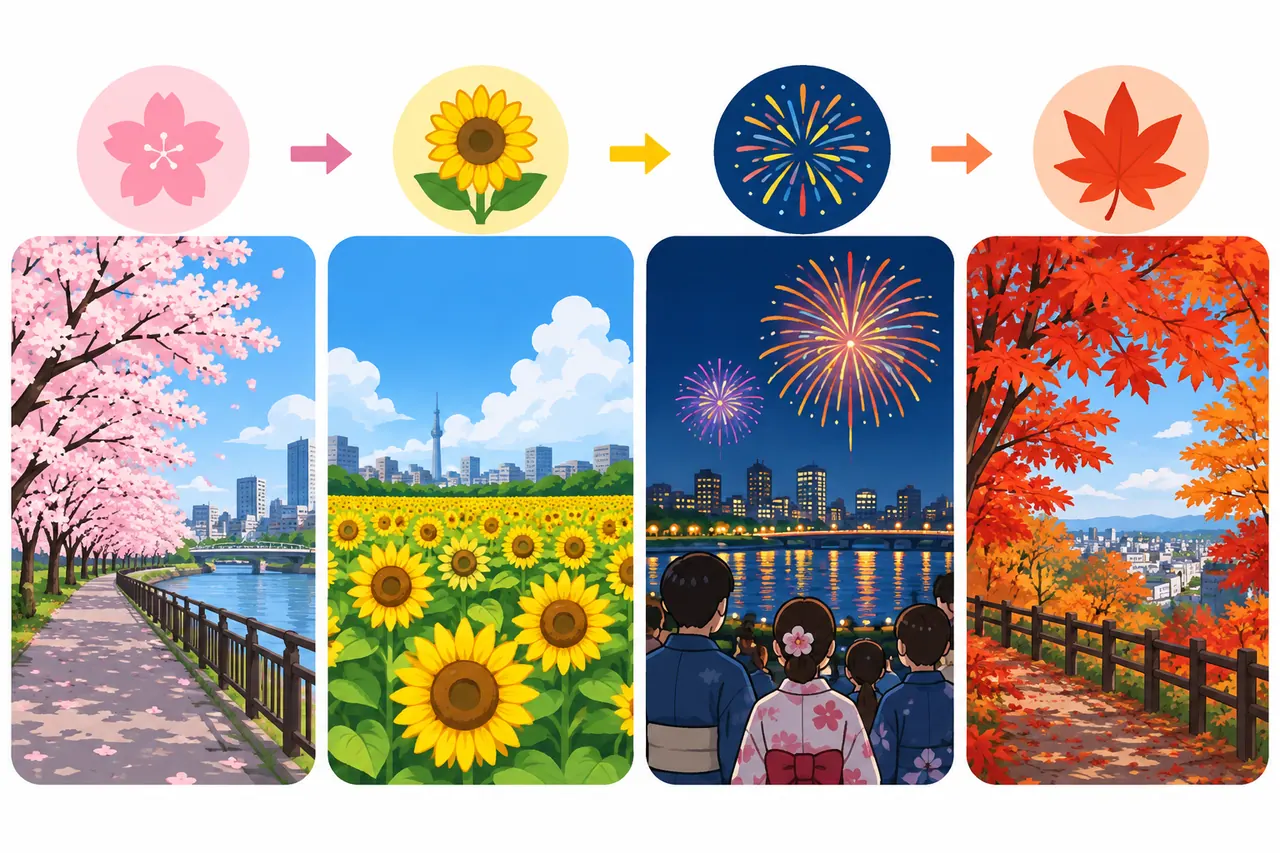
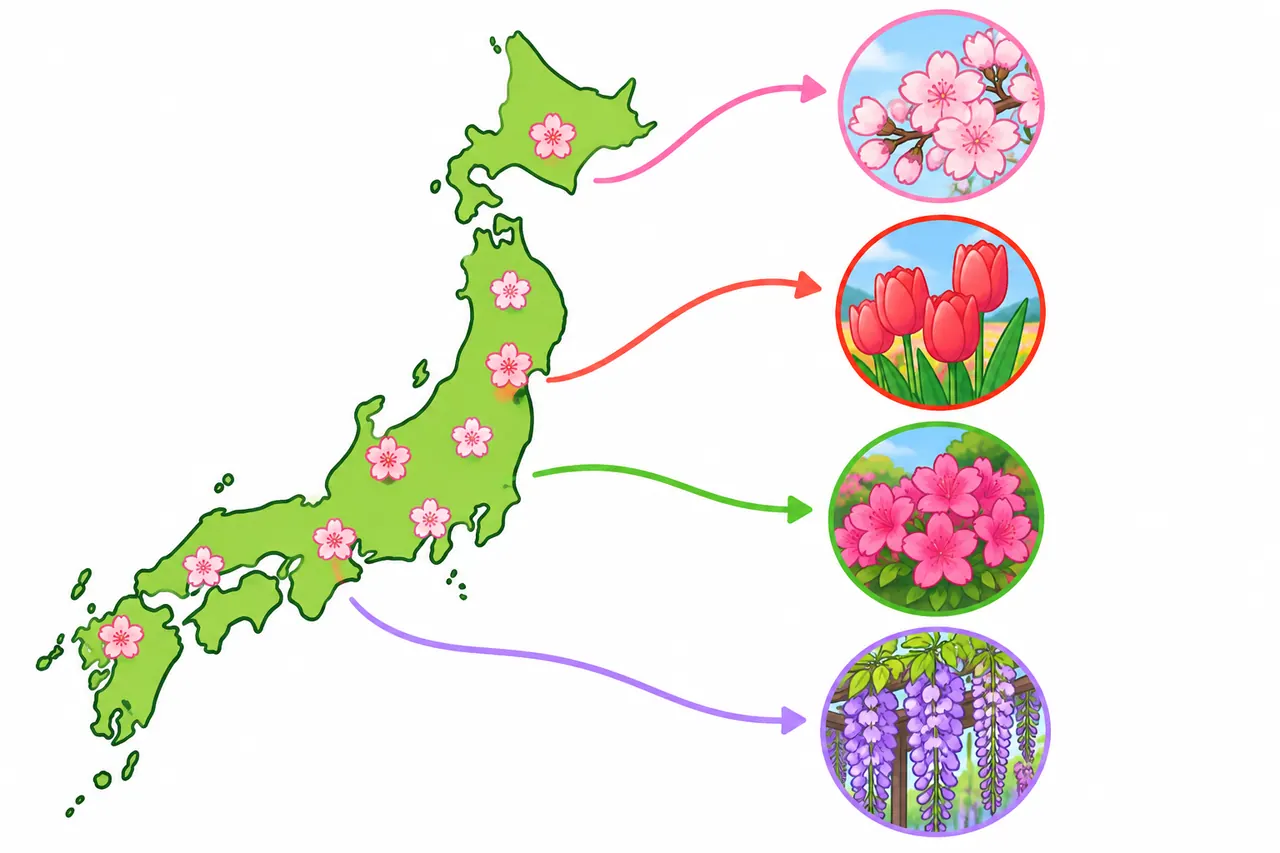
The best season depends on what you want to see, and flowers and leaves do not follow an exact annual timetable. Keep a seasonal stop flexible and group other sights by area, so a change in bloom timing does not undo the whole itinerary. GO TOKYO’s spring, autumn leaves and best-times-to-visit pages provide seasonal guidance.
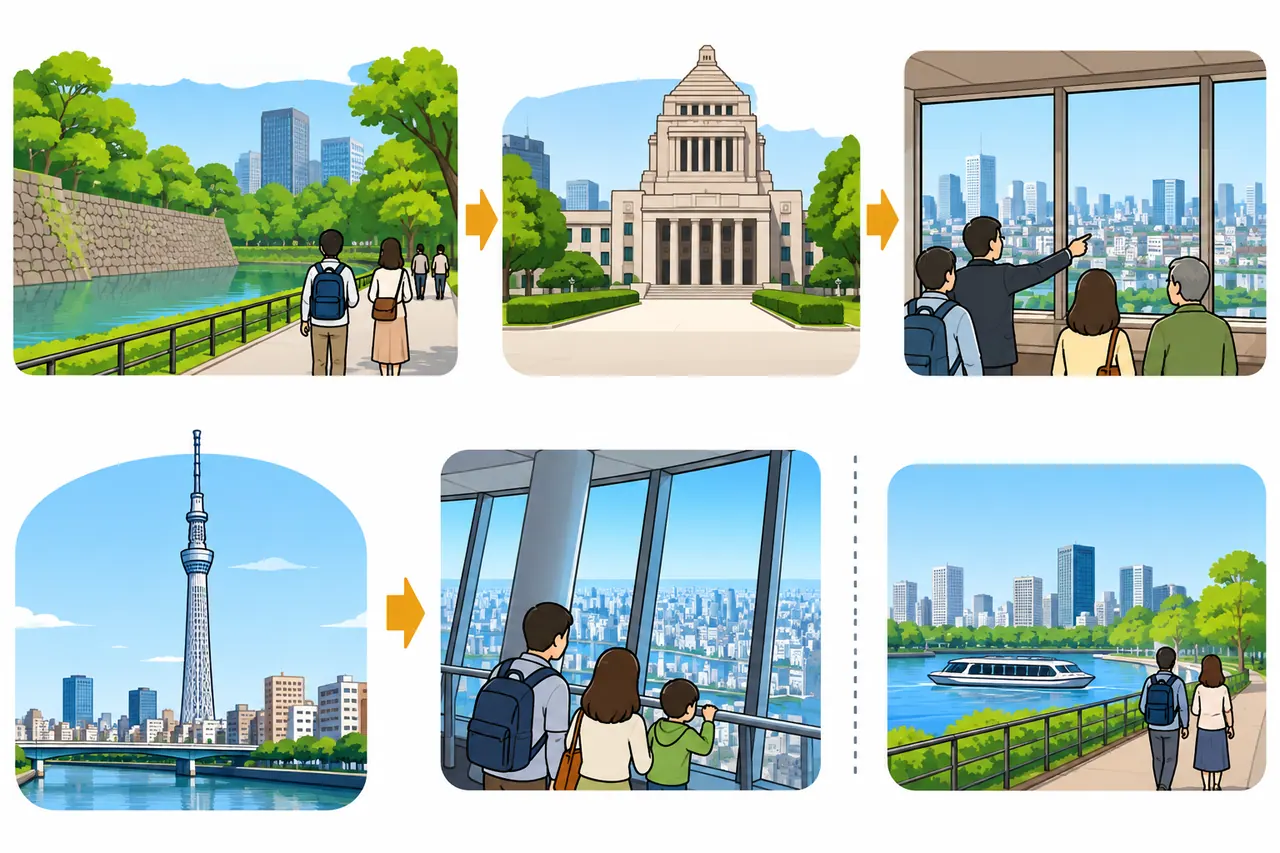
Seasonal timing at a glance
| Period | GO TOKYO’s guidance | Planning choice |
|---|---|---|
| Late March–early April | Usual cherry blossom window | Keep a blossom stop flexible. |
| Late March–April | Tulips at Showa Kinen Park | Check current flower updates. |
| Mid–late April | Azaleas at Nezu Shrine | Add a spring flower stop if it fits the route. |
| Mid-April–early May | Wisteria at Kameido Tenjin | Look for current updates. |
| Late April–early May | Golden Week; travel and stay costs can rise | Compare bookings early. |
| May | Sanja Matsuri in Asakusa | Check current event dates. |
| June | Rainy season in GO TOKYO’s 2020 weather guide | Prepare for rain and check current forecasts. |
| September–October | Typhoons can pass, according to the 2020 guide | Follow current weather notices. |
| Mid-November–early December | Usual central-Tokyo autumn-leaf window | Allow for yearly changes. |
A matsuri is a Japanese festival, and a typhoon is a strong tropical storm. GO TOKYO describes Sanja Matsuri as a three-day event with about 1.8 million visitors, but does not tie that figure to a particular year. Its spring guide advises arranging accommodation early, and notes that travel and lodging costs can rise substantially around Golden Week.
Spring blossoms and flowers
| Place | Flower | Usual window |
|---|---|---|
| Chidorigafuchi | Cherry blossoms | Late March–early April |
| Yoyogi Park | Cherry blossoms | Late March–early April |
| Inokashira Park | Cherry blossoms | Late March–early April |
| Meguro River and Naka-Meguro | Cherry blossoms | Late March–early April |
| Showa Kinen Park | Tulips | Late March–April |
| Nezu Shrine | Azaleas | Mid–late April |
| Kameido Tenjin | Wisteria | Mid-April–early May |
These are usual windows in GO TOKYO’s spring guide, not a forecast for a particular year. Choose a place that fits the rest of your route, then check recent updates before travelling to see a specific bloom. The shorter cherry blossom period can make flexibility more useful than building every day around one predicted date.
Autumn leaves
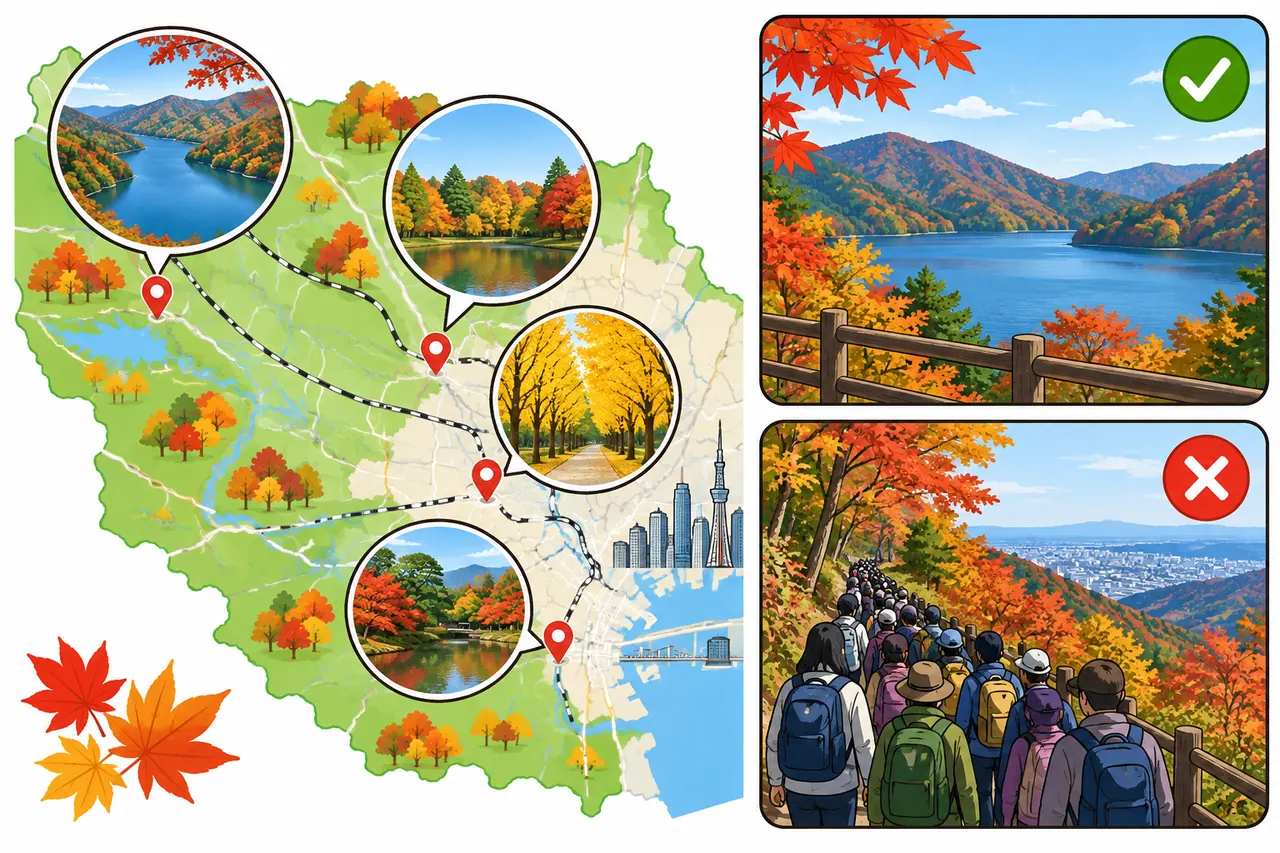
GO TOKYO says central Tokyo’s autumn-leaf timing can shift by one or two weeks from year to year. The usual periods below are planning guidance, not a guarantee for your visit. The autumn guide was updated September 1, 2026.
| Place | Usual best time |
|---|---|
| Meiji Jingu Gaien | Mid-November–early December |
| Shinjuku Gyoen | Mid-November–early December |
| Ueno Park | Mid-November–early December |
| Yoyogi Park | Late November–early December |
| Rikugien | Late November–mid-December |
| Showa Kinen Park | Late November–mid-December |
| Lake Okutama | Late October–mid-November |
“Gaien” means “outer garden,” so use the full name Meiji Jingu Gaien when searching for that spot. GO TOKYO gives two different usual windows for Mount Takao on the same page: late October–mid-November in one place and mid-November–early December in another. Check a current update rather than relying on either range alone.
Summer, winter and events
GO TOKYO’s general weather guide, updated in 2020, gives summer highs in the 30s °C and lows in the mid-20s °C; its rough winter guide gives a high of 10 °C and a low of 2 °C. These are broad seasonal descriptions, not a forecast for your travel week. Check current weather before departure and follow official notices if conditions change.
For fireworks, winter illuminations and other events, use the organizer’s current information. Confirm the date, venue, access and any booking conditions before making a plan around an event. The source guidance also identifies June as the rainy season and September–October as a period when typhoons can pass, but those older seasonal descriptions do not replace a current forecast.
One day: pick an area pair
| Route | Stops to consider | Time-sensitive choice |
|---|---|---|
| Asakusa → Ueno | Sensoji Temple, Nakamise, Kappabashi, Hoppy Street and Ameyoko | Choose the stops that matter most to you. |
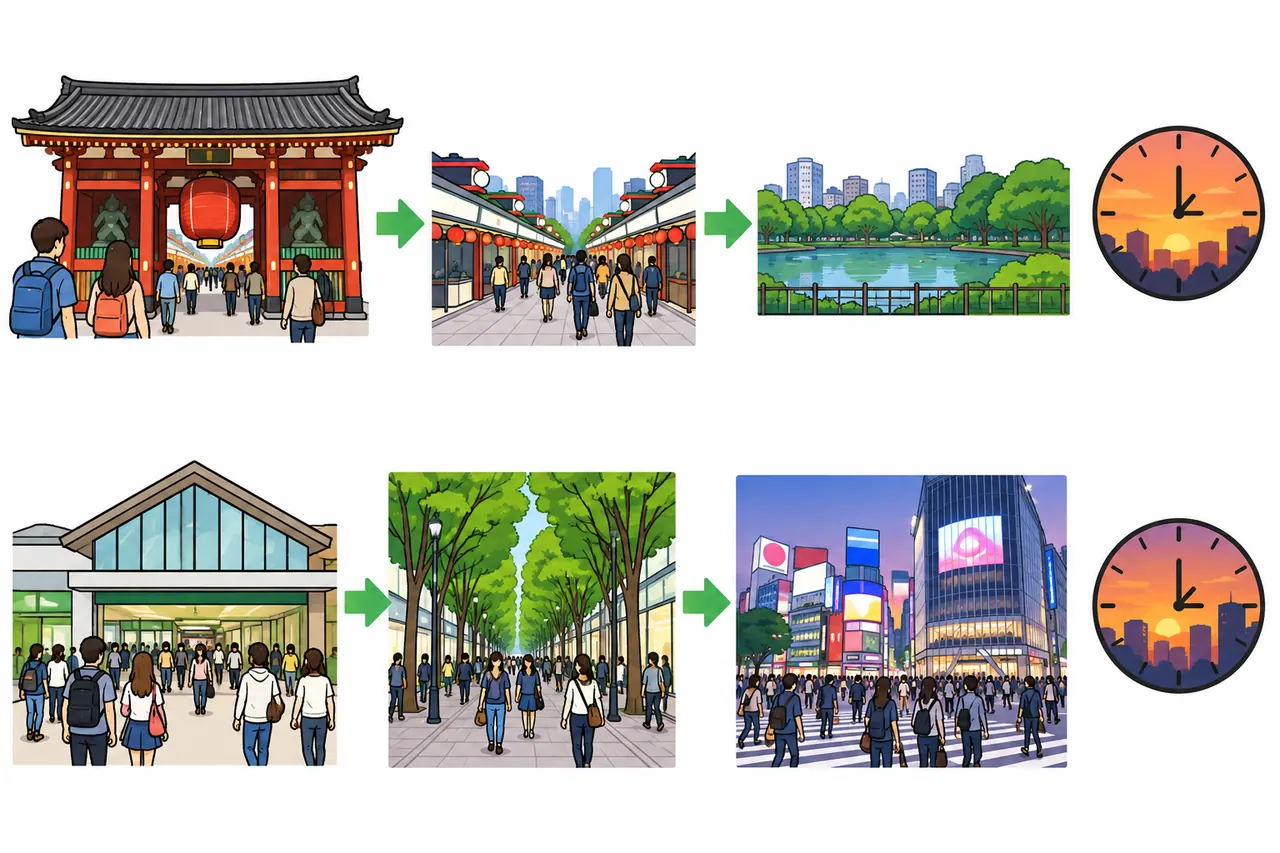
| Harajuku → Shibuya | Meiji Jingu, Takeshita Street and SHIBUYA SKY | Visit the shrine before its gate closes. |
| Harajuku → Shibuya at sunset | Shrine and shopping, then SHIBUYA SKY | Compare sunset, ticket availability and weather. |
Hoppy Street is part of the Asakusa route, and Sensoji Temple and Nakamise are nearby stops on that route. A one-day plan should leave room for travel and meals rather than trying to fit every listed place into one schedule. For a SHIBUYA SKY visit, GO TOKYO suggests allowing about 90 minutes and arriving about 30 minutes before sunset if sunset is your priority.
Three days: GO TOKYO’s route
| Day | Areas | Stops on the official route |
|---|---|---|
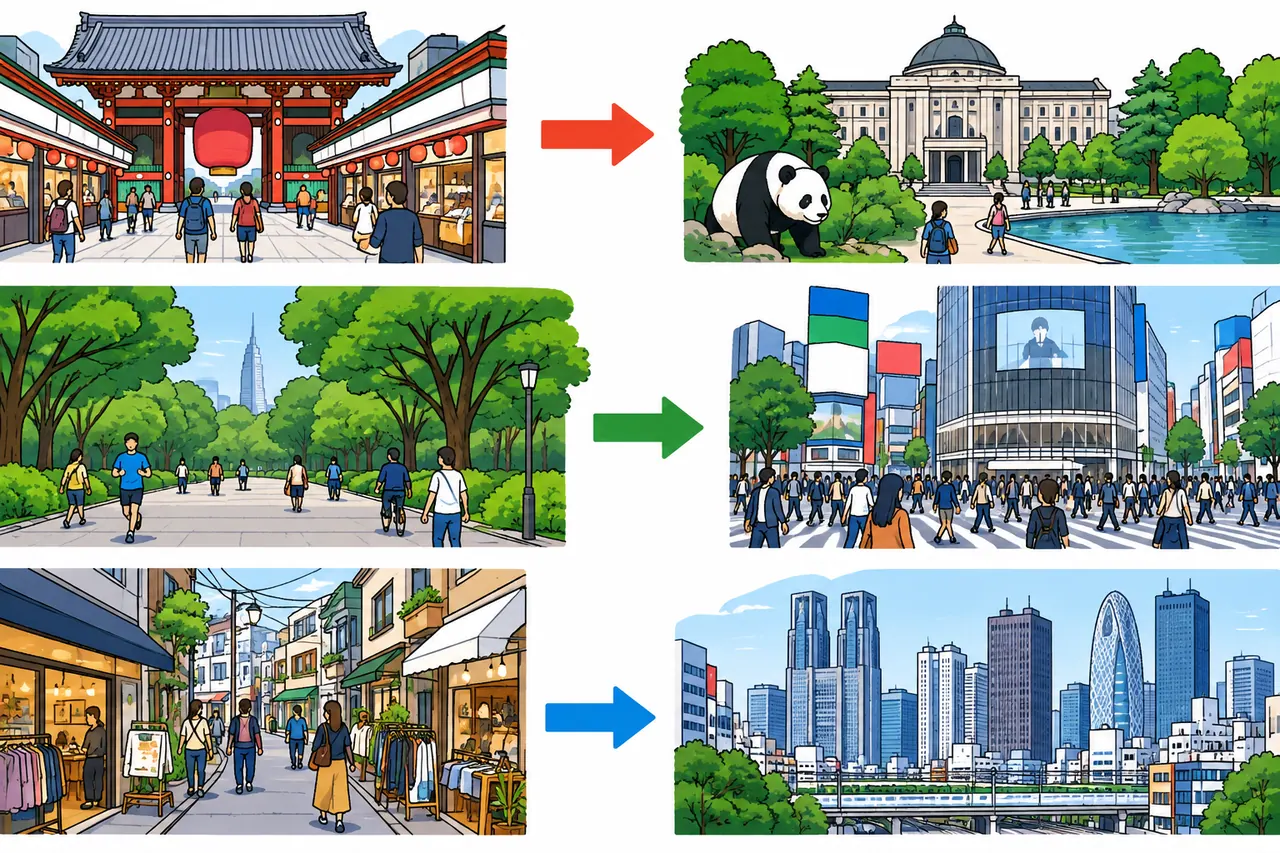
| 1 | Asakusa and Ueno | Sensoji Temple, Nakamise, Hoppy Street, Kappabashi and Ameyoko |
| 2 | Yoyogi, Harajuku and Shibuya | Yoyogi Park, Meiji Jingu, Takeshita Street, Cat Street, Miyashita Park, Shibuya PARCO and SHIBUYA SKY |
| 3 | Shimokitazawa and Shinjuku | Shimokitazawa, Shinjuku Gyoen, Ninja Trick House, Omoide Yokocho and Golden Gai |
The first day pairs Asakusa with Ueno, the second moves through Yoyogi, Harajuku and Shibuya, and the third combines Shimokitazawa with Shinjuku. In Shimokitazawa, the official route includes secondhand-clothing shops and cafés. Treat this as a framework: check attraction hours and ticket availability, then rearrange stops if a closure or booking makes that easier.
Add a fourth and fifth day
| Day | Possible plan | Main condition |
|---|---|---|
| 4 | Imperial Palace East Gardens, then a free government viewing room | The gardens and viewing rooms have different closure days. |
| 5 | Tokyo Skytree or a seasonal outing | Choose a paid view, flowers or autumn leaves to suit your dates. |
Switch days when a closure or ticket time makes that practical. Allow time for the East Gardens’ bag inspection and last-entry rule, and check the government viewing rooms’ separate south and north schedules. Day five can also be a return to a place you enjoyed; there is no need to fill every hour with a new stop.
Seasonal outings beyond central Tokyo
| Destination | Reason to consider it | Check before going |
|---|---|---|
| Mount Takao | Autumn leaves | GO TOKYO gives two different usual windows. |
| Lake Okutama | Autumn leaves, usually late October–mid-November | Check current leaf updates and both journeys. |
| Showa Kinen Park | Spring tulips or autumn leaves | Check access and seasonal information. |
Mark the exact destination in a map app, then check both the outward and return journeys. Confirm the transport operator’s timetable for your date and the destination’s current visitor information for hours and conditions. These are Tokyo-area outing options; this guide does not provide facts for travel to places outside Tokyo such as Hakone.
Budget, payments, entry and safety
A useful budget begins with known costs and leaves unknown expenses clearly marked for research. The figures below cover selected transport and sightseeing examples, not a complete trip. Flights, hotels, meals, airport transfers and any journeys outside ticket coverage need separate calculations.
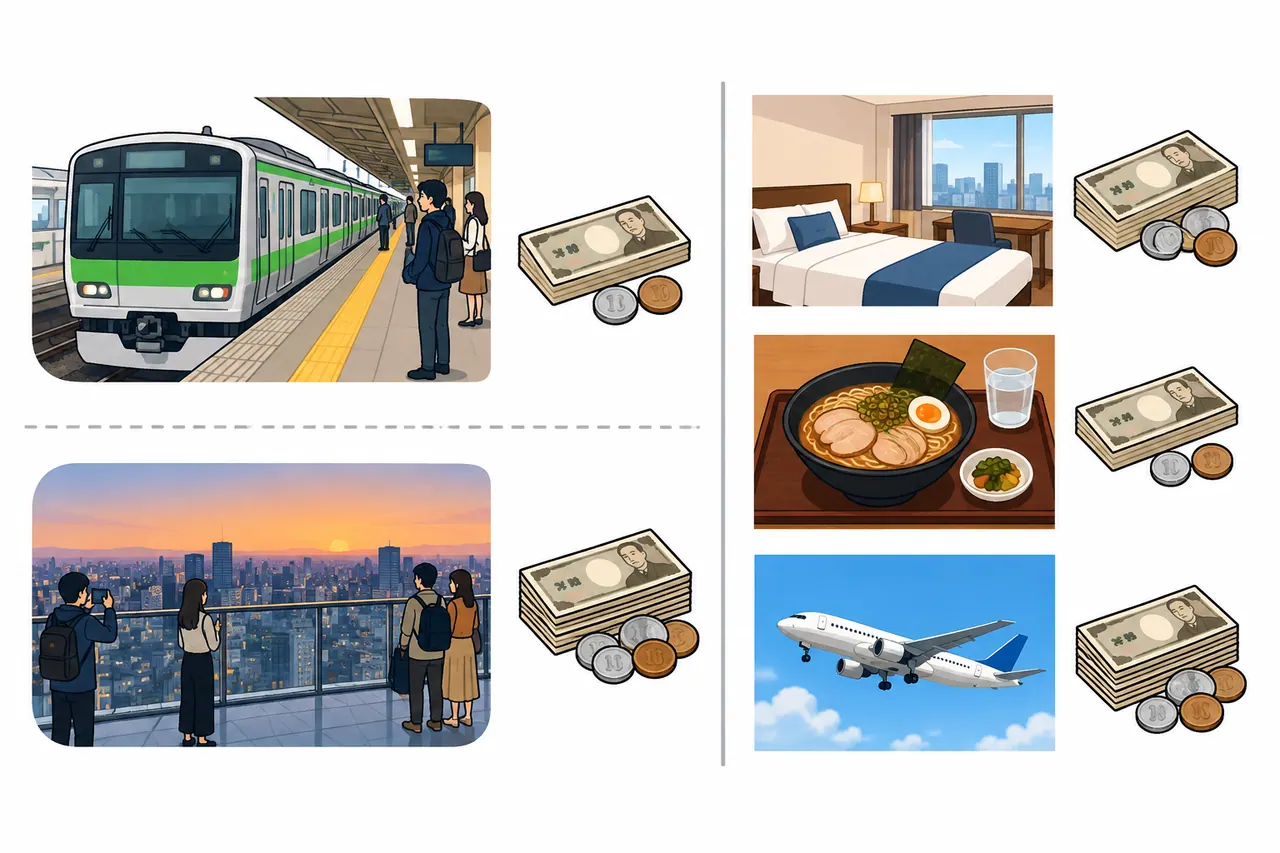
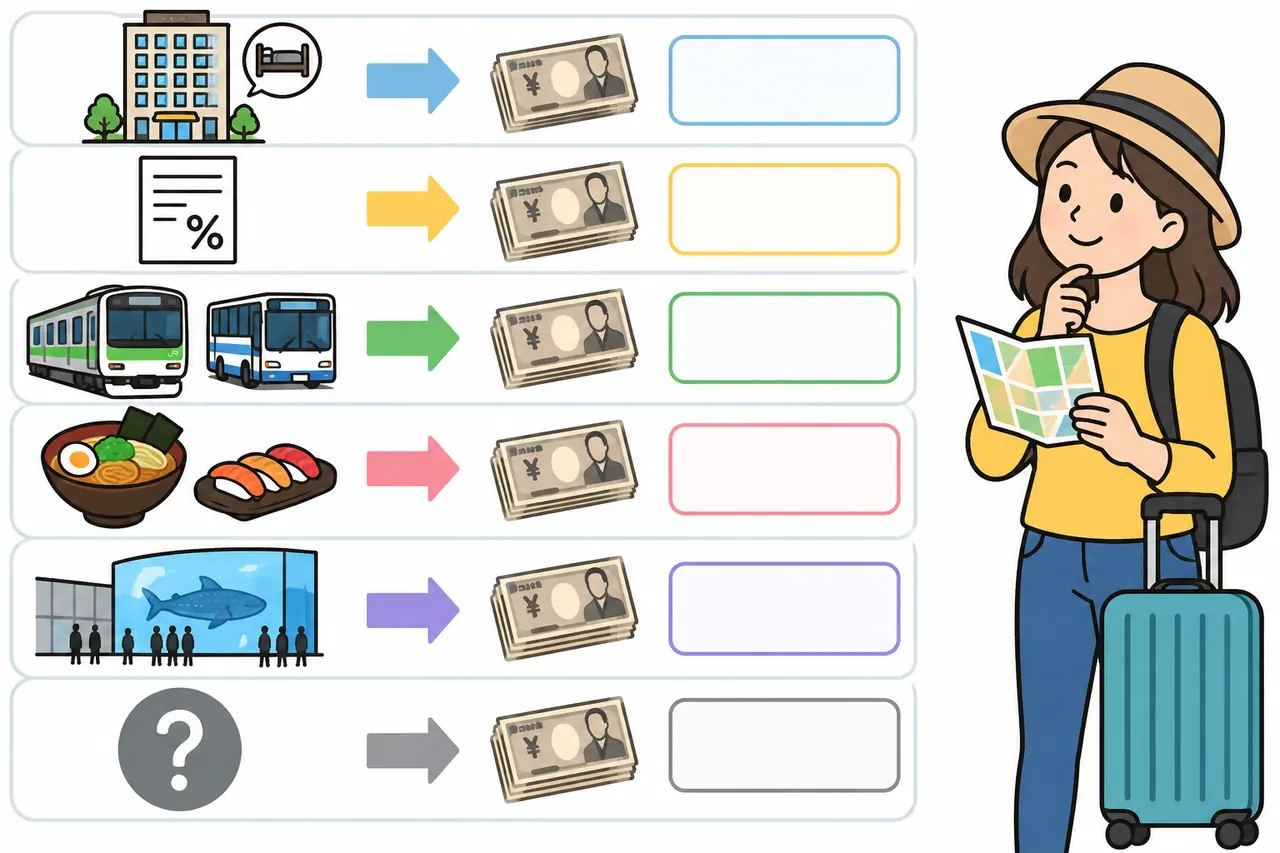
Is Tokyo expensive? Build a partial budget
Free sights include Meiji Jingu, the Imperial Palace East Gardens and the Tokyo Metropolitan Government viewing rooms. Toei’s ticket guide listed the 24-hour adult Tokyo Subway Ticket at ¥1,000 on November 3, 2026, and a 72-hour adult ticket at ¥2,000. The February 2026 Tokyo Ramen Street release listed sample bowls at ¥1,000–¥1,500, but those prices and dishes were not confirmed as current on November 3, 2026.
| Example | Subtotal |
|---|---|
| Listed 72-hour adult Tokyo Subway Ticket plus the free sights above | ¥2,000 |
| Listed 72-hour adult ticket, free sights and SHIBUYA SKY online entry from 3:00 p.m. | ¥5,400 |
The second example adds the listed ¥2,000 ticket to the ¥3,400 adult SHIBUYA SKY online price for entry from 3:00 p.m. It is a sightseeing subtotal, not a full trip budget, and the SKY amount depends on entry time and purchase conditions. Add confirmed hotel, tax, meal and transport costs separately rather than treating unknown costs as zero.
To build your own estimate, record the hotel total and any tax, note the fares for your planned journeys, and check the chosen attraction ticket prices. Add fees displayed at checkout, then keep separate lines for meals, flights and other spending that you have not yet confirmed. Recheck totals after changing dates or ticket choices.
Cash, cards and ATM use
Japan uses the yen, shown as ¥. Ask your bank about overseas card use and fees before travelling, and keep a way to access cash if you need it. Seven Bank’s international-card ATM instructions describe inserting the card, choosing the screen language, selecting a transaction and amount, checking the displayed conditions, and collecting the cash, card and receipt.
Some eligible cards allow a choice between yen and home-currency billing at the ATM. If you choose yen, the home-currency amount is determined when the card issuer bills the transaction; fees may apply depending on the transaction and card. Check whether your card is eligible and confirm the conditions with both the ATM provider and your card issuer.
Phone, internet, electricity and entry preparation
An eSIM is a digital phone plan rather than a physical SIM card. Check your phone settings and ask the provider whether its plan works with your device before buying. This guide does not confirm plug type or voltage, so check current official travel information and your device maker’s instructions rather than choosing an adapter from guesswork.
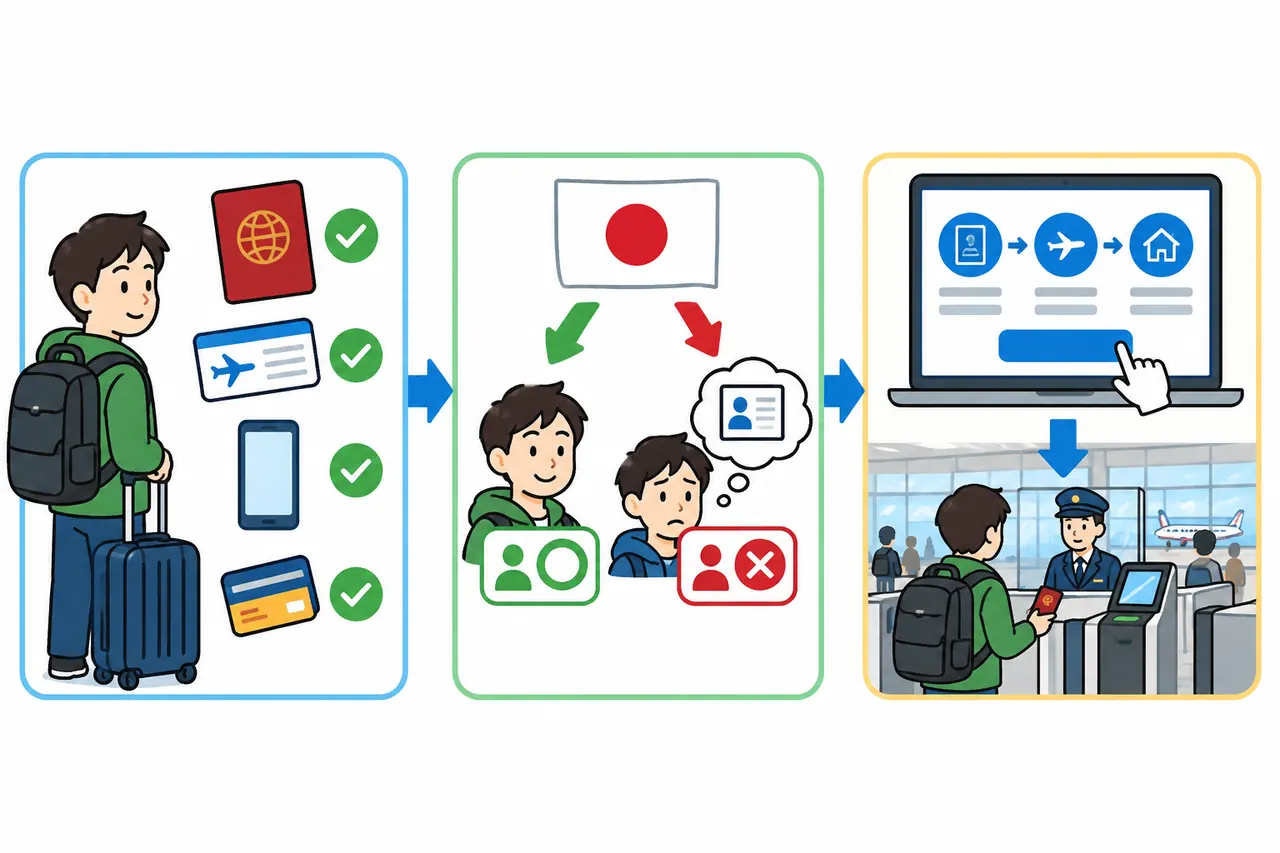
Visit Japan Web has a function for registering foreign visitors’ immigration and customs declaration information and displaying a QR code for procedures. Check the current Visit Japan Web information and official instructions for your trip; its linked manual was not accessible during fact checking. Entry and visa requirements depend on your passport and trip, so consult current official guidance rather than applying a general rule to every traveller.
Save your hotel address and arrival route before departure. Keeping a copy in your phone’s notes can help when you need to show someone where you are going, even if you cannot immediately open your booking email. GO TOKYO also provides visitor information on transport, accommodation, tourist information centres, safety and manners.
Guided walks and kabuki
Tokyo’s volunteer walking guides support seven languages, including English, but the language and tour may not be available on every requested date. Booking is available from one month to three days before the tour; meeting points differ by course. Groups have a maximum of five visitors and must include at least one person aged 20 or over.
The guiding itself is free, but participants pay their own and two guides’ transport and admission costs in yen. The total depends on the number of people and the course, so check the details before confirming. See GO TOKYO’s guide-service information for booking and course details.
Kabuki is traditional Japanese theatre. GO TOKYO describes full performances and, at times, single-act viewing, as well as English subtitle guidance and ticket information for online, telephone or theatre-counter purchases. Check the specific performance because a single-act ticket is not always available; photography and electronic-device use during the performance are prohibited. See the kabuki guide for current planning information.
Safety and emergency help
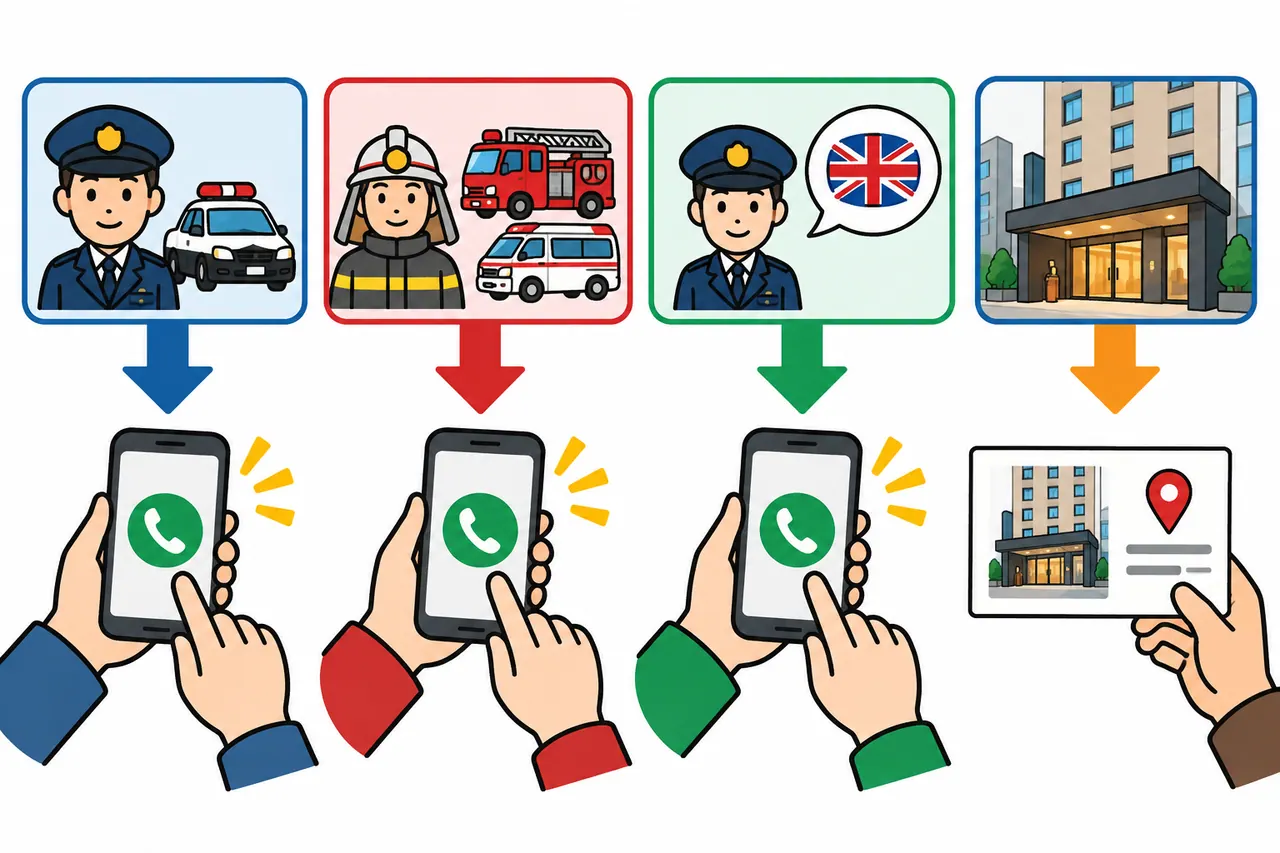
For emergencies, call 110 for police or 119 for fire or ambulance. GO TOKYO also lists 03-3501-0110 for police assistance by telephone in English; the Metropolitan Police Department identifies this as its general consultation centre number, not the emergency number for an incident in progress. Use 110 for an urgent crime or accident, and consult GO TOKYO’s health and safety page and the Metropolitan Police Department’s information for further guidance.
This guide does not assess Tokyo’s safety using crime statistics, so it cannot support a broader safety comparison. Save emergency contacts, your hotel address and relevant booking information before travelling. Follow current official instructions during an emergency or weather disruption, and use GO TOKYO’s linked disaster and multilingual information when needed.
Language and asking for directions
GO TOKYO and Tokyo Metro provide English information online, but that does not guarantee that every service or business will offer English assistance. If language support matters for a meal, tour or booking, ask the provider before committing. Save the hotel address and mark destinations on your map before setting out.
If you need to ask for help, show the address or map screen on your phone. Check GO TOKYO’s tourist information pages for places to ask questions, and keep the hotel details accessible in case your connection is unavailable. For guided walks, confirm the requested language and date directly through the guide-service booking information.
Tokyo FAQ for first-time travellers
These answers summarize practical choices covered above, but prices, opening schedules and seasonal conditions can change. Check the linked official page for the attraction or transport product you plan to use. Keep your own dates and route in mind when comparing general guidance.
How many days should I spend in Tokyo?
GO TOKYO’s sample route takes three days, covering Asakusa and Ueno, Yoyogi-Harajuku-Shibuya, then Shimokitazawa and Shinjuku. With one day, choose one area pair rather than trying to cross the city repeatedly. With five days, consider adding the East Gardens, a view and a seasonal outing, while allowing for closures and travel time.
Should I get Suica or PASMO?
GO TOKYO recommends either rechargeable card for its three-day route. Its guidance lists Suica at JR station ticket machines and PASMO at stations of railway companies that handle PASMO, with a ¥500 deposit for regular cards. Check current card availability and conditions with the provider before relying on a particular purchase location.
Is the Tokyo Subway Ticket worth buying?
It is worthwhile only if the fares for covered Tokyo Metro and Toei Subway rides exceed the ticket price. The adult 72-hour price listed by Toei on November 3, 2026, is ¥2,000, and JR journeys are not covered. Add the fares for your expected covered rides, then compare that total with the current ticket price and keep airport or other rail journeys separate.
Which free sights can I visit?
Meiji Jingu, the Imperial Palace East Gardens and the Tokyo Metropolitan Government viewing rooms are free. Their opening hours and closures differ, and the East Gardens have a last-entry cutoff and bag inspection. Check each official page for the date you plan to go rather than assuming that a free attraction is open all day.
When is cherry blossom or autumn-leaf season?
GO TOKYO gives late March to early April as the usual cherry blossom window. For central Tokyo autumn leaves, it gives mid-November to early December, with timing that can shift by one or two weeks between years. Check recent seasonal updates before fixing your route, and note the guide’s conflicting usual windows for Mount Takao.
Can I visit SHIBUYA SKY at sunset?
GO TOKYO suggests allowing about 90 minutes and arriving around 30 minutes before sunset. Compare ticket availability and the weather for your date, because an online sellout can also mean no adult counter ticket and bad weather can close the outdoor area. Check current notices, entry conditions and the prohibited-items guidance before travelling to the venue.