Things to do in Oita: Beppu baths and beyond
Contents
- 1. 1. Choose an Oita region and a reason to go
- 2. 2. Understand what the Beppu hell ticket covers
- 3. 3. Plan the two hell clusters and the transfers between them
- 4. 4. Take an ordinary bath or sand bath at Takegawara
- 5. 5. Build a realistic spending and action plan
- 6. 6. Common questions about things to do in Oita
A useful way to plan an Oita trip is to decide first whether you want to see Beppu’s geothermal sights, take a bath, or explore a different part of the prefecture. These are related experiences, but they do not use the same tickets: Beppu’s seven-hell common ticket covers sightseeing admission, while bathing at Takegawara Onsen is a separate purchase.
Beppu and Yufuin are among Oita’s best-known hot-spring destinations. The prefecture also offers a different kind of visit in the Kunisaki Peninsula, known for historical religious sites, and in Yabakei, which JNTO introduces for its natural scenery. Treat these as distinct destinations to plan around, rather than assuming they all fit into one Beppu outing. JNTO’s Oita guide is a useful starting point for comparing the regions.
This guide concentrates on practical choices for a Beppu visit: what the hell ticket includes, how to account for the two sightseeing areas, and how to add an ordinary bath or sand bath at Takegawara. Prices and operating details below were checked against the official sources on 4 November 2026. Always check the relevant official page again for your travel date, because the cited sources do not provide a complete account of every facility’s seasonal schedule or same-day changes.
1. Choose an Oita region and a reason to go
For a first visit focused on hot springs, Beppu is a straightforward choice for combining geothermal sightseeing with a separately planned bath. The seven hells are sightseeing attractions, not a single bathing experience, so decide whether you want to spend time on the viewing circuit, bathing, or both. If you are more interested in another part of Oita, JNTO’s descriptions of Yufuin, Kunisaki and Yabakei can help you choose a destination before you work out local transport and facility details.
| Main interest | Starting point to consider | What to plan separately |
|---|---|---|
| Geothermal sights | Beppu’s seven hells | Travel between the two hell clusters |
| Ordinary bathing or sand bathing | Takegawara Onsen in Beppu | The correct bath admission and on-site reception |
| Another hot-spring destination | Yufuin | Local transport, accommodation and the specific bath you want to visit |
| Religious history | Kunisaki Peninsula | The individual sites and the route between them |
| Natural scenery | Yabakei | Access for your travel date and the area you want to visit |
This is a way to narrow your research, not a claim that every destination has the same transport options or that one route suits all travel dates. JNTO identifies Beppu and Yufuin as major hot-spring destinations, introduces religious heritage on the Kunisaki Peninsula, and names Yabakei as a natural attraction; use its Oita destination overview to see how these choices differ. Check each destination’s own current visitor information before adding it to a Beppu-based plan.
If you arrive by rail from elsewhere in Japan, JNTO describes a route pattern that changes at Kokura to the Sonic limited express. That is useful for understanding the connection, but it is not a single fare or timetable for every starting point. Check your actual departure station and travel date before comparing rail with another option; do not assume that the connection description alone provides a complete door-to-door plan. For a journey beginning in Fukuoka, see the related Fukuoka to Beppu access guide as well as the current transport information for your date.
Once you are in Beppu, keep the city’s local transfers visible in your plan. A journey to a hell-tour stop, a transfer between the two hell areas, and a visit to Takegawara are separate parts of the day, even if you include them in one outing. The Beppu bus guide can help with local transport planning, while the official hell-tour access page gives the operator’s information about buses and the sightseeing bus.
2. Understand what the Beppu hell ticket covers
The Beppu Jigoku Meguri common ticket covers one admission to each of the seven hells. The operator lists the adult price as ¥2,400 for high-school age and above, and the elementary- and junior-high-school price as ¥1,200. The rate table says these prices apply from 1 February 2025; see the operator’s official ticket and fee page, checked on 4 November 2026.
| Ticket or activity | Price | What it covers | Important condition |
|---|---|---|---|
| Seven-hell common ticket, adult | ¥2,400 | One admission to each of the seven hells | Adult category is high-school age and above |
| Seven-hell common ticket, school child | ¥1,200 | One admission to each of the seven hells | Applies to elementary- and junior-high-school students |
| Takegawara ordinary bath, junior-high age and above | ¥300 | Ordinary bathing | Separate from the hell-tour ticket |
| Takegawara ordinary bath, child | ¥100 | Ordinary bathing | Children below elementary-school age are free |
| Takegawara sand bath | ¥1,500 | Sand-bathing admission | Separate from the hell-tour ticket; users must be at least six |
The common ticket can be purchased at any of the hells, and it is valid on the purchase day and the following day. Each included hell allows one admission, so the two-day validity gives you the option of spreading the circuit across those days; it does not allow repeat entry to the same hell. The operator lists common opening hours of 8:00–17:00 and says the hells are open year-round. Check the official ticket page before leaving for any notice affecting your visit. School-group rates require a reservation, so do not treat those rates as an ordinary walk-up option.
A simple party calculation can help you distinguish ticket prices from the full cost of a day. Two adults and one elementary-school child would pay ¥6,000 for the common tickets: two adult tickets at ¥2,400 each, plus one child ticket at ¥1,200. If all three also choose Takegawara’s ordinary bath, the bath admission adds ¥700—two admissions at ¥300 and one at ¥100—for a total of ¥6,700 in these admissions. This subtotal does not include transport, meals, accommodation or other purchases.
For one adult, the seven-hell ticket and Takegawara’s ordinary bath add up to ¥2,700 in admissions. Replacing the ordinary bath with the sand bath gives a combined admission subtotal of ¥3,900. The sand bath is not an upgrade included in the common ticket: it costs ¥1,500 separately and is available from age six. The age categories also differ between products, so check the ticket or facility information for each member of your party rather than applying one child category to the whole day.
3. Plan the two hell clusters and the transfers between them
The seven hells are split across two areas, not arranged behind one compact entrance. Five are in Kannawa and are within walking distance of one another, while the Chinoike and Tatsumaki area is about three kilometres from the Kannawa group. The operator’s official access page describes buses and cars for travel between the areas.
A practical first step is to mark the Kannawa group and the Chinoike and Tatsumaki area separately on a map. Then decide how you will make the transfer between them and keep the relevant bus or driving details visible as you plan the day. A map search for Beppu Jigoku Meguri can help you see the separation, but it is not a substitute for checking the operator’s access information or the transport details for your travel date.
The operator lists local buses from Beppu Station’s west exit towards Umi Jigoku-mae and other hell-tour stops. It also lists a regular sightseeing bus for the hells and states that online or telephone reservation is required for that bus. These are different choices: the page’s local-bus information is not a booking for the sightseeing bus, and the sightseeing-bus reservation requirement should not be assumed to apply to every independent local-bus journey. Check the operator’s transport information and choose the option that matches your plan.
If you drive, the operator gives approximately five minutes from Beppu Interchange to the Umi Jigoku area and lists free parking at the individual hells. Those parking details apply to the hells, not to every attraction in Beppu. In particular, Takegawara has a different parking situation, described in the next section, so check the destination-specific information before driving between sightseeing and bathing.
Because the ticket price covers admissions rather than movement between areas, include the transfer in both your route and spending plan. The three-kilometre separation is a useful reminder not to treat all seven sights as one immediate walk. If you are relying on public transport, make the connection between the two groups part of your plan before you begin, rather than waiting until you have finished the first cluster to decide how to continue.
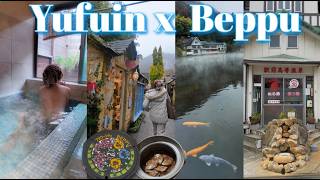
For descriptions of the included sights, see the related Beppu hells guide. Photos and travel posts associated with this guide show the range of the circuit, including coloured ponds, steaming landscapes, crocodiles and a geyser. They offer a visual preview, but the official operator information remains the source for ticket scope, hours and access arrangements.
4. Take an ordinary bath or sand bath at Takegawara
Takegawara Onsen offers both an ordinary bath and a sand bath. Its address is 16-23 Motomachi, Beppu City (別府市元町16-23); save its location separately from the hell-tour area when planning your transfers. You can open a map search for Takegawara Onsen, 16-23 Motomachi, then check the city’s official Takegawara facility page for the bathing and reception conditions.
The ordinary bath is open 6:30–22:30. The sand bath is listed as open 8:00–22:30, with a standard final reception time of 21:30; reception may finish earlier when it is busy. Sand bathing is available from age six, and the facility does not accept telephone or online reservations. Visitors need to go to reception in person, so arriving before the standard final reception time does not guarantee admission if reception has already closed for the day.
Takegawara’s closure rule is separate from the hells’ year-round opening statement. The bath closes on the third Wednesday of the month, or on the following day when that Wednesday is a public holiday. Check the city page for the closure rule when choosing your date; do not carry the hells’ operating schedule over to the bath.
The ordinary-bath prices are ¥300 for people of junior-high-school age and above, ¥100 for the child category, and free for children below elementary-school age. The sand bath costs ¥1,500 and has the separate minimum age of six. These prices and age conditions make it worth deciding which experience you want before you arrive, particularly if your party includes children whose ages fall into different categories. The city’s facility information is the relevant source for current operating conditions and admission details.
Beppu City states that the present bath building dates from 1938. Visit Oita’s listing says Takegawara has no parking and gives approximately 15 minutes by car from Beppu Interchange; that listing includes a May 2022 information date, so use it as a dated tourism reference rather than as a replacement for the city’s current facility page. The parking distinction is practical: the hell operator lists free parking at each hell, while the prefectural tourism listing says Takegawara has no parking. See Visit Oita’s Takegawara listing and the city facility page before choosing how to reach the bath.
Travel reels and posts connected with this guide show visitors combining hell sightseeing with other Beppu activities, including steamed food, a foot bath and a first sand-bath visit. These glimpses can help you decide whether a bathing stop interests you, but they do not mean the activities share a ticket or the same reception arrangements. Budget for each admission separately and check the official facility information for the conditions that apply to your visit.
5. Build a realistic spending and action plan
A useful budget starts with the products you know you want and keeps transport and other spending separate. For one adult, the common ticket plus the ordinary bath costs ¥2,700 in admissions; the common ticket plus the sand bath costs ¥3,900. Neither total is an all-inclusive price for a Beppu day, because the figures cover only the stated admissions and do not include transport, food, accommodation or other purchases.
For a family or other mixed-age party, calculate the hell ticket and bath costs independently. The hell ticket uses a high-school-and-above adult category and a school-child category for elementary- and junior-high-school students. Takegawara uses a junior-high-and-above rate for the ordinary bath, a separate child price, and free ordinary bathing for children below elementary-school age; its sand bath is limited to people aged six and above. Do not assume that a child’s category for one product automatically determines the price or eligibility for another.
Before settling on the day, work through these steps:
- Open the hell-tour ticket page and check the correct ticket categories, price, validity and one-entry-per-hell condition.
- Open the hell-tour access page and choose between independent local-bus travel and the reserved sightseeing bus, if either suits your plan.
- Mark both hell clusters and decide how you will travel between them; the Chinoike and Tatsumaki area is about three kilometres from the Kannawa group.
- Open the Takegawara city page and check its closure rule, bathing prices, sand-bath reception conditions and hours.
- Put Takegawara on your map as a separate stop and account for its different parking information if you plan to drive.
- Check the return transport before adding a destination elsewhere in Oita, since the official sources cited here do not provide a complete same-day route and fare for every possible combination.
For a visit centred on geothermal sightseeing, the common ticket is the relevant admission product, and the main additional planning task is the transfer between clusters. For a visit centred on bathing, compare the ordinary bath and sand bath by price, age eligibility and reception method before deciding whether to include the hells as well. If you want both types of experience, keep each ticket and its operating conditions separate in your notes so you do not mistake a sightseeing admission for bathing access.
The online material accompanying this guide includes a traveller’s day-trip account of Jigoku Meguri and a Thai-language post following the hell circuit. Such posts can provide a personal visual impression of the outing, while official pages are the right place to check current prices, opening information, closures and reservations. Use personal accounts as inspiration, not as proof that a particular route, service or reception condition will apply on your date.
6. Common questions about things to do in Oita
The main planning questions are about ticket validity, the separation between the hells, sand-bath reservations and parking. The answers below distinguish what the official pages state from details you still need to check for your own date. For other Oita destinations, use JNTO’s regional guide as an introduction and then verify the specific sites and transport you intend to use.
Can I use the Beppu hell ticket on two days?
Yes. The common ticket is valid on the purchase day and the following day, and it covers one admission to each of the seven included hells. Its two-day validity allows you to divide the sightseeing across those dates, but it does not provide repeat entry to an individual hell. Check the operator’s ticket page for the current ticket information before buying.
Are all seven hells within easy walking distance of one another?
No. The operator describes five hells in Kannawa as being within walking distance of one another, while the Chinoike and Tatsumaki area is about three kilometres away. Plan a bus or car transfer between the two areas instead of assuming the seven sights form one continuous walk. The official access page describes the operator’s transport information, including local buses and the sightseeing bus.
Can I reserve Takegawara’s sand bath online or by telephone?
No. Beppu City says the sand bath does not accept telephone or online reservations; visitors need to go to reception. The standard final reception time is 21:30, but reception may finish earlier when the facility is busy, so arriving before that time is not a guarantee of admission. Check the city’s Takegawara facility page before you go.
Is parking available at the hells and at Takegawara?
The hell-tour operator lists free parking at the individual hells. Visit Oita’s Takegawara listing says that the bath has no parking, so do not assume the hells’ parking arrangement applies there. For the bath, also note that the tourism listing gives approximately 15 minutes by car from Beppu Interchange and carries a May 2022 information date; consult the city’s facility page for the current bathing details.
Which part of Oita should I add if I have interests beyond Beppu?
JNTO introduces Yufuin as another well-known hot-spring destination, the Kunisaki Peninsula for historical religious sites, and Yabakei for natural scenery. These are different kinds of visits, so choose according to your interests and then check the transport and visitor information for the particular places you want to see. The JNTO Oita overview provides the regional starting point, but it does not replace date-specific route planning.