
Things to Do in Fukui: A Guide to Temples, Cliffs and Dinosaurs
Contents
- 1. Compare the main things to do in Fukui
- 2. Choose one area for the day
- 3. Visit Eiheiji for temple architecture
- 4. Explore Tojinbo and the coast
- 5. Discover Ichijodani’s reconstructed town and museum
- 6. Plan a dinosaur museum visit and check ticket conditions
- 7. Consider Echizen Matsushima Aquarium for an indoor visit
- 8. Walk the Araiso and Ninohama coast
- 9. Use creator posts for visual context
- 10. Frequently asked questions
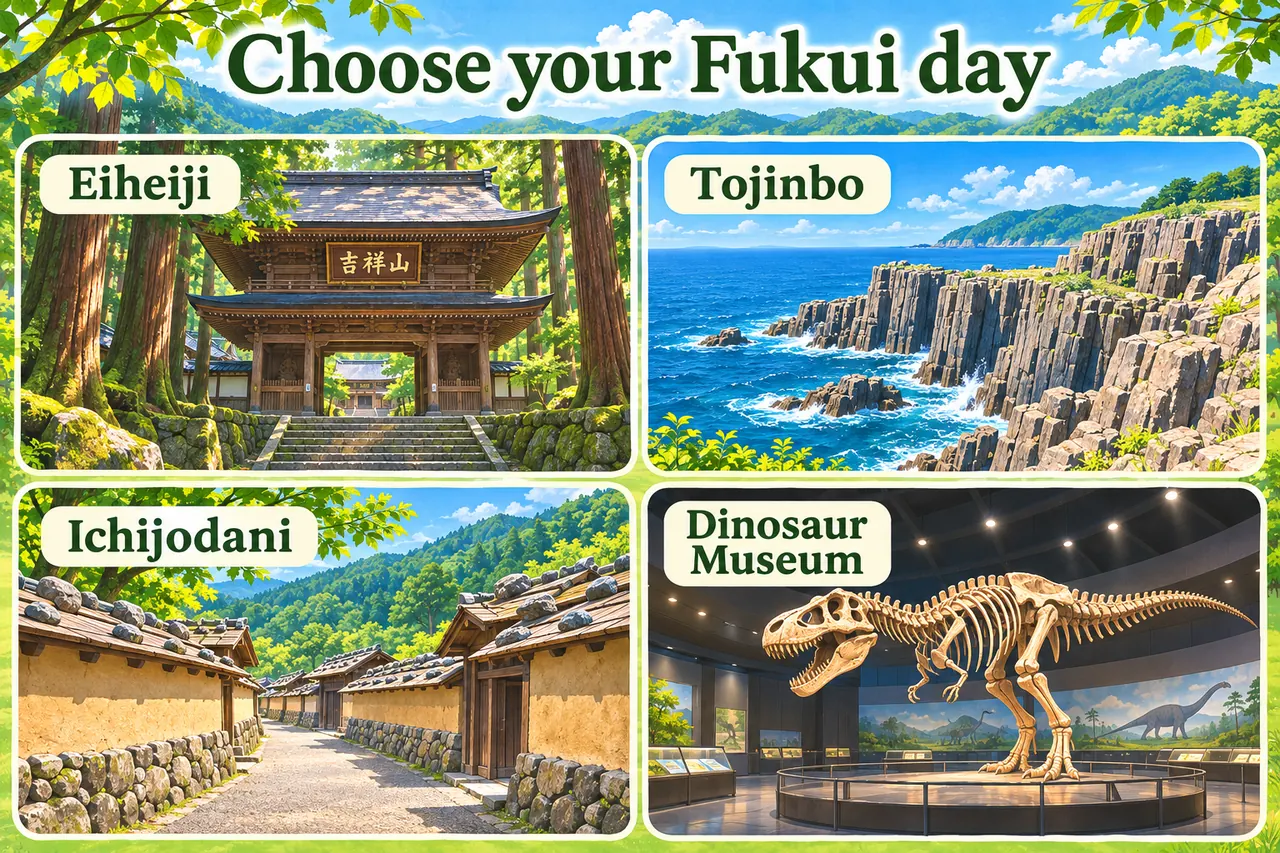
Fukui offers several very different kinds of day out: temple architecture at Eiheiji, columnar-jointed cliffs at Tojinbo, reconstructed samurai-era buildings at Ichijodani, and a major dinosaur museum. Echizen Matsushima Aquarium adds an indoor alternative, while the Araiso and Ninohama promenade offers a longer coastal walk. These places are spread across different areas, so it is usually more practical to choose a priority and plan around it than to assume they all fit into one day.
Choose your attractions and check each official calendar and ticket page for opening hours, prices and availability on your travel date.
Compare the main things to do in Fukui
Use this comparison to choose a focus before looking at transport. Prices are the published amounts checked on the dates above; activities such as the Tojinbo boat, tower and cliff walk are separate options rather than one combined admission.
| Place or activity | What to expect | Published price | Hours, booking or practical note |
|---|---|---|---|
| Eiheiji | Soto Zen temple architecture | General ¥700; elementary and junior-high students ¥300 | 8:30–16:30; reception until 16:00. Seasonal changes are possible. |
| Tojinbo coastal walk | Walk beside columnar-jointed cliffs | Free; parking costs extra | Walking area is listed as open 24 hours. |
| Tojinbo sightseeing boat | Coastal views from the water, including the back of Oshima | Adult ¥1,800; child ¥900 | About 30 minutes; seats are first come, first served, and the boarding location can change with the weather. |
| Tojinbo Tower | A separate viewpoint above the coast | Junior-high-school age and older ¥500; children ¥300 | Normally 9:00–17:00; winter hours end at 16:30. |
| Ichijodani reconstructed town | Reconstructed samurai residences and townhouses | Adult ¥330; cash payment | 9:00–17:00; admission until 16:30. Closed over New Year. |
| Fukui Prefectural Dinosaur Museum, permanent exhibition | Dinosaur and other museum exhibits | Adult ¥1,000; high-school and university students ¥800; elementary and junior-high students and visitors aged 70 or over ¥500; preschool children free | Normally 9:00–17:00; last admission 16:30. Timed advance tickets are generally required. |
| Echizen Matsushima Aquarium | Aquarium visit | Adult ¥2,200; elementary and junior-high students ¥1,200 | Normally 9:00–17:30; seasonal and special-day changes are possible. |
The official Fukui tourism listing for Eiheiji gives the temple’s visiting hours, fees and direct-bus estimate. For the coast, the Tojinbo tourism page separates the free walking area from paid parking and the tower, while the boat guide describes the roughly 30-minute trip. At Ichijodani, the cash-only detail is worth noting before leaving the station; the reconstructed town listing gives its admission and last-entry time.
Choose one area for the day
The most useful first decision is whether the day is about a temple, history, the coast or dinosaurs. Eiheiji is reached by a direct bus from Fukui Station’s east exit, while the Ichijodani museum and reconstructed town are both approached from Ichijodani Station. Tojinbo can be reached by bus from either Mikuni Station or Awaraonsen Station, but the two estimates differ, so plan from the station that matches your actual route.
| Day focus | Practical outline | Check before setting out |
|---|---|---|
| Temple | Fukui Station east exit → direct bus → Eiheiji | The published bus journey is about 30 minutes. Check the current timetable and leave time for the temple visit or a one-hour zazen experience. |
| History | Ichijodani Station → museum and/or reconstructed town | The museum is about a three-minute walk from the station; the reconstructed town is about 15 minutes on foot. Check the museum calendar, particularly for Monday closures. |
| Coast | Mikuni or Awaraonsen → Tojinbo | The bus journey is listed as about 15 minutes from Mikuni Station or about 45 minutes from Awaraonsen Station. Decide whether to walk, take the boat or visit the tower after checking the day’s conditions. |
| Dinosaurs | Choose a timed museum entry, then plan the rest of the day around it | Tickets are generally time-specific and should be checked for the date and party size. Availability is not established by this guide. |
These are separate day outlines, not a recommended public-transport circuit linking Eiheiji, the dinosaur museum and Tojinbo. If you have two nights, it is more sensible to give the middle day to your main priority and add a second area only if the actual connections leave enough time. The Ichijodani walking estimates start at the station; they do not describe the walk between the museum and the reconstructed town. For broader regional planning, compare the Fukui prefecture tourism guide and check bus information for your travel date.
Visit Eiheiji for temple architecture
Eiheiji is a Soto Zen temple in Shihi, Eiheiji Town, at 5-15 Shihi. Fukui tourism describes a direct bus from the east exit of Fukui Station, taking approximately 30 minutes. Check the timetable for your own date before setting out, since the published journey estimate is not a substitute for a current departure schedule.
The published admission is ¥700 for general visitors and ¥300 for elementary and junior-high students. Visiting hours are listed as 8:30–16:30, with reception until 16:00; the hours may change by season. The temple is listed as open throughout the year, but it is still worth checking its current arrangements before travelling, especially if a particular experience is central to your visit. Details are on the official Eiheiji listing.
Inside Sanshokaku, the ceiling has 230 painted panels, according to the Fukui tourism experience guide. The same guide describes a zazen session of about one hour that does not require advance booking. An overnight practice stay and participation in the morning service are different activities and require advance reservations, so check the Eiheiji experience information for the option you want rather than assuming the arrangements are the same.
A temple-focused visit can be planned around the bus journey, admission and the time you want to spend inside. If you are considering zazen, allow for the session’s approximate one-hour duration when deciding how it fits with your onward plans. The published reception cutoff is earlier than the stated closing time, so arriving close to 16:30 is not the same as arriving within visiting reception hours.
Explore Tojinbo and the coast
Tojinbo is known for its columnar-jointed cliffs, which can be seen on a free walk along the coast. The walking area is listed as accessible around the clock, but that does not mean every paid attraction operates at all hours. Parking costs extra, and the tower and sightseeing boat have their own fees and operating arrangements.
The bus journey is listed as approximately 15 minutes from Mikuni Station or approximately 45 minutes from Awaraonsen Station. Choose the estimate that corresponds to your route and check the current service before travelling. The official Tojinbo tourism page is the place to verify the listed access and attraction details.
The sightseeing boat offers a separate view of the coastline from the water. The trip is described as approximately 30 minutes and includes a view of the back of Oshima from the sea; published fares are ¥1,800 for adults and ¥900 for children. Seats are first come, first served, and the boarding location can change depending on the weather, so confirm the day’s operation and boarding information before relying on a particular departure. The official boat guide gives further information.
Tojinbo Tower is another paid option, not an entrance charge for the cliff walk. Its listed fee is ¥500 for visitors of junior-high-school age and older and ¥300 for children. Normal hours are 9:00–17:00, with a 16:30 closing time in winter; check the current listing if you intend to visit near closing time.
Discover Ichijodani’s reconstructed town and museum
At Ichijodani’s reconstructed town, visitors can see recreated samurai residences and townhouses. The site is in Kidonouchi, Fukui City, and is about a 15-minute walk from Ichijodani Station. Its published adult admission is ¥330, with cash payment specified, so plan for that before arriving.
The reconstructed town is listed as open from 9:00 to 17:00, with admission until 16:30, and closed over New Year. The official reconstructed town page provides the published access and admission information. Check the current calendar before travelling, particularly if your visit falls around the year-end closure.
The Ichijodani Asakura Family Historic Ruins Museum offers a different perspective on the site. Its displays include a full-scale reconstruction of part of the Asakura residence, and the museum is about a three-minute walk from Ichijodani Station. It generally closes on Mondays and over New Year; consult its official listing and opening calendar for your date rather than assuming that the museum and reconstructed town share the same hours.
You can make the museum, the town, or both the focus of a history visit, but allow for the separate walks from the station and between your chosen stops. The station walking estimates do not measure the distance between the museum and reconstructed town. If you want to see both, check each venue’s calendar and last-entry time before deciding the order.
Plan a dinosaur museum visit and check ticket conditions
The Fukui Prefectural Dinosaur Museum’s permanent-exhibition admission is listed as ¥1,000 for adults, ¥800 for high-school and university students, and ¥500 for elementary and junior-high students or visitors aged 70 and over. Preschool children enter free, and a group rate is listed for groups of 30 or more paying visitors. Normal hours are 9:00–17:00, with last admission at 16:30. The official fee and hours page also lists the regular closure pattern: the second and fourth Wednesday, the following day when a closure falls on a public holiday, and 31 December and 1 January; the museum is open during the summer holiday period, and other temporary closures are announced on its calendar.
Timed advance purchase is generally required, with tickets available from 60 days ahead. The museum says to enter during the time printed on the ticket; once inside, there is no stated limit on how long you may stay. Regular entry slots begin at 9:00–10:00 and are then offered hourly, with the last slot listed as 16:00–16:30. The official ticket guidance explains the time-slot system and purchase conditions.
Same-day ticket machines are available only when capacity remains, and telephone reservations are not accepted. If you need to change the date, time or party size, the museum’s guidance says the purchaser must cancel and buy again. The regular-ticket purchase page links to the authorised seller for permanent-exhibition tickets, but date-specific availability has not been established here; check the museum’s purchase options directly. The permanent-exhibition cancellation deadline is listed as 16:30 on the day of the visit.
The indoor fossil-research experience is a different product from the outdoor excavation tour. A fossil-research experience plus permanent-exhibition set is listed at ¥2,200 for adults, ¥1,800 for high-school and university students, and ¥1,100 for elementary and junior-high students and visitors aged 70 or over. The experience is for elementary-school age and older, and elementary-school participants must apply at the same time as a parent or other guardian. Advance sales for this set end at 23:59 on the day before; its stated cancellation deadline is 7:00 on the visit day.
The outdoor museum is also separate from both the permanent exhibition and the indoor research experience. Its listed individual fees are ¥1,300 for adults, ¥1,100 for high-school and university students, and ¥650 for elementary and junior-high students and visitors aged 70 or over; the outdoor fee does not include admission to the permanent or special exhibition. It can be visited only on a dedicated bus tour departing from the main museum, with a tour duration of about 120 minutes. During operation, one purchaser may book up to six people, or up to four children of elementary-school age or younger. Its 2026 season ran from 17 April to 3 November and had ended by 5 November; reopening in 2027 was planned for mid-to-late April, with the confirmed date to be announced. Check the outdoor museum’s official status page before making plans.
Special exhibitions have separate prices and conditions from the regular permanent exhibition. The 2026 special exhibition “Sauropods” ran from 10 July to 3 November and was listed as ended; its general admission was ¥1,800. The museum also announced that the three-sided Dino Theater in the special exhibition room was paused during removal of the exhibition. These are details of a past exhibition, not the current permanent-exhibition price or a promise about the next special exhibition.
The museum FAQ says visitors can re-enter on the same day by presenting their ticket. It also lists free wheelchair and stroller loans. If the lockers for large luggage are full, reception can hold the luggage, according to the museum FAQ. These arrangements can help with family visits and breaks, but check directly if you need a particular service on a specific day.
Consider Echizen Matsushima Aquarium for an indoor visit
Echizen Matsushima Aquarium is at 74-2-3 Saki, Mikuni, Sakai City. The prefectural tourism listing describes it as open year-round, with normal hours of 9:00–17:30 and possible extensions or reductions in some seasons and on particular dates. Check the current listing for the date you plan to visit rather than treating the normal hours as fixed.
Published admission is ¥2,200 for adults and ¥1,200 for elementary and junior-high students. These are the prices checked on 4 November 2026; consult the official aquarium listing for current conditions. It is a separate choice from the dinosaur museum, so compare the relevant hours, prices and route before deciding which indoor visit best fits your day.
Walk the Araiso and Ninohama coast
The Araiso and Ninohama promenade is approximately four kilometres long and connects the area around Tojinbo with the vicinity of Oshima. Fukui tourism describes the walking route as free and open around the clock. The official promenade information is useful for checking the route description before setting out.
Wild radish flowers are noted along the promenade from mid-April to mid-May. This is a seasonal guide, not a guarantee that flowers will be present on a particular day. If seeing them is important to your visit, ask local tourism information about current conditions and choose a route and footwear suitable for your group.
The promenade is a different scale of visit from a short walk to the cliffs, so consider whether the longer route suits your available time. You can also keep the free coastal walk separate from paid choices such as the tower or boat. Check the day’s conditions and the practical details of your route before setting out, especially if you are travelling with children or combining the walk with other stops.
Use creator posts for visual context
Creator posts can give you an individual view of places, but they do not replace official opening, booking or transport information. For example, @emika_kamieda’s Japanese-language reel shows an Eiheiji and Ichijodani day trip. @japanexperience_en’s reel includes Eiheiji, Tojinbo and the dinosaur museum.
Other posts show places beyond the main itinerary in this guide. @VisitJapanNow’s Chinese-language post shows views around the Mikata Five Lakes, and @jrwest.en’s short video shows the Rainbow Line summit area. @visitjapaninternational’s reel features eyeglass craft in Sabae, while @experience_fukui’s post shows a moss garden in Fukui City.
@jayzarrecinto’s short video shows the dinosaur museum. Posts capture individual visits and may not reflect current conditions or services, so verify practical details with the relevant venue. For a meal alongside a day out, consult the Fukui food guide and check the chosen venue directly for its current arrangements.
Frequently asked questions
Can I reach Eiheiji from Fukui Station by bus?
Fukui tourism lists a direct bus from the east exit of Fukui Station, with a journey of approximately 30 minutes. That is a published estimate, not a timetable for a particular date. Check the current bus information before setting out and allow time for the temple’s reception cutoff at 16:00.
Is it free to visit Tojinbo?
Walking around the Tojinbo coastal area is listed as free, while parking costs extra. The sightseeing boat and Tojinbo Tower are separate paid options, with their own published fees and operating arrangements. Check boat operation and the boarding location on the day, as the location can change with the weather.
Do I need to reserve zazen at Eiheiji?
The Fukui tourism experience guide describes an approximately one-hour zazen session that does not require advance booking. An overnight practice stay and participation in the morning service are different activities and require advance reservations. Check the experience information for the option you want before travelling.
Do I need to book a dinosaur museum ticket in advance?
The museum generally uses advance payment and timed entry, with tickets available from 60 days ahead. Same-day machines are available only if capacity remains, so they should not be treated as a guaranteed alternative. Check the official ticket page for the date and party size you need, and follow its instructions if you need to change a booking.
Can I leave and re-enter the dinosaur museum?
The museum FAQ says same-day re-entry is allowed when you present your ticket. It also lists free wheelchair and stroller loans, and says reception can hold large luggage if lockers are full. Check the FAQ and current museum information if you need a particular facility or service.
How should I combine stops in Fukui?
Choose a focus first: Eiheiji for temple architecture, Ichijodani for history, Tojinbo for the coast, or the dinosaur museum for an indoor museum visit. The bus and walking estimates in this guide start from particular stations or locations. Check actual services and venue calendars for your date before combining stops.


