
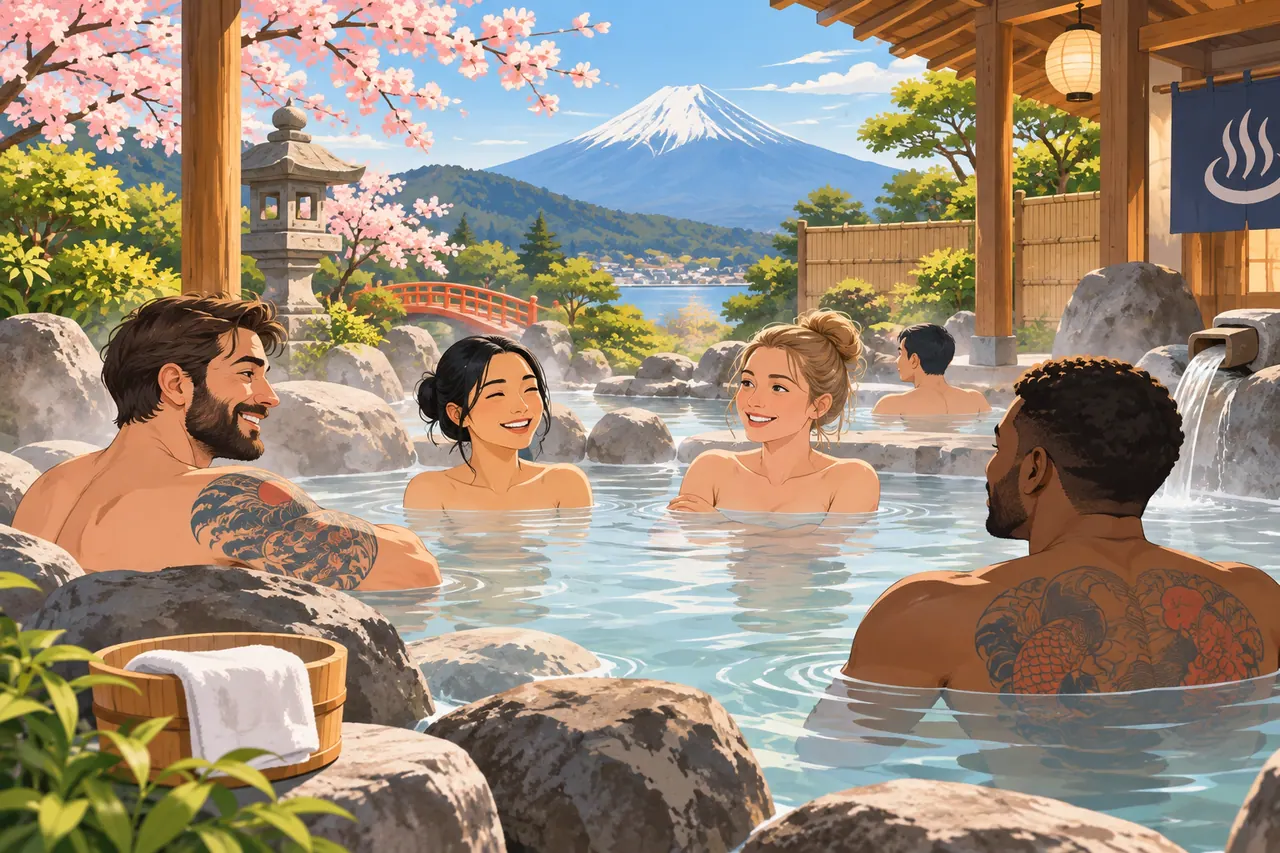
Tattoos in Japan Onsen: Rules, Prices and Where to Bathe
Contents
- 1. Are tattoos allowed in Japanese onsen?
- 2. Choose a bath type, then check its rule
- 3. Four options with confirmed tattoo acceptance
- 4. Three places to check before you plan around them
- 5. Covering tattoos: what to ask and what to buy
- 6. How to ask, book and handle a refusal
- 7. On the day: etiquette, access and practical checks
- 8. Using third-party tattoo maps
- 9. Frequently asked questions about tattoos in Japan onsen
Yes, you can bathe at some onsen in Japan with tattoos, but there is no single rule for every bath. One facility may welcome tattooed guests, another may allow them only if they are covered, and another may refuse entry to its shared bath. Check the policy for the specific bath you plan to use before booking or travelling.
An onsen is a Japanese hot spring bath. If you have tattoos, your practical options are to choose a bath whose official information says tattoos are accepted, use a cover only if that bath permits it, or ask about a private bath or a guest room with its own bath. Privacy does not automatically mean tattoos are allowed, so confirm the rule before paying.
This guide was checked against official pages on 3 November 2026, except for the Hyotan Onsen price comparison, checked on 4 November 2026. Prices, hours, temporary closures and access arrangements can change; check the linked facility or local-government page again before you go. None of the facilities listed here was visited, called or emailed for this guide.
Are tattoos allowed in Japanese onsen?
There is no nationwide rule that guarantees tattooed guests access to every onsen. Each facility sets its own policy, and a rule for one bath does not necessarily apply to a nearby inn, hotel or second bath operated in the same town. Japan National Tourism Organization (JNTO) guidance also advises travellers to check with the specific facility rather than assume that all shared baths have the same policy (JNTO: Onsen, tattoos and etiquette).
The government’s 2016 notice says that refusing a guest solely because of a tattoo is not appropriate, but it asks facilities to consider ways of avoiding friction between guests; it does not order every bath to admit tattooed visitors. The notice also explains that tattoos may have religious, cultural or fashion-related reasons, that bathers should try to understand one another, and that a tattoo itself is not a hygiene problem (Ministry of Health, Labour and Welfare and Japan Tourism Agency notice). Individual facilities may still set and apply their own bathing rules.
The Japan Tourism Agency notes that some inns historically refused tattooed guests because they were concerned that other bathers might feel uneasy. It also describes inns that do not impose a tattoo restriction and those that decide on a case-by-case basis (Japan Tourism Agency: Ryokan Q&A). For a traveller, the useful point is not to infer a policy from an inn’s location or reputation: ask about the exact bath you intend to use.
What the 2016 notice and 2023 parliamentary answer mean
The Japan Tourism Agency sent its notice to four hotel, inn and hot spring industry groups on 16 March 2016. On 18 March, the health ministry asked local governments to share the notice with facilities in their areas. Possible approaches listed in the notice include asking a guest to cover a tattoo with a sticker or clean bathing clothing, making no special request for a small tattoo that is not likely to cause concern, suggesting a different time or bath, or offering a private bath or a room with its own bath. The “palm-sized” example is not a national size limit.
In a 2023 parliamentary answer, the government explained that refusing access to bathing solely because of a tattoo does not directly constitute a violation of the Inn Business Act, while refusing accommodation solely because of a tattoo is not permitted. In practical terms, a hotel may be able to provide a room but still refuse access to its shared bath. The distinction is described in the House of Representatives record of 26 May 2023.
A minister also referred in 2023 to a 2015 Japan Tourism Agency survey in which about 56% of ryokan and hotels reportedly refused bathing to people with tattoos. That is an old figure, not a measure of current policy at any particular facility. A 2015 parliamentary answer says an industry survey began in mid-June.
Choose a bath type, then check its rule
Bath type helps you know what to ask. A ryokan is a traditional Japanese inn, and its shared bath may have a different rule from another bath nearby. A kashikiri-buro is a private bath for your group; a room with its own bath is another option, but either still requires a policy check.

| Bath type | What to ask before you go |
|---|---|
| Shared onsen bath | “Can I use this specific bath with my tattoos?” |
| Ryokan bath | “Which baths can I use, and does the policy differ between the shared and private baths?” |
| Private or family bath | “Are tattoos permitted in this bath, what is the fee, and how do I reserve it?” |
| Guest room with its own bath | “Does this room have a bath, and are there any tattoo-related conditions?” |
| Public bath in an onsen town | “Does this public bath allow tattoos, and is it open on the day I plan to visit?” |
A private bath can reduce contact with other bathers, but it is not a blanket exemption from a facility’s rules. JNTO says private baths often require an additional fee and advance booking, so ask both about admission and the private-bath charge. If you are staying at an inn, do not assume that the town’s public baths follow the inn’s policy, or that the inn’s bathing rules follow the town’s policy.
A useful cost comparison comes from Hyotan Onsen’s official price page: a 60-minute family bath for three adults is listed at ¥2,400. The same page lists an additional person aged 13 or older at ¥700, a child aged 4–12 at ¥300, children aged three or younger as free, a towel at ¥250 and a rental bath towel at ¥200. These prices were checked on 4 November 2026.
A sento, or neighborhood public bathhouse, is another bathing option to ask about. No general tattoo rule for sento was confirmed in the sources checked for this guide, so ask the individual bathhouse about tattoo acceptance and its current admission price.
Four options with confirmed tattoo acceptance
The four options below have tattoo acceptance stated on an official facility or local tourism page. “Confirmed” here means the official page checked for this guide says tattoos are accepted; it is not a guarantee that every bath, room, service or temporary operating arrangement is available on the day you arrive. Check the linked official information before setting out, especially where a closure or reopening status is noted as unconfirmed.
| Place | Area | Tattoo information | Adult price and usual hours |
|---|---|---|---|
| Kinosaki public baths | Toyooka, Hyogo | Tattoos of any size are accepted at the seven public baths; no cover is required. Inn baths set their own rules. | Six listed baths: ¥800; usual hours vary by bath. |
| Otaki no Yu | Kusatsu, Gunma | Its FAQ says it does not refuse guests with tattoos. | ¥1,200; 9:00–21:00. |
| Yamato no Yu | Narita, Chiba | Its FAQ says people with tattoos can use it. | ¥1,000 weekdays; ¥1,100 weekends and holidays; 10:00–22:00. |
| Hottarakashi Onsen | Yamanashi City, Yamanashi | Its FAQ says people with tattoos can bathe. | ¥900 per bath; about one hour before sunrise to 22:00. |
Kinosaki Onsen public baths
Toyooka City’s Visit Kinosaki page says tattoos of any size are accepted at Kinosaki’s seven public baths and do not need to be covered. This applies to the town’s public baths, not automatically to the baths inside individual inns. Ask your accommodation separately whether its own bath has a tattoo policy and whether any public-bath pass is included with your stay (Visit Kinosaki tattoo guidance).
The six baths with listed admission prices charge adults ¥800 and children aged three through elementary-school age ¥400. The “Yumepa” one-day pass is listed at ¥1,500 for adults and ¥750 for children, and can be bought at a public bath’s window.
| Bath | Address | Usual hours | Usual closing day | Map |
|---|---|---|---|---|
| Kounoyu (鴻の湯) | Kinosaki-cho, Yushima 610 | 7:00–23:00 | Tuesday | Map |
| Mandarayu (まんだら湯) | Kinosaki-cho, Yushima 565 | 15:00–23:00 | Wednesday | Map |
| Goshonoyu (御所の湯) | Kinosaki-cho, Yushima 448-1 | 7:00–23:00 | Thursday | Map |
| Ichinoyu (一の湯) | Kinosaki-cho, Yushima 415-1 | 7:00–23:00 | Wednesday | Map |
| Yanagiyu (柳湯) | Kinosaki-cho, Yushima 647 | 15:00–23:00 | Thursday | Map |
| Jizoyu (地蔵湯) | Kinosaki-cho, Yushima 796 | 7:00–23:00 | Monday | Map |
| Satonoyu (さとの湯) | Current post-rebuild address unconfirmed | Status and hours unconfirmed | — | Check the official information |
The address list is drawn from Toyooka City’s facilities document. Satonoyu was listed as closed for renovation from 1 April 2024, with a reopening date unconfirmed. Kounoyu’s published renovation period ran from 11 May through 30 October 2026. Ichinoyu and Jizoyu’s family baths are listed as out of service; check current notices before planning around any particular bath.
Otaki no Yu in Kusatsu
Otaki no Yu’s official FAQ says guests with tattoos are not refused. The facility is at 596-13 Oaza Kusatsu, Kusatsu-machi, Agatsuma-gun, Gunma. Admission is ¥1,200 for adults and ¥600 for children aged three through elementary-school age; its listed hours are 9:00–21:00, with last entry at 20:00.
The private bath called Shakunage is listed as open 9:00–19:00, with last check-in at 18:00. It costs ¥2,000 per hour, with the regular entry fee extra, and can be arranged at the front desk or by calling 0279-88-2600.
The official access information gives an example of travelling by JR bus from Naganohara-Kusatsuguchi Station, and the bath is about a seven- to eight-minute walk from Yubatake, Kusatsu’s central hot-spring field. Check current bus times before travelling. The facility describes itself as barrier-free except for the private bath and basement; it has no suitcase lockers, but says the front desk can keep luggage if asked (Otaki no Yu access information).
Yamato no Yu in Narita
Yamato no Yu’s FAQ explicitly says people with tattoos may use the facility. It is at 1630 Otake, Narita City, Chiba, and is listed as open every day from 10:00 to 22:00. Admission is ¥1,000 on weekdays and ¥1,100 on weekends and holidays; children below elementary-school age cannot enter, and smoking is prohibited throughout the building (official FAQ).
The facility’s route information recommends taking a taxi from JR Ajiki Station, about ten minutes away, and notes that Shimosa-Manzaki Station has no taxi stand. Check the route and transport availability before setting off, particularly if you plan to use a taxi.
Hottarakashi Onsen in Yamanashi
Hottarakashi Onsen’s FAQ says people with tattoos can bathe. The address is 1669-18 Yatsubo, Yamanashi City, Yamanashi. Each bath costs ¥900 for an adult and ¥400 for a child from birth through sixth grade; payment is cash only. The facility’s hours are about one hour before sunrise until 22:00, with last entry at 21:30 (official site).
The baths are separated by gender. Phones and cameras may not be taken into the bathing area, photography is prohibited there, and bathing after drinking alcohol is not allowed. There is no private bath, so this is not an option if you specifically need a private bathing space.
You can reach the facility by taxi from JR Yamanashi-shi Station in about ten minutes. A city bus goes to Fruit Park, followed by about a 20-minute walk; check the current service and walking route before relying on that option. The facility is usually open every day, but individual baths may close temporarily, so confirm current status, booking information and access needs directly.
Three places to check before you plan around them
These three baths publish useful prices, hours or access information. They appear in JNTO’s list of places to consider, but that general listing is not a substitute for a current answer from each facility. Contact the bath before travelling or booking, and treat the tattoo policy as unknown until it replies.
Dogo Onsen Honkan in Matsuyama
The tattoo policy for Dogo Onsen Honkan was not found on the facility’s official pages, so ask before using its bath. The address is 5-6 Dogo-Yunomachi, Matsuyama City, Ehime. From Dogo Onsen tram stop, the facility FAQ says the walk is about three minutes, while Matsuyama’s official tourism page says about five minutes; allow for the discrepancy (Dogo Onsen FAQ, Matsuyama tourism information).
The Kami-no-Yu bath-only ticket for the downstairs area is ¥700 for adults aged 12 and over and ¥350 for children aged 2–11. The Honkan is listed as open 6:00–23:00, with ticket sales ending at 22:30 and a 60-minute visit. Ordinary bathing cannot be reserved in advance, and the facility is usually open every day but closes for one day in December for major cleaning (Dogo Onsen Honkan official page).
A third-floor rest room in the Tama-no-Yu area can be reserved, but it has no bath inside. Reservations are accepted up to 90 days ahead online or by phone; online booking closes at 22:00 on the preceding day, while same-day booking is by phone. Ask the facility about cancellation terms and step-free access when booking. The Honkan fully reopened on 11 July 2024, and repair work was completed on 20 December 2024, according to Matsuyama City (repair information).
A nearby hotel’s policy should not be inferred from the public bath’s policy. For example, Dogo Miyu says tattooed guests cannot use its view bath and directs them to their guest-room open-air bath; see its official FAQ. This is a reminder to ask each accommodation about its own facilities.
Shibaseki Onsen in Beppu
The address is Noda 4-kumi, Beppu City, Oita. From the East Exit of JR Beppu Station, the city lists buses 26 or 26A to Shibaseki Onsen Iriguchi, about 30 minutes, followed by a walk of about five minutes (Beppu City facility information).
The main bath is listed as open 7:00–20:00. The family bath is listed as open 9:00–20:00, with last check-in at 19:00; entry is not allowed from 13:00 to 14:00 during cleaning. The usual closing day is the second Wednesday of the month, moving to the following day if that Wednesday is a holiday.
The main bath costs ¥300 for junior-high-school age and older, ¥100 for elementary-school children, and is free for younger children. A family bath costs ¥2,000 for one hour for up to four people. The official page lists a ramp, a barrier-free family bath, handrails in the baths and two wheelchairs on site, but ask whether the particular support or access arrangement you need is available. Ask the facility about tattoo rules, reservations and cancellation terms before booking.
Saki no Yu in Shirahama
It is at 1668 Shirahama-cho, Nishimuro-gun, Wakayama. From JR Shirahama Station, take a Meiko Bus towards Shin-Yuzaki for about 15 minutes, get off at Yuzaki and walk about five minutes (Shirahama Town’s Saki no Yu information).
Admission is ¥500 for anyone aged three and older. The seasonal hours are 8:00–17:00 from October through March, 8:00–18:00 from April through June and September, and 7:00–19:00 in July and August. Last entry is 30 minutes before closing. The bath is usually open every day, but may close or limit entry at short notice.
Shampoo, conditioner and soap are not permitted. The town lists free admission for a person with a disability and one helper; ask the bath directly about step-free access before visiting.
Covering tattoos: what to ask and what to buy
A cover is useful only if the bath accepts covered tattoos. JNTO says a cover sheet is one possible approach, but some facilities still refuse guests with covered tattoos, while others accept tattoos only under certain conditions. Before buying anything, ask whether covers are allowed and how much of the tattoo needs to be hidden (JNTO tattoo guidance).
| Option | What to check | Important limit |
|---|---|---|
| Tattoo cover sheet | Ask whether the bath accepts sheets and what area must be covered. | No nationwide rule or universal size limit applies. |
| Clean bathing clothing | Ask whether the bath permits this option. | The 2016 notice lists it as one possible facility response, not a general entitlement. |
| Private bath | Ask about tattoo acceptance, fee, available times and booking. | Privacy does not guarantee tattoo permission; extra fees or reservations are common. |
| Room with its own bath | Ask whether the room has a bath and what conditions apply. | Confirm the room type and price with the inn. |
JNTO says tattoo sheets may be available at some onsen, online and at Don Quijote, a discount-store chain in Japan. Ask the shop about stock before visiting. Read the package and follow its instructions, but do not rely on a product’s stated water resistance as proof that a bath will accept it.
A practical sequence is to contact the facility first, describe your tattoo’s size and location, and ask what covering it accepts. If the answer is yes, check the product size and instructions before purchase, then make sure it meets the facility’s stated requirement. Keep the facility’s reply on your phone and show it to staff if asked; if the rule is unclear, ask at reception before changing.
The Japan Tourism Agency’s guidance for Hakuba Happo-one describes a restriction on bathing with tattoos and asks guests with small tattoos to cover them with waterproof sheets. This is a specific local example, not a rule for all Japanese onsen or proof that another bath accepts waterproof covers.
How to ask, book and handle a refusal
Ask before you travel or make a non-refundable booking. JNTO recommends contacting a bath directly or asking through a booking agent, and the Japan Tourism Agency recommends checking with the inn. Include your visit date, group size, tattoo size and location, and any access needs so the facility can answer about the situation you actually have.
You can send this English message:
Hello. May I use your bath if I have a tattoo? I can provide my travel date, group size, and the tattoo location and dimensions. If a cover is required, what type of cover do you accept, and how much must it cover? If the shared bath is not available to me, can I use a private bath, and what are the price, booking and cancellation conditions? Thank you.
For a short question at reception, state that you have a tattoo and ask whether you may use the specific bath. If you need a cover, ask whether it is allowed and whether the entire tattoo must be covered. For a private bath, ask how to reserve it and confirm the price, time slot and cancellation conditions before paying.
The official booking details available for the facilities in this guide are limited. Dogo Onsen Honkan does not accept advance reservations for ordinary bathing, although its third-floor rest room can be reserved up to 90 days ahead. At Kinosaki, the Yumepa day pass is sold at public-bath windows; Otaki no Yu accepts private-bath arrangements at the front desk or at 0279-88-2600. Ask each of the seven facilities about cancellation terms before booking.
If staff refuse entry, thank them and follow the facility’s decision rather than arguing at the bath entrance. Ask whether a private bath, room bath or another time is an option, but do not assume any of these alternatives will be accepted or available. If there is no suitable option, choose another bath whose official page confirms tattoo acceptance and check that it is operating before travelling.
You can show staff these Japanese questions on your phone: 「タトゥーがあります。入浴できますか?」 means “I have a tattoo. Can I tell you its size and location? Can I bathe?” For a cover, ask 「タトゥーをシールで隠せば入浴できますか?全部隠す必要がありますか?」 (“Can I bathe if I cover it with a sticker? Must I hide all of it?”). For a private bath, use 「貸切風呂はどのように予約できますか?タトゥーがあっても利用できますか?」 (“How do I book a private bath? Can I use it with tattoos?”).
When preparing your enquiry, include the number of tattoos as well as their sizes and locations, and give children’s ages if they are coming with you. If the facility does not reply, try your booking site’s message service or choose another bath; no reply leaves the tattoo rule unconfirmed.
On the day: etiquette, access and practical checks
Follow the bath’s posted instructions and staff directions. The Japan Tourism Agency’s basic guidance includes washing your body before entering the water, keeping towels and long hair out of the bath, not taking photos and not bathing after drinking alcohol (Japan Tourism Agency: hot-spring manners and rules). Individual rules can be stricter: Hottarakashi Onsen prohibits phones and cameras in the bathing area, and Saki no Yu does not allow shampoo, conditioner or soap.
Before leaving, check the bath’s current hours, closing day and any temporary closure notice. Bring cash where required: Hottarakashi Onsen accepts cash only. Keep a screenshot of the facility’s answer about your tattoo, and bring a cover only if the facility has said that it permits one.
Ask about accessibility, toilets and luggage if those details affect your visit. Otaki no Yu says it has no suitcase lockers but can keep bags at the front desk if asked; its barrier-free information excludes the private bath and basement. Shibaseki lists a ramp, a barrier-free family bath, bath handrails and two wheelchairs, but you should ask whether the specific support you need is available.
Children’s rules differ too. Yamato no Yu does not admit children below elementary-school age, while other facilities have their own age and price arrangements. For example, the listed child admission rules differ among the baths in this guide, so confirm the age category and fee for your child before travelling.
Using third-party tattoo maps
A third-party policy map can help you identify baths to investigate, but it is not an official decision from a facility. Onsen Oni’s tattoo guide and map groups places under labels such as “OK,” “with conditions,” “not OK” and “unknown.” Treat these as leads, not as current permission to bathe.
The map’s data collection method and dates could not be confirmed, and many listed baths may have an unknown policy. A facility can change its rules or operating status after a map entry is added. Verify any promising result on the bath’s own site or by contacting the facility, and do not rely on map totals as current national statistics.
To keep your own checks organized, make a short list with the bath name, its tattoo rule, the official source link and the date you checked. Search the official page for “tattoo” or “tattoo policy,” but record “not found” if there is no statement rather than treating silence as permission. Save the official map or address link and any reply from staff so you can refer to it on the day.
Frequently asked questions about tattoos in Japan onsen
Can I use an onsen in Japan if I have tattoos?
Yes, some baths accept tattooed guests. The official pages checked for this guide confirm acceptance at Kinosaki’s public baths, Otaki no Yu, Yamato no Yu and Hottarakashi Onsen. Other facilities may have different rules, so check the exact bath before going.
Is there a national tattoo size limit?
No national size limit was found. The 2016 notice mentions a small tattoo that is not likely to cause concern as one example of a possible facility response, not as a rule that every bath must follow. Ask the facility about your tattoo’s size and location rather than relying on a palm-size standard.
Will a cover sheet make a tattoo acceptable?
Not necessarily. Some facilities accept covered tattoos, while others refuse them or set their own covering conditions. Ask whether a cover is permitted and what area must be hidden before buying or applying one.
Does booking a private bath guarantee that I can bathe?
No. A private bath gives your group a more private space, but the facility still sets its rules. Confirm tattoo permission, the fee, available times and booking and cancellation conditions before paying.
Can a hotel refuse my room because I have a tattoo?
The 2023 parliamentary answer says accommodation cannot be refused solely because of a tattoo. That does not guarantee access to the hotel’s shared bath: a facility may provide a room while applying a separate rule to its bathing area. Ask the hotel which baths you can use.
Are all Kinosaki baths and inn baths tattoo-friendly?
The official Visit Kinosaki guidance says tattoos of any size are accepted at the town’s seven public baths. Inn baths set their own policies, so ask your accommodation separately. Also check the current operating status of each public bath, because renovation and closure information can change.
Is the 56% figure still current?
No. It refers to a 2015 survey cited in a 2023 parliamentary answer and does not show how any facility treats guests today. For your visit, ask the individual facility about its current tattoo policy.
What should I do if a bath’s website says nothing about tattoos?
Treat the rule as unknown and contact the facility before travelling. Include the date of your visit, the size and location of your tattoo, and whether you would use a cover or private bath. If you cannot get a clear answer, choose a facility whose official information confirms that tattoos are accepted.


