Geisha Experience in Beppu: An Ozashiki Booking Guide
Contents
A geisha experience in Beppu is not necessarily a performance at a fixed theatre or a walk-in attraction. One documented option is a visiting ozashiki-style programme by Madokajyuku, arranged for a group at a suitable venue such as a ryokan. The programme listing gives a one-hour performance price, but transport, food and venue costs are separate, and extra support and interpretation charges apply in specified circumstances.
The main planning task is to confirm the complete arrangement before committing: the number of guests, the venue, the date and time, the sound setup and the total price. The listing’s capacity field says the programme is for 12 people or more, while other conditions set out charges for different group sizes; the available information does not resolve whether smaller parties can book. Treat the published conditions as a starting point for an enquiry, not as confirmation of availability or a final quote. (Madokajyuku’s programme listing, checked 5 November 2026.)
At a glance: the Beppu programme
Madokajyuku describes a mother-and-daughter performance featuring geisha arts, while the tourism-area listing describes a one-hour visiting experience at a venue arranged with the organiser. The listing gives a base fee of ¥60,000 per group, with transport, meals and venue costs not included. It also describes advance payment, a five-day application deadline and extra charges for supporter and interpreter staffing in specified cases. (Programme details and conditions; Madokajyuku introduction.)
| Planning item | Published information | What to confirm directly |
|---|---|---|
| Performance | One hour; ¥60,000 per group | Current price, date, time and programme |
| Venue | A desired venue, such as a Beppu ryokan, can be discussed | Venue availability, permission and separate cost |
| Transport | Charged separately | Transport amount for the proposed location |
| Food and venue | Not included in the performance price | Meal, room hire and any other venue charges |
| Supporter staffing | One supporter at ¥18,000 is listed for groups over 10 | How staffing conditions apply to the actual group |
| Foreign guests | One supporter at ¥18,000 and one English interpreter-supporter at ¥18,000 are listed as required, regardless of group size | Current staffing and full price |
| Foreign groups over 30 | Two supporters and two interpreters are listed | Total staffing and applicable charges |
| Capacity and timing | Capacity field says from 12 people; apply five days ahead; contact Madokajyuku for requests four days or less ahead | Whether a smaller group can be accepted and whether the requested date is available |
For illustration, the ¥60,000 base fee plus one ¥18,000 supporter and one ¥18,000 English interpreter-supporter totals ¥96,000 before transport, food, venue and other charges. This is arithmetic based on the listed amounts, not a confirmed quote; the listing includes overlapping group-size conditions that should be clarified for the particular party. The stated capacity of 12 or more also remains a question for the organiser if your group is smaller.
What the ozashiki programme describes
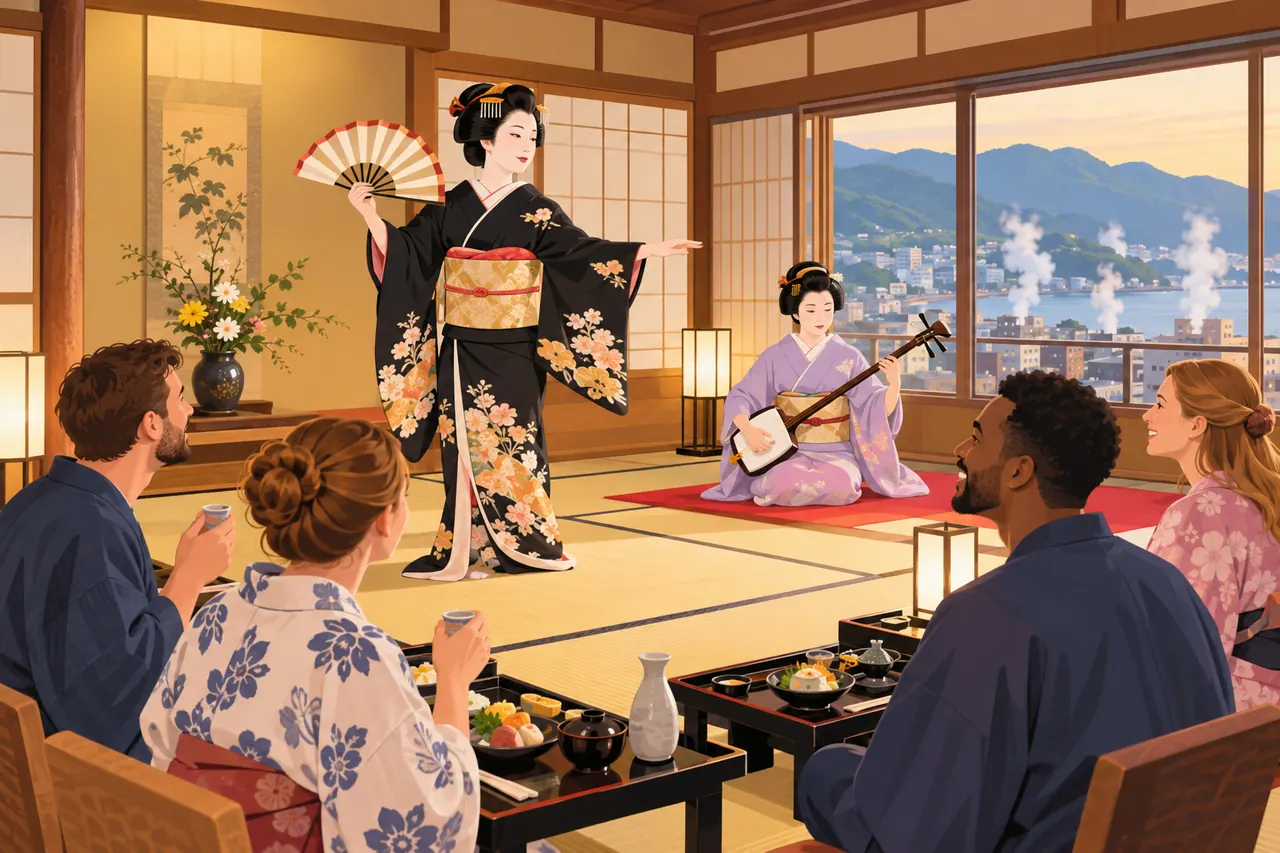
Madokajyuku presents the experience as a mother-and-daughter performance of geisha arts. Its introduction says the performers trained in Awara Onsen in Fukui Prefecture and identifies Hisano as the geisha who performs Japanese dance. The same introduction describes shamisen music and percussion including drums, kotsuzumi and bells. These are examples from the provider’s general introduction; ask which performers and elements are planned for the date you are considering. (Madokajyuku’s introduction.)
The activities described are not limited to a stage performance. Madokajyuku gives ozashiki games such as Konpira Fune Fune and Taiko Omawarisan as examples, and names Beppu Ondo and Tanko Bushi as examples of group dances. The introduction also describes a commemorative photograph wearing a jinbaori garment. Confirm in advance which activities are included in the proposed programme, since a general description does not guarantee that every listed element will be part of every event.
| Element described by Madokajyuku | Examples in the provider’s introduction |
|---|---|
| Dance | Japanese dance performed by Hisano |
| Music | Shamisen |
| Percussion | Drums, kotsuzumi and bells |
| Ozashiki games | Konpira Fune Fune and Taiko Omawarisan |
| Group dances | Beppu Ondo and Tanko Bushi |
| Commemorative photo | Wearing a jinbaori garment |
The provider says it can travel to banquets at hotels, ryokan and ryotei, and describes its service area as almost all of Oita Prefecture beyond Beppu. That is a broad service-area description, not a guarantee that every venue or date can be arranged at the same cost. Ask whether your chosen address is workable and request the transport charge for that location. (Madokajyuku’s introduction and service description.)
Price, extra charges and group conditions
The published ¥60,000 price is for one group and a one-hour visiting experience, not a per-person ticket price. The listing separately identifies transport, food and venue costs, so those should not be treated as included when comparing the base price with another activity. It says payment is made in advance; ask for the current payment instructions and cancellation terms before paying. (Current programme listing.)
The supporter and interpreter conditions need particular attention when working out the total. For groups over 10, the listing gives one supporter at ¥18,000; for foreign guests, it says one supporter at ¥18,000 and one English interpreter-supporter at ¥18,000 are required regardless of group size. For foreign groups over 30, it lists two supporters and two interpreters. Because these conditions refer to different group categories, ask the organiser how they apply together to your party rather than assuming that a single calculation covers every case.
| Cost or condition | Published detail | Practical implication |
|---|---|---|
| Base programme | ¥60,000 per group for one hour | Confirm the current price and what the requested performance includes |
| Transport | Extra | Give the organiser the proposed venue when asking for a quote |
| Food | Not included | Arrange and price meals separately if wanted |
| Venue | Not included | Ask the venue about hire costs and sound permission |
| Groups over 10 | One supporter listed at ¥18,000 | Confirm how this condition applies to the group total |
| Foreign guests | One supporter and one English interpreter-supporter, each listed at ¥18,000, regardless of group size | Ask for the complete staffing calculation |
| Foreign groups over 30 | Two supporters and two interpreters listed | Confirm the full amount for the actual number of guests |
A smaller group should not assume either that it is eligible or that it is excluded. The listing’s capacity field says “from 12 people,” while its staffing conditions also refer to other group-size thresholds; the available information does not explain how those statements work together. Ask whether the provider will consider your party size and request written confirmation before planning around the experience.
The listing describes the desired performance time as something to discuss with the provider and says the service is available during the day or evening throughout the year. Those statements do not establish availability on a particular date, so check the date and time directly. The listing gives a five-day application deadline and directs people making a request four days or less ahead to contact Madokajyuku; it does not promise that a late request will be accepted.
Choose and prepare a venue
This is a visiting programme, so the venue is part of the booking rather than a detail to leave until arrival. The listing says a desired place, such as a ryokan in Beppu, can be discussed with the organiser, while also making clear that venue costs are not included. Once you have a possible location, ask both the provider and the venue whether the proposed room and setup are suitable. (Venue and equipment conditions in the programme listing.)
The listing asks for sound equipment such as a microphone. It also says the organiser must obtain the venue’s permission in advance for the sound of the shamisen and percussion. Do not assume that a room can host the performance just because it can accommodate a group: establish permission for the instruments and confirm the equipment arrangement before paying a venue fee.
Use a written checklist when discussing the room, so that the provider and venue are responding to the same plan. Confirm the performance date and time, group size, proposed room, microphone or other sound equipment, permission for shamisen and percussion, and any separate venue or meal charges. If seating, movement around the room or participation in group activities matters to your party, ask the provider and venue about those arrangements; the available programme information does not specify them.
How to enquire and arrange a booking
Madokajyuku directs work requests and price enquiries to the Millennium Roman reservation form, which hosts the programme listing. Madokajyuku also provides its own enquiry form and says a representative will contact the enquirer later. An enquiry is not a confirmed reservation, so wait for the provider’s response and confirm the venue and terms before paying. (Madokajyuku enquiry page; Millennium Roman programme listing.)
A practical enquiry should include the date you want, a preferred time, the number of guests, the language needs of the group and the proposed venue or area. Ask whether the group meets the capacity condition, which supporter and interpreter staffing rules apply, and whether the requested performance elements can be arranged. Request a complete quote that separates the performance fee from transport, venue, food and any staffing charges.
Before treating the plan as settled, confirm the sound and equipment conditions with the venue as well as the organiser. Ask for the advance-payment instructions and current cancellation terms, since the listing describes advance payment but the details should be checked for the particular booking. The programme listing gives the tourism-area telephone number as 0977-85-8511; check the current contact route and availability when making your enquiry. It says to apply five days ahead and to contact Madokajyuku for requests four days or less before the event, without guaranteeing late availability.
Booking steps
- Read the current programme listing and note the capacity, deadline and published charges.
- Choose a possible venue, or ask the organiser about suitable venues such as a ryokan.
- Send the requested date, time, group size, language needs and venue details through the reservation route or Madokajyuku’s enquiry form.
- Ask for the full price and clarification of supporter and interpreter staffing for your group.
- Confirm that the venue permits the instruments and can provide the requested sound equipment.
- Proceed only after the provider and venue have confirmed the actual arrangement and you have checked the payment and cancellation terms.
Past event and local context
A Beppu City workation report dated 15 April 2025 records a Madokajyuku experience at Yamada Besso. It describes dance, music, ozashiki games and commemorative photography, and says an interpreter accompanied overseas participants. This report documents a past event; it does not establish that Yamada Besso, the same programme or the same dates are currently available for booking. (Beppu workation report.)
Yayoi no Yu’s page discusses the history of Beppu’s geisha booking office and refers to a historical figure of about 200 geisha. That number is historical, not a current count. The page is information about a bath facility and does not establish that it currently accepts geisha bookings; its note that the facility is about a seven-minute walk from Beppu Station is about Yayoi no Yu, not a directions guide to every performance venue. (Yayoi no Yu information.)
Videos and other descriptions of geisha experiences can refer to different places or event types. For example, the Beppu festival dance video has Vietnamese-language metadata and concerns a festival performance, not the private visiting programme described here. The Kyoto private geisha experience video concerns Kyoto, while Hangs with Christian’s Beppu travel video covers broader Beppu activities; none of these videos confirms availability or terms for a Madokajyuku booking.
Frequently asked questions
How much does a Beppu geisha experience cost?
The reviewed listing gives a base price of ¥60,000 per group for one hour. Transport, venue and food are additional, and the listing gives separate supporter and interpreter charges for specified groups. Ask for a current, complete quote based on your party size, language needs and chosen venue before paying. (Programme price and conditions.)
Can a group of fewer than 12 people book?
The capacity field on the listing says the programme is for 12 people or more. Other conditions describe charges for different group sizes, but the available information does not resolve whether smaller groups can be accepted. Ask Madokajyuku directly and get confirmation for your specific party before making plans.
Is the performance held at a fixed venue?
The programme is described as a visiting experience, and the listing says a desired venue, such as a Beppu ryokan, can be discussed with the organiser. The venue is not included in the performance fee, so ask about its availability and separate cost. Confirm that the venue permits shamisen and percussion and can provide sound equipment such as a microphone. (Venue conditions.)
Is English interpretation included?
The listing identifies an English interpreter-supporter at ¥18,000 as required for foreign guests, alongside a separately listed supporter at ¥18,000. For foreign groups over 30, it lists two supporters and two interpreters. Confirm the current staffing and total price for your group rather than assuming that interpretation is included in the ¥60,000 base fee.
What happens during the programme?
Madokajyuku’s introduction describes Japanese dance, shamisen and percussion, examples of ozashiki games, group dances and a commemorative photograph wearing a jinbaori garment. It identifies Hisano as the dancer and names examples including Konpira Fune Fune, Taiko Omawarisan, Beppu Ondo and Tanko Bushi. Ask which elements will be included in your event, since the general introduction is not a guarantee that every activity will appear each time. (Madokajyuku’s programme introduction.)
How far ahead should I enquire?
The programme listing says to apply five days ahead and directs requests made four days or less before the desired event to Madokajyuku. The listing describes service during the day or evening throughout the year, but that does not confirm availability on a particular date. Contact the organiser to check your date and do not assume that a late request will be accepted.
Can I book through Yayoi no Yu or the old geisha office?
Yayoi no Yu’s page discusses the history of Beppu’s geisha booking office, but it does not establish a current geisha-booking service at the bath facility. Its historical reference to about 200 geisha should not be interpreted as a present-day count. Use Madokajyuku’s enquiry form or the programme listing to ask about a current arrangement.
Related Beppu guides
For other parts of a Beppu trip, see the Beppu Bus Guide: Passes, Payment and Practical Tips; Beppu Day Trip from Fukuoka: Train, Bus, Cost & Plan; Beppu Hells Guide: Tickets, Hours and Access; Beppu Onsen Areas: Eight Districts, Baths and Prices; Beppu Sand Bath Guide: Where to Go, Prices and Hours; and Beppu to Yufuin: Bus Options, Fares and Current Service. Each concerns separate travel planning and does not change the terms of the geisha programme. Confirm current transport and attraction details with the relevant providers when planning your itinerary.