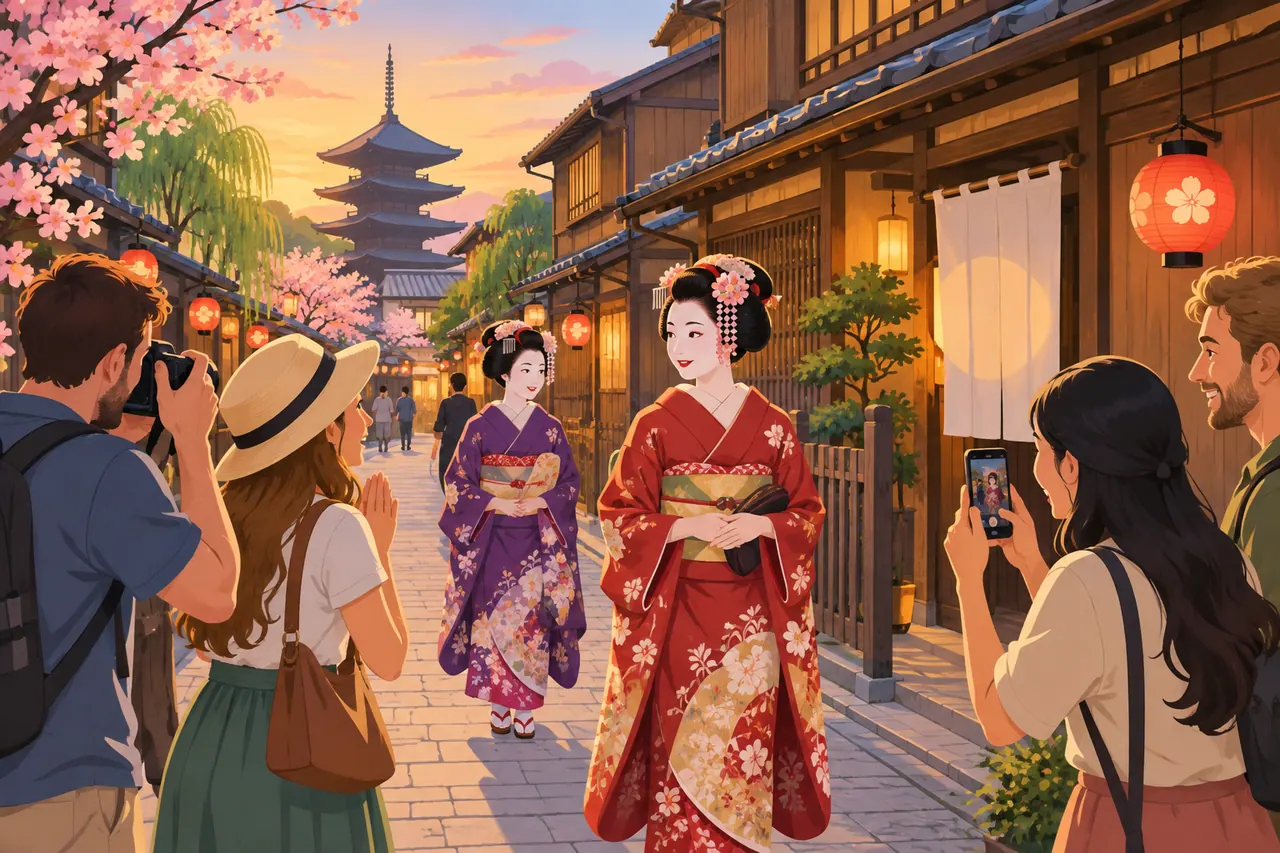
Geisha Experience in Japan: Prices, Booking and Etiquette by City
Contents
- 1. What a geisha experience in Japan includes
- 2. Types of geisha experience: compare the format
- 3. Geisha experiences in Japan by city
- 4. Geisha experience prices in Japan and how to book
- 5. Geisha experience etiquette in Japan
- 6. Choose an experience for your group’s practical needs
- 7. FAQ: geisha experiences in Japan
A geisha experience in Japan might mean watching a public dance performance, joining a booked tea-and-show programme, or arranging a private session for your group. These are different products: a ticket to a public show is not the same as a private dinner, and a headline price may be per person or for the whole group. Compare the programme, eligible ages, date, language support and final cost before booking.
Prices and dates below reflect official programme information checked on November 2, 2026. Some listings refer to events that have already taken place; use them as examples of format and published terms, not as offers that are still available. For a current booking, confirm the date, price and conditions with the organiser.
On this page
- What a geisha experience includes
- Formats to compare
- Experiences by city
- Prices and how to book
- Etiquette
- Choosing for your group
- Frequently asked questions
What a geisha experience in Japan includes
A programme may include dance, music, conversation, tea, food or party games, but the mix depends on the specific event. Read the activity description and inclusions rather than assuming that every experience is an ozashiki banquet. A photo opportunity, meal or interpreter may be available in one programme and absent from another.
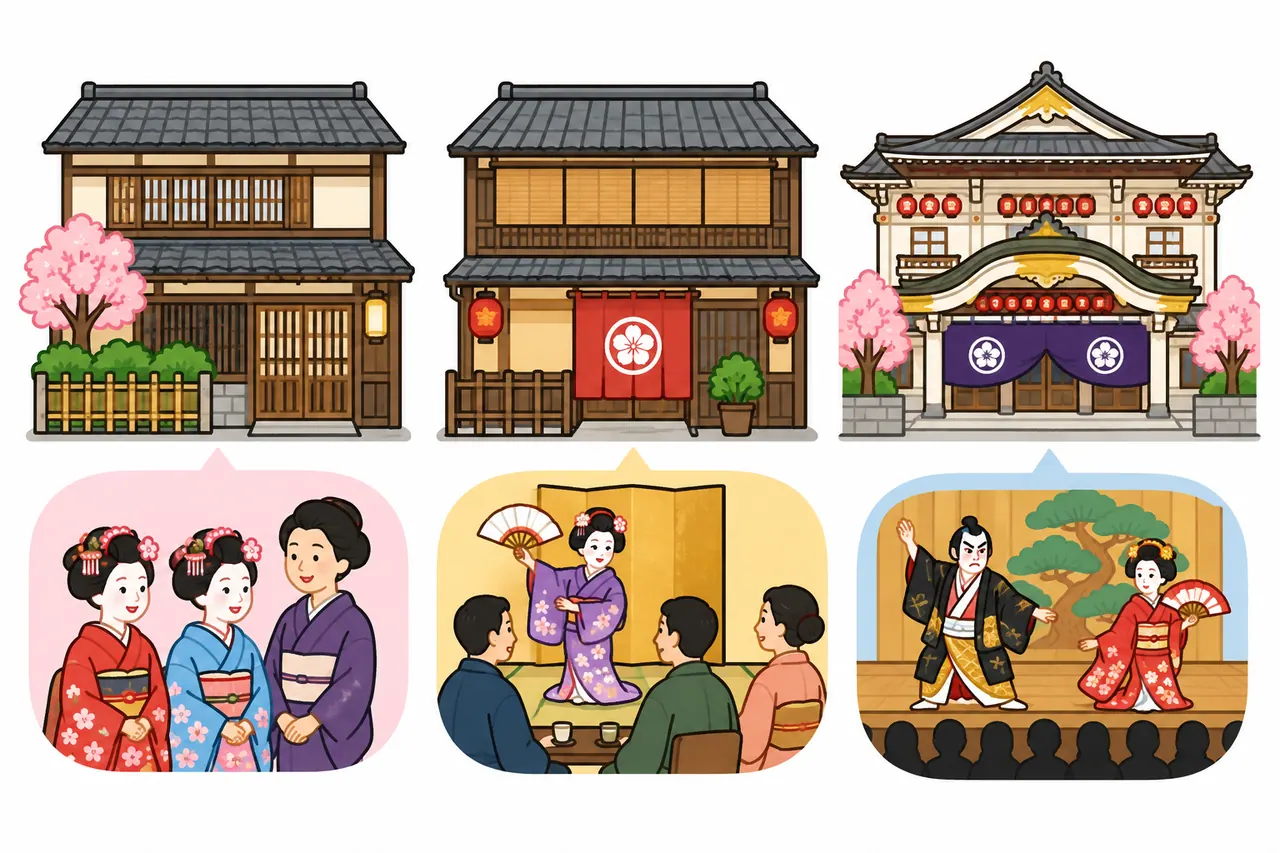
Kyoto’s terminology can help explain the setting. An ochaya is a place that receives and entertains guests, an okiya is a house where maiko and trainees live, and a kaburenjo is a venue for dance and song. In Kyoto, maiko describes someone training to become a geiko, the local term for geisha; Kyoto’s official tourism explanation describes roughly a year of preparation and an apprentice stage before becoming a maiko, followed by the change to geiko, called erikae, around age 20. Kyoto’s official explanation of the five kagai and their terminology also names Kyoto’s five geisha districts: Gion Kobu, Gion Higashi, Kamishichiken, Miyagawacho and Pontocho. Shimabara was formerly included in the count of six.
A performer’s role can also vary within a programme. In Hakata’s terminology, jikata provide shamisen and other musical accompaniment, while tachikata dance; a performance may feature one or both roles. Some experiences list party games such as tora tora, konpira fune fune or tosenkyo, but a game’s name does not tell you its full rules. Follow the host’s instructions if you are invited to take part.
You do not need to learn every term before choosing. First decide whether you want to watch, join a scheduled experience or arrange a session for your own group. Then check who performs, what activities are included, whether interpretation is provided and what the listed price covers.
Types of geisha experience: compare the format
Compare like with like: a public ticket price and a private group price cannot be ranked by their headline amounts alone. The options below illustrate the kinds of offers described in the official listings, but dates and prices may be tied to a particular event or season. Check the linked organiser’s page for the programme you intend to book.
| Format | Example | What to check |
|---|---|---|
| Public performance | Gion Corner or a scheduled Asakusa show | Exact date, individual ticket price, venue and programme |
| Tea and show | MAIKOYA in Gion | Date-based price, minimum age, interpreter and booking terms |
| Private group session | Furumachi in Niigata | Group total, venue, excluded dates and extra admission charges |
| Restaurant course | Hamacho in Kochi | Minimum group size, menu, performer time and final price |
| Special teahouse programme | Kanazawa city project | Specified Saturday, age conditions, access and cancellation terms |
A public performance is usually the clearest format to compare when you want a seat at a scheduled show, but do not assume that every listing publishes an individual price. A booked tea experience can include several activities within a set time; MAIKOYA, for example, describes tea, dance, conversation and a commemorative photograph in about 45 minutes. A private or restaurant session may give your party a different arrangement, but the price may be quoted for a group or depend on a minimum number of guests.
Language support is another point to compare directly. MAIKOYA states that English interpretation is included, whereas Hakata’s regular performances do not include an interpreter. An English-language booking page is not proof that spoken English assistance is part of the event. If a programme does not specify language support, ask the organiser what can be arranged for your date.
Geisha experiences in Japan by city
Start with the city already on your itinerary, then check the official page for the actual experience and date. The examples below keep published event dates, seasonal information and current booking questions separate. A past event listing can help you understand a format, but it is not a reservation for a future performance.
Kyoto: MAIKOYA, Gion Corner and the five kagai
MAIKOYA’s Gion tea-and-show experience lasts about 45 minutes and includes tea, dance, conversation and a commemorative photograph. A maiko normally performs, although a geiko may perform on some days, and an English interpreter is included. Children under seven cannot enter, advance booking is required, and walk-ins are not accepted; the official MAIKOYA experience page shows the price after you select a date in its booking calendar. Kimono rental is separate and requires its own time slot at least an hour before the experience.
Gion Corner is a public performance at the small theatre in Gion Kobu Kaburenjo. Its official group information lists performances at 18:00 and 19:00 and describes kyomai dance alongside other performing arts, including tea ceremony, flower arrangement, koto music, gagaku, kyogen and, depending on the season, bunraku or noh. The published rate for general groups of at least 20 is ¥4,700 per person; that information does not establish an individual ticket price or a performance duration. See Gion Corner’s group and school information for the terms that apply to that group rate.
Kyoto’s five kagai are Gion Kobu, Gion Higashi, Kamishichiken, Miyagawacho and Pontocho. Kyoto’s official tourism article also discusses seasonal dance performances such as Miyako Odori and Kyo Odori in April, Kamogawa Odori in May, and the five-district Miyako no Nigiwai in June. Those dates describe the article’s programme information, not a confirmed schedule for 2026 or later, so check the individual event’s current page before planning around it.
Tokyo: Asakusa, Kagurazaka and Hachioji
Asakusa’s 2026 spring and summer Ozashiki Odori performances took place on April 11, June 6, 13 and 20, and July 4 and 11 at the Asakusa Culture Tourist Information Center’s sixth floor. The listed starts were 13:00 and 14:30, with Premium tickets at ¥6,000 and Standard tickets at ¥5,000. Those prices belong to the completed spring/summer performances. The Taito City event listing states that those tickets were sold online until the day before and at the information centre’s first-floor counter, including same-day tickets, and gives 03-3842-5566 as a phone contact; do not assume the autumn event has the same sales rules.
The autumn 2026 Asakusa listing covers October 3 through November 14, with starts at 13:00 and 14:30. GO TOKYO describes an approximately 40-minute programme featuring dance, taikomochi entertainment and a games experience, but individual performance dates and prices need confirmation with the organiser. The autumn details are in the GO TOKYO event listing; the spring/summer ticket prices and sales conditions above should not be carried over to this season.
In Kagurazaka, Ryotei Yukimoto’s 27th Kagura Goyomi events took place on October 9 and 17, 2026. The listed ¥38,000 per person included food, drinks and geisha hospitality, while playing in a separate room after the event cost extra. Those dates have passed, and the Yukimoto events page does not establish the next programme’s price or inclusions; it gives 03-3260-1576 as the contact for asking about an event.
Soto Terrace in Hachioji lists a daytime session from 12:00 to 13:00 at ¥6,000 including tax, and an evening session from 18:30 to 20:30 at ¥14,000 including tax. A session is cancelled if there are five or fewer participants, reservations close three days before the event, and same-day booking is not accepted. A separate package with three geisha for 120 minutes is ¥95,000 including tax, with food and drinks extra; check the Soto Terrace programme page for dates and availability rather than treating these offers as interchangeable.
Niigata, Kanazawa, Hakata, Kochi and Hakone
Niigata’s Furumachi private programme runs for 60 minutes for groups of one to 30 during the period April 1, 2026–March 31, 2027. The listed group prices, all including tax, are ¥130,000 at Enkikan, ¥130,000 at the Former Saito Family Villa and ¥80,000 at Sangyo Kaikan; admission to the villa is extra. The programme’s time window is 12:00–15:00, excluding Sundays, public holidays and venue closure days. Contact the Niigata Tourism Convention Association during the planning stage at 025-223-8181, weekdays 08:30–17:15, using the official Furumachi programme information.
Kanazawa’s special project opens teahouse experiences to the public on specified Saturdays in 2026–27, from 13:00 to 14:00. General admission is ¥5,000 and the listed price for university students and younger eligible students is ¥2,500; tea and sweets are included. Preschool children cannot participate or enter, and the programme excludes July, August and year-end/New Year dates. The venue is upstairs without a lift, and the project asks guests to wear socks, with a spare pair useful in rainy weather. Check the Kanazawa project page for its specified dates, access details and cancellation conditions.
Hakata Traditional Performing Arts Hall lists geigi performances on December 10 and 26, 2026, at ¥3,000 per person for 50 minutes. Regular performances generally require advance reservation and advance payment, and they do not include an interpreter. Select the exact performance on the official schedule and use the hall’s request-performance information if you are asking about a different arrangement or language needs.
At Hamacho in Kochi, the January 2026 course revision lists geigi ozashiki courses at ¥33,000, ¥55,000 and ¥88,000 per person, including tax, for groups of at least four. Tosa geigi accompany guests for about an hour, and parties of four or fewer are asked to consult the restaurant. A separate ¥22,000 introductory course is hosted by restaurant attendants rather than geigi; see the Hamacho dinner course page and ask which course applies to your party.
Kanagawa’s tourism material describes an accommodation-based Hakone experience with about 20 minutes of song and dance, about 30 minutes of games and about 60 minutes of conversation. The material does not provide a current package price, so treat it as a description rather than a priced ticket offer. For inquiries, it lists Kanagawa DMO at 045-681-0007, 09:00–17:00; use that contact to ask about the actual venue, date and charge.
Geisha experience prices in Japan and how to book
The most useful comparison is the final amount for the particular date, party and format you want. The table separates per-person prices from group prices and notes important limits; it is not a guarantee that a place is still available. All figures are the published amounts in the official information checked on November 2, 2026.
| Programme | Published price | Unit and key condition |
|---|---|---|
| Niigata, Sangyo Kaikan | ¥80,000 | Per group of 1–30; 60 minutes |
| Niigata, Enkikan or Former Saito Family Villa | ¥130,000 | Per group of 1–30; 60 minutes; villa admission extra |
| Kanazawa special project | ¥5,000 general; ¥2,500 for eligible students | Per participant; specified Saturdays |
| Hakata, December 10 or 26 performance | ¥3,000 | Per person; 50 minutes |
| Hamacho geigi course | ¥33,000, ¥55,000 or ¥88,000 | Per person; from four people |
| Soto Terrace daytime or evening session | ¥6,000 or ¥14,000 | Per session; participant conditions apply |
| Soto Terrace three-geisha package | ¥95,000 | Package for 120 minutes; food and drinks extra |
MAIKOYA’s current price is selected by date in its booking calendar, so there is no single amount to quote here. Gion Corner’s published ¥4,700 price applies to general groups of at least 20, not an established individual ticket price. For a restaurant course or private arrangement, keep the meal, drinks, interpreter, room or venue charges and any separate admission visible in the quote rather than estimating them from another event.
A sensible booking process is to follow the official page for the exact programme, not just a general search for “geisha experience.” Use these steps before paying:
- Choose the programme and date. Confirm whether the listing is for a current event, a past example or a season with dates still to be announced.
- Enter your party details. Give the organiser the number of guests and ages, especially if children are travelling with you or the price depends on group size.
- Check what is included. Confirm the meal, drinks, performance, interpreter, photograph and any separate venue admission.
- Ask for the final amount. If the page does not explain a charge that matters to your group, ask the organiser before booking.
- Read the cancellation terms. Kanazawa’s special project has cancellation charges that vary by timing, including 100% for a same-day cancellation; it also has refund-fee conditions.
- Keep the confirmation. Save the venue name, address, meeting time, contact details and payment conditions so you can follow the confirmed arrangement on the day.
Booking channels differ. MAIKOYA requires advance booking and does not accept walk-ins; its separate kimono rental needs a time slot at least an hour before the experience. Niigata asks guests to consult the tourism bureau while considering dates, while Hakata’s regular performances use the official performance details and accept payment by bank transfer or PayPal. Soto Terrace reservations close three days before the event and same-day bookings are not accepted. For Yukimoto’s Kagura Goyomi, call 03-3260-1576 to ask about the date and programme.
Past prices should not be mistaken for current quotations. Yukimoto’s October 2026 dates have passed, as have Asakusa’s spring and summer performances, and their published terms may not carry over to the next event. The Akasaka Asada page describes a plan introduced in 2018; confirm current operation and price with the hotel before relying on it.
Geisha experience etiquette in Japan
Follow the rules of the venue and the event you actually booked. Permission to take a photograph at one programme does not give permission to photograph performers elsewhere, and a public performance reservation does not grant access to private streets or property. When an organiser gives instructions, treat them as part of the experience rather than assuming that another venue’s rules apply.
At MAIKOYA, there is a designated commemorative photo opportunity after the performance, but filming the full tea ceremony or dance is not permitted. If you want to make a short private video, ask during the designated photo time and follow the staff’s answer. The MAIKOYA programme page describes these restrictions.
Gion’s private-road rules prohibit photography on those roads. Do not block a route to wait for performers, enter private property or treat a street as a photo location; use public routes and follow posted notices. The Kyoto City and local-district notice sets out the photography rule for private roads.
For meals, tell the restaurant about allergies or religious restrictions before the visit and ask about the actual course. Hamacho asks guests to consult in advance, while Kappo Kaga says it accepts consultations about vegetarian, halal and kosher meals. These are inquiry routes, not a guarantee that every dish or course will meet every requirement; confirm what the restaurant can provide for your booking.
Choose an experience for your group’s practical needs
The programme that suits one traveller may not suit another, even if the event description sounds appealing. Check the price unit, minimum group size, ages, language, venue access and meal conditions before comparing totals. A short written inquiry can resolve several of these questions before you commit.
Solo travellers and couples
First establish whether you are buying an individual seat or arranging a private session. Niigata’s ¥80,000–¥130,000 prices are for a group of one to 30, so the published amount is a group price, not a per-seat ticket that can be split with unrelated travellers. Hamacho’s geigi course is listed from four people, and smaller parties are asked to consult the restaurant.
For a solo traveller, a scheduled public performance or an individual-seat programme may be easier to compare than a private booking, but check the exact admission terms. Couples should ask whether a two-person booking is accepted and whether the price is per person or for the whole party. Do not calculate either person’s bill from a group quote until the organiser confirms the amount payable.
Families and children
Age rules vary by programme rather than following one rule across Japan. MAIKOYA does not admit children under seven, while Kanazawa’s special project excludes preschool children from both participation and entry. The Akasaka Asada hotel page says guests under 18 cannot enter, but the page describes a plan introduced in 2018, so check current availability and conditions with the hotel before planning around it.
Soto Terrace’s daytime session allows elementary- and junior-high-school children when a guardian makes the application, and lists a child price of ¥3,000 including tax. Do not extend that price to its evening session or private package without confirmation. Before adding up a family budget, establish that every child can enter and that the child category applies to the particular booking.
English interpretation and other language needs
An English-language website does not establish that the event itself includes an interpreter. MAIKOYA explicitly includes an English interpreter in its tea-and-show programme, while Hakata’s regular performances do not include one. The official listings do not establish spoken-English conditions for every restaurant or event in this guide.
For a request-based programme, ask what language help can be arranged on your date. Specify whether you need help with the booking, explanations during the performance or conversation afterward, since those are different needs. Keep the organiser’s written reply with your confirmation so the whole party knows what has been agreed.
Venue access, food and the meeting point
Kanazawa’s special project takes place upstairs in a venue without a lift, so confirm that the stairs work for everyone in your party before buying. The project also asks guests to wear socks; a spare pair can be useful in rainy weather. These are programme-specific conditions, not general rules for every teahouse.
Niigata offers three distinct venues at different prices: Enkikan, the Former Saito Family Villa and Sangyo Kaikan. Choose the venue before planning your route, and remember that the villa’s admission is extra. Use the confirmed venue name and address from the booking rather than relying on a map pin alone.
For dietary requirements, ask about the exact course and ingredients. Hamacho requests advance consultation about allergies and religious restrictions, and Kappo Kaga accepts consultations about vegetarian, halal and kosher meals. Do not assume a course is suitable from its cuisine name or a photograph of another guest’s meal.
Dance, games, music and photographs
A public stage show is not automatically a private banquet, and it may not include audience games. Gion Corner lists kyomai and other performing arts, while MAIKOYA specifies tea, dance, conversation and a photo opportunity. Asakusa’s autumn listing describes dance, taikomochi entertainment and a games experience, so read the listing for the actual programme rather than inferring it from a photograph.
If games matter to you, look for them in the programme description or ask the organiser. Soto Terrace names tora tora, konpira fune fune and tosenkyo, but those names do not establish the rules or level of participation at every venue. The same care applies to music and photos: confirm which performers and activities are included, and follow the event’s photography instructions.
Cancellation and dated listings
A dated event announcement tells you what was advertised, not whether a place is reserved for you. Asakusa’s spring and summer 2026 performances and Yukimoto’s October 9 and 17 events have passed; they remain useful examples of format and published terms, but a future booking needs its own date and confirmation. Do not transfer a past ticket price to a later event unless the organiser confirms it.
Other listings also have conditions that affect planning. Niigata’s programme runs from April 1, 2026 to March 31, 2027, within a 12:00–15:00 window and excluding specified days; Soto Terrace requires booking at least three days ahead. Kanazawa’s special project has specified Saturdays and cancellation charges, including 100% for a same-day cancellation. Save the relevant page and the organiser’s reply together, and use the contact route on the confirmation if your plans change.
FAQ: geisha experiences in Japan
Can visitors book a geisha experience without an introduction?
Yes, public programmes and advance-booked experiences provide ways to attend without arranging a private teahouse visit. MAIKOYA accepts advance reservations, and Kanazawa’s special project opens specified teahouse experiences to the public. Use the official booking process for the programme you choose rather than assuming that one city’s arrangement applies to another.
Are prices per person or per group?
Both kinds of pricing appear in the official listings. Niigata’s ¥80,000–¥130,000 Furumachi sessions are priced per group of one to 30, while Kanazawa’s general ¥5,000 special-project admission is per participant. Check the price unit before comparing options or working out your party’s total.
Can I attend on my own?
That depends on whether the programme sells individual seats or charges for a group session. The Niigata price is a private group price, and Hamacho’s geigi course is listed from four people, with smaller parties asked to consult. Ask the organiser whether your party size can book and what the final amount would be.
Are geisha experiences suitable for children?
Age conditions are specific to the programme. MAIKOYA excludes children under seven, and Kanazawa’s special project excludes preschool children from participation and entry. Soto Terrace lists a daytime child price of ¥3,000 for elementary- and junior-high-school children applying with a guardian, so check its separate conditions before booking.
Is English interpretation included?
Not in every programme. MAIKOYA explicitly includes an English interpreter, while Hakata’s regular performances do not. If the listing does not say, ask the organiser what language support is available for the exact date and activity.
Can I take photographs or video?
Follow the policy for the specific venue and activity. MAIKOYA provides a designated photo opportunity but does not permit filming the full tea ceremony or dance; a short private video requires asking during the designated time. Photography is prohibited on Gion’s private roads, so do not use a performance booking as permission to photograph there.
What should I wear?
The information here does not establish a dress code that applies to every ozashiki experience. Kanazawa’s special project asks guests to wear socks rather than enter barefoot, and recommends having spare socks in case of rain. Check your own booking confirmation for any other venue-specific instructions.
Can I request vegetarian, halal, kosher or allergy-conscious food?
Ask the restaurant about the exact course before booking. Kappo Kaga accepts consultations about vegetarian, halal and kosher meals, and Hamacho asks guests to discuss allergies and religious restrictions in advance. These statements do not guarantee that every course can meet every requirement, so get confirmation for your group’s needs.
What happens if I cancel?
Cancellation terms vary by programme and date. Kanazawa’s special project has timing-based cancellation charges and a 100% charge for cancellation on the day, as well as refund-fee conditions; the Akasaka Asada page lists a 100% charge from 14 days before use for the plan described there. Confirm which terms apply to your own reservation, particularly where a page may describe an older offer.
How do I check the meeting place?
Use the venue address in your booking confirmation and compare it with the organiser’s current event information. Niigata has three different venue options, and the villa has a separate admission charge; a general map search cannot tell you which one was assigned to your booking. Keep the confirmation available on the day so you can check the venue name, meeting time and contact details.
The best choice is the programme that offers the experience you want on a date you can attend, at a total cost and under conditions your group understands. Confirm the actual venue, age rules, language support, inclusions and cancellation terms before paying. For a longer trip, fit the confirmed event into your Japan itinerary rather than building the rest of your travel around an unconfirmed listing.


)](https://i.ytimg.com/vi/3J5VSdqPW4Y/mqdefault.jpg)


)](https://i.ytimg.com/vi/4NOXJydIPKk/mqdefault.jpg)