Osaka Travel Guide: Areas, Transport, Food and 2–4 Day Plans
Contents
- 1. Osaka at a glance: history and five sightseeing areas
- 2. Getting to Osaka and moving around the city
- 3. Osaka sightseeing passes: what they cover and how to compare value
- 4. Food, accommodation, seasons and practical preparations
- 5. Build a route and budget for two to four days
- 6. Frequently asked questions
For a first visit, choose a base in Kita/Umeda or Minami/Namba, then group sights by area to avoid unnecessary cross-city trips. A practical two-day outline is Osaka Castle and Minami on one day, then Tennoji and Kita on the other. With three or four days, add a full day in the Bay Area or a day trip outside the city.
Before booking, settle three things: how many days you have, which airport you will use, and whether a sightseeing pass fits your plans. If you are arriving at Kansai International Airport (KIX) and staying near Namba, Nankai’s Rapi:t is a direct option taking as little as 34 minutes; its Kanku Tokuwari ticket is ¥1,560 for an adult regular seat. For attractions, compare the current Osaka Amazing Pass and Osaka e-Pass rules with the admission prices of the sights you actually plan to visit. Dates, prices and operating details below reflect the supplied official-source checks, mainly dated November 3, 2026; Osaka Castle Tower listing details were also checked November 4, and hotel and restaurant information November 5. Conditions can change, so follow the linked operator pages before travel.
Osaka at a glance: history and five sightseeing areas
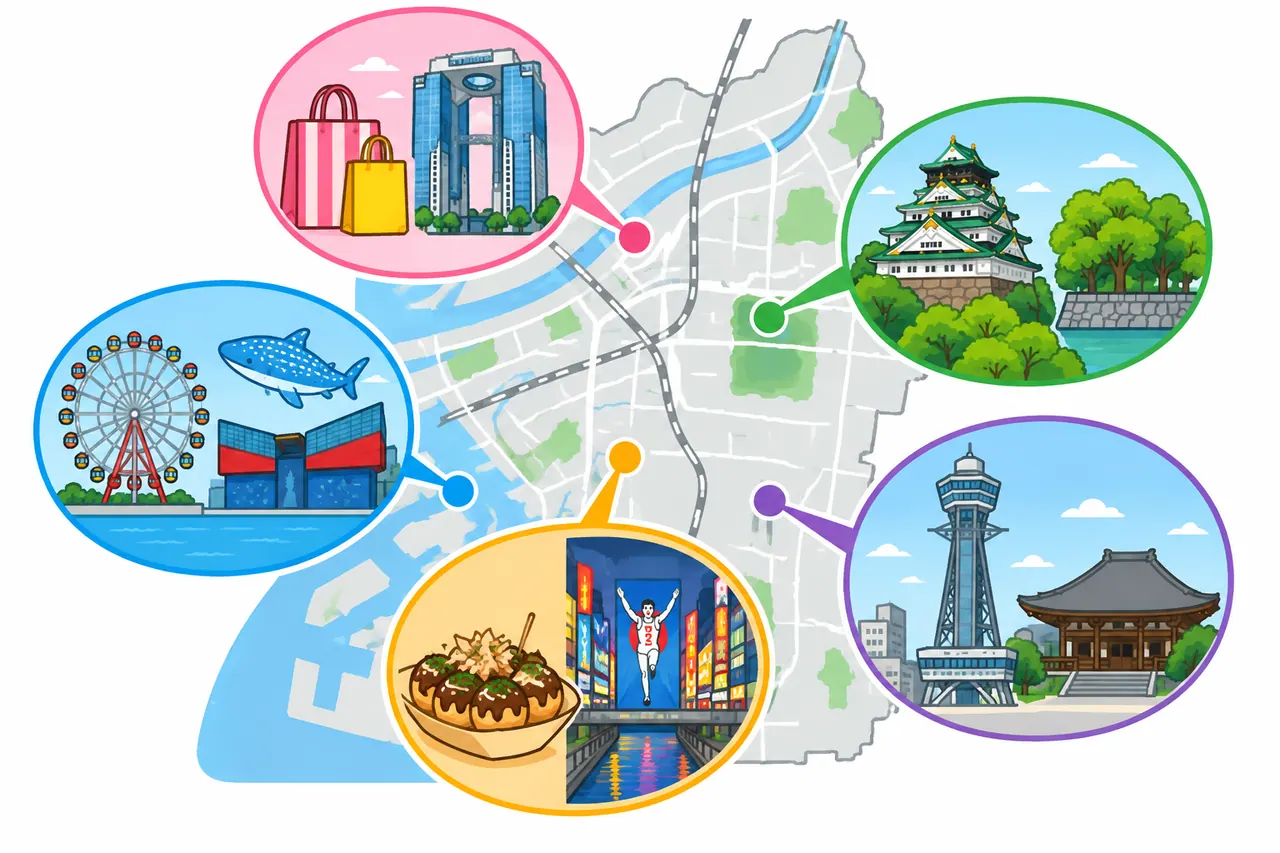
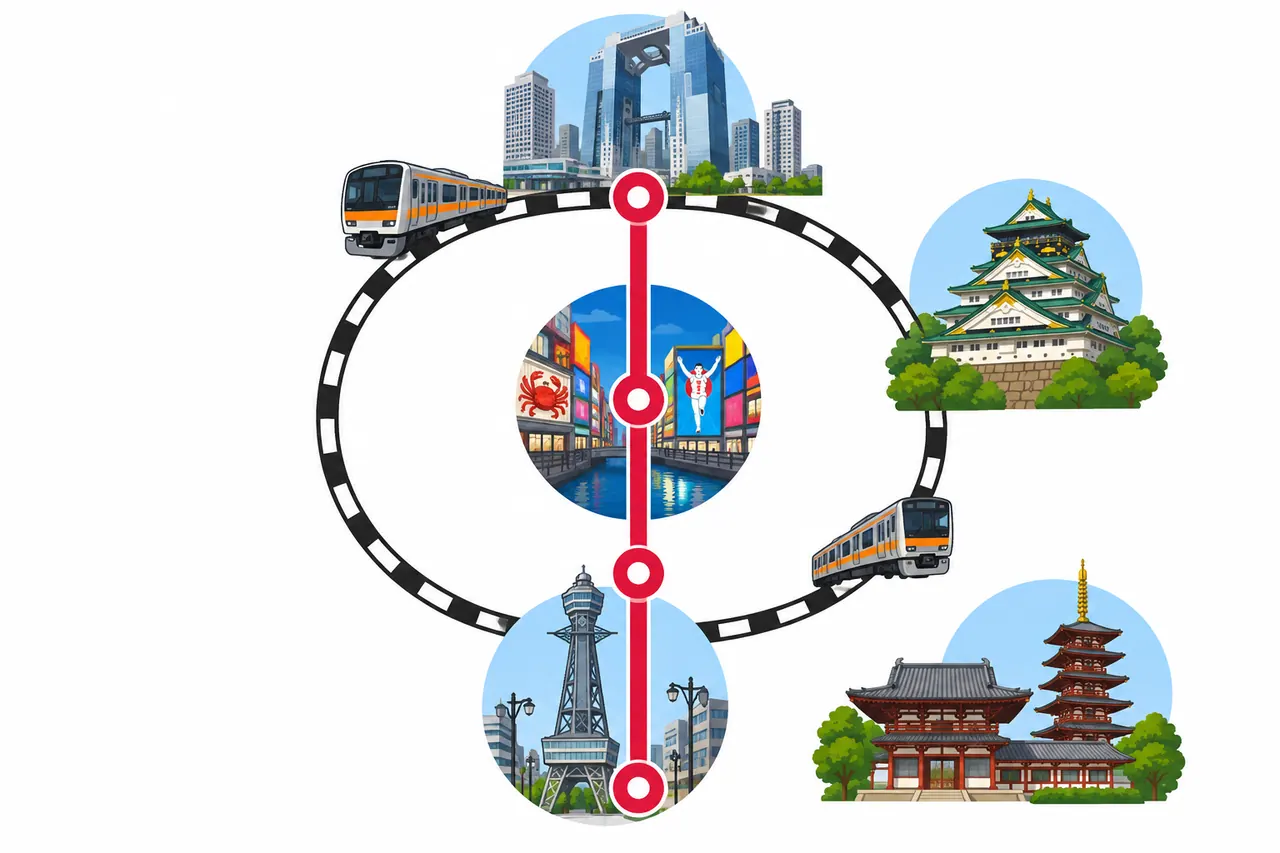
Osaka is a large city in Japan’s Kansai region, known for its castle, shopping streets, food and waterfront attractions. Many visitors also use it as a base for Kyoto and Nara, although a day trip requires a separate check of the train route and timetable. The city’s official tourism site, OSAKA-INFO, groups its visitor attractions into areas that make it easier to plan by neighborhood.
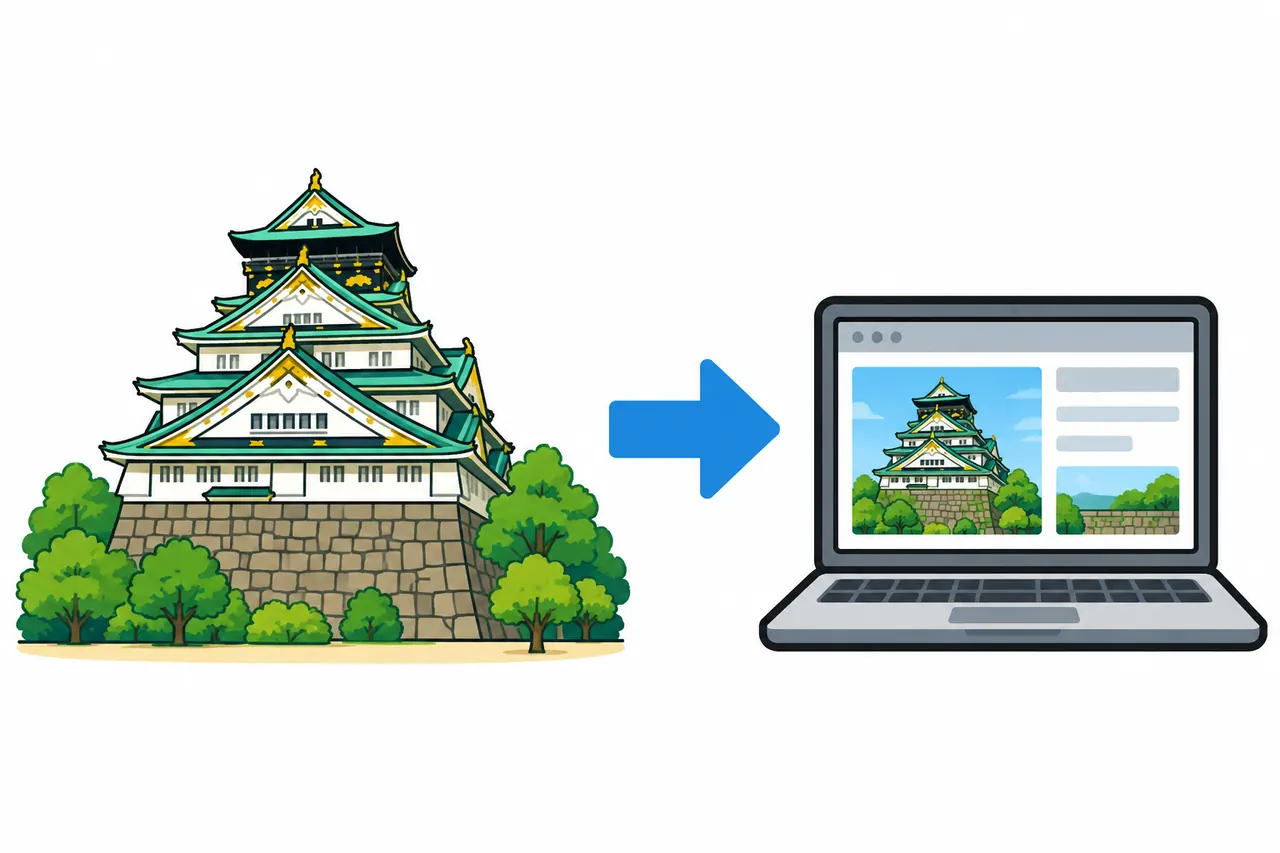

The current Osaka Castle Main Tower is not the original Toyotomi-era tower. The castle’s official history says the present tower is the third, rebuilt in 1931 with donations from citizens and used as a museum from that reconstruction; the stone walls, moats and Otemon gate visible today date from the Tokugawa period or later. The tower was registered as a national tangible cultural property in 1997 and designated an Osaka City tangible cultural property in 2025, according to the castle’s official website.
| Area | Good for | Examples |
|---|---|---|
| Kita / Umeda | Shopping, department stores and city views | Umeda Sky Building, Grand Front Osaka, Hanshin Umeda Main Store, Yodobashi Umeda Tower |
| Minami / Namba | Food, shopping streets and nightlife | Dotonbori, Hozenji Yokocho, Ura-Namba, Sennichimae Doguyasuji |
| Osaka Castle | Park walks, castle museum and gardens | Osaka Castle Park, Main Tower, Nishinomaru Garden, Miraiza Osaka-Jo |
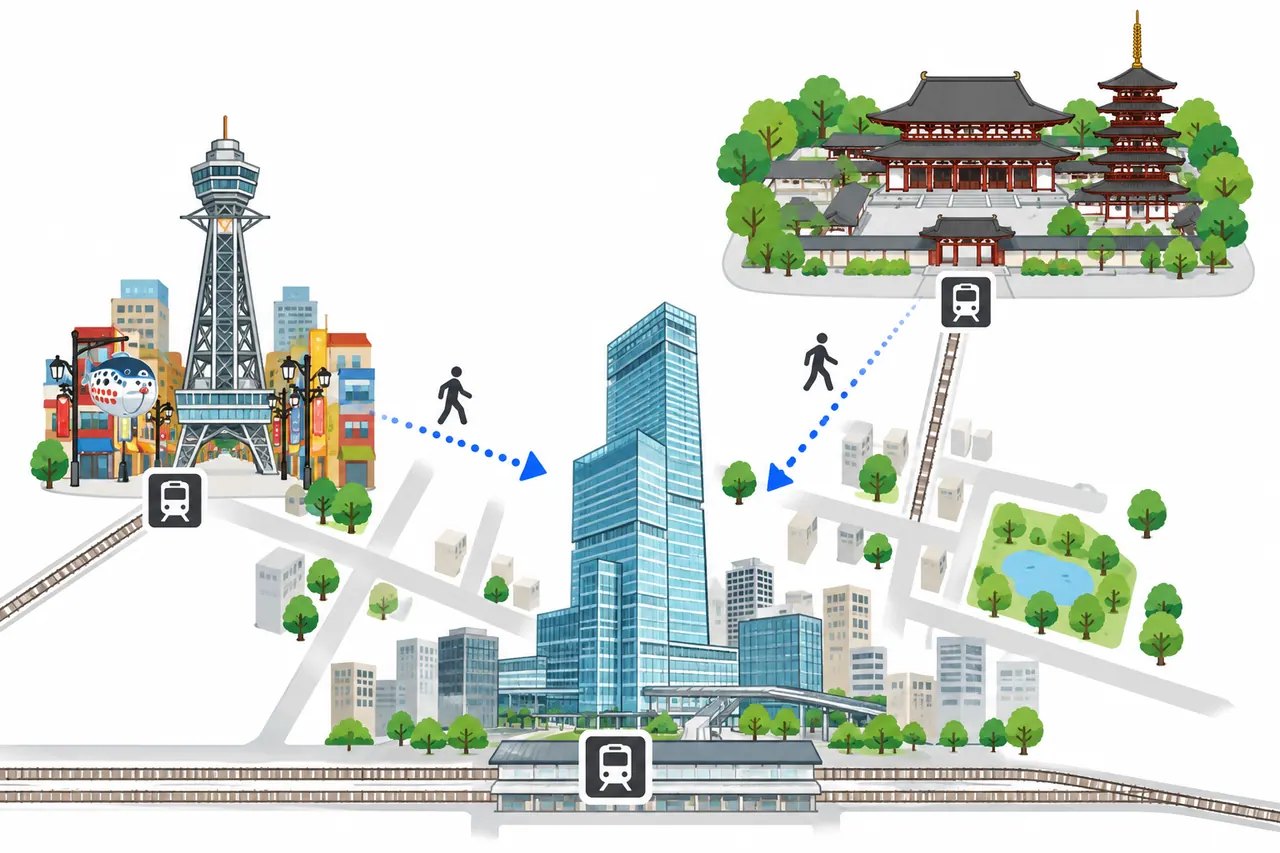
| Tennoji–Abeno | Temple, tower and high-rise views | Tsutenkaku, Shitennoji, Abeno Harukas |
| Bay Area | Theme park, aquarium and sightseeing boat | Universal Studios Japan, Kaiyukan, Santa Maria |
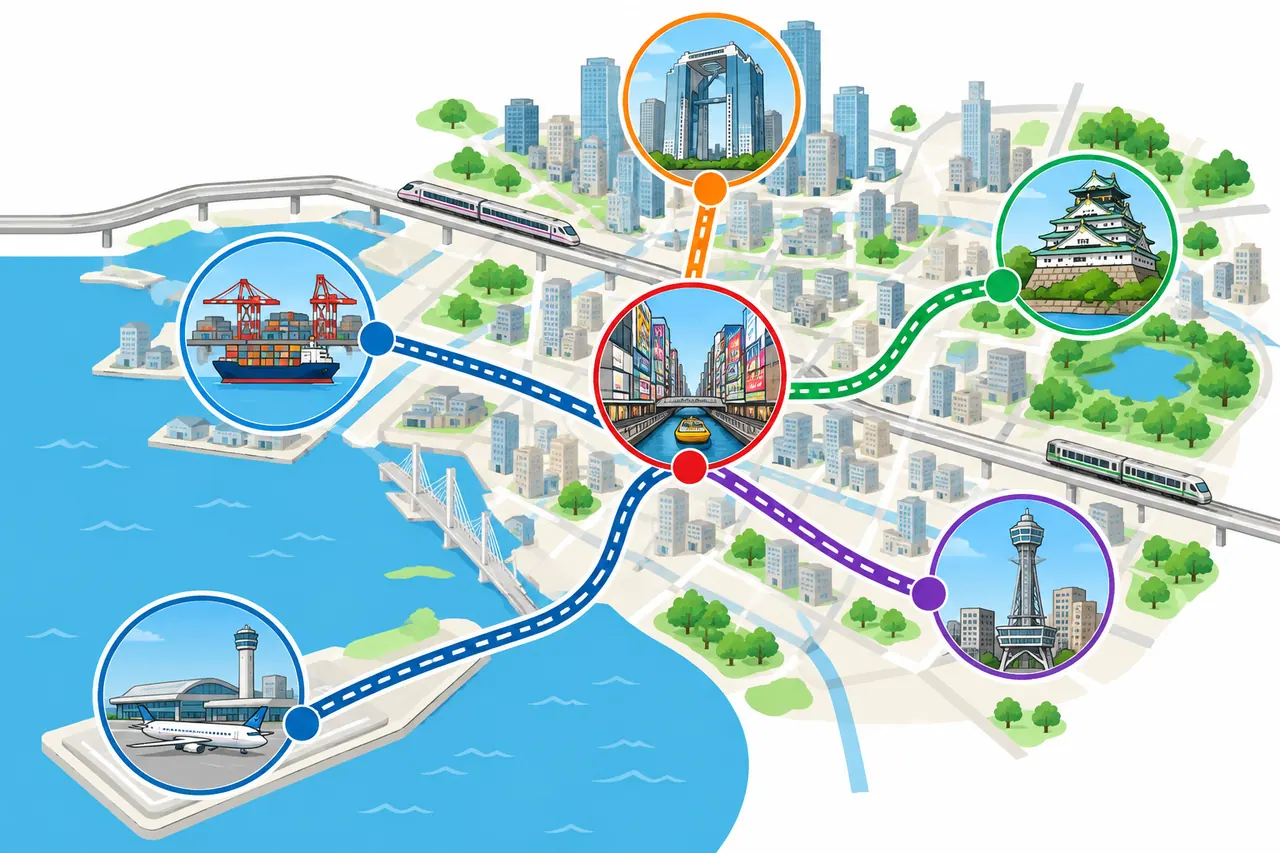
“Kita” means north and usually refers to the Umeda area around Osaka Station; “Minami” means south and refers to Namba and Dotonbori. Nakanoshima, near Kita, is a waterside area with older-style buildings that can be explored on foot from the Kita district. A map-based video by YouTube creator @smarttravelmimi also presents Osaka area by area, including Kita, Nakanoshima, Minami, Tennoji, the castle and Osaka Bay; use it as a visual orientation aid rather than an operating-hours source.
Osaka Castle Park and the Main Tower
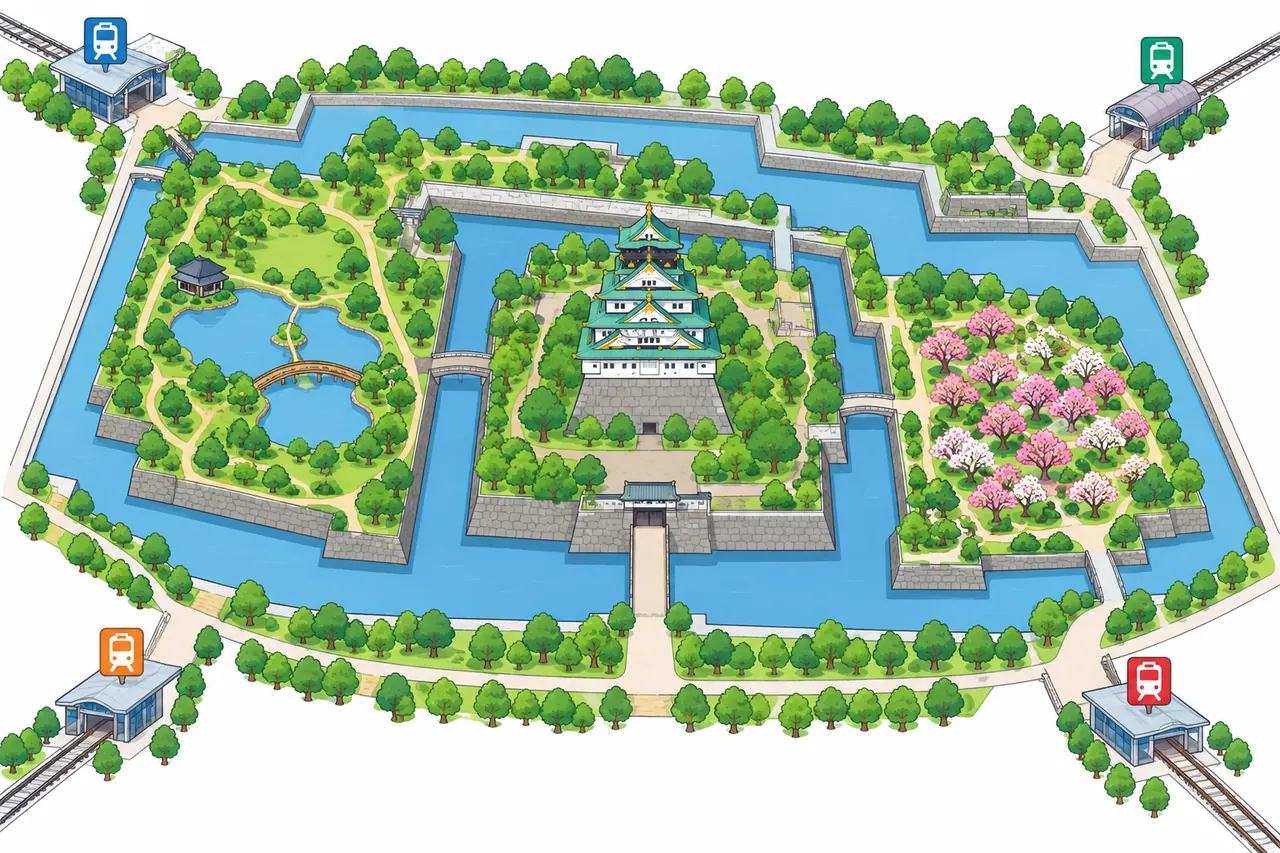
Osaka Castle Park is free to enter and open 24 hours, but individual attractions within the park set their own fees and hours. The park covers 105.6 hectares and includes the Main Tower, Nishinomaru Garden, Miraiza Osaka-Jo and a plum grove with 1,245 trees across 105 varieties, according to OSAKA-INFO’s park guide. JR Morinomiya and JR Osakajokoen are nearby access points; Osaka Metro stations in the surrounding area include Temmabashi and Tanimachi 4-chome.
The Main Tower is a museum, not a free part of the park. Its individual admission is ¥1,200 for adults, ¥600 for high-school and university students, and free for junior-high-school students and younger; proof of student status or age is required, and overseas high-school or university students are asked to show an ISIC card. For groups of 15 or more paying visitors, the adult rate is ¥1,080 each and the high-school or university rate is ¥540 each; contacting the castle about a group does not itself reserve admission.
| Main Tower visitor category | Admission | Proof |
|---|---|---|
| Adult | ¥1,200 | None listed |
| High-school or university student | ¥600 | Student ID; overseas students should show an ISIC card |
| Junior-high-school student or younger | Free | Proof of age |
| Group of 15+ paying adults | ¥1,080 each | Group conditions apply |
| Group of 15+ paying high-school or university students | ¥540 each | Student ID |
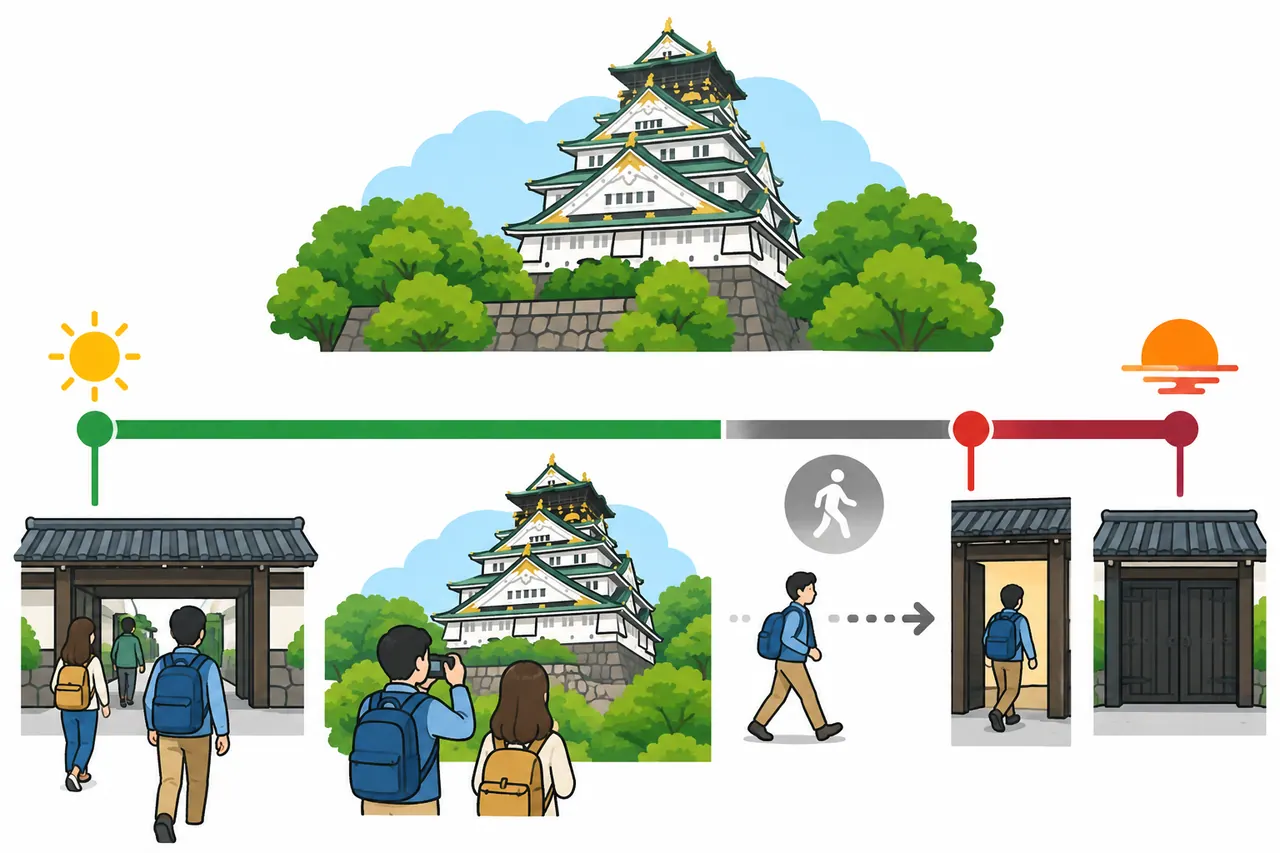
The tower is normally open 9:00–18:00, with last entry at 17:30, and closes December 28–January 1. On busy days, the ticket queue may close early, so do not treat the stated last-entry time as a guarantee that tickets will still be available at that moment. From JR Morinomiya or JR Osakajokoen, allow about 15–20 minutes on foot to reach the tower; follow the park signs and use walking directions to “Osaka Castle Main Tower” for the final approach. Check the castle’s visitor guide before setting out.
Nishinomaru Garden is known for about 300 cherry trees, but its ordinary admission fee, hours and closing days could not be confirmed from the supplied official check: the garden page displayed placeholder content. Check the garden’s official page before making a special trip, and confirm any seasonal admission separately. Cherry blossom conditions also vary by year.
Tennoji–Abeno: Tsutenkaku, Shitennoji and Harukas 300
Tsutenkaku is 108 metres tall and was rebuilt in 1956. Its regular observation deck is open 9:00–21:45, with last entry at 21:15; admission is ¥1,500 for visitors aged 15 and over and ¥800 for ages 5–14. The tower’s official information says the special outdoor deck’s last entry is 21:35, while OSAKA-INFO lists 21:45, so use the earlier official tower time and arrive with a margin. See the Tsutenkaku visitor information.
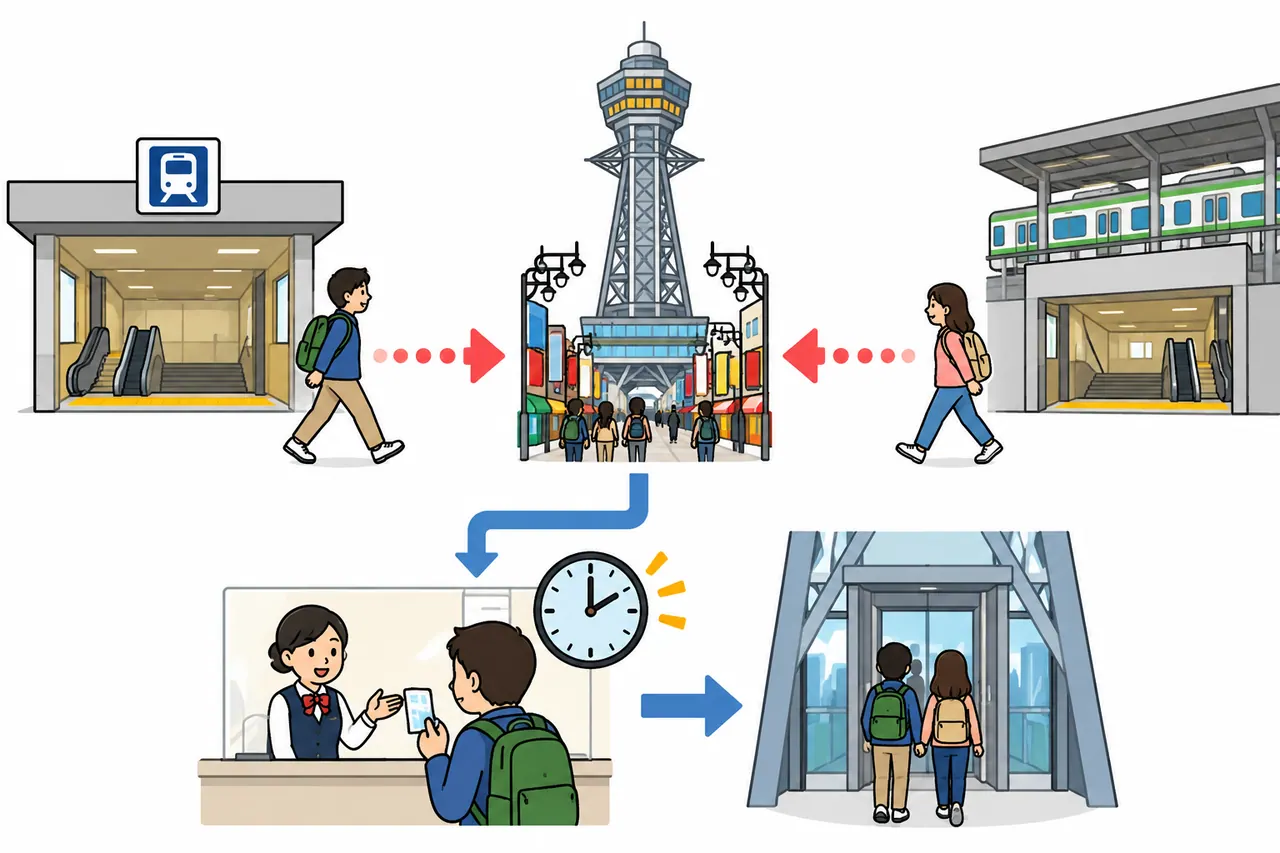
Tsutenkaku uses timed entry, meaning visitors select a time to go up. Holders of the Osaka e-Pass or Osaka Amazing Pass should book their time at the tower counter on the day of their visit rather than assuming the pass itself guarantees an immediate entry slot. Osaka Metro Ebisucho Station is about a three-minute walk away, and JR Shin-Imamiya is about six minutes away; follow station signs toward the tower. The Billiken statue is associated with a local good-luck custom: people say touching the soles of its feet brings good luck.
The surrounding neighborhood is called Shinsekai, or “new world.” A TikTok creator, @the.nomadalmanac, describes a visit and says Shinsekai is about five minutes by metro from Dotonbori; treat that as the creator’s account, not as a verified route time for every trip. Check a route app for your actual starting point and departure time.
Shitennoji is at 1-11-18 Shitennoji, Tennoji-ku. OSAKA-INFO lists the central precinct at ¥500 for adults and the garden at ¥300; the temple is about a five-minute walk from Shitennoji-mae Yuhigaoka Station or a 15-minute walk from JR Tennoji Station. Opening hours were not confirmed in the supplied check, and the tourism listing advises checking with the temple before visiting. “Central precinct” refers to the main group of temple buildings; see the OSAKA-INFO listing and reconfirm current details with the temple.
Abeno Harukas is a tall building in the Abeno area, and its Harukas 300 observation deck occupies floors 58 to 60. OSAKA-INFO lists hours of 9:00–22:00 and says it is open every day, while noting hours may change. Admission was not confirmed in the supplied notes, so check the official Harukas 300 information before budgeting.
Kita: Umeda Sky Building and HEP FIVE
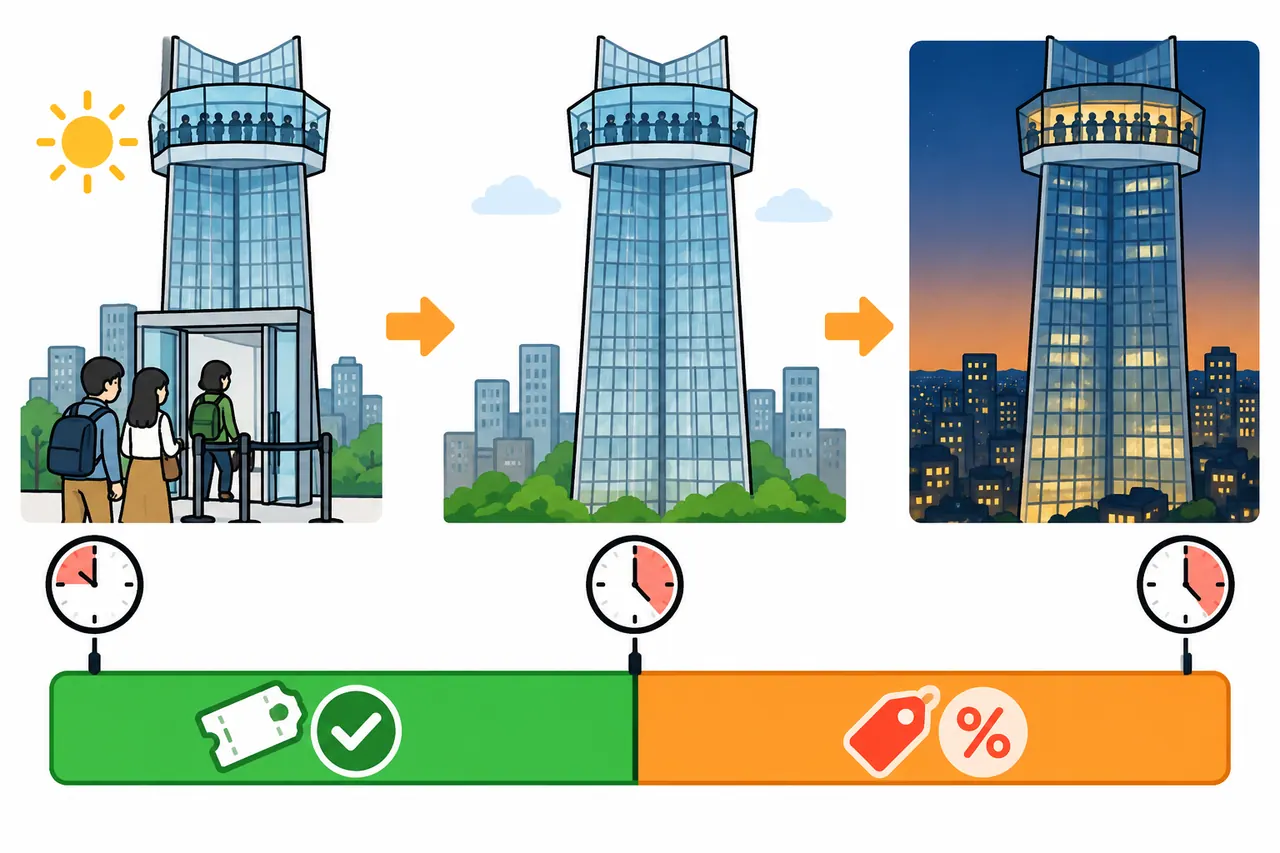
The Floating Garden Observatory is the viewing deck at the top of the Umeda Sky Building. Its normal hours are 9:30–22:30, with last entry at 22:00; the listed admission is ¥2,000 for adults, ¥500 for children aged four through elementary-school age, and free for children under four. Check the operator’s current hours and ticket information because special schedules can apply: on November 8, 2026, for example, maintenance shortened opening to 9:30–19:00, with last entry at 18:30.
The Osaka e-Pass and Osaka Amazing Pass provide free entry to the observatory only until 15:00; after 15:00, the benefit is a 10% discount rather than free admission. That difference matters if you are choosing the observatory for an evening view, because a sightseeing pass will not cover the full listed adult ticket after the free-entry window. HEP FIVE’s Ferris Wheel is another Kita-area option; the e-Pass model-course listing gives a ¥1,000 price dated April 1, 2026, so confirm the current fare with the operator before riding.
Minami: Dotonbori, the river cruise and Kuromon Market
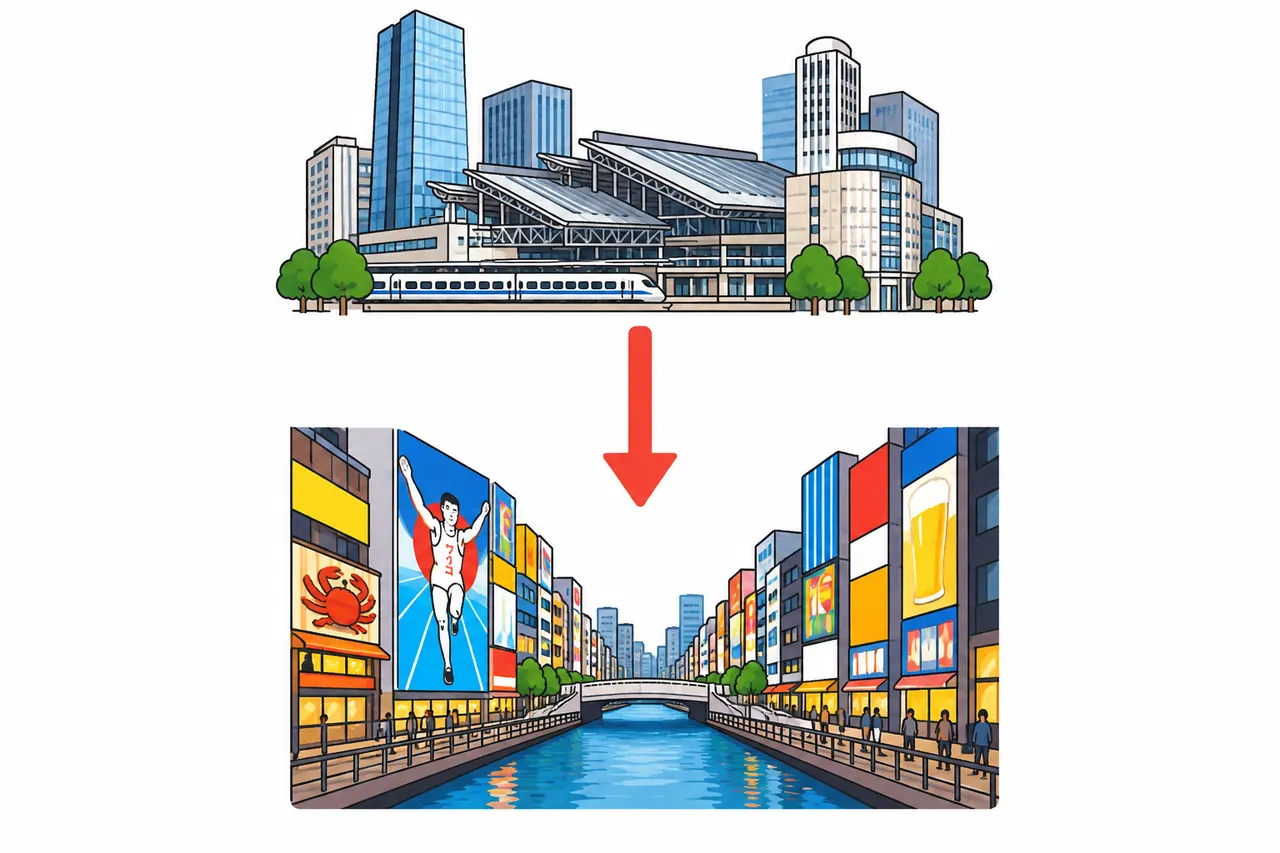
Dotonbori is a busy riverside area in Minami, reached from Namba Station. Walking through the area is free, but each shop and restaurant chooses its own hours, closing days and prices; check individual businesses if you have a particular meal or shop in mind. OSAKA-INFO’s Dotonbori guide is a useful orientation page. Nearby Minami sights also include Hozenji Yokocho, Ura-Namba and Sennichimae Doguyasuji, where a yokocho is a narrow side street often lined with small restaurants.
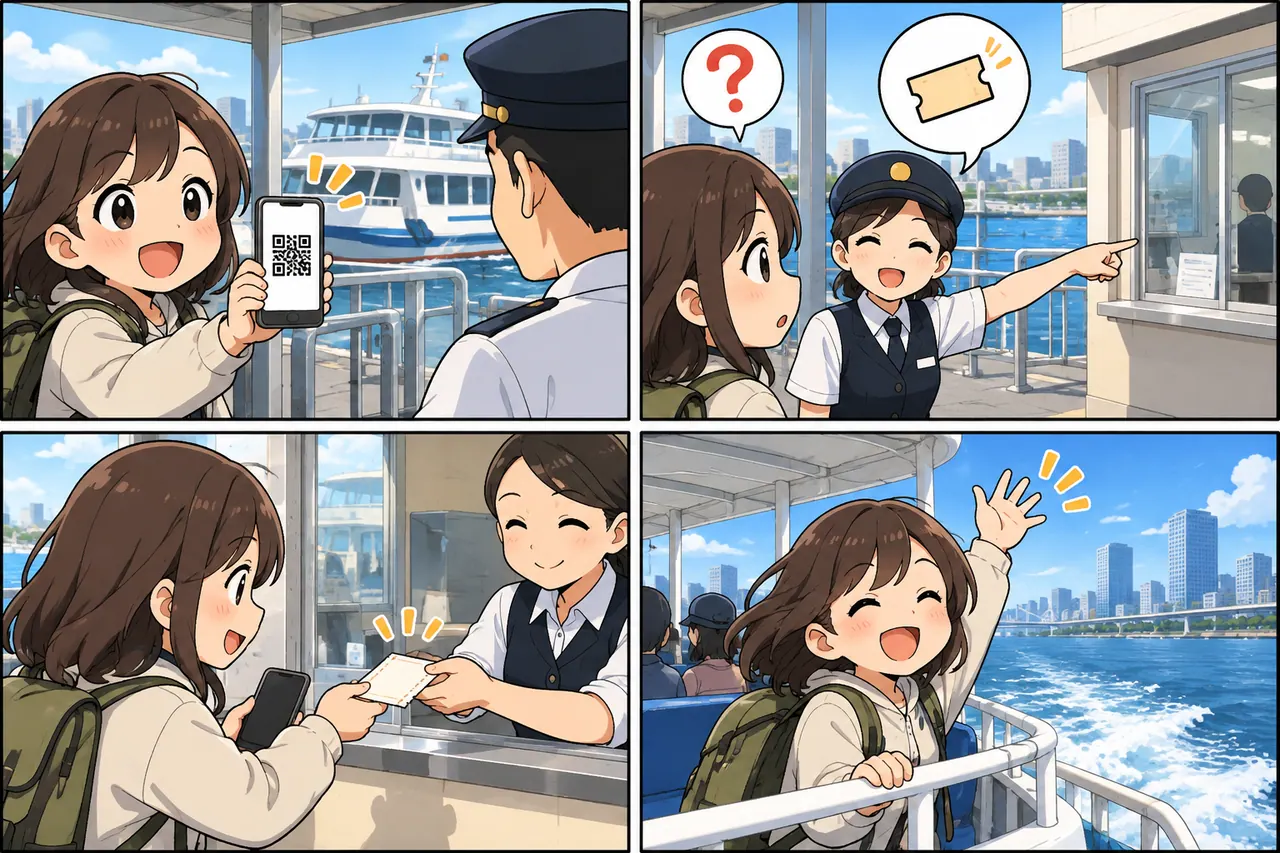
The Tombori River Cruise is an approximately 20-minute boat trip departing from Tazaemonbashi Pier. The operator’s listed prices are ¥2,000 for adults, ¥1,000 for junior-high, high-school, university and vocational-school students with student ID, and ¥500 for elementary-school students; one preschool child per adult rides free, while a second preschool child pays the elementary-school fare. This follows the boat operator’s information because OSAKA-INFO’s price box contains conflicting child notes. The operator’s fare and service information and OSAKA-INFO cruise listing should both be checked before travel.
Boats usually depart at :00 and :30 from 11:00 to 21:00, but weather can cancel a trip or change its schedule. Some departures can be booked and paid for online; OSAKA-INFO says online booking is available until 10 minutes before departure, but the cancellation rules were not confirmed in the supplied check. Read the booking page’s conditions before paying, and allow time to reach the pier.
Kuromon Market has shops selling fresh fish, fruit and vegetables, prepared food and clothing. Store hours, closing days and prices are set by individual businesses and were not confirmed in the supplied check, so avoid treating the market as a single shop with uniform hours or pricing. A Facebook tips video by JoshuainJapan discusses tourist-trap concerns, including prices at the market; use it as a prompt to check posted prices before ordering rather than as a price list.
Bay Area and places beyond the center
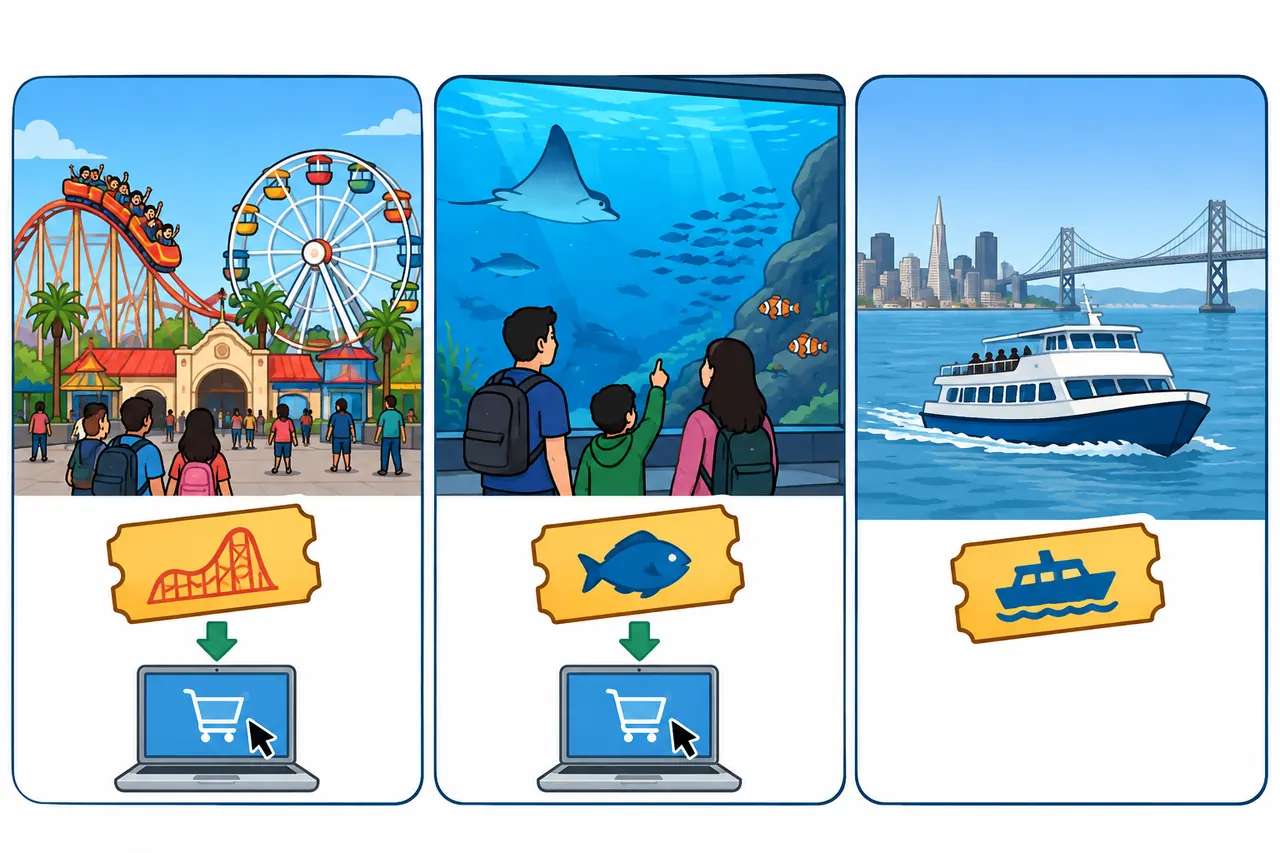
The Bay Area includes Universal Studios Japan (USJ), Osaka Aquarium Kaiyukan and the Santa Maria sightseeing ship. A full day is a practical way to allocate time to one major attraction, but opening schedules and ticket terms need checking for your selected date. A Facebook reel by Paola Rojas shows Osaka Bay, the Tempozan Ferris wheel, Dotonbori arcades and Osaka Castle at sunset; it is a creator’s visual account, not an official guide.
| Attraction | Supplied price or ticket information | What to check |
|---|---|---|
| Universal Studios Japan | 1-Day Studio Pass from ¥8,400 adult and ¥5,500 child; exact price varies by date | Date-specific ticket price and operating hours |
| Kaiyukan | Date-based admission; dated e-tickets are available online | Calendar price and timed-ticket availability |
| Santa Maria | e-Pass lists a choice of one of two trips | Eligible trip and current operating details |
USJ hours change by date. The official schedule showed 8:00–22:00 on November 8, 2026, but this is a dated example, not a standing daily schedule; check the official park calendar. An Express Pass can help visitors skip some lines but does not admit them to the park by itself, so a separate entry ticket is also required; see the official ticket lineup.
Kaiyukan uses date-dependent admission prices and offers online e-tickets for a selected date and time. A specific day’s price could not be retrieved in the supplied check, so use the aquarium’s official ticket calendar instead of relying on a general estimate. The Santa Maria is a sightseeing ship shaped like a sailing ship; e-Pass holders choose one of two listed trips, subject to the pass’s current conditions.
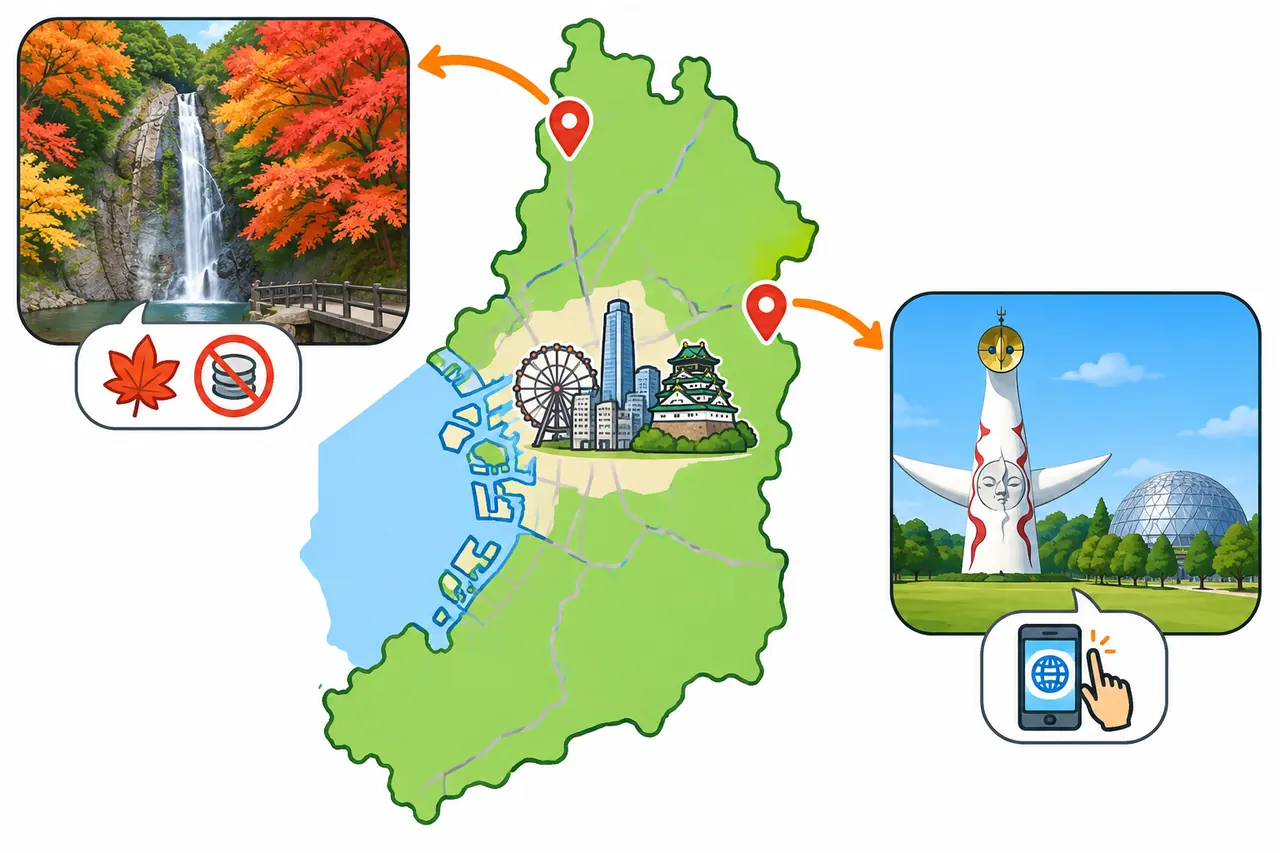
Outside the center, Minoo Falls is a waterfall associated with autumn foliage. OSAKA-INFO gives mid-November to early December as the usual viewing window and lists entry as free, but weather and yearly conditions can shift the foliage. The Expo ’70 Commemorative Park has an area pass, but its price, covered places and closing days could not be confirmed from the supplied page, so check OSAKA-INFO’s pass information before purchasing.
Getting to Osaka and moving around the city
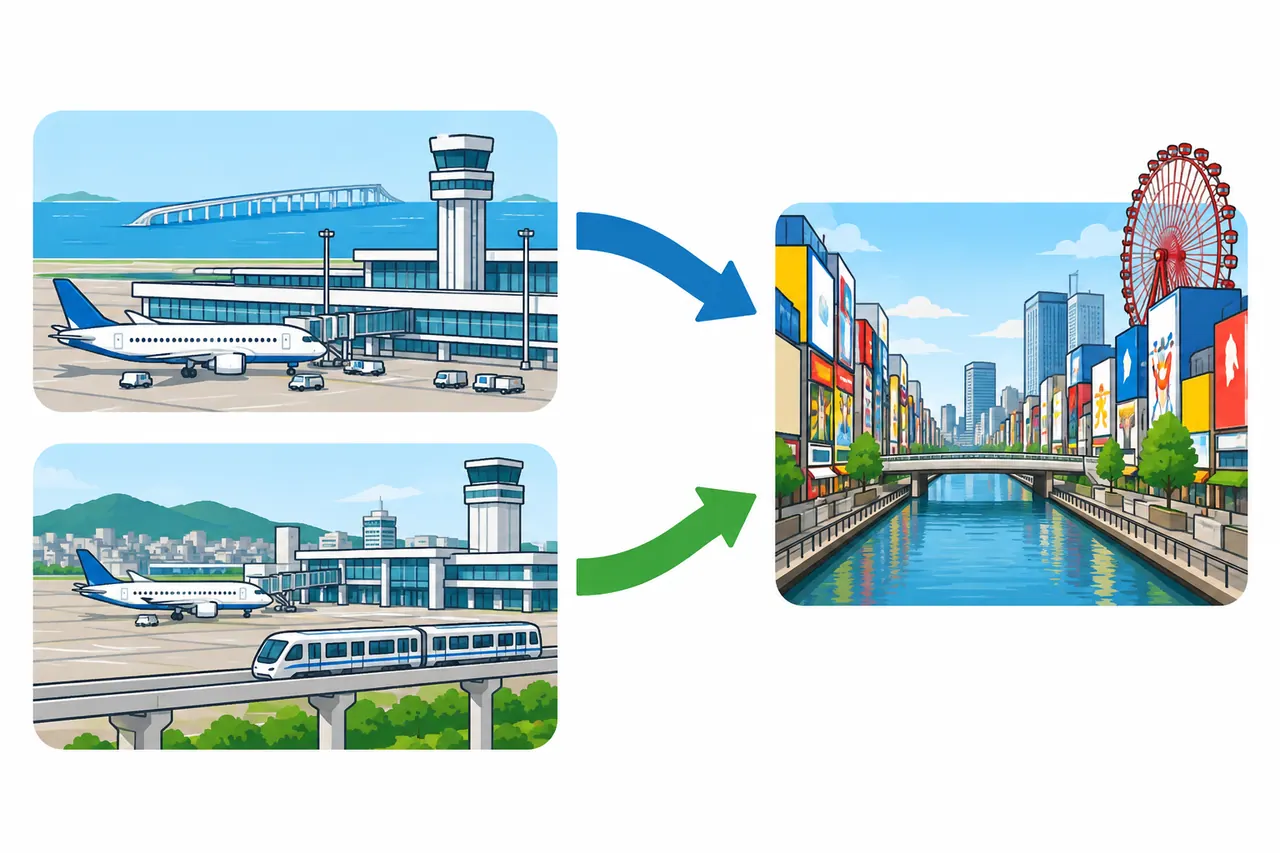
Osaka has two airports commonly used by visitors: Kansai International Airport (KIX), the main airport for international flights, and Itami Airport, which is closer to the city. First confirm which airport is on your ticket, because the route into town differs. Flight prices were not checked for a set date; compare the same dates on a fare-search service and the airline’s own site, including taxes, baggage fees, change terms and the arrival airport, before paying.
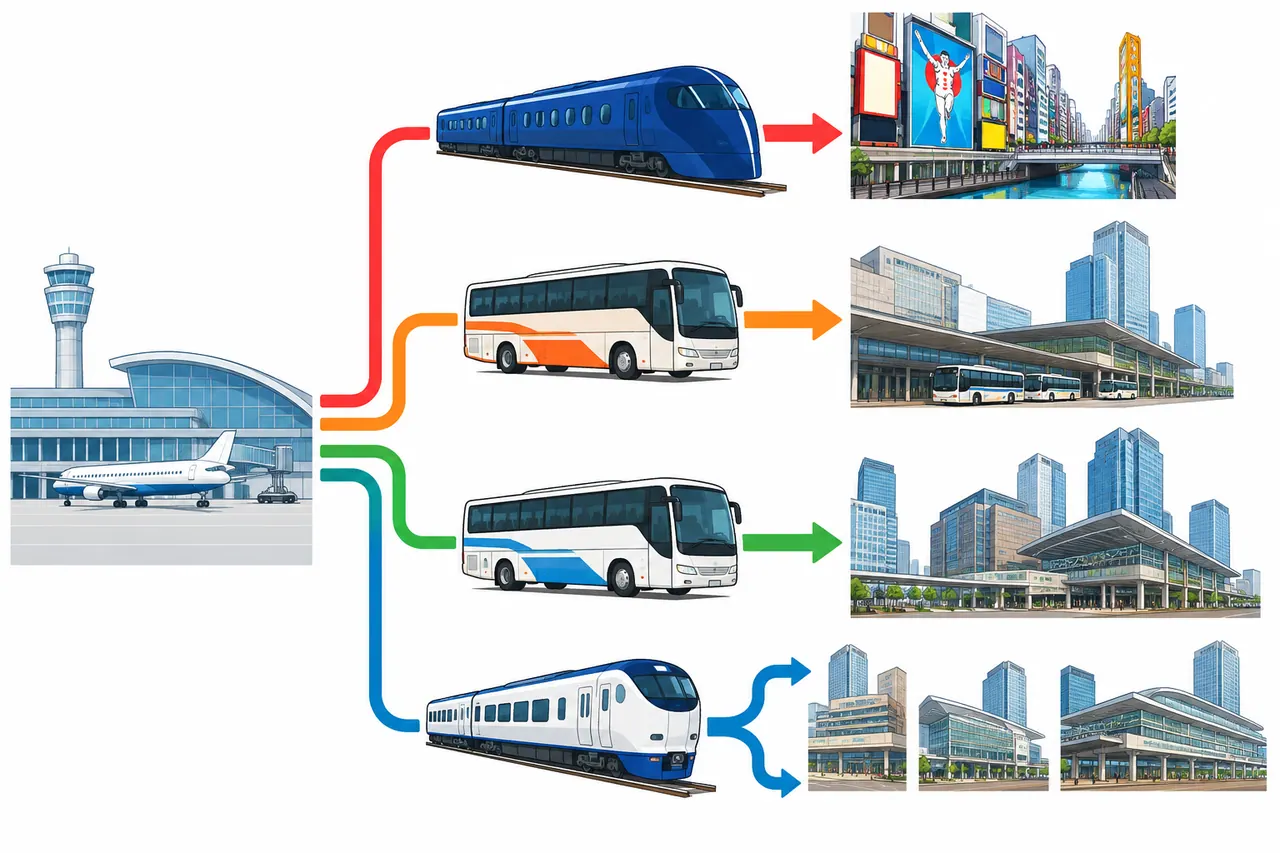
A limited express is a faster train that stops at fewer stations and requires an extra limited-express fee in addition to the basic fare. Nankai Rapi:t and JR HARUKA are limited-express trains. OCAT means Osaka City Air Terminal, the bus terminal in Namba.
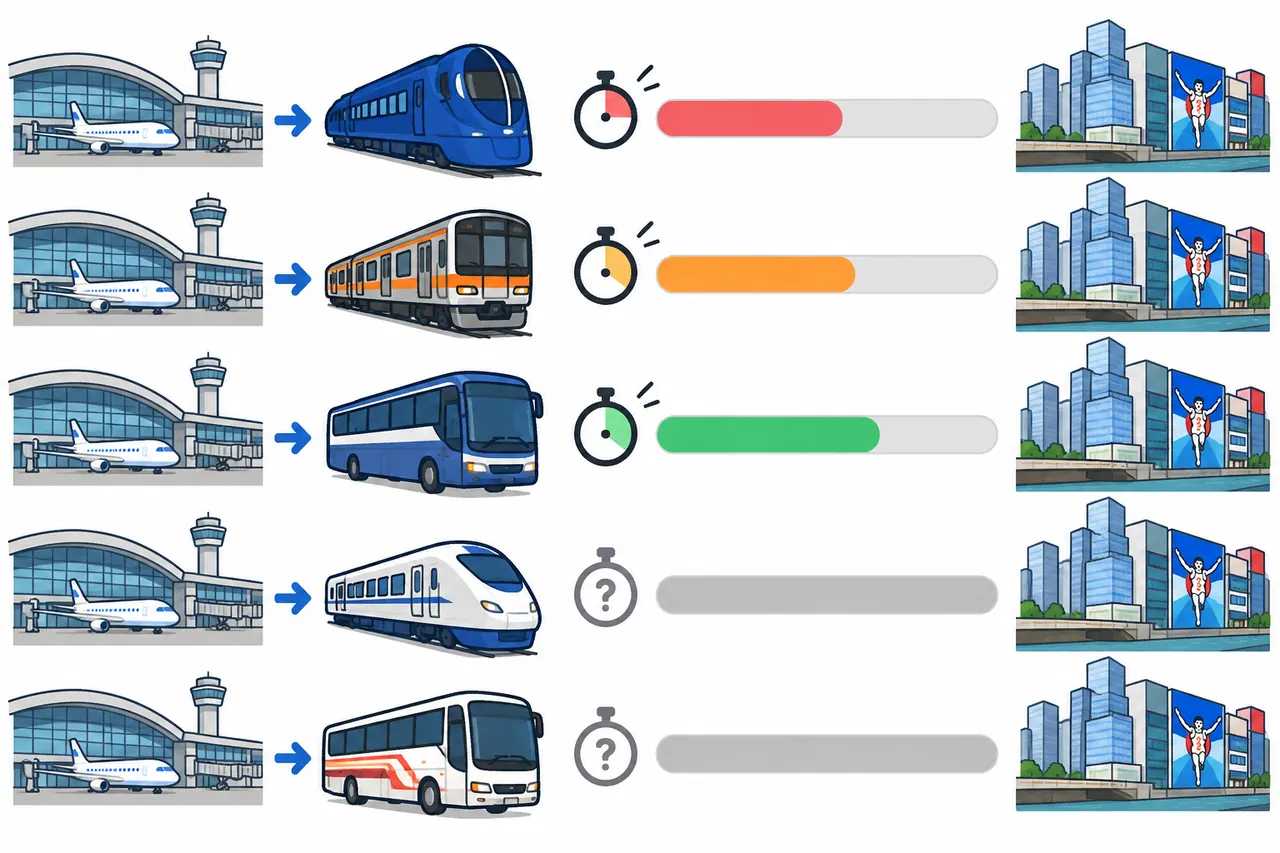
Kansai Airport to Osaka: compare the main routes
| Option | Destination | Time confirmed in the supplied notes | Fare / booking details |
|---|---|---|---|
| Nankai Rapi:t | Namba | As little as 34 minutes | Kanku Tokuwari regular seat: adult ¥1,560, child ¥780; sold from one month before travel |
| Nankai Airport Express | Namba | About 45 minutes | Normal ticket; exact fare not confirmed |
| Limousine bus | Namba OCAT | About 50 minutes from Terminal 1 | First come, first served; fare not confirmed |
| Limousine bus | Osaka Station area | Depends on the service | Stops vary by departure; fare and time not confirmed |
| JR HARUKA | Tennoji, Osaka and Shin-Osaka | Not confirmed | Direct service; check the current product and price |
Rapi:t is the fastest of the Namba options with a confirmed time in this table, not necessarily the fastest of every possible route. The cheapest option could not be established because the Airport Express fare and bus fares were not readable in the supplied official checks. Choose by the location of your hotel as well as travel time: each option reaches a different station or terminal.
For Rapi:t, follow airport signs to Kansai Airport Station, then ask at a Nankai ticket window for the “Kanku Tokuwari Rapi:t” regular-seat ticket. It costs ¥1,560 per adult and includes the basic fare and limited-express fee; check the departure time printed on the ticket and ask station staff if you are unsure. Board the train marked Rapi:t and get off at Namba; confirm current departure times on Nankai’s access timetable and the discount-ticket page.
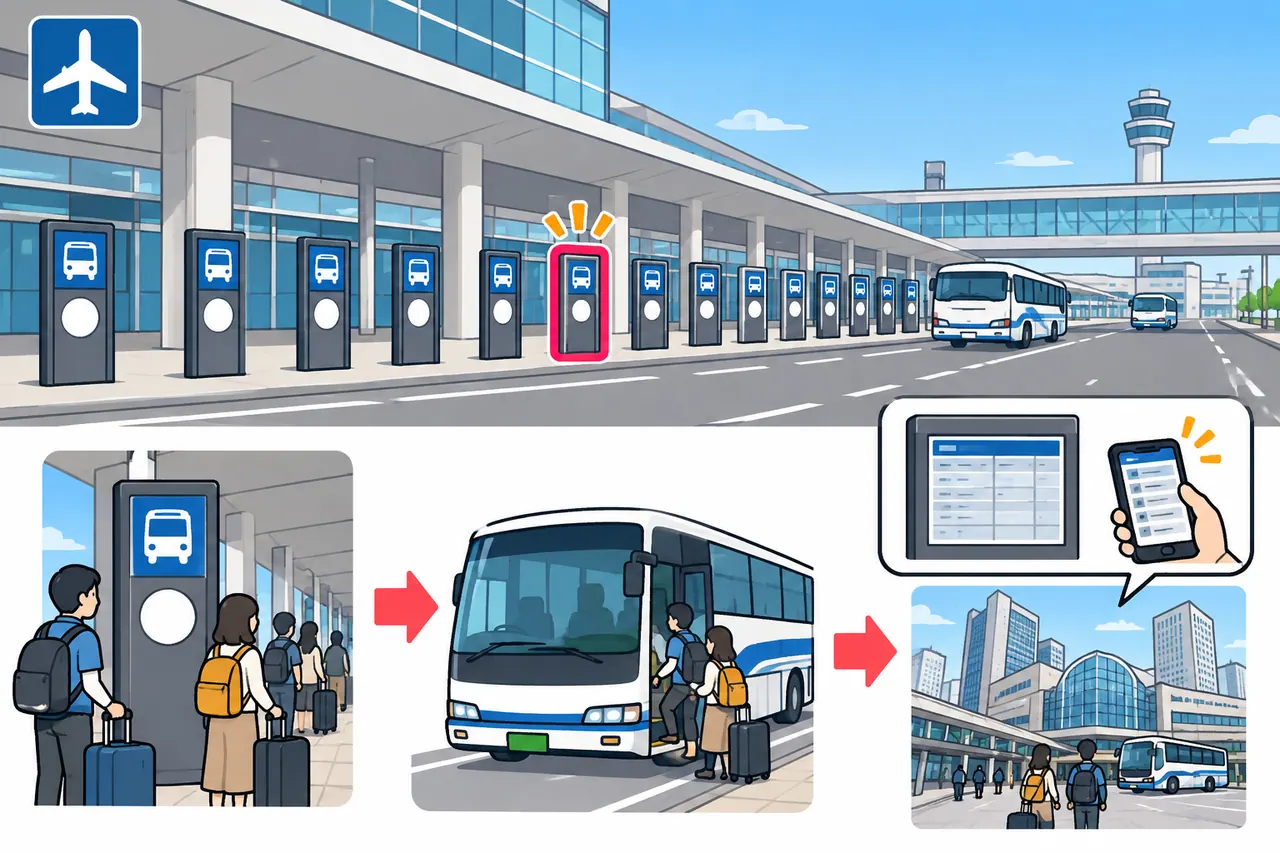
For the limousine bus, go to the bus stops outside Terminal 1 arrivals and check the operator’s current stop and timetable before boarding. Namba OCAT-bound buses use stop 11 at Terminal 1; the service is not reservation-based and boards on a first-come, first-served basis. For the Osaka Station area, check the specific departure because stops differ: Terminal 1 buses leaving between 8:45 and 19:30 do not stop at Hankyu Sanbangai. The operator’s fare images could not be read in the supplied check, so use the current OCAT timetable, Osaka Station timetable and airport bus-stop guide for fare, stop and payment details.
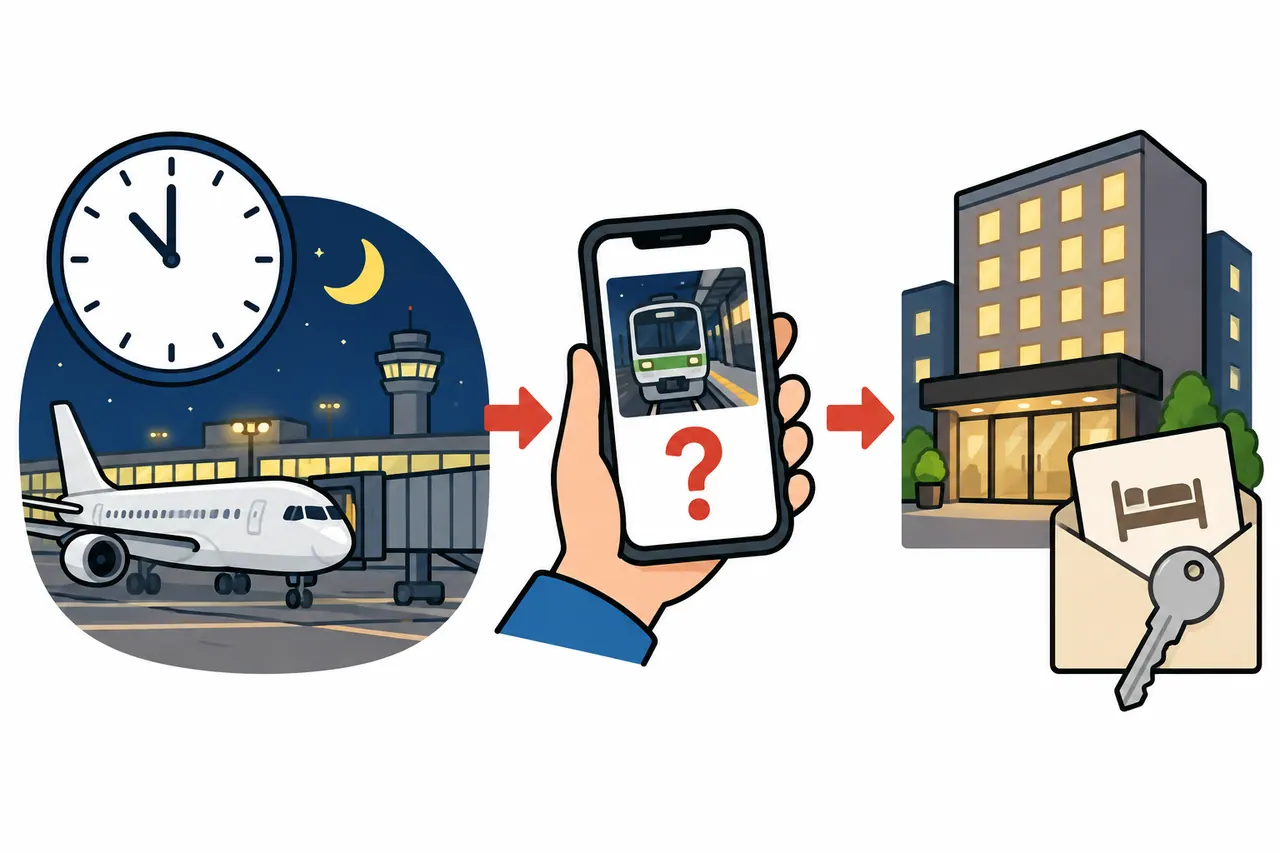
HARUKA runs directly from KIX to Tennoji, Osaka and Shin-Osaka. JR West’s foreign-visitor one-way product page notes a price change from November 1, 2026, so the new price and journey time were not confirmed in the supplied check; verify both on JR West’s HARUKA page. If you arrive late, check the last train or bus for your exact date before flying, because departures vary by timetable. If a delay may affect hotel check-in, contact the hotel before arrival.
Itami Airport, Shin-Osaka and city transport
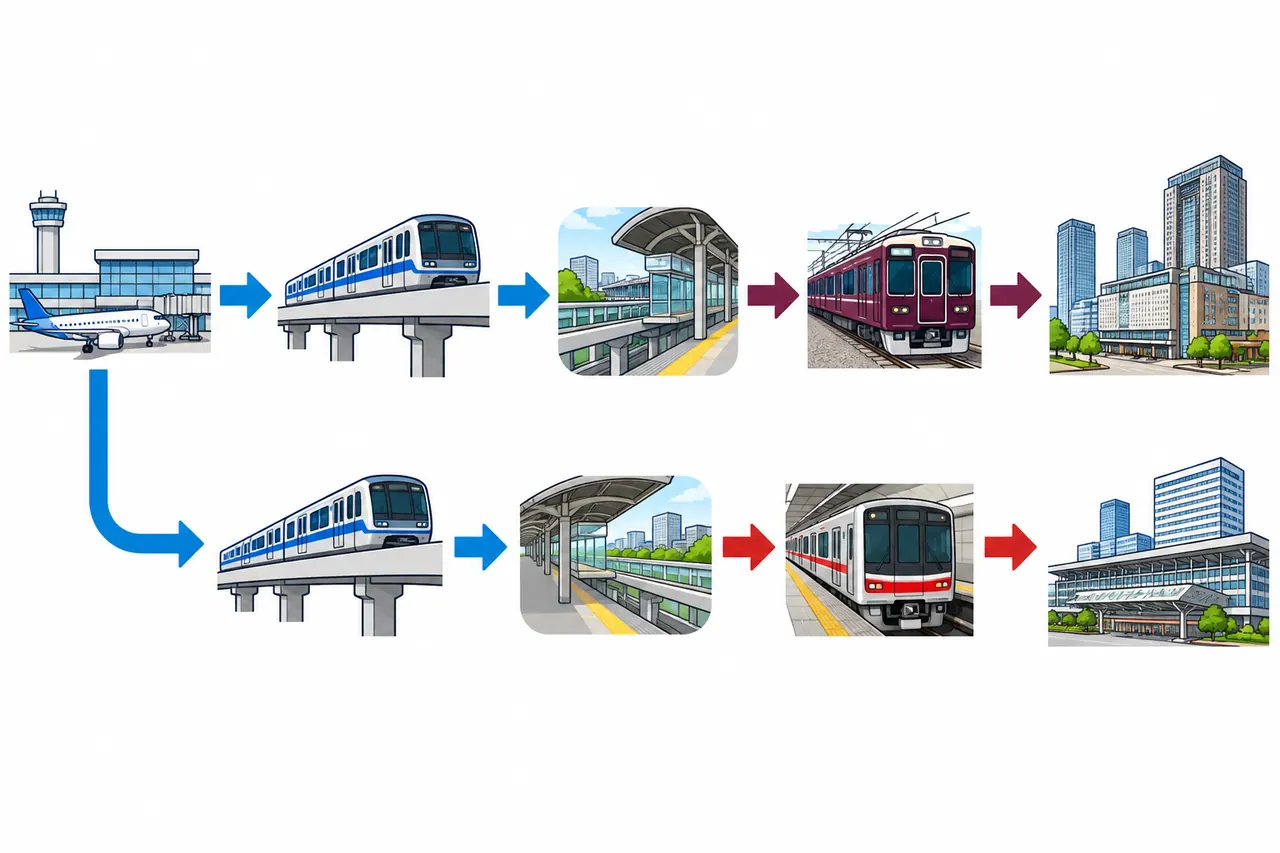
From Itami Airport, one route toward Umeda is the Osaka Monorail to Hotarugaike, followed by a Hankyu train toward Osaka-umeda. The monorail fare from Osaka Airport to Hotarugaike is ¥200 for an adult; the Hankyu fare was not confirmed. At arrivals, follow signs to Osaka Airport Station, buy a ticket to Hotarugaike, then follow the signs to the Hankyu Line and check the onward fare at the station. Consult the monorail fare page and route details before departure.
For Shin-Osaka, the suggested route is the monorail to Senri-Chuo, followed by Kita-Osaka Kyuko and the Osaka Metro Midosuji Line. The supplied check did not confirm a current fare or journey time for this route, so search from the airport to your hotel’s exact address in a route app. Shin-Osaka is the Shinkansen station; once there, continue by local train or Metro to your accommodation.
Osaka Metro is the subway system, while the JR Osaka Loop Line circles the central area. ICOCA is a rechargeable IC travel card: tap it at the ticket gate instead of buying a separate paper ticket for each eligible ride. Stations and railway companies can have similar names around Osaka Station and Umeda, so leave extra time when changing trains and follow station signs. A Facebook reel by Travel Japan Together filmed outside Osaka Station discusses station layout and escalator etiquette; follow the signs and local instructions on the day.
The Enjoy Eco Card is a one-day Osaka Metro and city-bus ticket. OSAKA-INFO lists it at ¥820 for adults, ¥620 on Saturdays, Sundays and holidays, and ¥310 for children, but the exact relationship between the weekend price and holiday service rules was not confirmed in the supplied check. It covers transport, not attraction admission; compare its price with the rides you expect to take and check current OSAKA-INFO travel-pass information.
Osaka sightseeing passes: what they cover and how to compare value
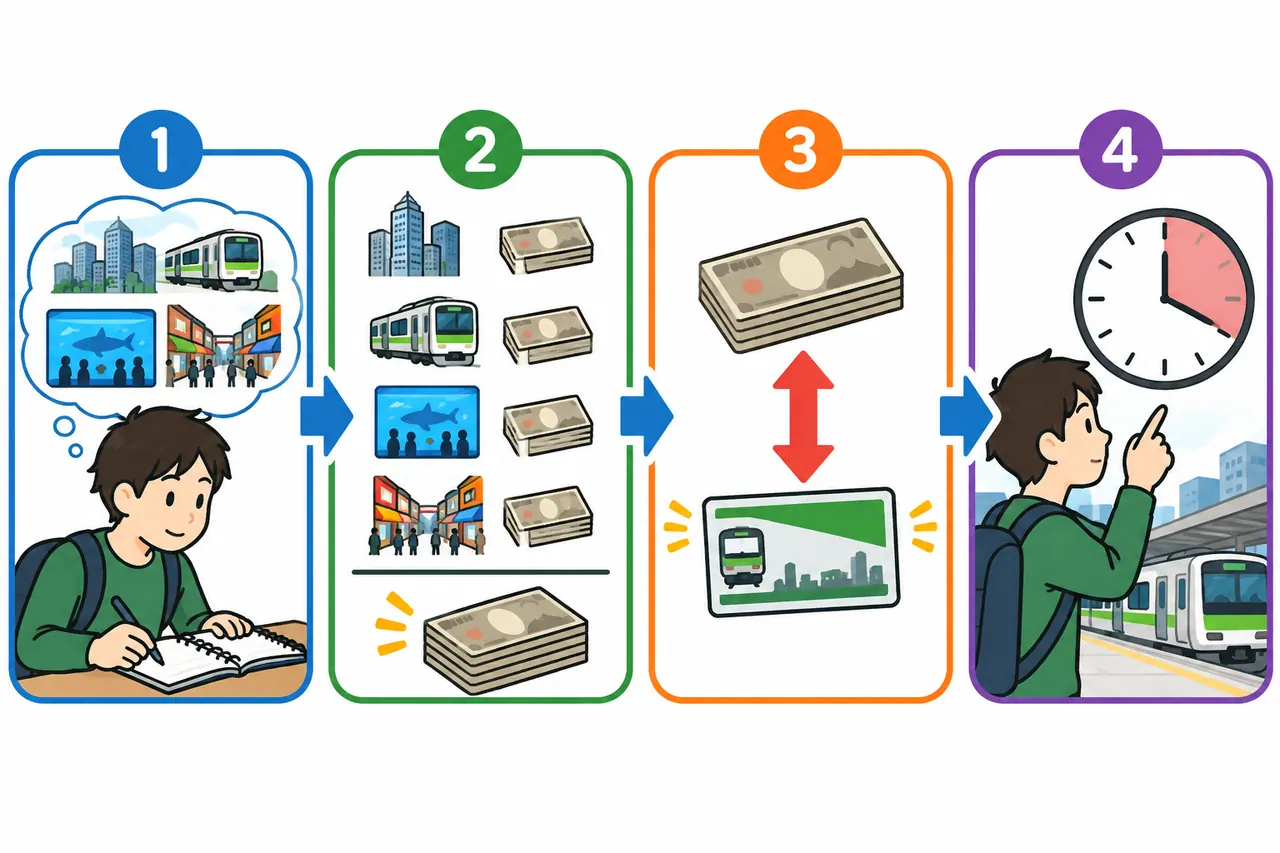
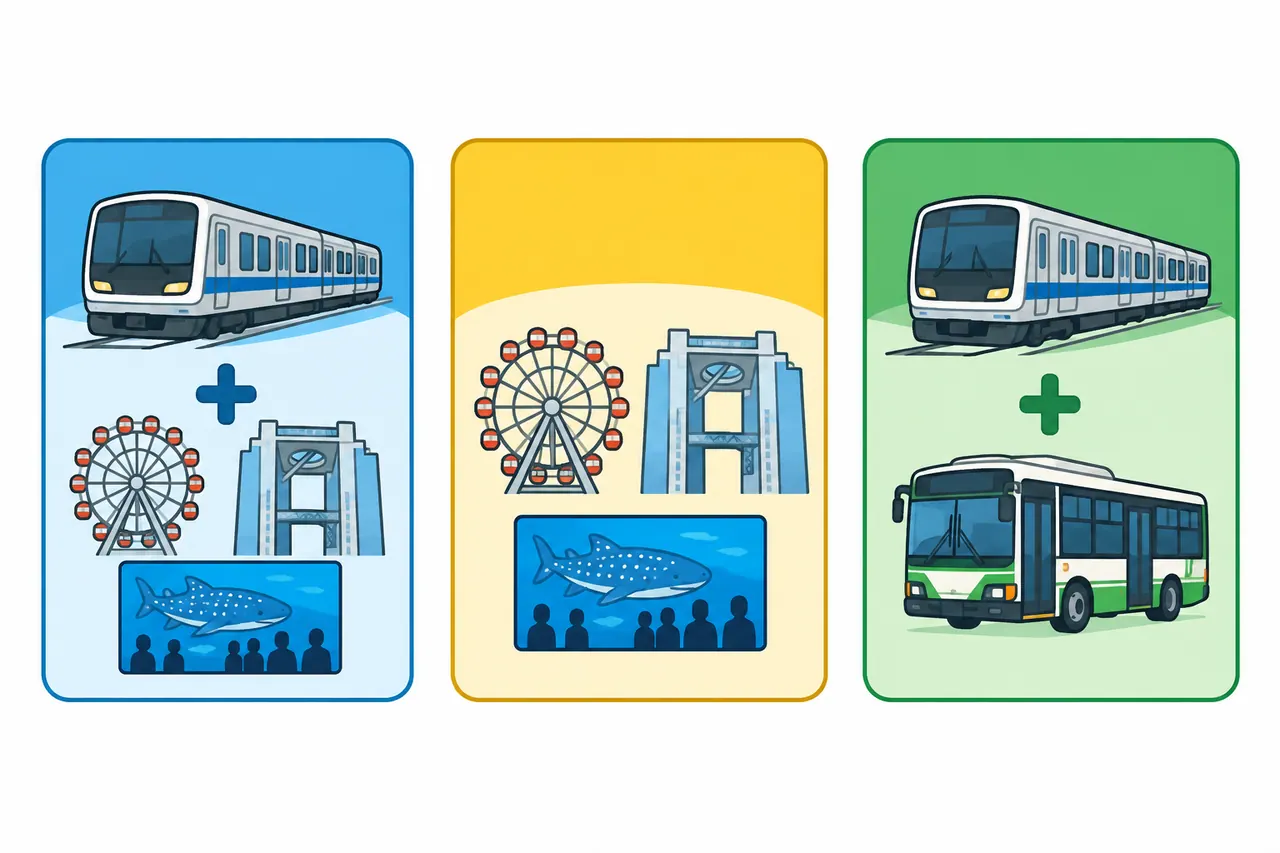
A pass is worth considering only when its covered transport or attractions match your plans. The Amazing Pass includes specified transport and sights but not every rail line; the e-Pass covers attractions but not train or bus fares. If you plan to visit only one or two paid sights, an IC card for transport and individual admission tickets may be simpler.
| Pass | Price in supplied notes | Main coverage and conditions |
|---|---|---|
| Osaka Amazing Pass, 1 day | ¥3,500 | Listed transport and attractions; not every line |
| Osaka Amazing Pass, 2 days | ¥5,000 | Listed transport and attractions over two consecutive days |
| Amazing Pass, Itami version | ¥3,800 / ¥5,400 | One day / two days |
| Amazing Pass, KIX version | ¥5,300 for 28 hours | Includes one Nankai trip from KIX to Namba |
| Osaka e-Pass | ¥2,400 / ¥3,000 in model-course material dated April 1, 2026 | 25+ attractions; no transport |
| Enjoy Eco Card | ¥820 adult; ¥620 weekends and holidays; ¥310 child | Osaka Metro and city buses |
| KANSAI RAILWAY PASS LITE | ¥5,200 for 2 days; ¥6,500 for 3 days | Eligible Kansai railways; not JR or buses |
Osaka Amazing Pass
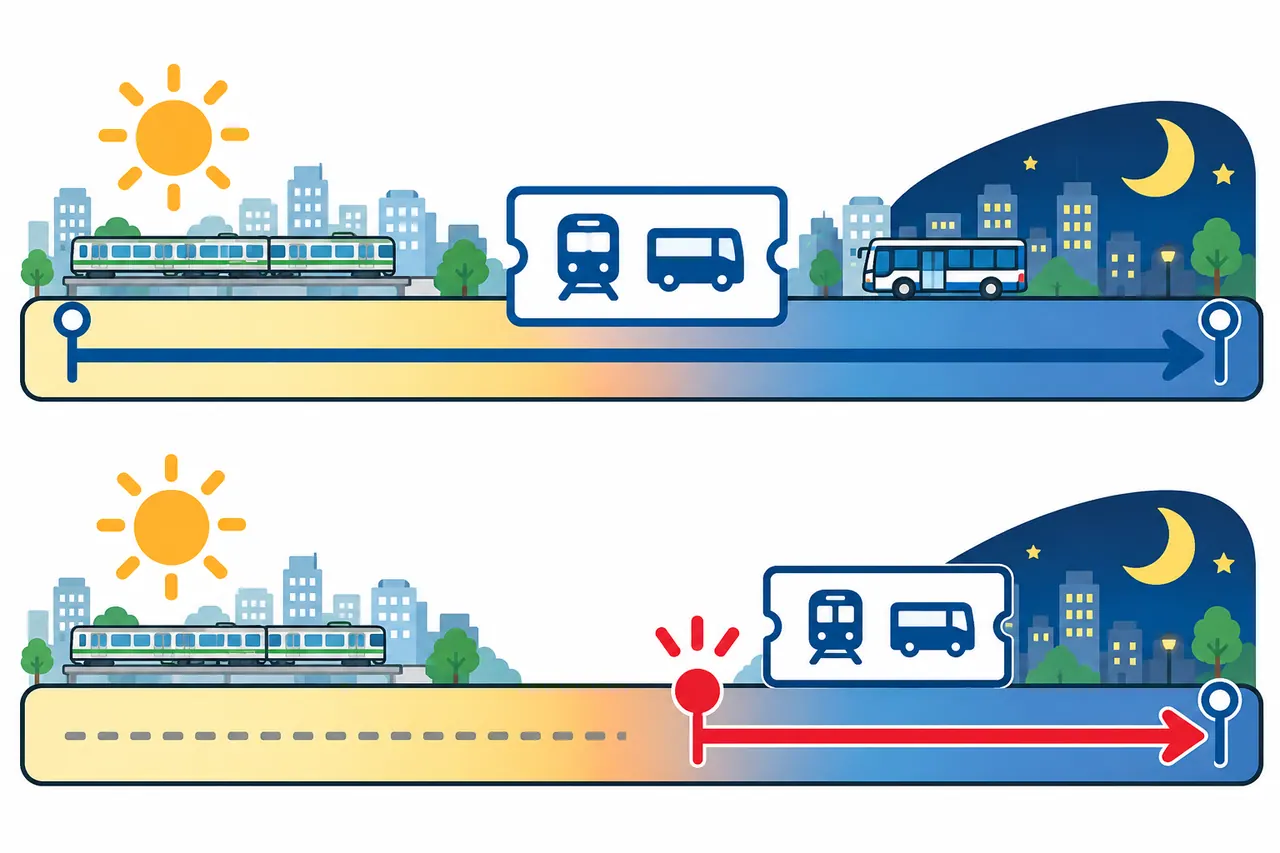
The current Osaka Amazing Pass prices listed in the supplied official notes are ¥3,500 for one day and ¥5,000 for two days. It is used on a smartphone, has no child price, and covers only the listed transport and sights—not every line or every attraction. The one-day period runs from 3:00 to 2:59 the following morning, so it is not 24 hours; the two-day pass is not 48 hours either. Check the current official pass rules and attraction list before buying.
The supplied sales period is March 25, 2026 to March 31, 2027. The pass must be started within three months of purchase, and its final start date is March 31, 2027. The older Amazing Pass website shows ¥2,500 and ¥3,300, but sales on that old site have ended, so those are not current prices. For airport versions, the Itami pass is listed at ¥3,800 for one day or ¥5,400 for two days; the KIX version is ¥5,300 for 28 hours and includes one Nankai trip from KIX to Namba. The KIX version’s supplied sales period is October 1, 2026–March 31, 2027.
Osaka e-Pass
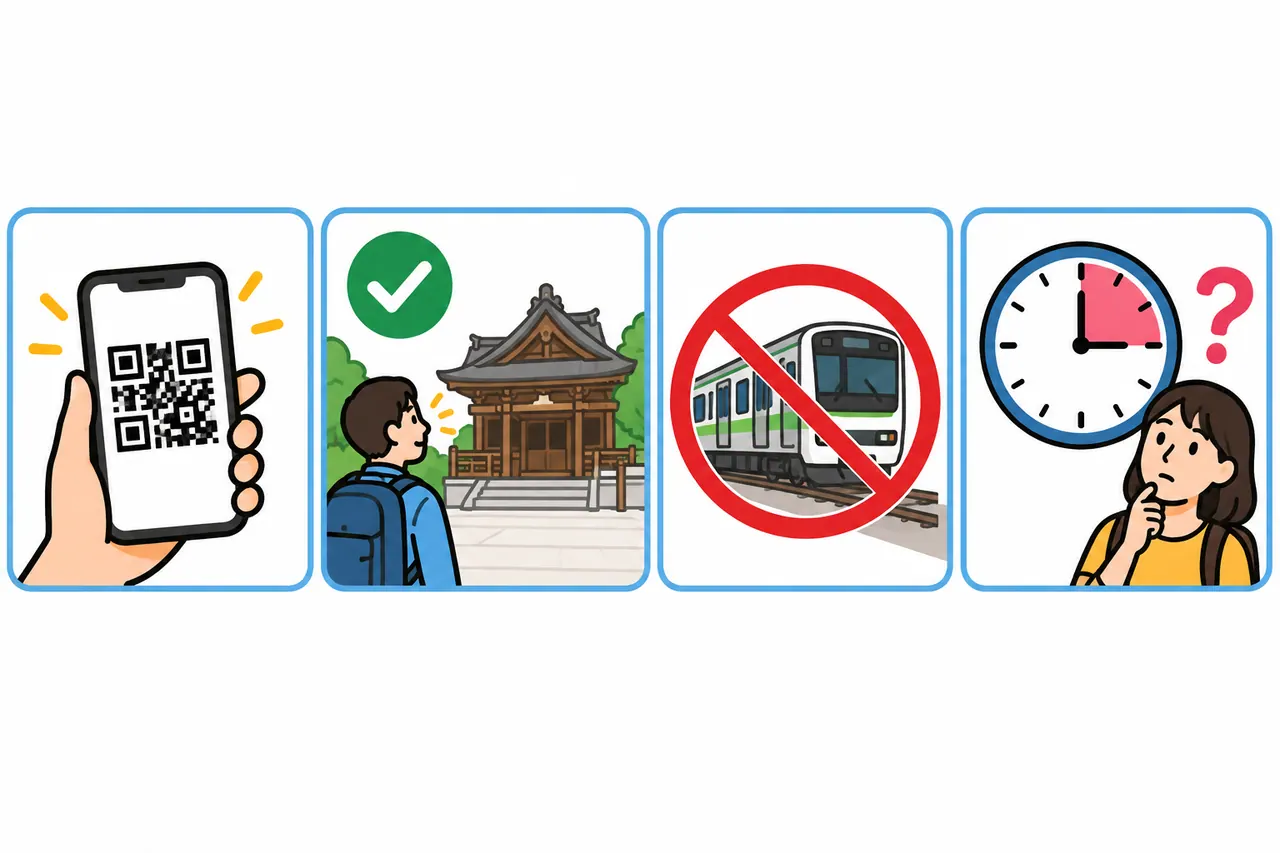
The Osaka e-Pass, called Osaka Rakuyu Pass in Japanese, uses a QR code for entry to more than 25 attractions and does not include train or bus fares. It has no child price, cannot be cancelled after purchase, and each attraction can be used once even with the two-day pass; the two-day version is for two consecutive days. The supplied model-course pages show ¥2,400 for one day and ¥3,000 for two days, but these are dated April 1, 2026 and the price shown on the purchase screen on November 3, 2026 was not confirmed. Check the official e-Pass guide and free-facility list for current conditions.
The e-Pass help pages describe a gap between attractions in different ways: the English page refers to more than 30 minutes after leaving one attraction, while the Japanese page refers to at least 30 minutes between entry to one attraction and entry to the next. Because these descriptions do not match exactly, ask the operator before buying if this rule affects your route. Some attractions also require exchanging the QR benefit for a separate boarding ticket; the Tombori River Cruise is one example. The pass lists a choice of one of two Santa Maria trips and one of three listed water-bus trips.
Both the e-Pass and Amazing Pass provide free access to the Umeda Sky Building observatory only until 15:00; after that, the benefit is a 10% discount. The e-Pass list also notes date-specific conditions at LEGOLAND Discovery Center Osaka: an update dated October 23, 2026 says entry is free from 14:00 on specified November dates. Confirm eligible dates and any booking requirement with both the attraction and the pass site before relying on that benefit.
Compare pass savings instead of assuming a pass pays off
The e-Pass’s one-day model course, dated April 1, 2026, lists five example admissions: Aqualiner ¥2,000, Gozabune boat ¥1,800, Umeda Sky Building ¥2,000, a museum ¥1,300 and the HEP FIVE Ferris Wheel ¥1,000. Those listed regular prices total ¥8,100, excluding transport; the model course compares that total with a ¥2,400 e-Pass and shows a ¥5,700 difference. Because the purchase-screen price was not confirmed on November 3, 2026, treat that as the arithmetic in the dated model—not a guaranteed saving today. Check each attraction’s date, operating status, entry window and exchange rules before doing your own calculation.
The official one-day model course begins at Osaka Station at 09:10 and includes the Aqualiner toward Osaka Castle Park, the castle sightseeing boat, Umeda Sky Building, a museum and HEP FIVE Ferris Wheel. It is a starting point, not a promise that every listed boat will operate on your date or that each benefit will fit your schedule. The official model-course page gives its information as of April 1, 2026; check current operation and transport costs separately. A two-day model course is also available on the official course page.
Other regional products have separate coverage rules. KANSAI RAILWAY PASS LITE was listed for October 1, 2026–March 31, 2027 at ¥5,200 for two days and ¥6,500 for three days for adults; use is on consecutive days, and JR lines and buses are excluded. It must be started within three months of purchase and by March 31, 2027. The JR West Kansai Area Pass ended sales on September 30, 2026, though tickets purchased by the deadline may still be used within their validity period; KANSAI THRU PASS sales also ended. The national Japan Rail Pass is listed at ¥50,000 for an adult ordinary-class seven-day pass when bought through the official website, or ¥53,000 through overseas designated sales offices; Nozomi and Mizuho require an additional special ticket. Check each operator’s current product page before assuming a pass is available or covers a route.
Food, accommodation, seasons and practical preparations
Choose a dish first, then compare the restaurant’s own menu and opening details. Osaka’s signature dishes are different preparations, not interchangeable labels for a generic local meal. OSAKA-INFO’s local-food guide and Osaka’s konamon guide provide background.
| Dish | What it is | Useful question before ordering |
|---|---|---|
| Takoyaki | Round grilled batter balls typically containing octopus | Which serving size and toppings are included in the menu price? |
| Okonomiyaki | A flat griddled dish of batter, cabbage and other ingredients | What ingredients are in this version? |
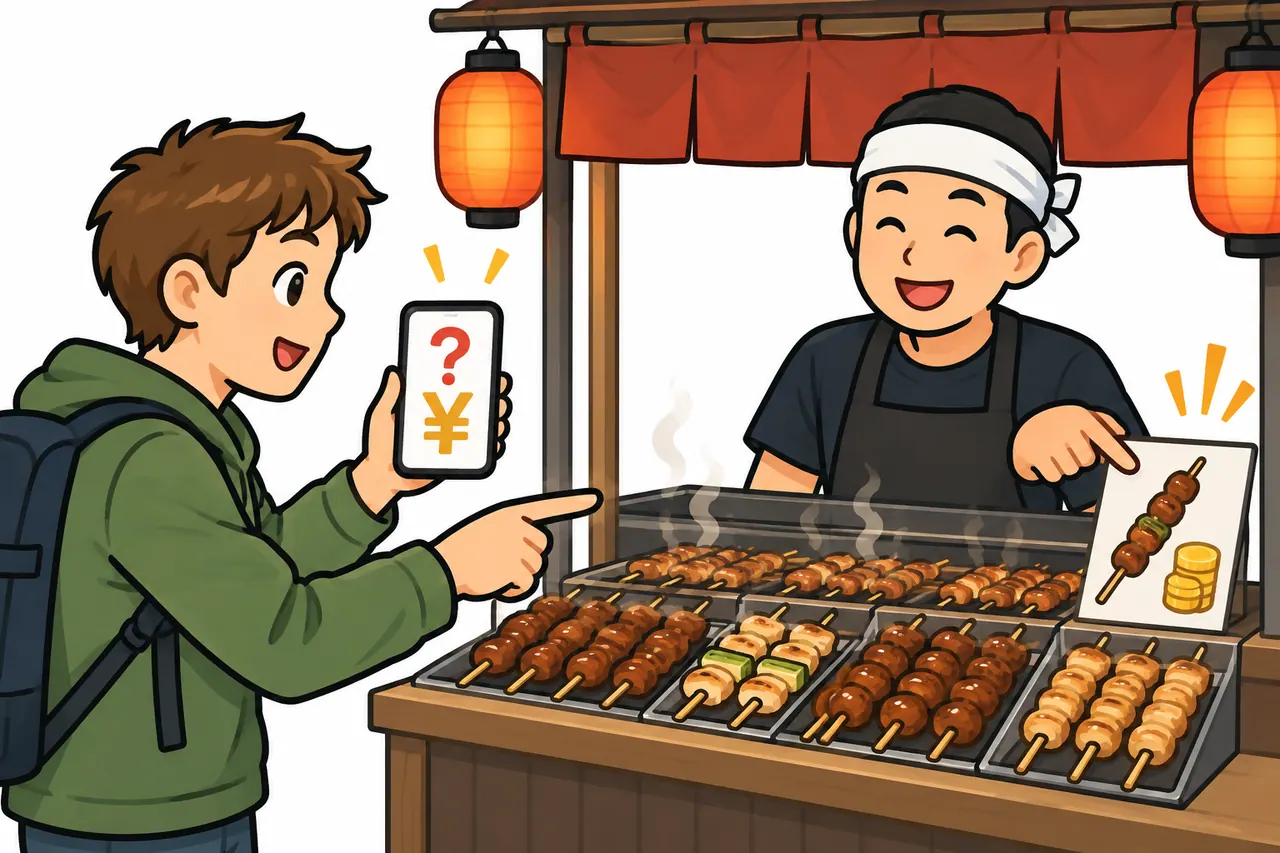
| Kushikatsu | Meat or vegetables on skewers, coated and fried | Is the displayed price per skewer or per set? |
For a specific restaurant example, Chibo lists Dotonbori-yaki from ¥1,480 and Chibo-yaki from ¥1,980, but the chain notes that availability and prices vary by branch. Chibo’s Dotonbori Building restaurant lists hours of 11:00–23:00, with last order at 22:00; its chain-wide starting prices are not a confirmed bill at that branch. Check the menu and Dotonbori Building branch page before going. If you have dietary requirements, ask the restaurant about actual ingredients: a dish name or photograph cannot establish whether a meal meets your needs.
For accommodation, Kita/Umeda and Minami/Namba are useful bases for different routes, but their location does not prove which hotel or room will be cheaper. Hotel Monterey Osaka lists a roughly five-minute walk from JR Osaka Station’s west exit and about 12 minutes from Hankyu Osaka-umeda; Swissôtel Nankai Osaka is above Nankai Namba Station, with direct rail access to KIX. These are location comparisons, not a same-date price comparison. Both properties have construction notices: Hotel Monterey lists exterior work planned through December 31, 2026 and an electrical-work closure from December 31, 2026 to January 3, 2027; Swissôtel reports lobby renovation work from August 20, 2026 through March 2027, with some areas or operating hours potentially affected. Check the Monterey access page, Monterey hotel page and Swissôtel Nankai Osaka page for your dates.
| Compare before reserving | What to record | Why it matters |
|---|---|---|
| Dates and guests | Check-in, check-out, number and ages of guests | A headline rate may describe different conditions |
| Total payment | Taxes, service fees and other charges | Compare the amount you would actually pay |
| Cancellation | Free-cancellation deadline and later charges | A lower price may have stricter conditions |
| Arrival | Nearest station, exit and walking route | Match the hotel to your airport and sightseeing plan |
| Connectivity | Property’s Wi-Fi details | Confirm that the service meets your needs |
The supplied hotel pages did not return a verified room total for matching dates, party size, room conditions and cancellation terms, so this guide does not claim one property is less expensive. Japan National Tourism Organization (JNTO) recommends checking Wi-Fi when booking accommodation; its connectivity advice also describes options such as free Wi-Fi at Kansai International Airport, rented mobile Wi-Fi and visitor SIMs. Check the provider’s price, device compatibility and return terms; a SIM may require an unlocked phone.
Weather and seasonal visits
Japan Meteorological Agency monthly averages for Osaka are based on observations from 1991–2020, not a forecast for your travel dates. The monthly mean temperatures are January 6.2°C, February 6.6°C, March 9.9°C, April 15.2°C, May 20.1°C, June 23.6°C, July 27.7°C, August 29.0°C, September 25.2°C, October 19.5°C, November 13.8°C and December 8.7°C. Check the JMA climate normals and a current forecast when packing; the supplied sources do not establish a month-by-month clothing list.
For cherry blossoms, Nishinomaru Garden in Osaka Castle Park is a candidate, with about 300 cherry trees, but its usual fee, hours and seasonal opening conditions were not confirmed. The park’s plum grove is another seasonal option, with 105 varieties and 1,245 trees; the supplied sources do not confirm the 2026 bloom status. For autumn foliage, OSAKA-INFO gives Minoo Falls a usual mid-November to early-December window and lists entry as free, while noting in effect that seasonal timing depends on the year and weather. See the autumn foliage guide and check conditions close to your visit.
Safety, connectivity and everyday details
JNTO describes Japan as a comparatively safe travel destination while still recommending ordinary precautions; this is not a guarantee of safety in Osaka or anywhere else. Japan generally does not have a tipping custom at restaurants, hotels or taxis. Electrical supply is 100V, frequency is 50Hz or 60Hz depending on the region, and the common plug type is A; check whether your devices support the voltage and whether you need an adapter. JNTO’s travel FAQ and travel-preparation pages provide broader visitor guidance.
For emergencies, call 110 for police and 119 for fire or ambulance. JNTO’s visitor hotline is 050-3816-2787 and operates 24 hours; review the official emergency information and keep the numbers accessible offline. For connectivity, airport free Wi-Fi, rented mobile Wi-Fi and travel SIMs are options described by JNTO, but their prices, device compatibility and return conditions depend on the provider. If using a SIM, check whether your phone is unlocked before purchase.
Build a route and budget for two to four days
For two days, cluster the city’s central sights rather than trying to cross Osaka repeatedly. One workable outline is Osaka Castle Park and its tower followed by Minami—Dotonbori, the river cruise if operating, and Kuromon Market—on one day, then Tennoji’s Shitennoji and Tsutenkaku followed by Kita’s Umeda sights on the other. This is an area-based suggestion, not a timed itinerary: check opening hours, travel connections, ticket availability and the amount of walking you want to do before fixing the order.
With three days, reserve one day for a major Bay Area attraction such as USJ or Kaiyukan rather than assuming both fit comfortably with other sightseeing. With four days, consider a day trip or a slower visit to the Bay Area and city neighborhoods; the supplied sources do not verify a complete timed Kyoto or Nara itinerary. JR West describes the Yamatoji Rapid as a service that enters the Yamatoji Line from the Osaka Loop Line, but a travel-day timetable, fare and journey time were not confirmed. Decide on the destination first, then check the operator’s current timetable and whether your chosen pass covers the train.
Budget by category, not by a single attraction subtotal. Add the actual return airport journeys, local transport, admission for your eligibility category, meals and the full accommodation total for your dates; include optional purchases separately. The supplied information does not support a minimum whole-trip total because matching hotel rates, all meals, specific-day airfares and some local transport costs were not confirmed.
| Budget item | How to estimate it | Keep separate |
|---|---|---|
| Airport travel | Choose the route and current ticket product for your airport | A route to a different destination |
| Local travel | Add the tickets or pass needed for your chosen stops | Airport journeys unless included |
| Attractions | Use your admission category and selected options | Time- or date-restricted pass benefits |
| Meals | Check the menu prices for the dishes you choose | Another traveller’s social-post total |
| Accommodation | Use the final room quote for the whole party | A nightly headline rate without taxes |
| Return and extras | Add airport return, luggage and purchases | Attraction-only subtotals |
One useful confirmed calculation is the Kanku Tokuwari Rapi:t ticket: at ¥1,560 per adult each way, two adults making a round trip would pay ¥6,240 for those four one-way tickets. That is only the airport rail portion; it excludes city transport, hotel, meals and attractions. A specific hotel comparison using November 17–18, 2026, two adults in one non-smoking room, room-only and KIX as the airport was not available from the supplied hotel pages, so no full-trip amount is presented as if it were a quote.
For rain or a changed outdoor plan, Kaiyukan and the Umeda Sky Building observatory are possible alternatives, but both still need date-specific checks. Kaiyukan admission varies by date and its timed e-ticket availability depends on the calendar; the observatory’s hours and view conditions can also vary. Consult the Kaiyukan ticket page and observatory information before switching plans. A sightseeing pass does not automatically make either attraction available at every time.
Frequently asked questions
How many days should I plan for Osaka?
Two days can be organized around the central areas: Osaka Castle and Minami on one day, then Tennoji and Kita on another. A third day gives you room to focus on one major Bay Area attraction such as USJ or Kaiyukan. A fourth day can be used for a day trip or a less rushed city visit, but check the actual route and operating times for your chosen places.
Is the Osaka e-Pass also a train pass?
No. The e-Pass covers listed attractions under their individual conditions, while train and bus fares are separate. It has one-use-per-attraction rules, and its two-day version covers two consecutive days rather than allowing a second entry to the same sight. Read the official rules before purchase.
Does the Osaka Amazing Pass last 24 hours?
No. Its one-day period runs from 3:00 to 2:59 the next morning, so starting late in the day does not create a new 24-hour window. The two-day option follows the stated day rule and is not a 48-hour ticket. Check the official pass information and confirm the listed transport and attraction coverage for your route.
What is the adult admission price for Osaka Castle Main Tower?
The adult ticket is ¥1,200, while high-school and university students pay ¥600 with student identification. Junior-high-school students and younger enter free with proof of age; overseas high-school and university students are asked to show an ISIC card. The tower is listed as open 9:00–18:00, last entry 17:30, and closed December 28–January 1; see the official visitor guide for current details.
How long does it take to reach Namba from Kansai Airport?
Nankai lists Rapi:t at as little as 34 minutes and the Airport Express at about 45 minutes. The Rapi:t requires a limited-express ticket as well as the basic fare; the Kanku Tokuwari regular-seat ticket is listed at ¥1,560 per adult. Check current departures and ticket availability on Nankai’s timetable, especially if your flight arrives late.
Do I need to book the Tombori River Cruise?
Some departures can be booked and paid for online, and OSAKA-INFO says booking is available until 10 minutes before departure. Boats usually leave at :00 and :30 from 11:00 to 21:00, but weather may cause cancellations or schedule changes. Check the operator’s information, the booking page’s cancellation terms and the day’s service status before travelling to the pier.
What should I check before choosing a hotel?
Compare the same dates, guest count and room conditions, then record the final total including taxes and service fees. Check cancellation deadlines, the route from your arrival station and the property’s Wi-Fi information; a hotel’s neighborhood alone does not show which room is cheaper. JNTO also recommends checking connectivity when booking, and the property’s own notice page can flag construction or facility changes.
Before finalizing the trip, check the official pages for your airport route, attractions and pass. For questions about Osaka tourism, OSAKA-INFO lists a visitor call center at 06-6131-4550, open daily from 9:00 to 17:30. The facts in this guide are based on the supplied official-source checks dated November 3, 2026, with the Osaka Castle Tower listing checked November 4 and hotel and restaurant pages checked November 5; confirm current conditions close to your visit.