Osaka to Kyoto by Train: JR, Hankyu & Keihan (2026)
Contents
- 1. 1. Osaka to Kyoto trains: compare routes and stations
- 2. 2. Osaka to Kyoto by JR: Special Rapid and Shinkansen
- 3. 3. Osaka to Kyoto by Hankyu or Keihan
- 4. 4. Osaka to Kyoto from airports and Universal Studios Japan
- 5. 5. Osaka to Kyoto passes: compare the cost
- 6. 6. Osaka to Kyoto train checklist: avoid mistakes
- 7. 7. Osaka to Kyoto train FAQ
The best train depends on where you are going in Kyoto, not just how quickly a train leaves Osaka. JR’s Special Rapid service runs from Osaka Station to Kyoto Station in about 30 minutes; Hankyu and Keihan serve other parts of the city, including central Kyoto. These are train-time estimates, not full door-to-door journey times, so add travel to your departure station, transfers, waiting and the trip onward from your arrival station.
For Kyoto Station, start with JR. For central Kyoto, compare Hankyu’s Karasuma and Kyoto-kawaramachi stations with Keihan’s Gion-shijo and Sanjo stations. The station names matter: Osaka Station and Shin-Osaka Station are different, and Kyoto Station is not the same as Kyoto-kawaramachi or Gion-shijo.
The comparison below uses adult one-way fare examples. They come from sources with different dates, and the applicable fare on your travel day is not confirmed in every case. Check your route and ticket with the operator before travelling.
| Route | Train-only time | Adult one-way fare example | Notes |
|---|---|---|---|
| JR Osaka → Kyoto | About 30 minutes | ¥580 in JR West’s March 2026 fare table | Travel-day fare not confirmed. |
| Hankyu Osaka-umeda → Kyoto-kawaramachi | About 45 minutes to central Kyoto | ¥410 in a FAQ updated in 2024 | Travel-day fare not confirmed. |
| Keihan Yodoyabashi → Gion-shijo | Check the train for its time | ¥490 in a fare table revised in October 2025 | Travel-day fare not confirmed. |
| Shinkansen Shin-Osaka → Kyoto | Check the train for its time | ¥1,450 in an October 2025 LINE from EX product example | Ordinary-class non-reserved seat; current price not confirmed. |
Sources: Kyoto City Tourism Association route guidance, JR West fare table, Hankyu fare FAQ, Keihan fare table and JR Central product price table. Sources and route guidance were checked on 3 November 2026; confirm travel-day fares and services.
1. Osaka to Kyoto trains: compare routes and stations
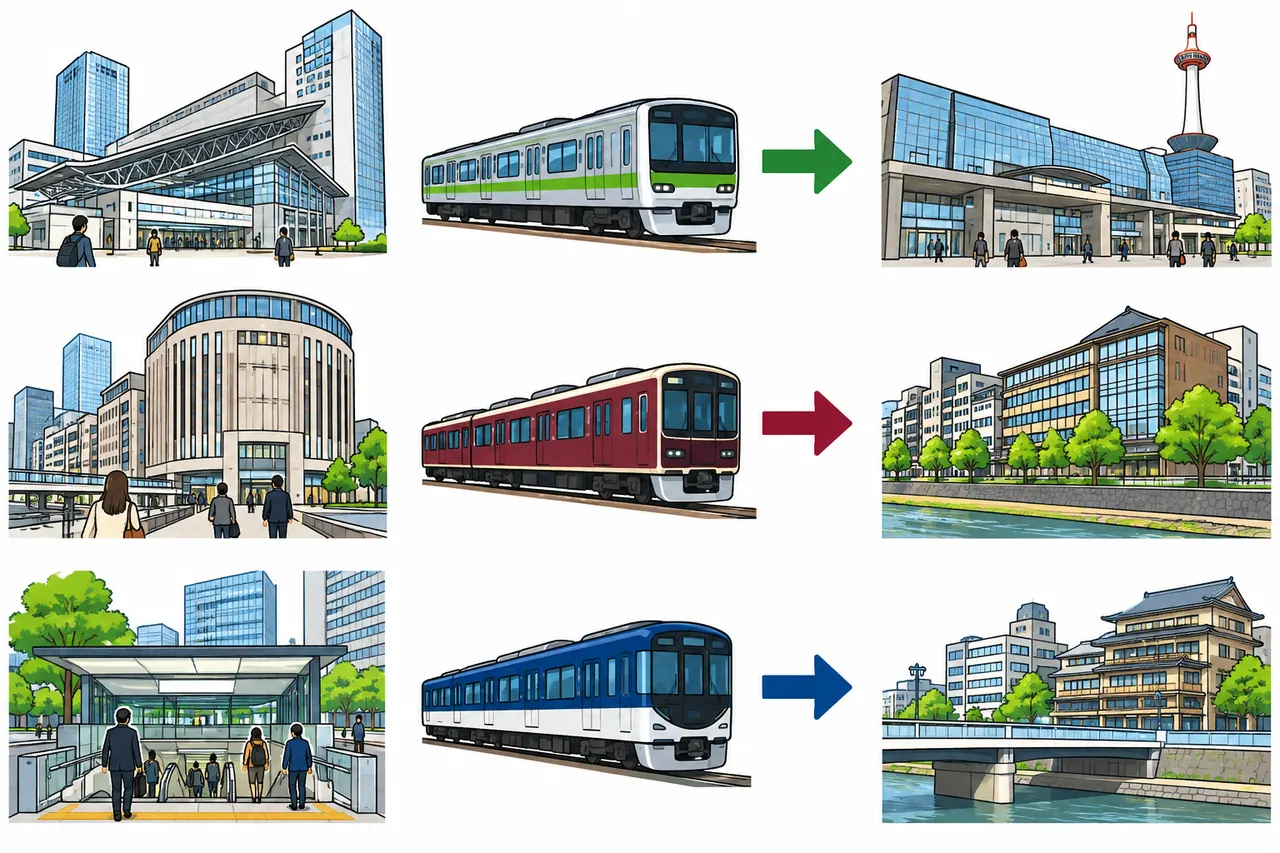
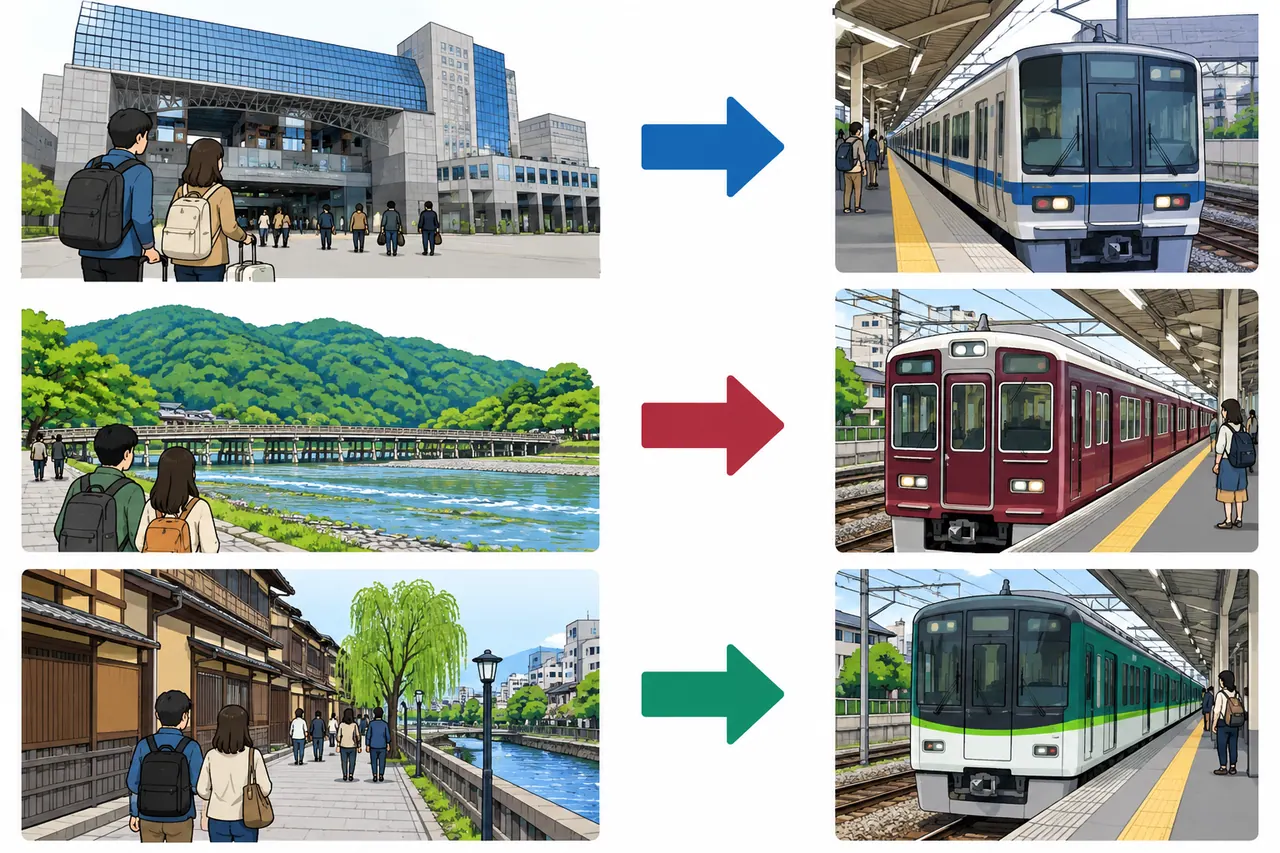
Choose your Kyoto arrival station first, then compare the route from where you will actually start. A direct train runs between the listed stations without changing trains, but it does not necessarily cover your whole journey. The Kyoto tourism association estimates about 30 minutes from JR Osaka Station to Kyoto Station by Special Rapid, about 45 minutes from Hankyu Osaka-umeda to central Kyoto, and about 48 minutes from Keihan Yodoyabashi to central Kyoto; its 48-minute estimate does not specify the arrival station. Keihan separately describes its direct Osaka–Kyoto Limited Express journey as about 50 minutes, so check the exact train and stations for your trip.

| Your priority | Start by checking |
|---|---|
| Kyoto Station | JR Special Rapid from Osaka Station. |
| Central Kyoto | Hankyu Karasuma or Kyoto-kawaramachi, or Keihan’s Kyoto stops. |
| Gion-shijo | Keihan from Yodoyabashi; Gion-shijo is a Keihan stop. |
| Arashiyama | Hankyu, changing at Katsura for the Hankyu Arashiyama Line. |
| Lowest listed fare | Hankyu’s dated example is the lowest in the table, but it ends at a different station from JR and Keihan. |
| Shortest full journey | Add travel to the departure station, connections and the onward trip from the arrival station. |
Starting in Namba or Tennoji
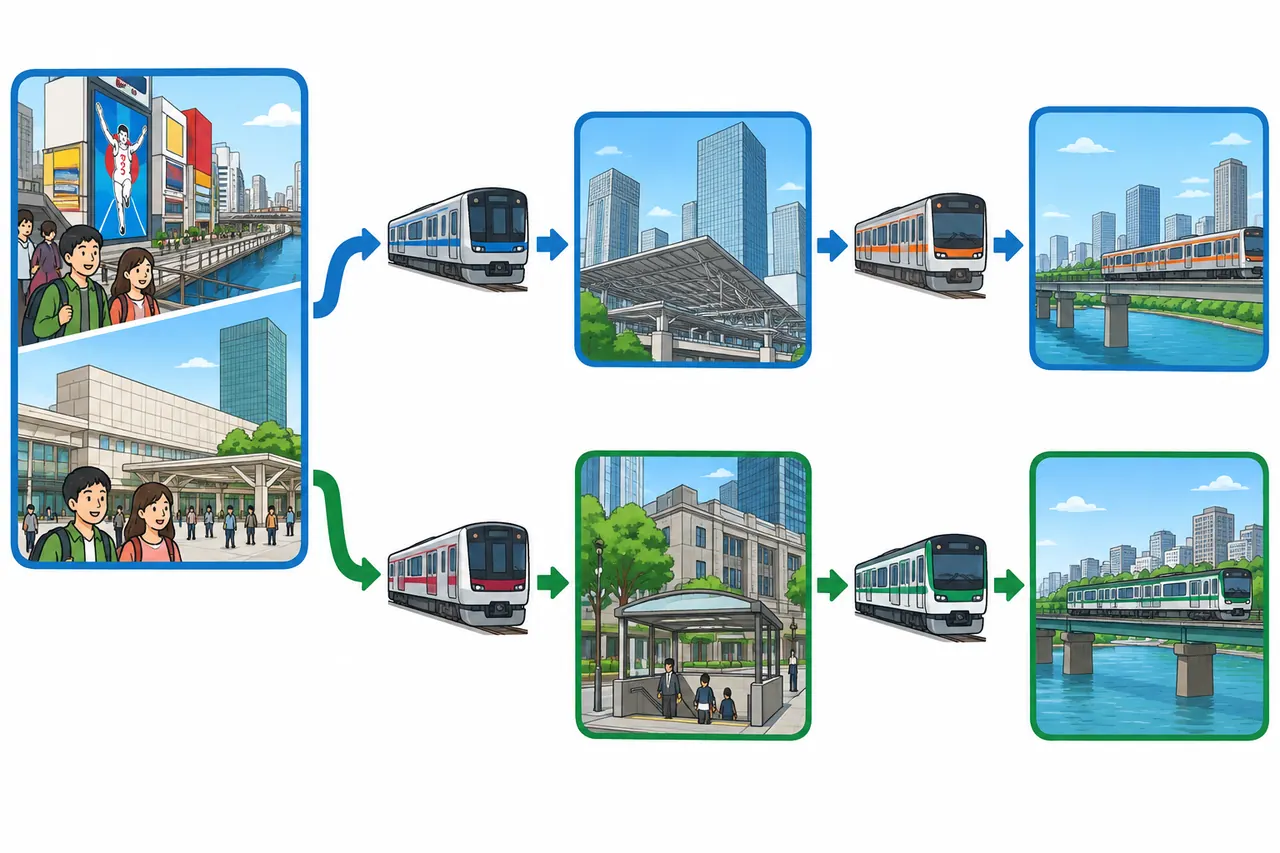
From Namba or Tennoji, Osaka Metro’s Midosuji Line can take you toward either Umeda or Yodoyabashi. For Kyoto Station, use the Midosuji Line to Umeda, then follow signs to JR Osaka Station and take a Kyoto-bound train. For Gion-shijo, travel on the Midosuji Line to Yodoyabashi and change to Keihan.
These are route outlines, not confirmed end-to-end timetables or through-fare quotes. Check the Midosuji Line timetable for your travel date, and check the rail operators for connection times and fares. Once you reach the interchange, follow signs for the railway you are changing to rather than relying on the city name alone.
Station names and maps
Save the operator and full station name in your travel notes. JR Osaka Station is where you start for the JR route to Kyoto Station, while the Shinkansen departs from Shin-Osaka; Hankyu Osaka-umeda and Keihan Yodoyabashi are separate stations served by different railways. In Kyoto, Kyoto Station, Kyoto-kawaramachi and Gion-shijo are distinct arrival points.
Useful official pages include the JR Osaka Station map, JR Kyoto Station page, Hankyu Osaka-umeda, Hankyu Kyoto-kawaramachi, Keihan Yodoyabashi and Keihan Gion-shijo. Keihan lists Gion-shijo’s location as Shijo Ohashi Higashizume, Higashiyama-ku, Kyoto, and its station page links to a map. For Shin-Osaka, Katsura, Karasuma, Arashiyama, Kyobashi or Sanjo, check the relevant operator’s official station information for a map and exit.
An IC card is a reusable travel card, but do not assume that a particular card is accepted on every service or for every ticket product. Check acceptance with the railway you plan to use. An IC card also does not change which station or train you need to reach your destination.
2. Osaka to Kyoto by JR: Special Rapid and Shinkansen
The JR Special Rapid is the straightforward choice when Kyoto Station is your destination. The Shinkansen is another option, but it starts at Shin-Osaka, not Osaka Station, and its full-journey value depends on how you reach Shin-Osaka and where you are going after arriving in Kyoto. For either route, check the train’s destination and stops on the station display before boarding.
Buying and boarding the Special Rapid
A Special Rapid is a regular JR train service, but trains can skip stations. Check that the specific train you choose stops at Kyoto rather than relying only on a general direction such as “Kyoto-bound.” JR’s train usage guide explains basic ticket and boarding procedures.
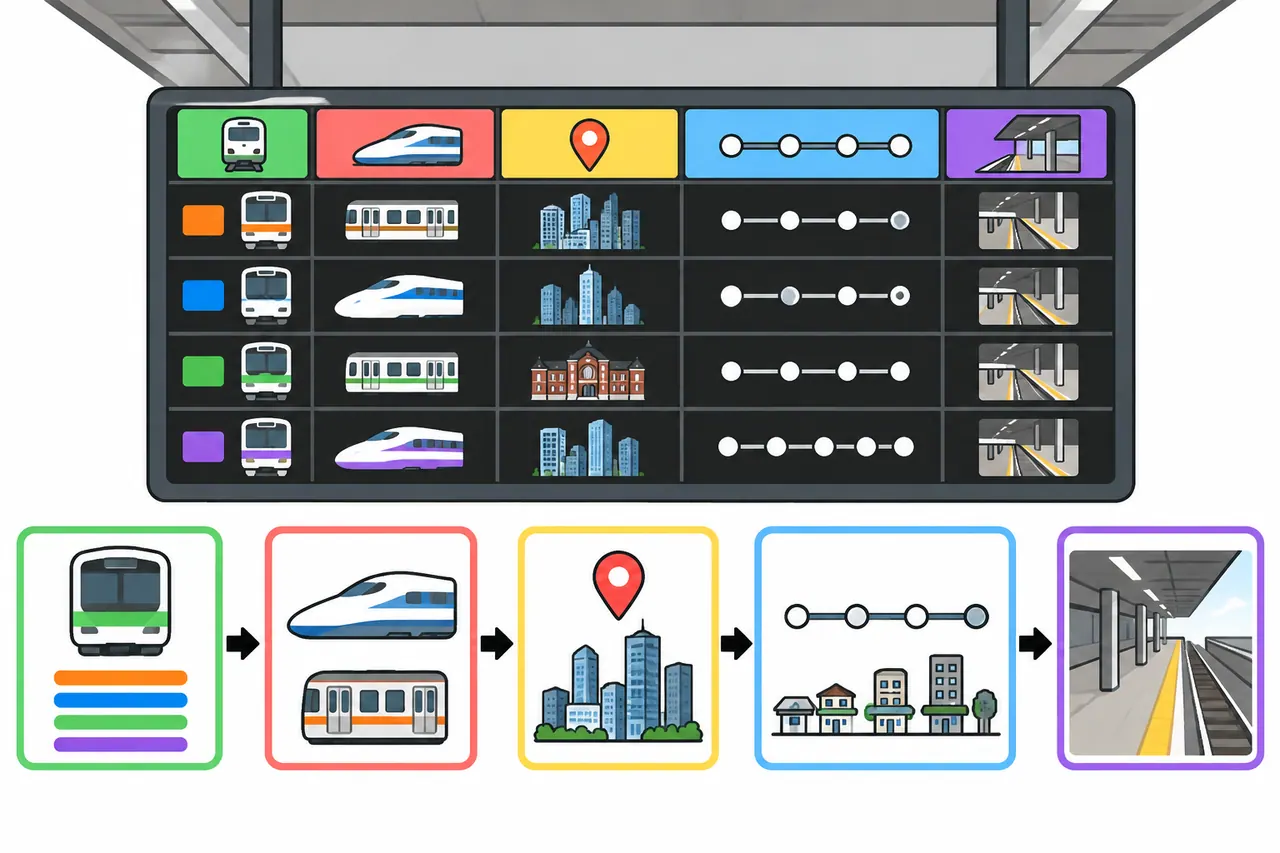
At Osaka Station, read the departure board for a train toward Kyoto, check its train type and stop list, then follow the displayed platform number. If you are unsure which ticket to buy, ask at a JR ticket counter for the current Osaka-to-Kyoto fare and ticket choices. The platform number depends on the train, so use the station display rather than assuming a fixed platform.
Haruka from Osaka Station
Haruka is a JR airport Limited Express that also stops at Osaka Station’s Umekita underground platforms. Use the JR Osaka Station map to find the underground area, and check the departure display for your train. If you are taking Haruka from Osaka to Kyoto, ask JR for the applicable fare and departure time.
A basic ticket covers the journey, and a Limited Express ticket is also needed for Haruka. Airport-specific ticket products may have different conditions from a regular journey, so check the terms of the ticket you plan to buy. The WEST QR Haruka ticket described in the airport section is for eligible visitors travelling between Kansai Airport and Kyoto; it is not a general substitute for checking the Osaka-to-Kyoto fare.
Shinkansen: compare the whole journey
The Shinkansen leaves from Shin-Osaka, not Osaka Station. A non-reserved seat is not assigned to a particular passenger, but it still requires the appropriate Shinkansen ticket as well as the basic ticket; JR’s ticket and boarding guide explains the ticket components for JR services.
The ¥1,450 fare in the comparison table is an October 2025 example for an adult one-way ordinary-class non-reserved seat on JR Central’s LINE from EX product. It is not confirmed as the current price. Compare the full journey in three parts: your start point to Shin-Osaka, Shin-Osaka to Kyoto, and Kyoto Station to your final destination. Check the actual train’s time and fare for your travel date rather than treating the Shinkansen segment alone as the whole trip.
JR Central lists online booking hours as 5:30–23:30. Sales usually open at 10:00 one month before travel, although some products differ; check the booking page and the cancellation rules for your specific ticket before buying. The JR Central online booking information gives the booking details.
A JR West Kansai Area Pass does not cover the Shinkansen. It covers eligible services in its specified area, including certain Special Rapid, Rapid and Local trains and reserved seats on Haruka, subject to its rules; Haruka seat reservations must be made before boarding, and the pass allows up to two reserved-seat uses. Sales of the Kansai Area Pass ended on 30 September 2026, though a pass purchased earlier can still be used within its specified validity period. A national JAPAN RAIL PASS holder needs to buy the special Nozomi/Mizuho ticket before boarding Nozomi. Check the JR West pass page and the JAPAN RAIL PASS Nozomi guidance for the relevant rules.
3. Osaka to Kyoto by Hankyu or Keihan
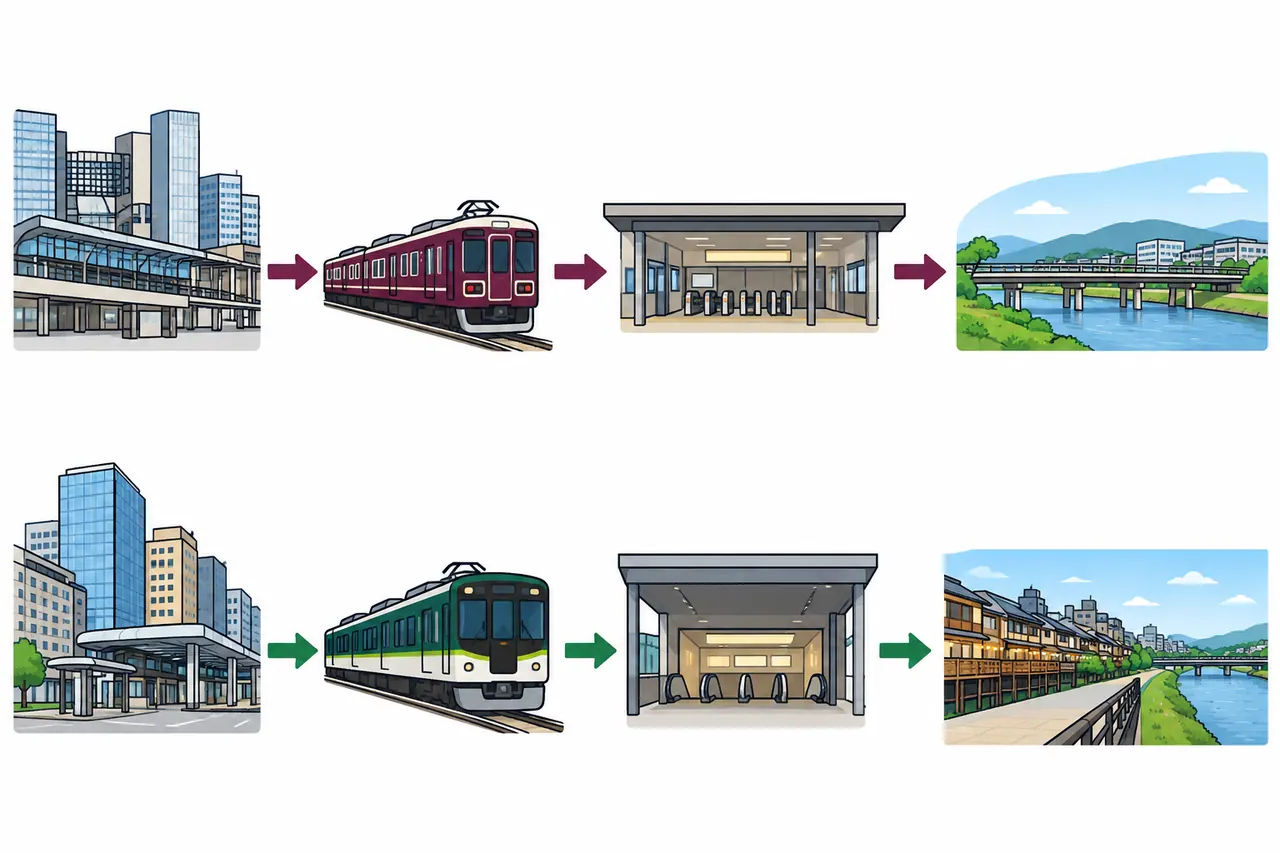
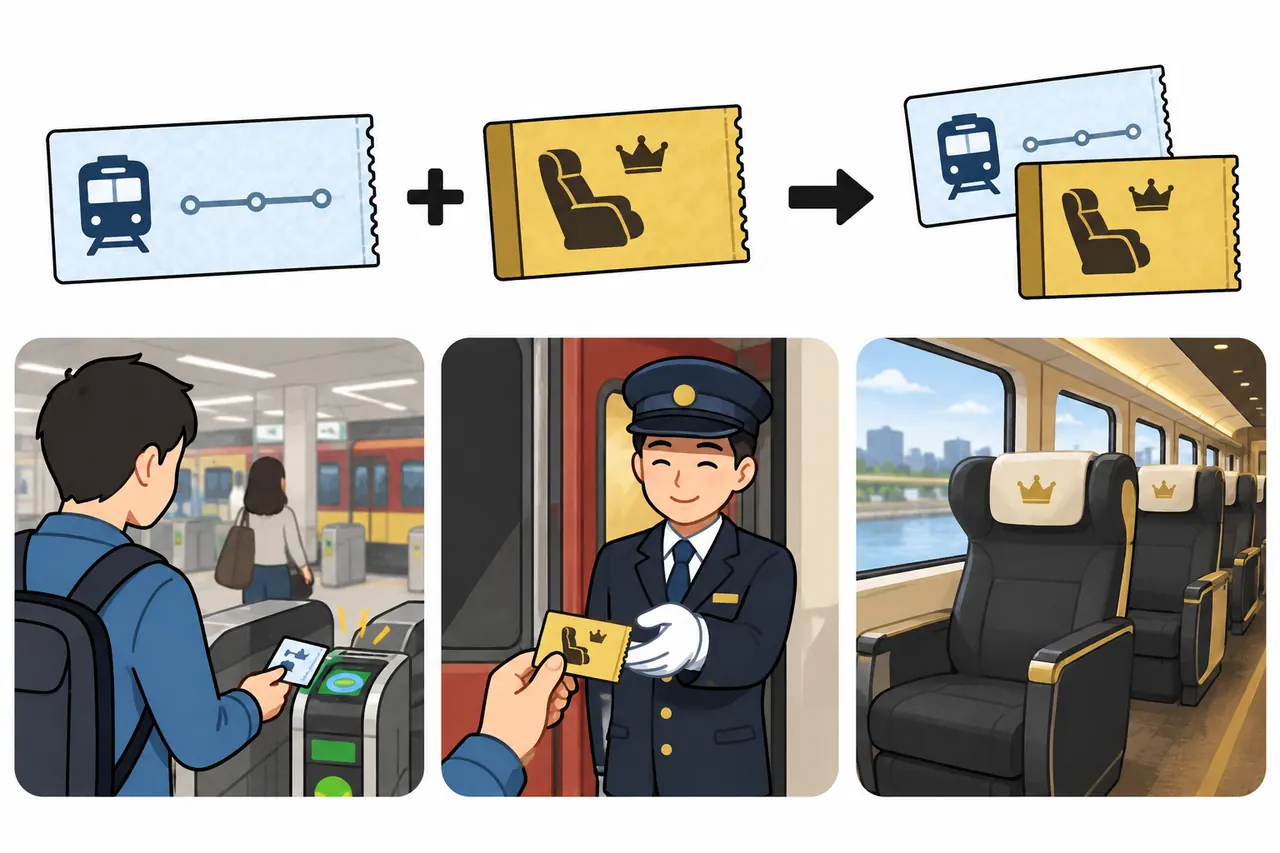
Hankyu and Keihan can be more convenient than JR if your plans are in central Kyoto, but neither arrives at JR Kyoto Station. Hankyu serves Karasuma and Kyoto-kawaramachi, while Keihan serves Gion-shijo and Sanjo. Match the railway, station and final destination before choosing an exit or transfer.
Hankyu for central Kyoto and Arashiyama
Hankyu runs from Osaka-umeda toward Kyoto-kawaramachi, with Karasuma also useful for central Kyoto. The tourism association gives an approximate 45-minute journey from Osaka-umeda toward central Kyoto; a JR West comparison document gives 43 minutes from Osaka-umeda to Kyoto-kawaramachi as a fastest daytime weekday example, without specifying the train type. These are different measures and should not be treated as a guaranteed journey time.
Check Hankyu’s weekday timetable or weekend and holiday timetable for the date you travel. At Osaka-umeda, read the departure board and check the train’s stops. For Arashiyama, change at Katsura for the Hankyu Arashiyama Line, then check the next platform display; add the connection time when estimating the whole journey.
Kyo-train Garaku is Hankyu’s sightseeing train, but it does not require a reservation or an extra sightseeing-train charge: you pay the normal fare. One example on the weekend and holiday schedule is a 9:32 departure from Osaka-umeda and 10:15 arrival at Kyoto-kawaramachi, a 43-minute journey. Check Hankyu’s service information for your travel day, since this example is not a promise that the train runs on every date.
PRiVACE is Hankyu’s paid reserved-seat service on the Kyoto Line. A seat ticket costs ¥500 in addition to the normal fare; Hankyu says online booking opens 14 days before travel and closes one minute before departure from your station. If seats remain, you can also buy on board. See Hankyu’s PRiVACE guide for booking and use details.
Keihan for Gion-shijo and Sanjo
Keihan’s Limited Express stops at Gion-shijo, and the railway describes a direct Osaka–Kyoto Limited Express journey as taking about 50 minutes. The Kyoto tourism association gives about 48 minutes from Yodoyabashi to central Kyoto but does not specify which arrival station that estimate uses. Treat both as broad guidance and check your chosen train, departure station and arrival station.
On station signs, 特急 means Limited Express. Keihan’s line guide describes its routes, including the Uji Line for the Byodoin area and the Otsu lines connecting the Kyoto and Shiga areas. Check the line and stations for your own itinerary rather than assuming that every Keihan service covers every destination.
Keihan’s Premium Car has reserved seats, and you need a separate Premium Car ticket as well as the basic ticket. Buy the Premium Car ticket before boarding, and check the Premium Car information for current details. Use the Gion-shijo station page and map to plan your arrival; for Sanjo, check Keihan’s official station information and timetable.
4. Osaka to Kyoto from airports and Universal Studios Japan
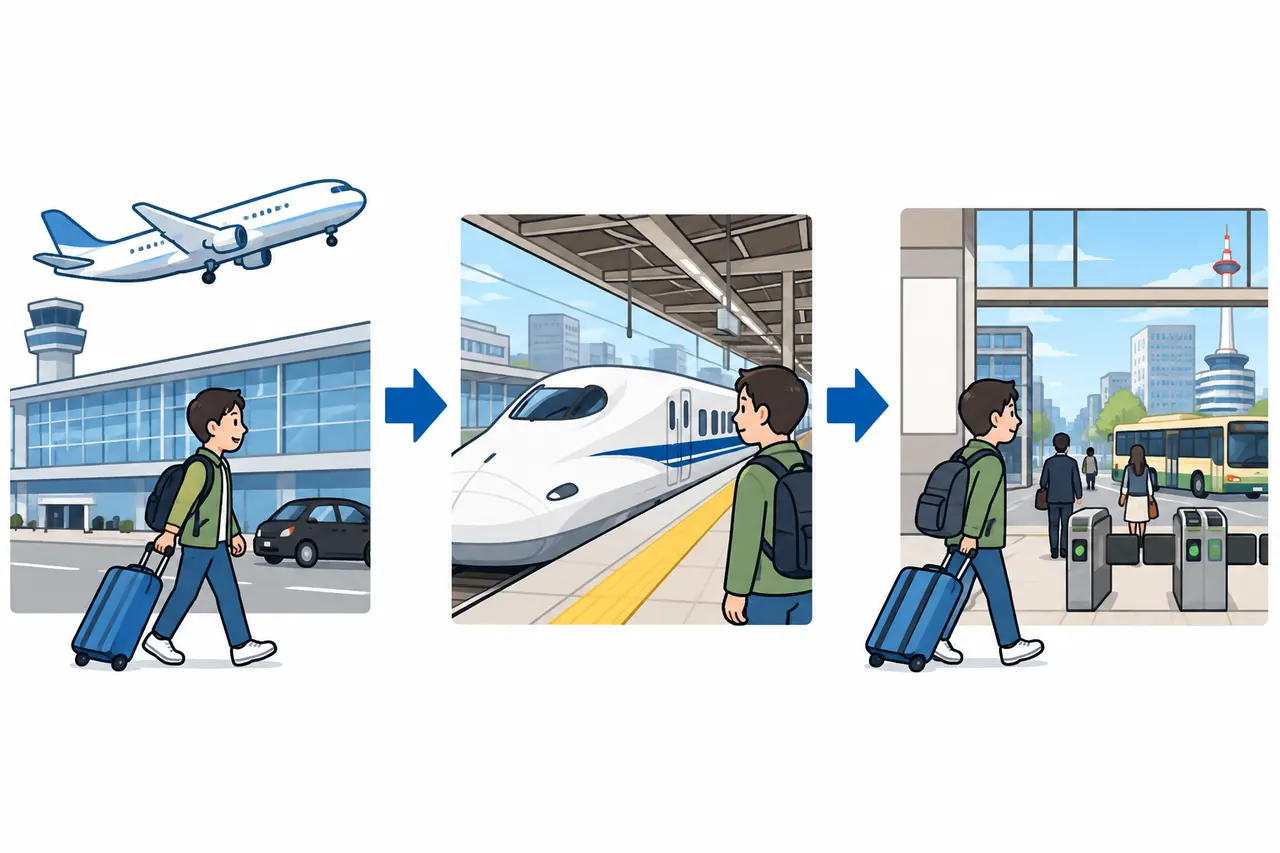
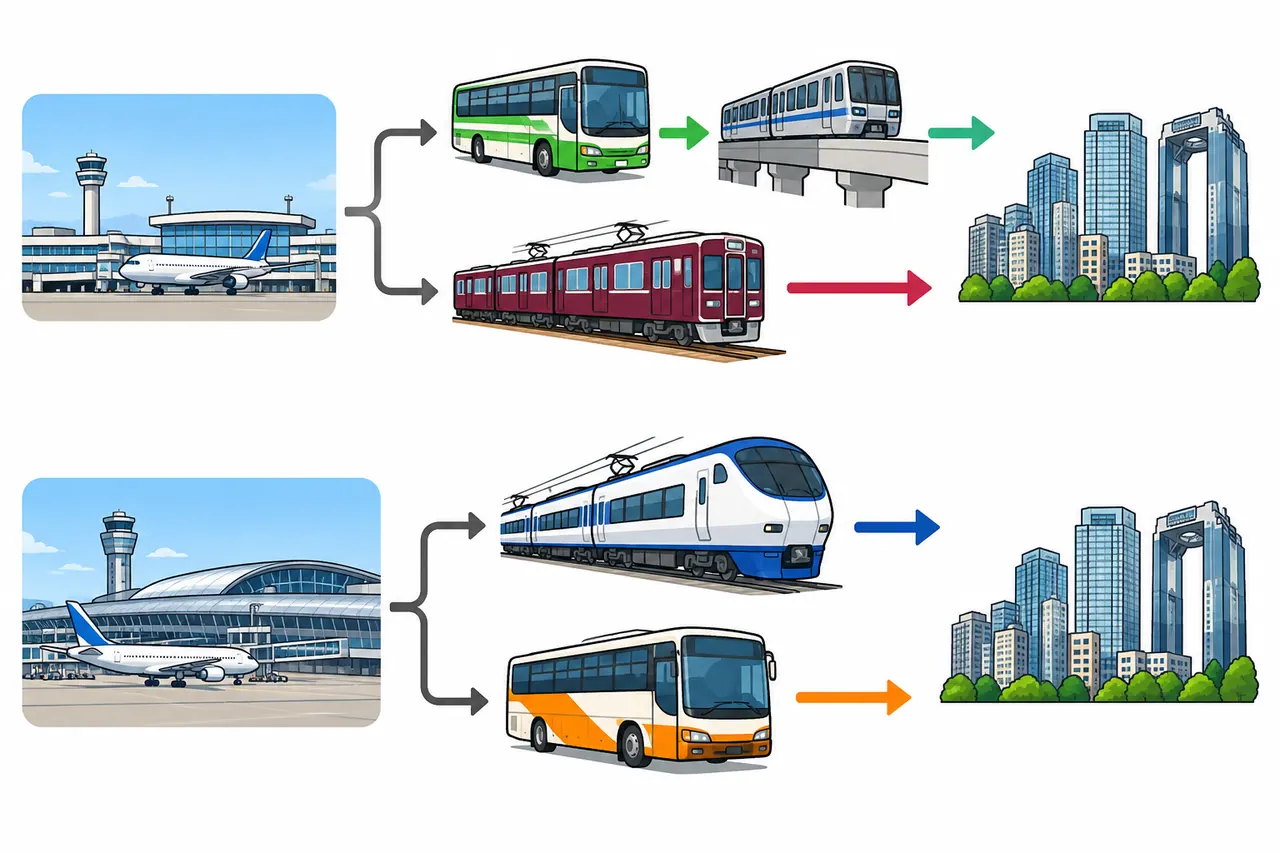
From Kansai International Airport, compare the Haruka train with the Kyoto airport bus; from Itami Airport, compare the Kyoto bus with a monorail-and-Hankyu journey. The listed times and prices below are examples from the operators and tourism association, not door-to-door guarantees. Airport buses can be affected by road conditions, and booking rules depend on the route and direction.
| Route | Time and one-way price example | Conditions |
|---|---|---|
| Itami Airport → Kyoto Station by bus | About 50–55 minutes; adult ¥1,500, child ¥750 | First come, first served; traffic can delay the bus. |
| Itami → Minami-Ibaraki → Hankyu | Check operators for time and fare | Change from the Osaka Monorail to Hankyu at Minami-Ibaraki. |
| Kansai Airport → Kyoto by Haruka | About 80 minutes; eligible WEST QR ticket: adult ¥2,700, child ¥1,350 | WEST QR prices apply to sales from 1 November 2026 and eligibility conditions apply. |
| Kansai Airport ↔ Kyoto Station by bus | Adult ¥2,800, child ¥1,400 | Check the schedule; booking rules differ by direction. |
Haruka and WEST QR tickets
The Kyoto tourism association gives about 80 minutes for the direct Haruka journey from Kansai Airport to Kyoto. The WEST QR Haruka one-way ticket costs ¥2,700 for an adult and ¥1,350 for a child for sales from 1 November 2026, according to JR West; check the WEST QR product page for the applicable price and terms.
This ticket is for eligible visitors entering Japan for a short stay with a passport issued by a foreign government. Japanese nationals cannot use it, even if they hold permanent residence abroad. It allows advance seat reservations in the Haruka cars covered by the product, but it does not cover the Shinkansen.
JR West says the ticket cannot be bought through travel companies in Japan or through JR West’s online reservation service. An internet-connected smartphone is needed to use WEST QR; if the traveller does not have one, the ticket can be displayed on a companion’s device. Check JR West’s page for available purchase channels and full conditions before buying.
Haruka also stops at the underground Umekita platforms at Osaka Station. For an Osaka-to-Kyoto journey by Haruka, check the applicable fare, Limited Express ticket and departure time with JR; the airport product conditions do not establish the fare for that separate trip.
Airport bus booking and stops
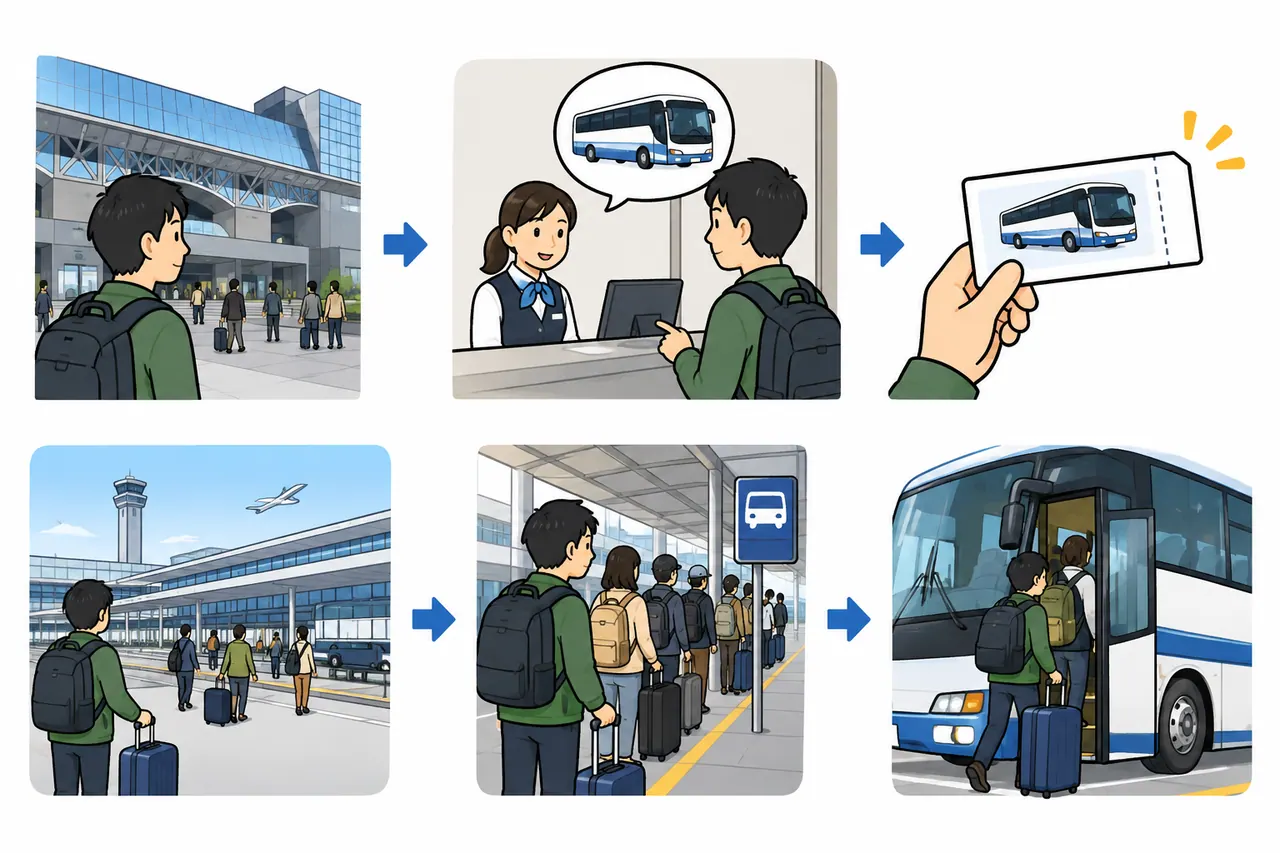
The Itami Airport–Kyoto Station bus is first come, first served and has no reservation. Its listed adult fare is ¥1,500 and child fare ¥750, with a standard journey time of about 50–55 minutes; road traffic may delay it. The Hankyu Kanko Bus timetable has route information, and the Kyoto bus uses stop 2 at Itami Airport, as shown on the airport stop map. The Kyoto departure is at Kyoto Station’s Hachijo-guchi side; use the operator’s Kyoto stop information.
The Kansai Airport–Kyoto bus fare example is ¥2,800 for an adult and ¥1,400 for a child. All services are assigned-seat services, but passengers cannot reserve the Kansai Airport-to-Kyoto direction: they board in line order. Reservations are available for Kyoto-to-Kansai Airport services from one month before travel.
Keihan Bus lists a reservation deadline of 23:00 on the previous day for services leaving the first stop at or before 9:00, and one hour before departure for services leaving at or after 9:00. Since both descriptions include a 9:00 departure, ask the operator which deadline applies to that service. Check the Keihan Bus route and booking page, select the correct direction and use its map to find your stop.
From Universal Studios Japan
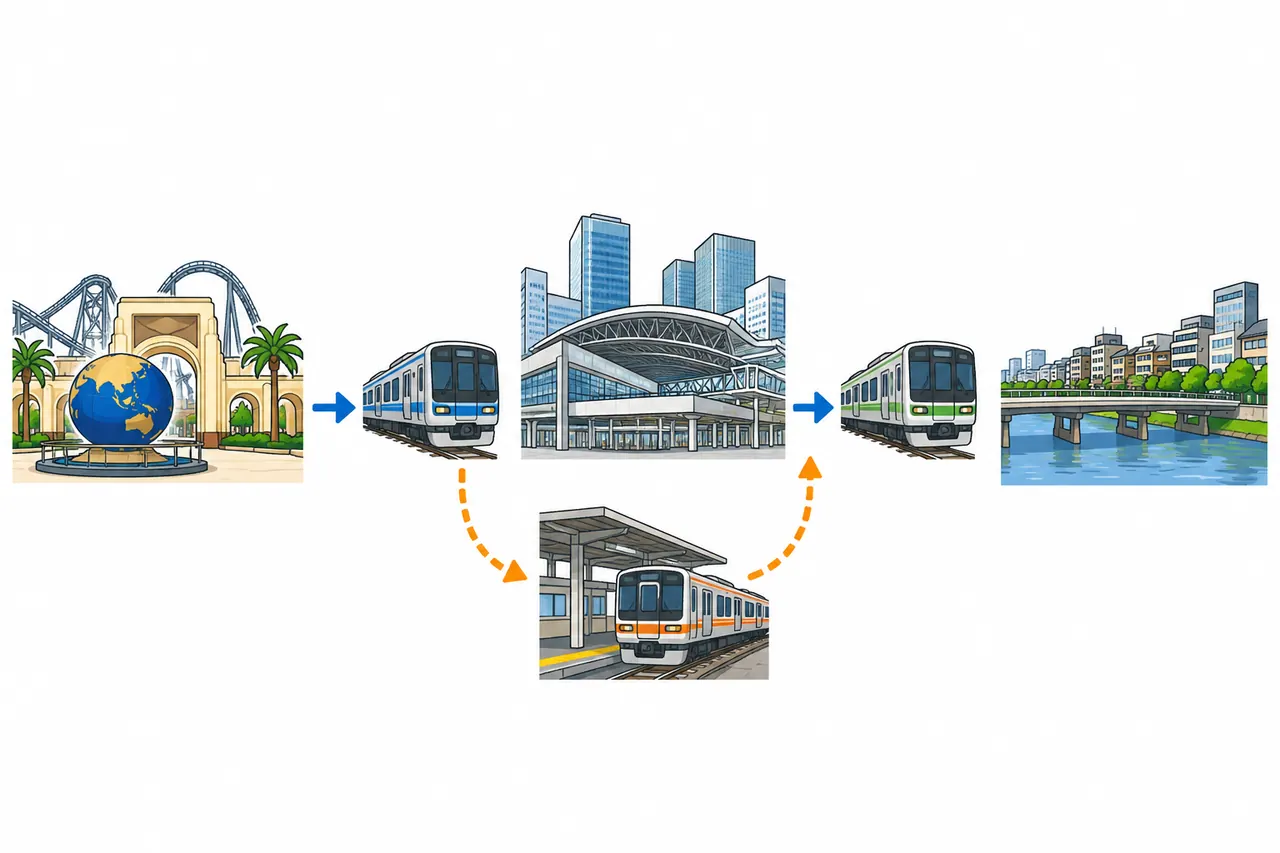
Use JR Universal City Station for Universal Studios Japan. JR West’s 2018 guide describes travel between Osaka Station and Universal City, including some direct services and a possible change at Nishikujo; that older guide does not confirm the reverse journey or the connection to Kyoto for your travel date. Check the current timetable and ask JR staff whether your selected train requires a change at Nishikujo.
The official Universal City Station page lists its address as 6-2-28 Shimaya, Konohana-ku, Osaka. The Nishikujo station map lists 1-32-18 Nishikujo, Konohana-ku, Osaka, and provides station-layout information. For the Kyoto connection, check the Universal City-to-Osaka timetable, then read the Osaka Station board for a Kyoto-bound train.
5. Osaka to Kyoto passes: compare the cost
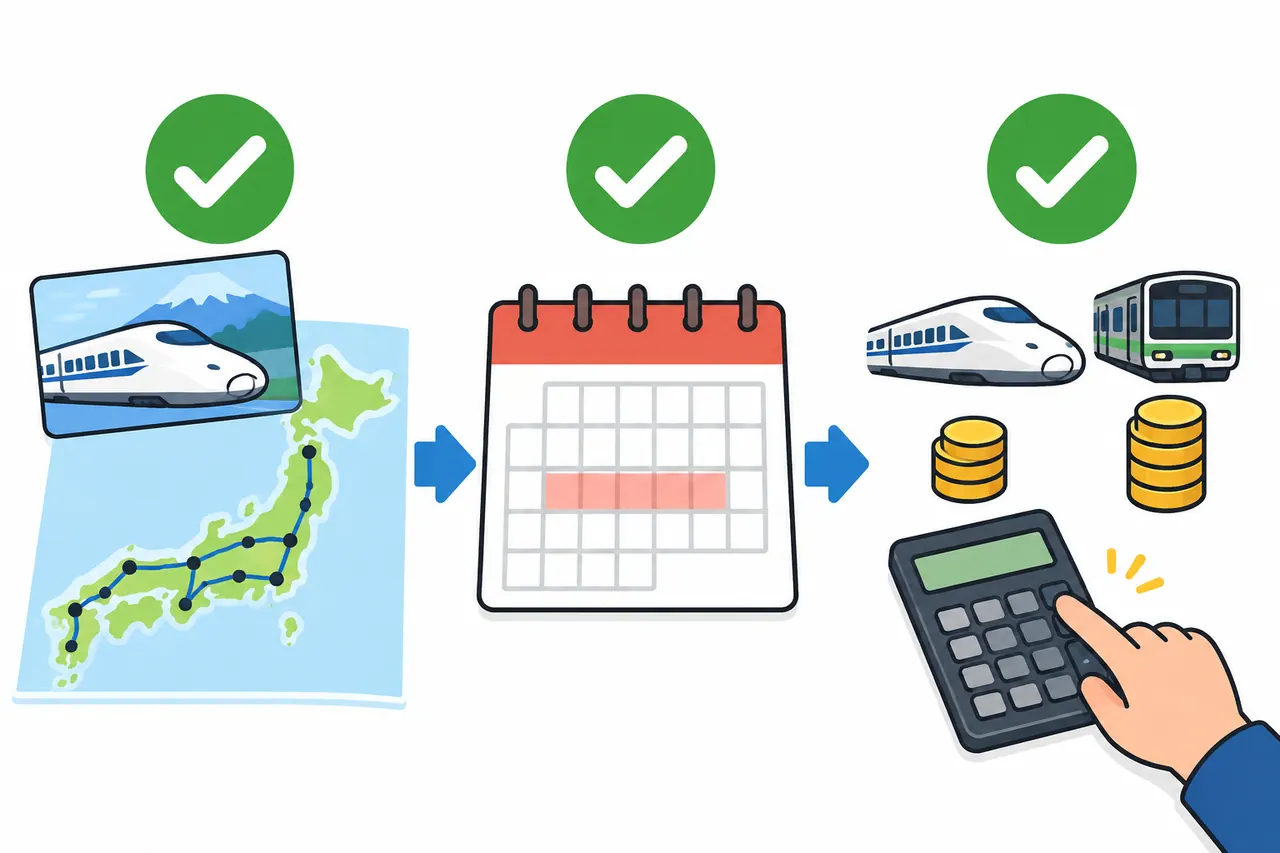
A pass is worthwhile only if its price is lower than the fares for the trips it actually covers. Add your planned outward, return and other rides first, then check the pass map and validity rules. The pass prices and conditions below were checked on 3 November 2026; confirm the sales page again before purchase.
A two-ride example
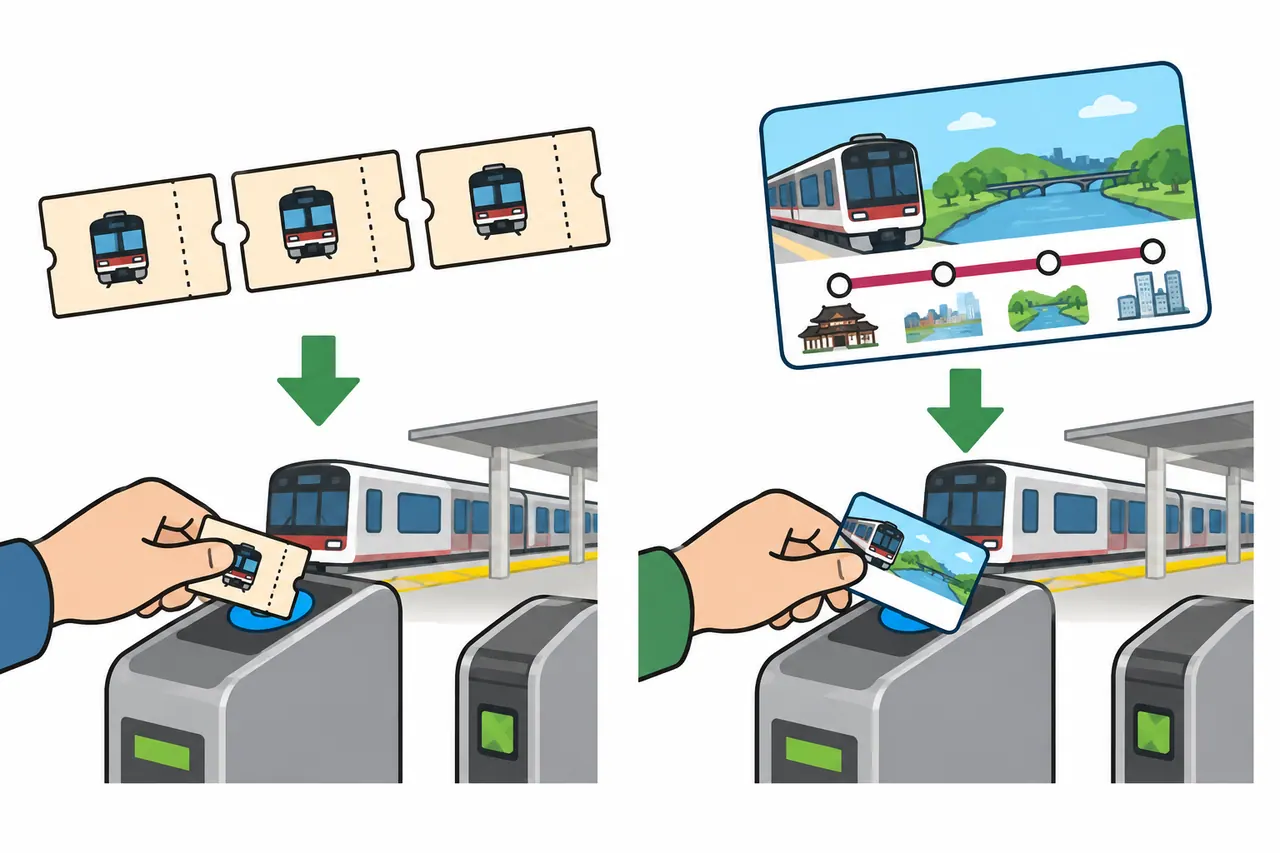
For one adult making only a Keihan return trip between Yodoyabashi and Gion-shijo, the dated fare examples total ¥980. That is ¥670 less than the listed ¥1,650 adult Osaka–Kyoto 1-day ticket, before any other rides. This calculation uses fares in Keihan tables revised in October 2025, so confirm the fare that applies on your travel date.
| Item | Cost and source |
|---|---|
| Yodoyabashi → Gion-shijo | ¥490, Keihan outward fare table |
| Gion-shijo → Yodoyabashi | ¥490, Keihan return fare table |
| Two separate rides | ¥980 using those dated fares |
| Osaka–Kyoto 1-day ticket | Adult ¥1,650, child ¥830; Keihan ticket page |
The example excludes other rides, food and sightseeing. If you plan additional Keihan journeys, add those fares before comparing the total with the pass price. A pass covering more railways may be useful for a different itinerary, but only for the routes and dates listed in its conditions.
Compare pass rules
| Ticket | Listed price | Coverage and important conditions |
|---|---|---|
| Keihan Osaka–Kyoto 1-day ticket | Adult ¥1,650; child ¥830 | Keihan lines and the Iwashimizu-hachimangu cable railway; Otsu lines excluded. Digital ticket; advance registration and credit-card payment required. Use on one day within three months of purchase. |
| ONE KANSAI Kyoto 3-way Pass | Adult ¥1,800 | Selected Keihan, Hankyu and JR routes, not every line. Use on a chosen day through 31 March 2027; KANSAI MaaS registration required. |
| Kyoto–Osaka Sightseeing Pass | ¥1,650 for one day; ¥1,850 for 24 hours | Keihan visitor pass; check eligibility and current conditions on the official page. |
| Hankyu-Hanshin 1day Pass | Adult ¥1,600 | Hankyu, Hanshin and Kobe Kosoku lines. Sale and use dates apply. |
| Eizan and Keihan 1-day ticket | Adult ¥2,100; child ¥1,050 | Eizan, Keihan and the cable railway; Otsu lines excluded. Sale and use dates apply. |
| KANSAI RAILWAY PASS LITE | Adult ¥5,200 for two days; ¥6,500 for three days | JR, Kyoto City Subway and buses are excluded; use on consecutive days. |
The Keihan 1-day ticket page lists its digital ticket rules. The ONE KANSAI pass page describes the selected routes, including Keihan Yodoyabashi–Demachiyanagi, Hankyu Osaka-umeda–Kyoto-kawaramachi and JR Osaka–Kyoto; it does not cover every line. Its QR code must be displayed from the app ticket screen, and screenshots cannot be used. Keihan Premium Car and Hankyu PRiVACE require separate fare supplements.
For the Hankyu-Hanshin 1day Pass, the 2026 fiscal-year page lists a sale period of 1 April 2026 to 31 March 2027 and a use period of 1 April 2026 to 30 April 2027, on one day within three months of purchase; credit-card payment is required. The Eizan and Keihan ticket page lists adult and child prices and a sale period of 20 March 2026 to 31 March 2027; use is on one day from 1 April 2026 to 31 March 2027 and within three months of purchase.
The KANSAI RAILWAY PASS LITE page lists ¥5,200 for two days and ¥6,500 for three days for sales from 1 October 2026 to 31 March 2027. Use must start by 31 March 2027, within three months of purchase, and days must be consecutive. The final use date is 1 April 2027 for the two-day ticket and 2 April 2027 for the three-day ticket.
To compare a pass, write down your outward station and fare, return station and fare, and any other rides. Add the fares, check every planned ride against the official pass map, then compare the total with the pass price and validity dates. Do not count a route just because it is operated by a railway named in the pass; the specific section must be covered.
6. Osaka to Kyoto train checklist: avoid mistakes
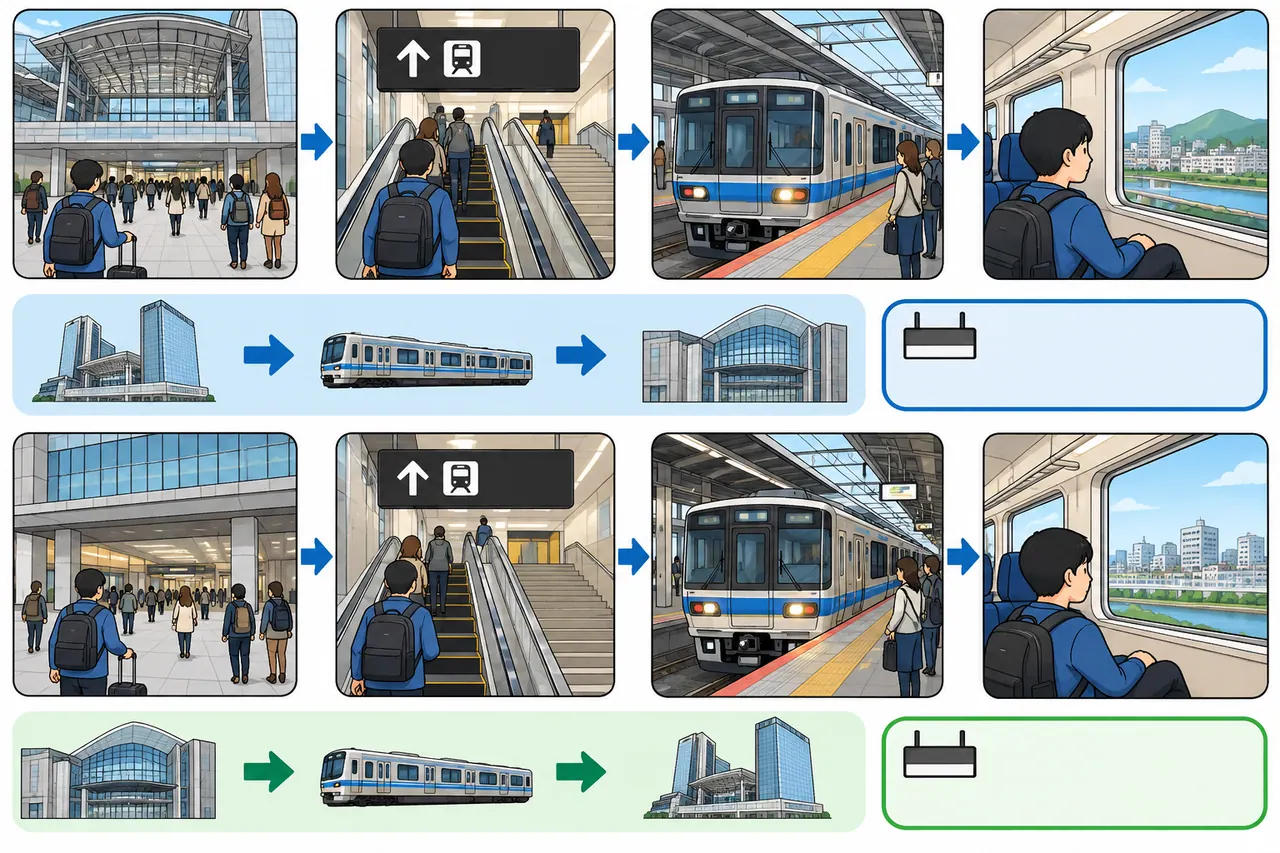
Before leaving, match the railway, station name and train stops. Also check a suitable return service for your date, especially if your plans depend on a connection. The table highlights common errors that can add time or lead to buying the wrong ticket.
| Common mistake | Better move |
|---|---|
| Going to Osaka Station for the Shinkansen | Check your ticket: the Shinkansen departs from Shin-Osaka. |
| Choosing a route by city name alone | Match the railway and full station name, such as JR Kyoto or Hankyu Kyoto-kawaramachi. |
| Boarding a train that skips your stop | Read the stop list or ask station staff. |
| Buying only the basic Shinkansen ticket | Check that you also have the required Shinkansen ticket. |
| Assuming a pass covers every line | Open the official map and check the exact route and dates. |
| Leaving the return trip until late | Look up the last suitable train in advance. |
Before travel
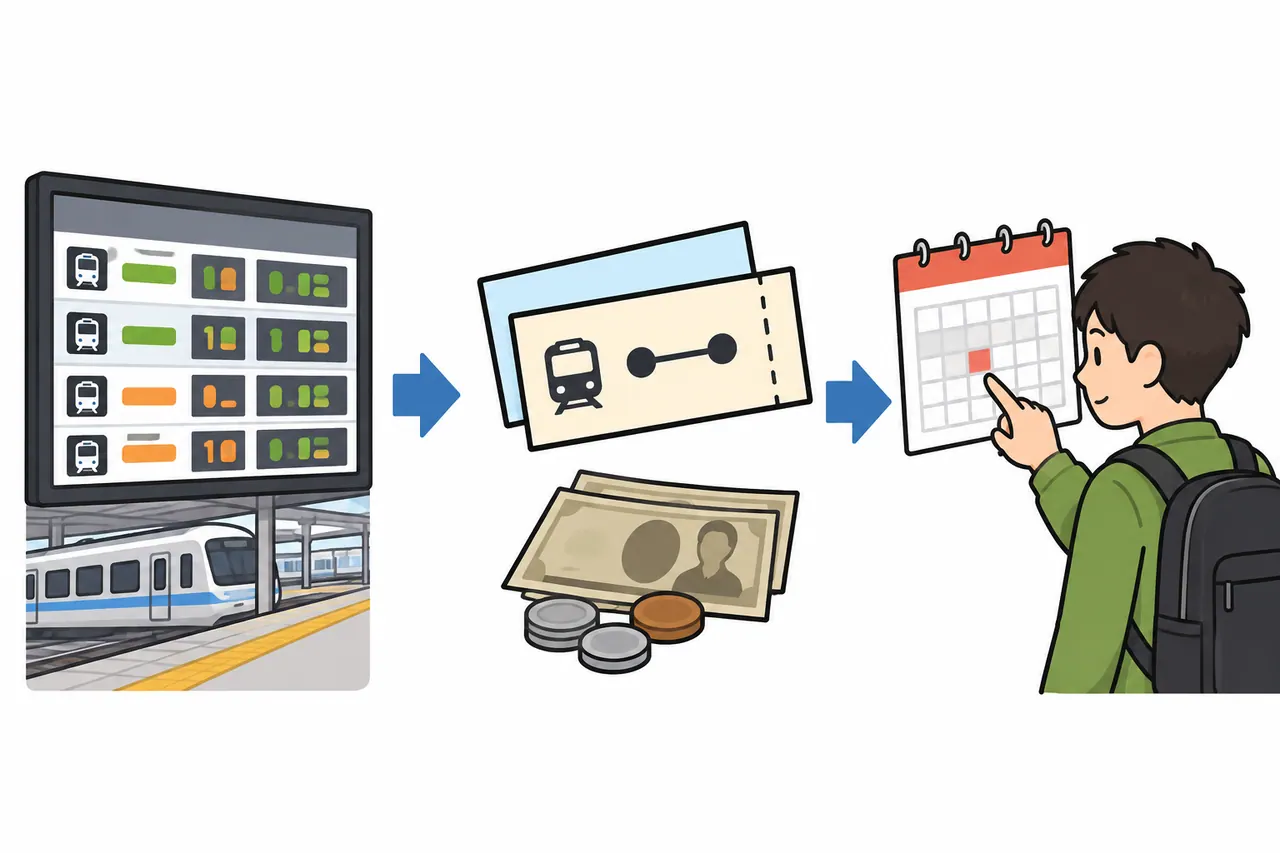
Open the operator’s timetable for your travel date and day of the week. Find an outward and return train that stops at your stations, then check fare and ticket rules on the operator’s official page. Save the relevant station map and ask staff about any unclear connection rather than guessing the platform or exit.
| Situation | What to check |
|---|---|
| Rain | Review station maps and plan your connection before leaving. |
| Crowds | Identify another suitable train and leave room in your plan. |
| Travelling with children | Confirm child fares and ask staff about the route. |
| Limited mobility | Ask staff about lifts and step-free paths for your exact connection. |
| Large bags | Check station information and consider whether to carry or send them. |
Step-free paths have not been confirmed for every connection in this guide, so ask the operator about your specific route. Look for toilets on the station map, keep bags out of other passengers’ way, and follow posted platform and filming rules. For another luggage option, see the guide to luggage forwarding in Japan.
7. Osaka to Kyoto train FAQ
These answers distinguish between a route estimate, a dated fare example and a rule that depends on the ticket product. Check the operator’s current page for your travel date, particularly for fares, timetables and reservations. The FAQ does not replace a station display or the conditions printed for the ticket you buy.
How long does the train from Osaka to Kyoto take?
JR’s Special Rapid takes about 30 minutes from Osaka Station to Kyoto Station, according to the Kyoto tourism association. Hankyu takes about 45 minutes from Osaka-umeda toward central Kyoto, while Keihan’s estimates are about 48 minutes from Yodoyabashi to central Kyoto or about 50 minutes for a direct Osaka–Kyoto Limited Express; the 48-minute estimate does not specify its arrival station. These are train-only estimates, so add walking, waiting, connections and travel after arrival.
How much is a one-way ticket?
Dated adult one-way examples are ¥580 for JR Osaka–Kyoto in JR West’s March 2026 fare table and ¥410 for Hankyu Osaka-umeda–Kyoto-kawaramachi in a FAQ updated in 2024. Keihan’s October 2025 revised fare table lists ¥490 from Yodoyabashi to Gion-shijo. The applicable fare for your travel day is not confirmed by those examples; check the JR fare table, Hankyu FAQ and Keihan table.
Do I need a reservation for Kyo-train Garaku or Keihan Premium Car?
Kyo-train Garaku does not require a reservation, and you pay the normal Hankyu fare with no extra sightseeing-train charge. Keihan Premium Car has reserved seats, and you need a Premium Car ticket as well as the basic ticket; buy it before boarding. Check the Garaku service page and Keihan Premium Car information for current details.
Can I reserve a Hankyu PRiVACE seat?
Yes. Hankyu says web booking opens 14 days before travel and closes one minute before departure from your boarding station, and you can buy on board if seats remain. The seat ticket costs ¥500 in addition to the normal fare. See Hankyu’s PRiVACE guide before booking or boarding.
Can I use a JR pass on the Shinkansen?
The JR West Kansai Area Pass does not cover the Shinkansen, and sales of that pass ended on 30 September 2026; a previously purchased pass can still be used within its specified validity period. A national JAPAN RAIL PASS holder needs to buy the special Nozomi/Mizuho ticket before boarding Nozomi. Check the JR West Kansai Area Pass conditions and JAPAN RAIL PASS guidance for the ticket you hold.
Can I reserve the airport bus?
For the Kansai Airport-to-Kyoto bus, reservations are not accepted; passengers board in line order. The Kyoto-to-Kansai Airport bus can be reserved, with the operator’s listed booking deadlines depending on the service’s departure time; the wording around a 9:00 departure overlaps, so confirm the deadline with Keihan Bus. The Itami Airport–Kyoto bus is also first come, first served; check the Keihan Bus and Hankyu Kanko Bus pages for current details.