
Nara Park Guide: Deer, Temples and How to Plan Your Visit
Contents
Nara Park brings together wild deer, wooded paths and some of Japan’s most celebrated temples and shrines. It is easy to reach on a day trip from Osaka or Kyoto, but there is enough to see for a leisurely half-day or longer.
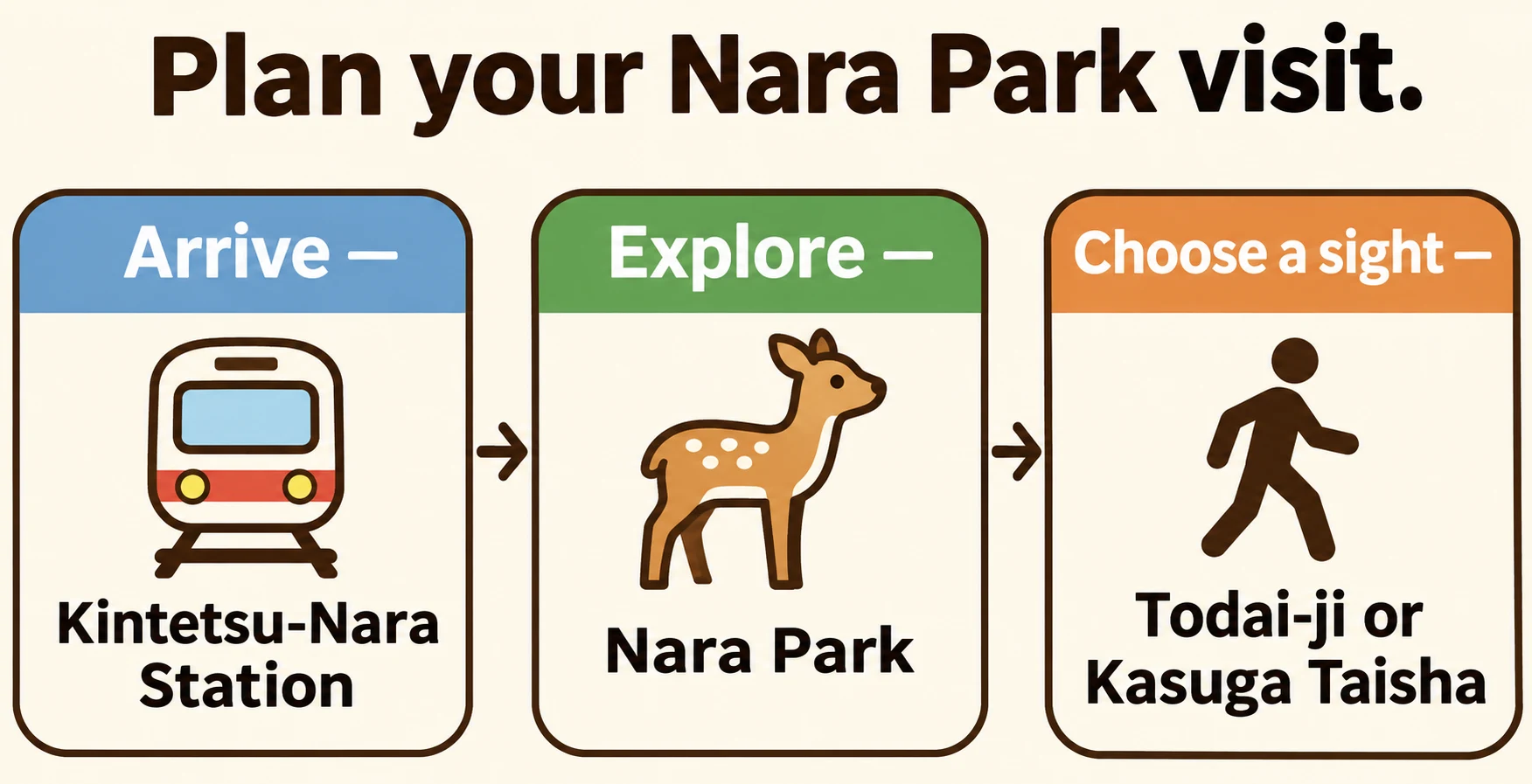
The park grounds are free to enter and open around the clock. Tōdai-ji, Kasuga Taisha and other individual attractions have their own hours and charges. Start at Kintetsu-Nara Station for the shortest walk, then choose one or two sights to build your route around. (narashikanko.or.jp)
For a wider itinerary, see our guides to Osaka to Nara, Kyoto to Nara and a Nara day trip.
Nara Park at a glance
| What to know | |
|---|---|
| Location | Kasuganochō and surrounding areas, east of central Nara |
| Park admission | Free, with no park entrance reservation |
| Park hours | 24 hours a day, year-round |
| From Kintetsu-Nara Station | About 8 minutes on foot to the park |
| From JR Nara Station | About 20 minutes on foot, or about 7 minutes by city-loop bus to Kenchō-mae |
| Best for | Deer watching, historic sites and walks through greenery |
The Nara City Tourism Association’s park page gives the station walking estimates and lists the park office’s number as 0742-22-0375. The park opened on February 14, 1880, and has no single, clearly defined entrance: streets and paths lead into its different sections. (narashikanko.or.jp)
Use Nara Park on Google Maps to get oriented, then set your next destination to a specific place such as Tōdai-ji or Ukimidō. The station-to-park walk is only the beginning of the distance you may cover.
How to get to Nara Park
From Osaka or Kyoto by Kintetsu
Kintetsu-Nara is convenient if you want to start walking as soon as you arrive. The following are adult, one-way examples from Kintetsu’s route information:
| Route | Train | Basic fare | Additional charge | Example journey |
|---|---|---|---|---|
| Osaka-Namba–Kintetsu-Nara | Express | ¥680 | None | About 39 minutes |
| Kyoto–Kintetsu-Nara | Direct express | ¥760 | None | About 48 minutes |
| Kyoto–Kintetsu-Nara | Limited express | ¥760 | ¥520 | About 34 minutes |
These are examples of particular services, rather than a timetable for every departure. The Osaka example comes from Kintetsu’s route search; the Kyoto examples are from its Kyoto–Nara search. (eki.kintetsu.co.jp)
From Kyoto, look for a train displaying Kintetsu-Nara as its destination. Some services require a change at Yamato-Saidaiji; a direct Nara-bound service continues through the station without a transfer.
A regular express needs only the basic fare. On a limited express, all seats are reserved, and you also need a limited-express ticket. Buy it online, at a limited-express ticket machine or at a major station counter. Special sightseeing trains can have additional charges: the Aoniyoshi fare page separates its basic fare, limited-express charge and special-car fare. (kintetsu.co.jp)
The KINTETSU RAIL PASS guide shows each pass’s rail and bus zones. The 1-day and 2-day passes include designated Nara Kotsu bus zones; the 5-day pass does not include buses, while the 5-day plus includes designated bus areas. Limited-express tickets are extra. The Kintetsu pass is separate from JR services. (kintetsu.co.jp)
From JR Nara Station or by car
From JR Nara Station, walk east toward the park or take the outer-loop city bus to Kenchō-mae. The tourism association estimates about 20 minutes on foot or 7 minutes on the bus. If Kasuga Taisha is your first stop, the shrine also describes buses to Kasuga Taisha Honden and the more frequent city loop to Kasuga Taisha Omotesandō; the latter is followed by a walk to the sanctuary. (narashikanko.or.jp)
Drivers can use paid prefectural or private parking near the park. For an approach from the shrine side, Kasuga Taisha’s parking lot lists ¥1,500 for a passenger car; its posted hours are 7:30 a.m.–5:00 p.m. from March to October and 7:30 a.m.–4:30 p.m. from November to February. During busy sightseeing periods, Nara Prefecture suggests parking farther away, such as near JR Nara, and continuing by bus. (kasugataisha.or.jp)
How to enjoy the deer safely
The deer are wild animals, even when they approach people. They can bite, kick, charge or strike with their antlers. Keep children beside an adult, avoid touching deer carelessly, and give each animal room to move away. Take particular care around mothers with young in spring and males during the autumn mating season. (pref.nara.lg.jp)
If you decide to feed them:
- Buy shika senbei, the crackers made for Nara’s deer. Nara City lists a bundle of 10 at ¥200. Part of the proceeds from the identifying paper bands supports deer protection. (city.nara.lg.jp)
- Put away maps, plastic bags and other loose belongings before approaching. Deer may try to eat them.
- Give the crackers promptly rather than holding them out of reach or pretending to offer them. If several deer crowd around you, stop the interaction and move away calmly.
- Do not give deer bread, vegetables, sweets or other food. Deer crackers are the exception to the park’s feeding rule.
The prefecture’s deer guidance also asks visitors not to chase or hit deer. Keep dogs on a leash and away from them: a frightened deer may run into people or traffic, or attack in self-defence. (pref.nara.lg.jp)
Feeding is optional. You can watch and photograph deer from a comfortable distance while continuing between the park’s sights.
What to see in and around the park
| Place | Why visit | Adult admission and hours |
|---|---|---|
| Tōdai-ji Great Buddha Hall | The large bronze Buddha and the temple’s monumental hall | ¥800; 7:30 a.m.–5:30 p.m. April–October, 8:00 a.m.–5:00 p.m. November–March |
| Kōfuku-ji National Treasure Museum | Buddhist art near the Kintetsu station approach | ¥900; 9:00 a.m.–5:00 p.m., last entry 4:45 p.m. |
| Kasuga Taisha | Lantern-lined approaches and shrine architecture | Special worship ¥700; 9:00 a.m.–4:00 p.m., with scheduled closures |
| Nara National Museum | Buddhist art and special exhibitions | Exhibition fees vary; the Ritual Bronzes Gallery is free during the Buddhist Sculpture Hall renovation |
| Ukimidō and Tobihino | Outdoor scenery and a break between historic sites | Free park areas |
Tōdai-ji and Kōfuku-ji
At Tōdai-ji, allow time for both the approach through Nandaimon Gate and the Great Buddha Hall itself. The temple’s visitor page lists a ¥1,200 adult joint ticket for the Great Buddha Hall and Tōdai-ji Museum, available at either location. A ¥500 audio guide is available beyond the hall’s ticket gate; individual visitors do not need to reserve it. The temple states that admission payments are cash only. (todaiji.or.jp)
Kōfuku-ji is a useful first or last stop because it is close to the station side of the park. Its National Treasure Museum is a good choice if Buddhist sculpture interests you. The museum accepts cash for admission. (kohfukuji.com)
Kasuga Taisha and Nara National Museum
The walk to Kasuga Taisha is part of the experience: paths lead through trees and past stone lanterns toward the sanctuary. General worship hours are 6:30 a.m.–5:30 p.m. from March to October and 7:00 a.m.–5:00 p.m. from November to February. The paid special-worship area has different hours and closes for ceremonies, including March 8–13 and December 20–January 7. Pets are not permitted within the shrine precincts. (kasugataisha.or.jp)
For an indoor stop, Nara National Museum is close to the major temples. Its hours and admission page lists exhibition information and tickets. The Buddhist Sculpture Hall is closed for renovation from September 14, 2026, until around spring 2028; during that closure, the Ritual Bronzes Gallery is free. The museum is generally closed on Mondays, with exceptions for holidays and events. Its shop and café in the underground passage are accessible without an admission ticket. (narahaku.go.jp)
Ukimidō, a pavilion by the water, and Tobihino, an open grassy area, give the day a different pace from the temple interiors. The tourism association also highlights nearby Kasugayama Primeval Forest for a longer nature walk. Shōsōin is another important heritage site in the area; its treasures feature in exhibitions at the museum. (narashikanko.or.jp)
Three ways to plan your walk
The tourism association recommends setting aside at least half a day for the area. The routes below are planning choices: add time for photographs, meals, queues and the places you enter. (narashikanko.or.jp)
A short outdoor visit
Arrive at Kintetsu-Nara, walk toward Kōfuku-ji and continue into the park. Spend time watching deer, then head to Ukimidō before returning toward the station.
This works well if you want a flexible walk without a paid attraction. Bring a bag for rubbish and choose a place away from deer if you stop for a snack.
A half-day with the Great Buddha
Start early at Tōdai-ji, visit the Great Buddha Hall and walk through the surrounding park. Add the temple museum if you want more background, then take a break before returning through the station-side area.
The Great Buddha Hall opens earlier than many indoor attractions. If a quieter start appeals, the tourism association recommends the early morning; make the hall your first stop and leave the open park areas for later. (narashikanko.or.jp)
A full day of temples, shrine and scenery
Begin at Kōfuku-ji, continue to Kasuga Taisha, then walk to Tōdai-ji. The tourism association estimates about 30 minutes on foot from Kōfuku-ji to Kasuga Taisha and another 20 minutes from Kasuga Taisha to Tōdai-ji, excluding sightseeing time. (narashikanko.or.jp)
Alternatively, follow its culture-and-scenery route from Kōfuku-ji via Isuien Garden, the Nara National Museum and Ukimidō to Kasuga Taisha. This route makes it easy to choose an indoor stop if rain arrives. Roofed shelters and gazebos in the park also offer places to pause. (narashikanko.or.jp)
Costs and practical tips
For a simple adult day-trip plan from Osaka-Namba, budget ¥1,360 for a return trip on regular Kintetsu express trains, ¥800 for the Great Buddha Hall and ¥200 for one bundle of deer crackers: ¥2,360 in total. This is a planning example; add your own food, local transport and any other admission choices. (eki.kintetsu.co.jp)
A few details make the walk easier:
- Carry your rubbish out. The park has no rubbish bins, and deer can swallow discarded plastic and paper.
- Leave bicycles in designated parking spaces and explore the grounds on foot.
- Keep dogs leashed, and keep them away from deer. Shrine rules can differ from park rules.
- Do not play ball games in the park. Smoke only where ashtrays are provided, not while walking.
- Take personal photographs freely in the park. For news coverage or similar filming, contact the park office about permission; follow individual sites’ photography rules indoors. (pref.nara.lg.jp)
These Japanese phrases can help when asking staff for directions or tickets:
- 奈良公園はどちらですか?
Nara Kōen wa dochira desu ka? — Which way is Nara Park? - 東大寺まで歩いて何分ですか?
Tōdai-ji made aruite nan-pun desu ka? — How many minutes is it to Tōdai-ji on foot? - 大人一枚、お願いします。
Otona ichimai, onegai shimasu. — One adult ticket, please. - このバスは春日大社に行きますか?
Kono basu wa Kasuga Taisha ni ikimasu ka? — Does this bus go to Kasuga Taisha?
Frequently asked questions
Is Nara Park free?
Yes. The public park grounds are free and open year-round. Tickets for places such as the Great Buddha Hall and special exhibitions are purchased separately. (narashikanko.or.jp)
How long should I spend there?
A short outdoor walk can fit into a limited schedule, but at least half a day gives you more room to enjoy the park and visit a major attraction. For several temples and a meal, make it a full day. The association’s walking estimates between sights exclude time spent looking around. (narashikanko.or.jp)
Can I visit without feeding the deer?
Yes. Watch them from a distance and keep walking if one approaches. Do not offer human food, even if you have not bought deer crackers. (pref.nara.lg.jp)
Where can I get help?
For park questions, call the Nara Park Office at 0742-22-0375. For advice about an injury caused by a deer, the prefecture lists the Nara Park Deer Consultation Office at 0742-26-7755. (narashikanko.or.jp)
Primary sources
- Nara Prefecture: About Nara Park
- Nara City Tourism Association: Nara Park visitor information
- Nara City Tourism Association: Park highlights and walking routes
- Nara Prefecture: How to interact with deer
- Nara Prefecture: Park FAQ
- Nara City: Historic landscape plan, including deer crackers
- Kintetsu: Route and fare search
- Kintetsu: Rail Pass guide
- Tōdai-ji: Opening hours and admission
- Kōfuku-ji: Visitor information
- Kasuga Taisha: General information
- Nara National Museum: Hours and admission
Prices and visitor information checked November 7, 2026; check official pages for changes before visiting.


