Miyazaki Prefecture Travel Guide: Coast, Horses and Mountain Scenery
Contents
- 1. Compare Miyazaki’s main highlights
- 2. Choose one main area before building an itinerary
- 3. Spend time around Aoshima
- 4. See the Misaki horses at Cape Toi
- 5. Explore Takachiho’s gorge, shrines and mountain scenery
- 6. Try Miyazaki food and compare coastal stops
- 7. See individual creators’ Miyazaki posts
- 8. Miyazaki travel FAQ
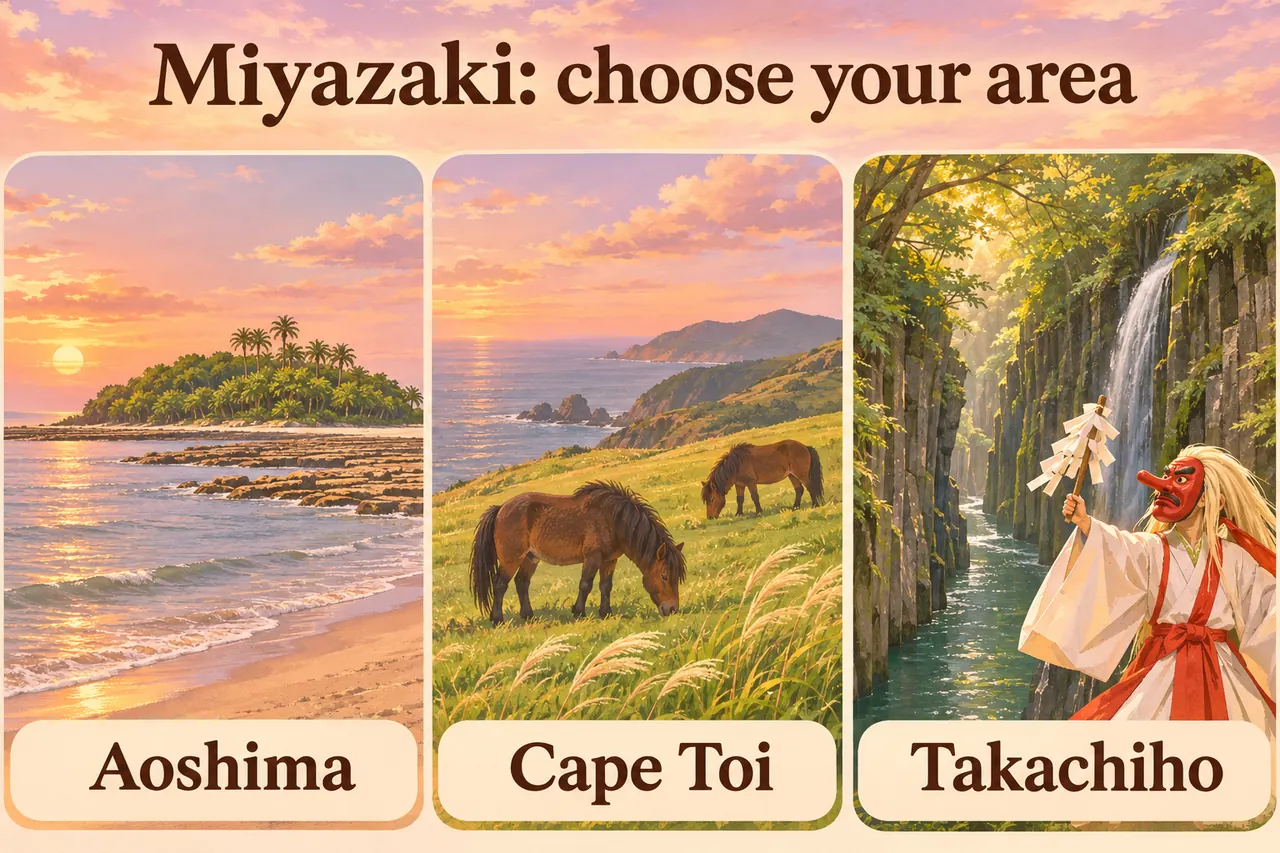
Miyazaki offers very different kinds of trips: a coastal visit to Aoshima, a drive to Cape Toi to see native Misaki horses, or a mountain-area stay around Takachiho’s gorge and shrines. These destinations do not form one simple sightseeing circuit, and the access times below refer to specific starting points and endpoints rather than connections between every place. Use them to choose a main area first, then confirm the actual transport and availability for your travel dates.
The access, opening hours and prices in this guide were checked against the cited official information on 4 November 2026, except for Takachiho kagura details checked on 5 November 2026. Published information can change, so confirm current services and availability with the relevant operator before you set out.
Compare Miyazaki’s main highlights
The three headline stops differ in both atmosphere and practical planning: Aoshima is the simplest rail-based option described here, Cape Toi is a driving-based outing, and Takachiho has a bus connection from Nobeoka as well as separate access estimates from Kumamoto Airport and Takachiho Interchange. Their listed costs are not directly comparable: Aoshima’s botanical garden is free, while Cape Toi has a vehicle contribution and separate lighthouse admission. Takachiho activities also need to be checked individually, especially the gorge boat and shrine performance.
| Place | What to see or do | Published time or price | Access information |
|---|---|---|---|
| Aoshima and Miyakoh Botanic Garden Aoshima | Coast, outdoor garden, greenhouses, and activities such as surfing, stand-up paddleboarding and canoeing | Outdoor garden 8:30–17:00; greenhouse 9:00–17:00; admission free | About 30 minutes from Miyazaki Station to Aoshima Station on the JR Nichinan Line, then about 10 minutes on foot to the garden |
| Cape Toi | Native Misaki horses, a guided observation course, and a lighthouse | Conservation contribution: ¥500 per car or ¥200 per motorcycle; lighthouse: ¥300 for junior-high-school age and older | About 90 minutes by car from Miyazaki Airport or about 30 minutes by car from JR Kushima Station |
| Takachiho | Gorge scenery, shrines, mythology, and mountain views | Check prices and availability for each activity | About 90 minutes by bus from Nobeoka Station to the Takachiho area; separate driving estimates are listed below |
A free garden visit, a vehicle contribution and a lighthouse ticket are different kinds of costs, so they should not be treated as a single admission price. A full trip budget also depends on transport, meals, accommodation and any activities you choose. For official starting points, see Miyazaki City’s Aoshima guide, the prefectural Cape Toi guide and the prefectural Takachiho-area guide.
Choose one main area before building an itinerary
For a two-night outline, make either the coast or Takachiho the main purpose of the trip, with arrival and departure arranged around one principal sightseeing day. A four-night stay can allow separate days for Aoshima, a driving-based Cape Toi visit and Takachiho, but only if the inter-area connections and overnight stops work for your dates. These are ways to divide your time, not a published timetable connecting northern and southern Miyazaki.
| Travel preference | Useful anchor | What you still need to settle |
|---|---|---|
| No car, coastal visit | Miyazaki Station to Aoshima Station, about 30 minutes by rail | Choose the actual outbound and return JR Nichinan Line trains |
| Car, Cape Toi | Miyazaki Airport to Cape Toi, about 90 minutes by car | Check the seasonal gate hours and the separate lighthouse schedule |
| No car, Takachiho | Nobeoka Station to the Takachiho area, about 90 minutes by bus | Plan accommodation around the actual return service and chosen activities |
| Car, Takachiho | Aso Kumamoto Airport to Roadside Station Takachiho, about 90 minutes by car | Check the remaining journey to your specific shrine or the gorge |
The two 90-minute driving estimates in the table have different origins and destinations: one is from Miyazaki Airport to Cape Toi, and the other is from Aso Kumamoto Airport to Roadside Station Takachiho. Neither is a Miyazaki City–Takachiho travel time, and neither describes a journey between Takachiho and Cape Toi. Before combining these areas, choose the actual route and overnight stops rather than assuming the estimates connect. The official guides for Cape Toi access and Takachiho access give the relevant starting points.
Spend time around Aoshima
Aoshima is a good choice if you want a coastal stop that can be reached by rail from Miyazaki Station. Miyazaki City’s guide places a yellow postbox before Yayoi Bridge and says Aoshima Beach Center is about five minutes on foot from Aoshima Station. The same guide introduces surfing, stand-up paddleboarding and canoeing; ask the relevant activity operator for current prices, availability and conditions before booking.
Miyakoh Botanic Garden Aoshima is on the western side of Aoshima, at 2-12-1 Aoshima, Miyazaki City. The listed hours are 8:30–17:00 for the outdoor garden and 9:00–17:00 for the greenhouse, with free admission to both. The city’s Aoshima feature was written in September 2025; its listed details were checked on 4 November 2026.
Check the greenhouse closing days if a particular collection matters to you. The large greenhouse is closed on Tuesdays except public holidays, while the tropical fruit greenhouse is closed on Wednesdays except public holidays. These are separate schedules, so a visit on a day when one greenhouse is open does not necessarily mean the other is open.
For the garden, the city guide gives an approximate journey of 30 minutes from Miyazaki Station to Aoshima Station on the JR Nichinan Line, followed by about 10 minutes on foot. Kodomo no Kuni is at 7275-1 Kaeda and is listed as about one minute on foot from Kodomonokuni Station. These are published access estimates, not a substitute for checking trains on your own date; consult the JR Kyushu Miyazaki guide for regional rail information and confirm the current timetable before travelling.
Aoshima’s coast and garden can be combined as a flexible day, but the activity options have their own availability and conditions. Do not assume that an activity is operating simply because it appears in a tourism feature. A Japanese-language post by @hitoka_sakai_official shows an Aoshima visit and local food, offering an individual example rather than current operating information.
See the Misaki horses at Cape Toi
Cape Toi, in Onou, Kushima City, lies at the southern end of the Nichinan Coast Quasi-National Park. The prefectural tourism guide identifies the horses living there as native Misaki horses and lists a guided wild-horse observation course. The presence of the horses is the central reason to make the trip, but check current road conditions and the observation arrangements before travelling.
Gate hours vary by season: 8:30–18:00 from April through September, and 8:00–17:30 from October through March. The listed wild-horse conservation contribution is ¥500 per car or ¥200 per motorcycle. Lighthouse admission is a separate ¥300 for visitors of junior-high-school age and older; the published lighthouse hours are 9:00–16:30 from November through February. Check the current details on the official Cape Toi page.
The prefectural guide estimates about one hour and 30 minutes by car from Miyazaki Airport and about 30 minutes by car from JR Kushima Station. These are estimates from two different starting points, not a bus schedule or an all-purpose journey time. If you plan to visit the lighthouse, compare its winter closing time with the cape’s gate hours: the gate schedule does not establish that the lighthouse will remain open until the gate closes.
For a simple cost comparison, one adult arriving in one car and entering the lighthouse would pay ¥500 for the vehicle contribution plus ¥300 for lighthouse admission, or ¥800 for those two components. That subtotal excludes fuel, car hire, other transport, meals, accommodation and any additional activity. An English-language reel by @jesseogn shows Cape Toi’s horses and coastal scenery, but current access and visiting conditions should be checked with the official tourism information.
Explore Takachiho’s gorge, shrines and mountain scenery
Takachiho Gorge is a nationally designated place of scenic beauty and natural monument, known for cliffs of columnar-jointed rock. Nearby cultural and mythological sites give the area a different focus from the coast: Takachiho Shrine is associated with a nighttime kagura performance, while Amano Iwato Shrine and Amano Yasukawara are connected with stories about the sun deity Amaterasu. In the legend, Amaterasu hides in a cave, and Amano Yasukawara is presented as the place where deities gathered.
Kunimigaoka is a place where a sea of clouds may appear on early mornings in autumn and winter under suitable conditions. Treat this as a possible natural sight, not a guaranteed view; the conditions determine whether it can be seen. If it is a priority, plan around an early start while keeping your expectations flexible.
The prefectural guide lists a bus journey of approximately 90 minutes from Nobeoka Station to the Takachiho area. For drivers, it estimates about 90 minutes from Aso Kumamoto Airport to Roadside Station Takachiho and about 10 minutes from Takachiho Interchange to that roadside station. These estimates refer to different origins and endpoints, so check the route and remaining journey to the particular shrine or gorge you intend to visit using the official Takachiho-area guide.
The current boat price and availability at the gorge require a separate check with the boat operator. Do not use an old price or assume that a boat will be available on a particular date. The gorge, shrines and kagura are distinct parts of a visit, so check each activity’s own arrangements rather than relying on one general area description.
Book the Takachiho Shrine kagura performance carefully
The Takachiho Tourism Association describes a one-hour performance of four representative kagura dances at Takachiho Shrine’s Kagura Hall, from 20:00 to 21:00. It does not run on December 31 or January 1. The individual admission price is ¥1,000, with elementary-school children and younger free; groups of 20 or more are listed at ¥900 per person, but the group discount does not apply to online reservations. See the official performance information and reservation page.
The detailed online allocation is 230 places, and reservations open at 10:00 30 days before a performance and close at 17:00 on the performance day. Advance credit-card payment is required, and each reservation entry can include up to 10 people; for a larger party, the official instructions say to make another entry and add it to the cart. The page also contains a separate statement describing capacity as approximately 300, so do not interpret that as 300 online places or as a guarantee of availability.
Reservation-holder reception begins at 19:00. A limited same-day allocation of 50–60 tickets is sold first come, first served at the Kagura Hall counter from 19:30, with reservation holders seated in a forward area and same-day ticket holders in a rear area. Cancellation fees are 10% from the time of booking until two days before, 50% the day before and 100% on the day; contact the Tourism Association about cancellations or date changes, noting that a full date may not be changeable. Availability is date-specific, so use the official page rather than an older availability table.
This one-hour shrine performance is separate from the seasonal village event known as Takachiho’s Yokagura. The town’s published information says that the public village events listed for visitors do not require advance reservations; a suggested offering is not a fixed admission ticket. The reference offering is about ¥3,000–¥4,000 for one person or around ¥5,000 for two, commonly given as shochu with a noshi or as a contribution, rather than purchased as a set-price ticket. Check the town’s village-event information for the particular date and location, and do not apply the shrine performance’s online booking conditions to a village event.
A Korean-language reel by @lovyeun shows Takachiho, Cape Toi and other Miyazaki sights. It reflects one creator’s trip rather than a verified route between those locations, so use official transport information to plan the connections.
Try Miyazaki food and compare coastal stops
Miyazaki’s tourism food guide introduces chicken nanban and charcoal-grilled local chicken as representative dishes, as well as mango and hyuganatsu citrus. These are useful starting points when deciding what to look for, but the guide does not establish a particular restaurant’s menu, price or hours. Check the chosen restaurant directly for current details, and use the prefectural gourmet guide to explore the region’s food introductions.
For coastal sightseeing, JR Kyushu highlights Aoshima, the rock formations known as the Devil’s Washboard, and Udo Jingu. These are different kinds of stops to research when choosing a route: Aoshima combines coast and activities, while the other two provide additional coastal sightseeing options. Their inclusion in a regional guide does not establish a workable connection or a fixed travel time between them; check the actual route for your chosen stops using the JR Kyushu Miyazaki page.
Keep activity costs separate from the basic admission figures. Aoshima’s garden admission is free, while the Cape Toi example above totals ¥800 for one adult arriving by car and entering the lighthouse, based only on the listed vehicle contribution and lighthouse admission. Neither figure prices a complete holiday, and transport, meals, accommodation and any activities remain additional costs.
See individual creators’ Miyazaki posts
Social posts can help you picture different landscapes and travel styles, but they represent individual visits rather than current venue information. Check official sources for dates, conditions, access and prices before building plans around something shown in a video. The posts below are the examples included in this guide.
- @kazuking_shrine presents places across the prefecture.
- @ryu_journey_ shares a Korean-language reel about a one-night trip and the creator’s costs.
- @ana.japan features northern Miyazaki in a Japanese-language post.
- @rie_ririchan presents coastal, shrine and gorge scenery.
Miyazaki travel FAQ
These answers distinguish published access estimates from details that need a current operator check. Confirm train and bus services for your dates, and check activity availability before making a long journey for a particular experience. Official links are included where current information is available.
Can I visit Aoshima without a car?
The published rail option is the JR Nichinan Line from Miyazaki Station to Aoshima Station, taking approximately 30 minutes. Miyakoh Botanic Garden Aoshima is about a 10-minute walk from Aoshima Station, and Aoshima Beach Center is listed as about five minutes on foot from the station. Check the train timetable for your date through the JR Kyushu Miyazaki information page.
How much is admission at Cape Toi?
The listed conservation contribution is ¥500 per car or ¥200 per motorcycle, and lighthouse admission is a separate ¥300 for visitors of junior-high-school age and older. One adult arriving in one car and visiting the lighthouse would therefore pay ¥800 for those two components, before other trip expenses. Check the prefectural Cape Toi guide for the seasonal gate schedule and the separate winter lighthouse hours.
Can I count on taking a boat in Takachiho Gorge?
No current boat price or date-specific availability is established in the information used for this guide. Check the boat operator’s current arrangements before planning around a boat trip. The gorge’s scenic designation and access information do not guarantee that a boat will be available on your travel date.
Is the sea of clouds at Kunimigaoka guaranteed?
No: the prefectural guide describes it as a sight that can occur in autumn and winter on early mornings under suitable conditions. Weather and visibility affect whether it appears during a particular visit. Treat it as a possible bonus rather than a guaranteed feature of an itinerary.
Are the shrine kagura and village Yokagura the same event?
No. The shrine’s one-hour performance of four representative dances is a ticketed event with an online reservation system and a limited same-day allocation. Village Yokagura is a separate seasonal event, and the town’s visitor information describes its listed public events as not requiring advance reservations; check the town’s event details for the specific village and date.