

Kyoto food guide: market manners, tofu meals and clear prices
Contents
- 1. 1. Understand What You Are Ordering
- 2. 2. Visit Nishiki Market Without the Common Mistake
- 3. 3. Compare Published Tofu-Meal Prices
- 4. 4. Ask About Vegetables, Stock and Dietary Needs
- 5. 5. Plan a Realistic Food-Focused Half Day
- 6. 6. Creator Clips: What They Show and What They Do Not Confirm
- 7. 7. Kyoto Food Guide FAQ
- 8. Official Pages and Further Planning
For a practical food-focused visit to Kyoto City, pair a walk through Nishiki Market with one confirmed seated meal. The market is useful for seeing ingredients and buying snacks or food to take away; a tofu or Kyoto-style course gives you a chance to compare a full meal with published menu prices. Plan those as separate parts of the day: Kyoto’s official guidance asks visitors not to eat while walking through Nishiki Market.
The menu names are helpful, but they do not guarantee a particular ingredient list, serving size or dietary accommodation. Check the restaurant’s own menu and ask about the exact dishes you plan to order. The prices in this guide are restaurant-specific listings checked on 4 November 2026, not citywide averages or confirmation that a menu is available on your chosen date.
1. Understand What You Are Ordering
Kyoto food is not one fixed menu. The city’s official guide introduces several different traditions, including seasonal multi-course kaiseki, everyday obanzai, distinctive vegetables, pickles and sushi. Before comparing prices, decide whether you are looking at an individual market purchase, a simple dish or a seated course: those are different kinds of meal and should not be treated as equivalent. See Kyoto’s official food and drink guide.
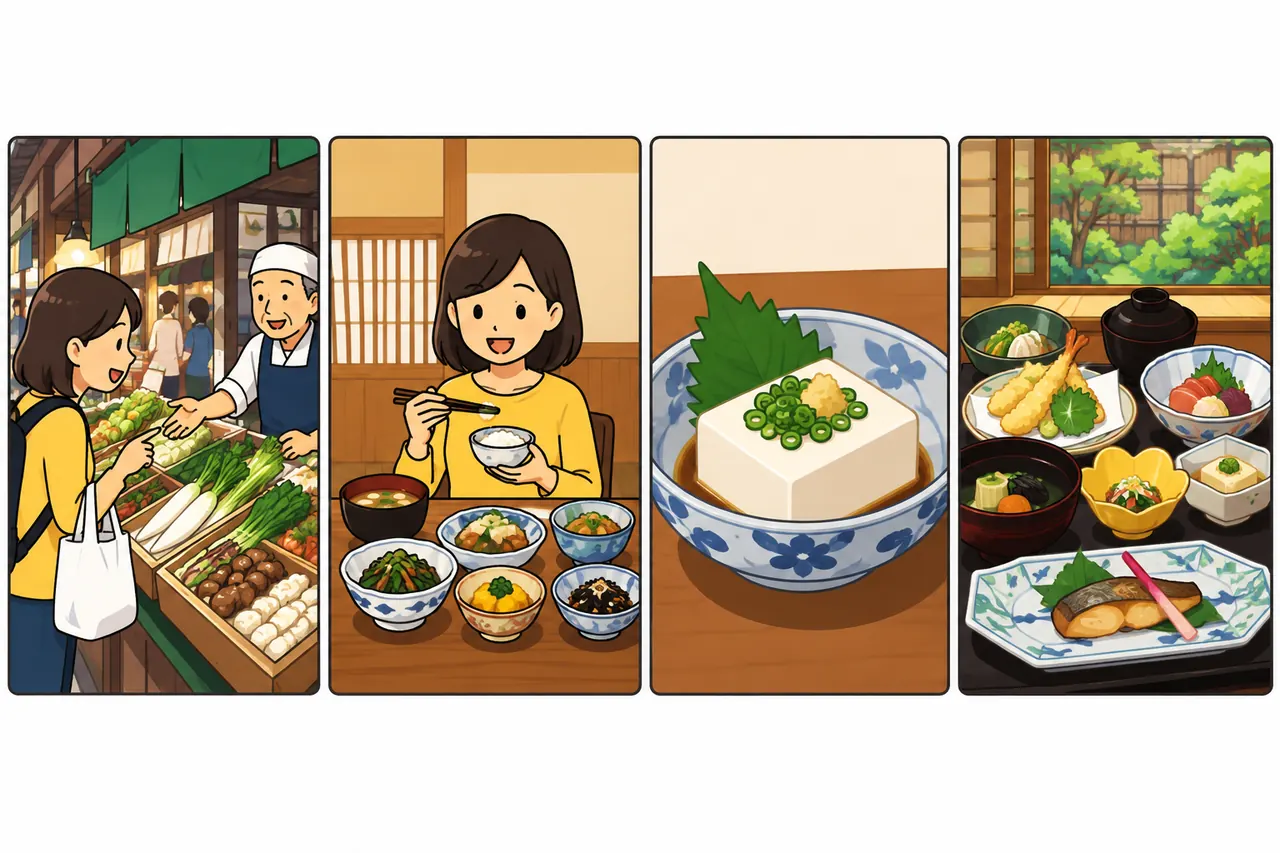

Kaiseki is described in the city guide as a sequence of dishes using seasonal ingredients. Contemporary kaiseki may include meat or seafood, so the word alone is not a promise of a vegetarian meal. Ask what is included in the specific course and whether its dishes vary with the season. A named course and its price tell you what the restaurant lists, but the restaurant is the source to consult for the details of the meal on your date.
Obanzai refers to everyday cooking passed down in Kyoto households. It does not, by itself, mean a vegetarian buffet, a fixed number of dishes or a particular price. If a restaurant offers obanzai, ask which dishes are being served and what they contain; the name describes a style of home cooking, not a guaranteed menu.
| Food or format | What the official guide confirms | Useful question to ask |
|---|---|---|
| Kaiseki | Seasonal multi-course cooking; contemporary versions may include meat or seafood | What is included in this exact course? |
| Obanzai | Everyday Kyoto household dishes | Which dishes are served today, and what are their ingredients? |
| Saba sushi | Mackerel sushi is a representative Kyoto style | What portion is served, and how should it be stored? |
| Mushi sushi | Steamed sushi is mainly a winter specialty | Is it available on my date? |
| Yuba | The film that forms on warmed soy milk | Is this fresh or dried yuba, or is it part of a course? |
The sushi and yuba descriptions in the table are useful for reading menus, but do not assume that every restaurant serves the same version. The city guide identifies mackerel sushi as a representative Kyoto style and describes steamed sushi as mainly a winter specialty. The Japan National Tourism Organization’s Nishiki Market guide notes both fresh and dried yuba in the market; a restaurant dish may use yuba in a different way or serve it with other ingredients.
When you are comparing menus, note the course name, listed price, tax information and any stated service charge. Then ask about the parts that the listing does not settle: the exact dishes, availability, possible additions and whether the restaurant can meet your dietary needs. This makes the comparison more useful than relying on the label alone.
2. Visit Nishiki Market Without the Common Mistake
Nishiki Market extends between Teramachi and Takakura, and Kyoto’s official tourism guide describes it as about 400 metres long. The shops sell a range of ingredients and prepared foods, including fish, meat, dried ingredients, prepared dishes, yuba and Kyoto vegetables. JNTO also mentions pickles and Japanese sweets. Check the official Kyoto Nishiki Market guide for the market description and the JNTO market page for its access guidance.
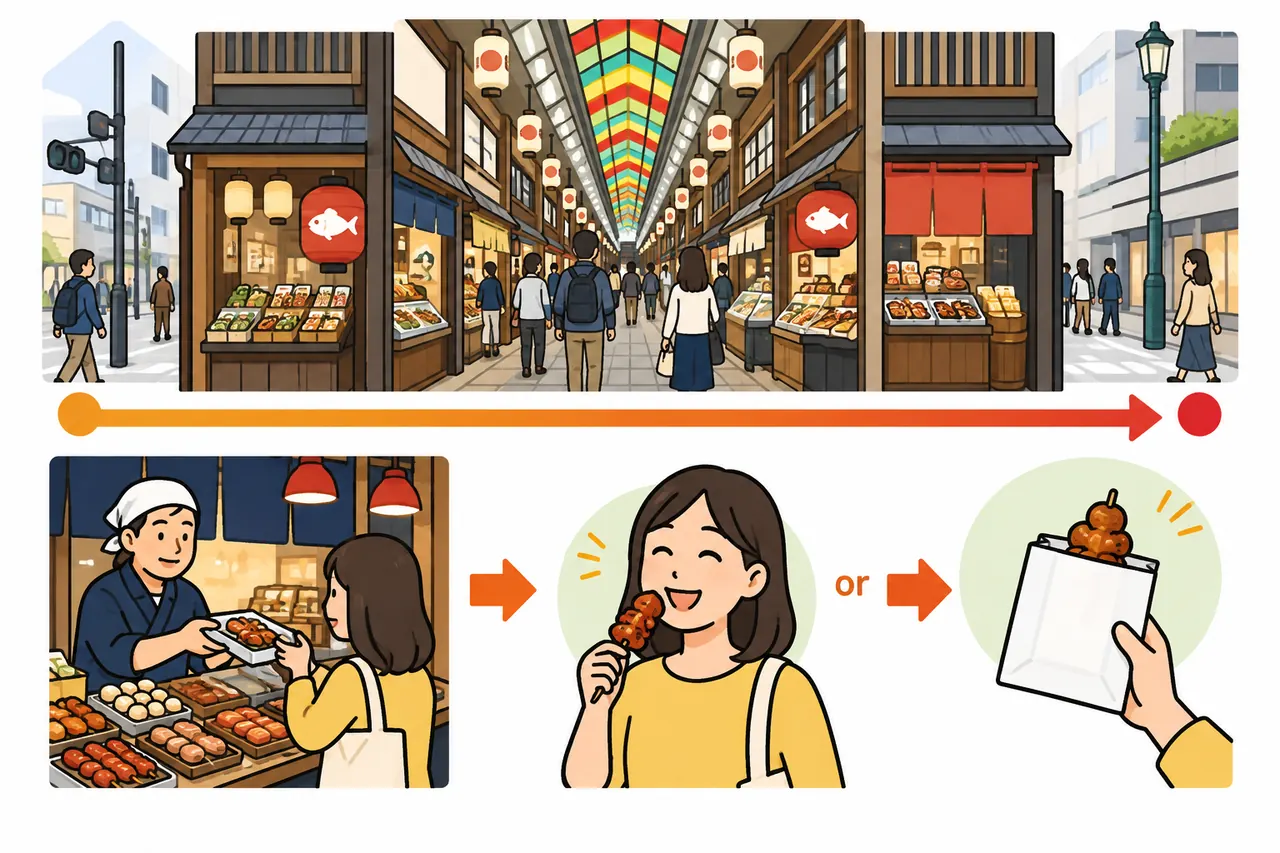
From Kyoto Station, JNTO describes taking the Karasuma subway line to Shijo Station and approaching the market’s western end from Takakura Street. The eastern end connects with Teramachi Street, so the route through the market runs between those two ends. Before you leave your accommodation, save Nishiki Market 錦市場 on a map. Keep the market visit separate from the journey to your meal reservation: the access description does not establish a timed connection between the market and a restaurant.
The market’s eating rule is straightforward. Kyoto’s official guidance asks visitors to avoid eating while walking through Nishiki; eat a purchase at the shop where you bought it, where permitted, or take it away. Do not use the central passage as your dining area. A creator’s video showing a snack being prepared or eaten does not establish where other visitors may eat, so follow the market guidance rather than treating a clip as permission.
A useful way to browse is to look at the ingredient names before deciding what to buy. Choose purchases you can carry and handle, and ask the seller how an item should be stored or prepared, especially if you plan to travel with it afterward. Fresh and dried yuba are different products, and the market offers both. The same practical question is useful for fish, prepared foods, pickles and sweets: ask about handling before buying rather than assuming that every product has the same storage needs.
Treat the market as a place to notice the range of Kyoto ingredients as well as a place to shop. You might encounter vegetables, pickles, seafood, meat, dried goods and sweets in the same visit, but the market’s range does not mean that every shop carries every product. If a particular item matters to your plans, check with the seller rather than building your day around an assumption that it will be available.
3. Compare Published Tofu-Meal Prices
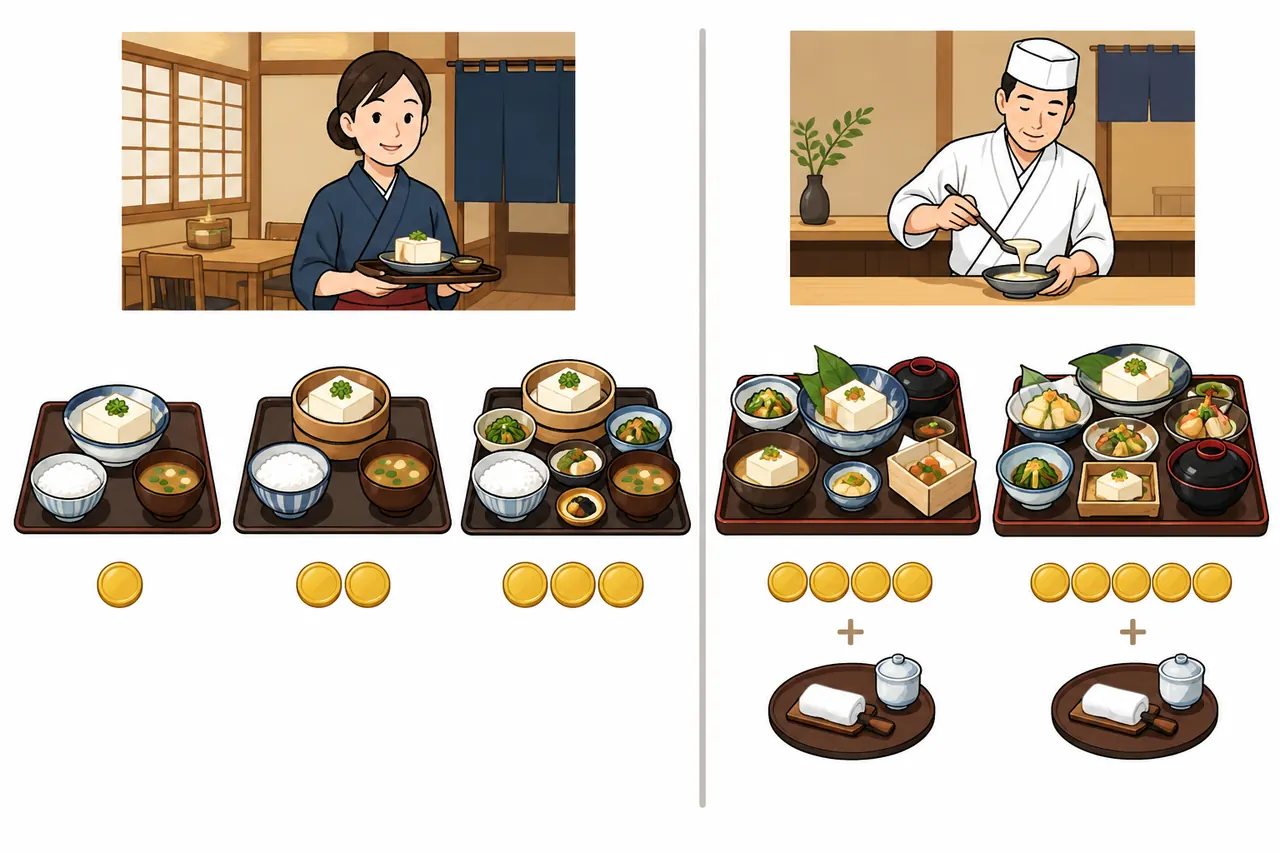
The prices below are published examples from two Kyoto City restaurants: Gion Uemori and Nanzenji Junsei. They were checked on 4 November 2026 and should be read as restaurant-specific menu listings, not as a current citywide average. A listed course price does not confirm availability for a particular date, party size or dietary request.
| Restaurant and menu option | Published price | What to note before comparing |
|---|---|---|
| Gion Uemori tofu/yuba kaiseki | ¥4,950, tax included | Listed for lunch and dinner |
| Gion Uemori lunch kaiseki | ¥6,600, tax included | Listed as a lunch course |
| Uemori tofu addition to a kaiseki course | ¥1,430, tax included | Check which course permits the addition |
| Junsei Hana | ¥3,850, tax included | Named tofu menu course; consult the official menu for contents |
| Junsei Tsuki | ¥4,950, tax included | Confirm availability for your date and party size |
| Junsei Yuki | ¥5,830, tax included | Confirm availability for your date and party size |
| Junsei Aoi / Tsutsuji | ¥7,700 / ¥9,350, tax included | Tofu with a seasonal selection; confirm the exact menu |
| Junsei tofu kaiseki | ¥11,000–¥16,500, tax included | Service charge is additional; request the final total |
| Junsei shabu-shabu | From ¥11,000, tax included | Service charge is additional; request the final total |
Gion Uemori describes itself as a Kyoto-cuisine restaurant in Gion and says it uses tofu from Morika in Saga-Arashiyama. Its English menu and restaurant information list tofu/yuba kaiseki at ¥4,950 including tax for lunch and dinner, a lunch kaiseki listing at ¥6,600 including tax, and an additional tofu option at ¥1,430 including tax. The published hours are lunch 12:00–14:00 last order and dinner 17:00–20:00 last order. The restaurant lists irregular closing days, so check the actual date with the restaurant.
Nanzenji Junsei introduces both tofu and yuba cooking. Its official menu lists Hana at ¥3,850, Tsuki at ¥4,950 and Yuki at ¥5,830, each including tax. It also lists Aoi at ¥7,700 and Tsutsuji at ¥9,350 for tofu with a seasonal selection. The menu lists tofu kaiseki at ¥11,000–¥16,500 including tax, with service charge additional, and shabu-shabu from ¥11,000 including tax, also with service charge additional. Consult the menu for the course contents and ask the restaurant for the final amount when a service charge applies.
Among the named options listed here, Junsei’s ¥3,850 Hana course has the lowest stated price, while Uemori’s tofu/yuba kaiseki is listed at ¥4,950. That is a comparison of published menu prices, not a claim that one restaurant is universally cheaper or that the courses contain equivalent dishes. A price comparison is most useful when you compare the same type of meal and account for any additional charges.
Do not confuse a last-order time with a guaranteed arrival window. Uemori’s listing gives last-order times; it does not, by itself, tell you that a particular arrival time will work for your party or that a full course can be served then. Contact the restaurant through its official information page to check your date, ask when your party should arrive and confirm whether the course you want is available. For a restaurant with irregular closing days, checking the actual day matters more than relying on a generic weekly schedule.
4. Ask About Vegetables, Stock and Dietary Needs
Kyoto’s official food guide gives Shogoin daikon, Kujo spring onion and Kamo eggplant as examples of Kyoto vegetables. Representative Kyoto pickles include senmaizuke, suguki and shibazuke. These names can help you recognise ingredients on a menu or ask what accompanies a course, and they may also help you choose something to take home. They do not, on their own, describe every ingredient or seasoning in a dish.
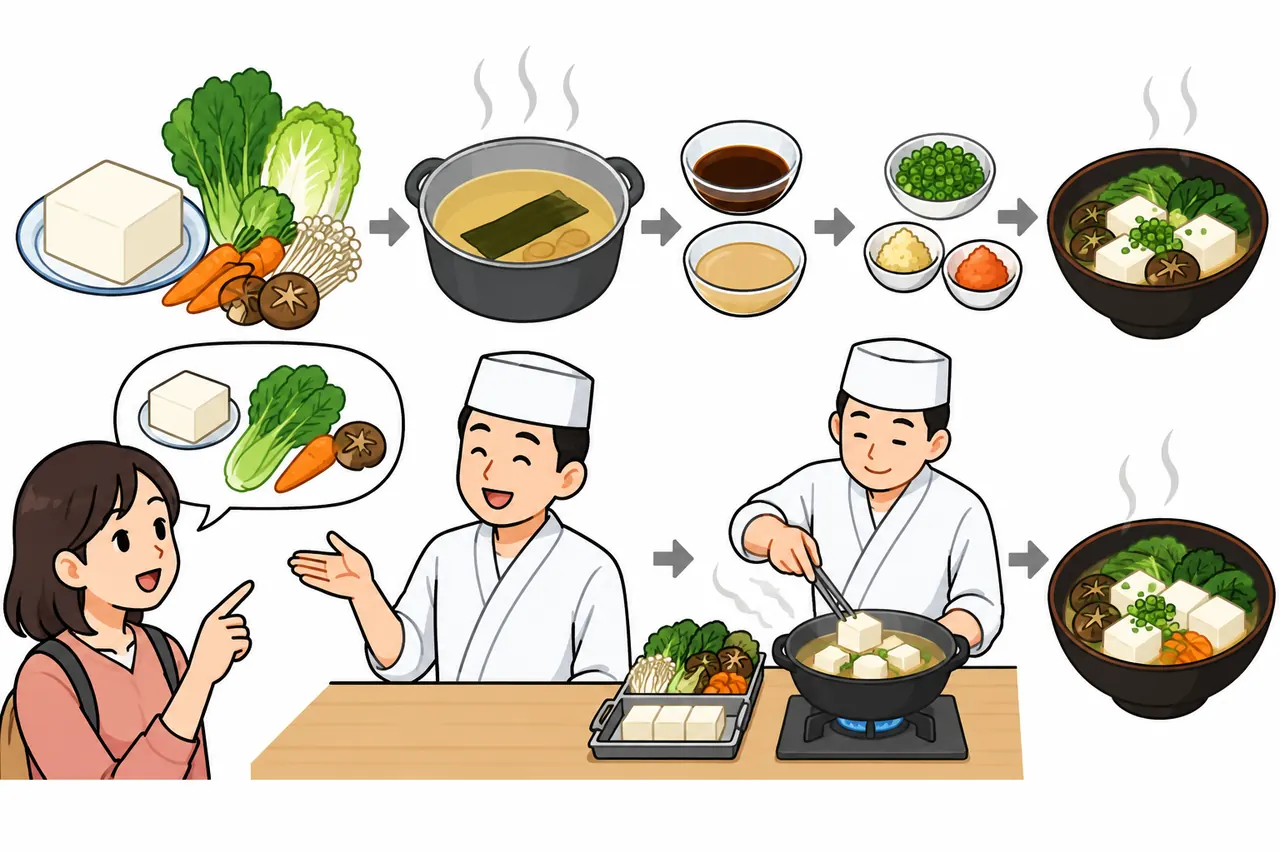
A vegetable-based main ingredient is not proof that a dish uses vegetable-only stock. Kyoto’s official guide warns that even some restaurants presenting shojin cooking may use fish stock. If you avoid fish, meat or animal products, tell the restaurant clearly before you settle on a course, and ask about the stock, sauce and garnishes as well as the main ingredient. Asking only whether a dish contains tofu may not answer the questions that matter to you.
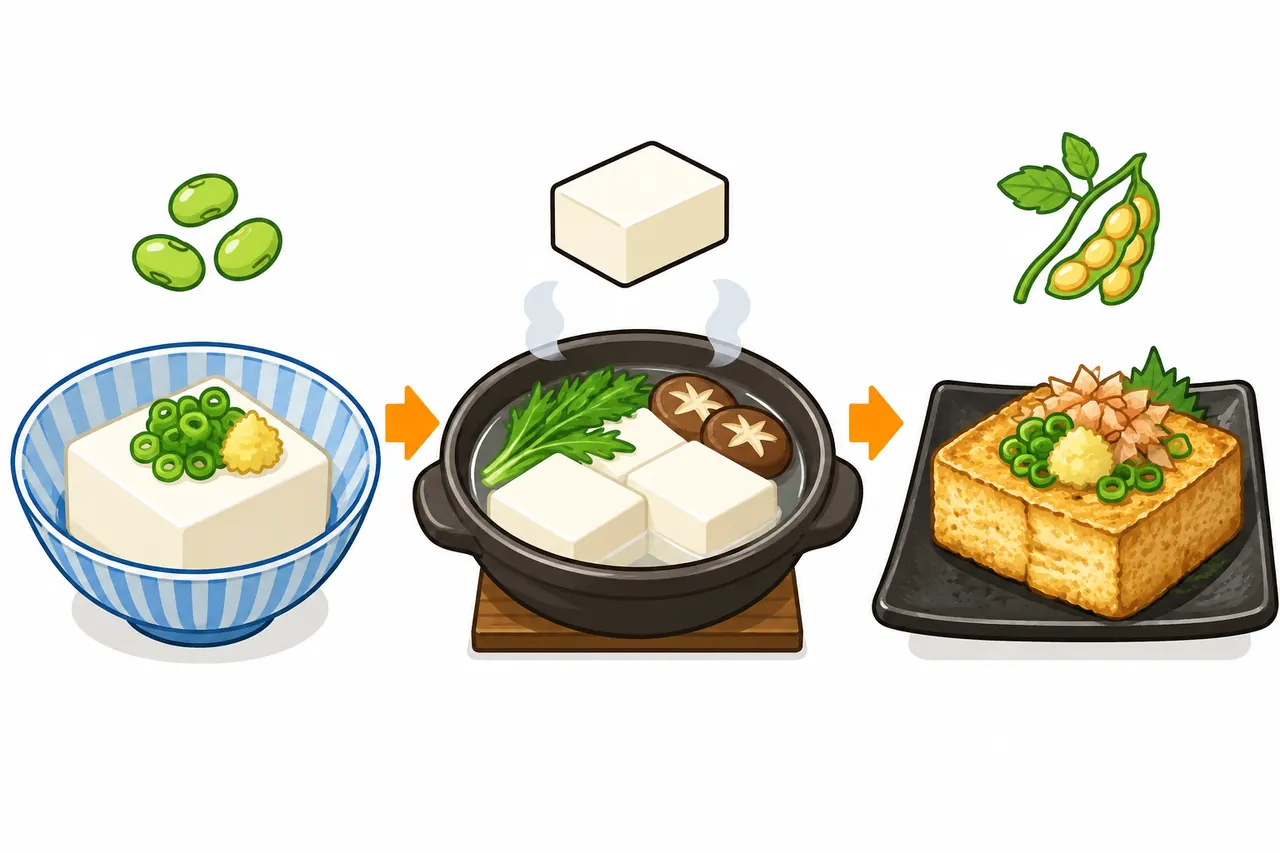
Yuba is the film that forms on the surface of warmed soy milk. It can be sold fresh or dried at Nishiki Market and can also appear as part of a restaurant meal. The word “yuba” does not tell you every seasoning or accompanying dish. Similarly, if you are considering boiled tofu, or yudofu, ask what accompanies it rather than assuming the name describes the entire meal.
For an allergy, name the exact ingredient and ask about preparation and possible substitutions before making a reservation or ordering. The published menu prices in this guide do not promise allergen removal, halal certification or a completely vegan kitchen. They also do not establish that a restaurant can alter a particular course. Ask the restaurant about the specific meal you intend to eat so that its answer applies to that menu and date.
Useful questions include: “Does this course use fish stock?”, “Are there animal products in the sauce or garnish?” and “Can you accommodate this specific allergy?” Be precise about what you need, and do not treat a broad label such as tofu, vegetable dish or shojin as a substitute for a direct answer. If the restaurant cannot confirm an accommodation, do not assume that the course is suitable.
5. Plan a Realistic Food-Focused Half Day
A practical city plan is one market visit followed by one confirmed seated meal, rather than a checklist of distant food stops. Choose the restaurant and meal time first, then check the route between Nishiki Market and the restaurant. The market is a place to browse and buy, so leave room in your appetite and schedule for the meal you have chosen rather than treating every market purchase as a full meal.
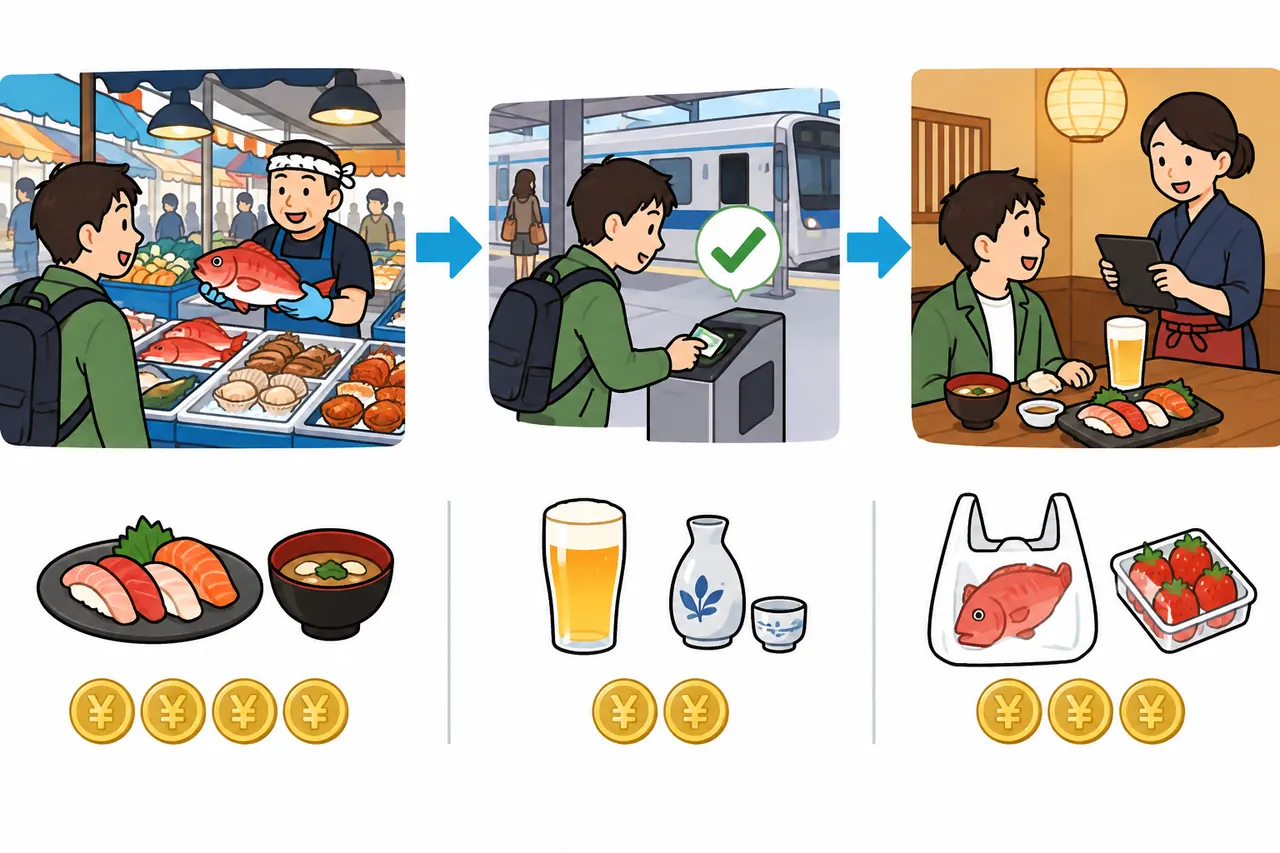
For a lunch-focused example, take the Karasuma subway line from Kyoto Station to Shijo Station, then approach Nishiki’s western end from Takakura Street, as described by JNTO. Browse toward the Teramachi end, and eat any market purchase at the shop where it is permitted or take it away. If you are considering Gion Uemori afterward, check the route and contact the restaurant about availability: its published information gives a lunch last-order time of 14:00 within the stated 12:00–14:00 lunch listing and notes irregular closing days. Those separate details do not constitute a timed connection or a confirmed reservation. See JNTO’s Nishiki access information and Uemori’s official menu and hours.
If you want to compare the lower-priced named courses in this guide, Junsei’s Hana is listed at ¥3,850 including tax and Uemori’s tofu/yuba kaiseki at ¥4,950 including tax. These are two different restaurants’ menu listings, not a like-for-like assessment of the food or a guarantee that either is available on your date. At the higher end, remember that Junsei’s tofu kaiseki and shabu-shabu listings state that a service charge is additional. Ask for the final total before comparing those prices with options that do not list an additional charge.
For a simple budget, keep the course, drinks, additions, transport and take-home purchases as separate amounts. Two Uemori tofu/yuba kaiseki meals at the listed rate total ¥9,900 in menu charges for two diners. That arithmetic includes only two meals at the stated menu price; it does not include extra drinks, additions or travel. The same approach helps you avoid mistaking a course price for the total cost of a day out.
The priced restaurant examples in this guide are in Kyoto City. A broader plan involving Uji tea, Wazuka or seafood in Tango needs the relevant operators’ own schedules and prices; the information here does not verify those details. Do not treat a social video as confirmation that a tea session, seasonal seafood meal or other experience is available to book. For an itinerary beyond the city, check the specific operator before making plans.
6. Creator Clips: What They Show and What They Do Not Confirm
The linked food clips offer visual examples of Kyoto-area snacks and meals, but they are not official menu listings or booking information. One clip shows a vendor pressing two whole shrimp into pink batter on a hot iron press to make a large shrimp senbei cracker associated with Arashiyama; another shows a giant crispy shrimp cracker against the Arashiyama bamboo grove. A separate close-up tour shows a sushi meal served on wooden tables at a Kyoto restaurant. These clips can suggest dishes to look for, but they do not establish a current price, serving availability or restaurant policy.
Other linked posts show a promotional salmon and seafood restaurant clip, a vendor preparing a mochi-ball snack near Fushimi Inari Shrine, and a thin folded pancake introduced with Indonesian on-screen text comparing it to kue cubit. A separate post shows a private-room shabu-shabu dinner at Kiraku in Pontocho, while another follows a visit to Motokichi Yukimura’s Kyoto restaurant and his omurice cooking. Use each post as an illustration of what its creator chose to show, not as confirmation of current opening hours, menu prices, dietary suitability or booking conditions.
7. Kyoto Food Guide FAQ
Is Kyoto kaiseki vegetarian?
Not necessarily. Kyoto’s official food guide describes kaiseki as seasonal multi-course cooking and notes that contemporary versions may include meat or seafood. Ask the restaurant about the exact course and its ingredients before you book or order, particularly if you avoid particular foods.
Does a tofu or shojin meal always avoid fish stock?
No. The city’s official guidance warns that some restaurants presenting shojin cooking may use fish stock, so a vegetable or tofu main ingredient is not enough to establish that a meal suits your needs. Ask specifically about stock, sauces, garnishes and the other dishes in the course.
Can I eat while walking through Nishiki Market?
Kyoto’s official guidance asks visitors to avoid eating while walking through Nishiki Market. Eat a purchase at the shop where you bought it, where permitted, or take it away. If you are unsure what a particular shop permits, ask there rather than assuming that an open passage is a suitable place to eat.
Which tofu meal is the cheapest in this price comparison?
Junsei’s Hana course is listed at ¥3,850 including tax, the lowest stated price among the named menu options in this guide. Uemori’s tofu/yuba kaiseki is listed at ¥4,950 including tax, but it is a different restaurant’s course and should not be assumed to have identical contents. Check each restaurant’s official menu and confirm availability before deciding.
Are Junsei’s higher-priced courses subject to an additional charge?
The published menu states that Junsei’s tofu kaiseki, listed at ¥11,000–¥16,500 including tax, has a service charge additional. Its shabu-shabu listing starts at ¥11,000 including tax and also states that a service charge is additional. Ask Junsei for the final total for the exact meal you are considering.
Do the prices in this guide cover Kyoto Prefecture beyond Kyoto City?
No. The priced examples here are for Kyoto City restaurants, and the information does not verify individual prices for places in areas such as Uji, Wazuka or Tango. For those trips, check the relevant operator’s official information for its own prices and schedule. Treat a social post as inspiration rather than confirmation of a bookable experience.
Official Pages and Further Planning
Use the official pages for the details that matter to your decision: Kyoto’s food guide for the descriptions of local food and dietary cautions, the Kyoto and JNTO market pages for Nishiki’s layout and access, and the restaurants’ own menus for published prices and conditions. Menu information checked on 4 November 2026 may change, so confirm the exact date, course and final amount with the restaurant before you go. For broader sightseeing, see Kyoto Travel Guide: Sights, Passes and Plans, Gion Kyoto Guide: Yasaka Shrine, Performances and Local Etiquette and Maiko Experience Kyoto 2026–27: Dances, Prices, Etiquette.
Further food reading includes Beppu Food Guide: Toriten, Reimen and Jigoku-mushi, Best Ramen in Fukuoka: 8 Shops to Try, Best Ramen in Kyoto: 10 Shops and How to Book, Best Ramen in Osaka: 10 Shops and How to Order, Best Ramen in Tokyo: 10 Shops and How to Book and Best Sushi in Fukuoka: Where to Eat and How to Book. Use the restaurant’s own information for current menu details rather than assuming another guide or a creator clip reflects the conditions on your date. If you have a recent experience or a question about planning this trip, share it with JGO! or suggest a correction.


)](https://i.ytimg.com/vi/3J5VSdqPW4Y/mqdefault.jpg)
