
Kyoto Autumn Leaves: Dates, Reports and Temple Hours
Contents
Choose Kyoto autumn leaves by the latest dated report for the place you intend to visit, then check that temple’s admission hours and any special-opening notice. A typical season, a previous year’s calendar, a dated observation and an event schedule answer different questions; none should be treated as a guarantee of peak colour on a particular day.
For 2026, Tenryuji published special early garden entry for November 14–30, while Kiyomizudera published an autumn night opening for November 21–30. Those dates describe scheduled access, not the condition of the leaves on every event day. If you are planning for another year, check the temples’ own current notices rather than carrying these dates forward.
Anna Film Production’s collection of Kyoto autumn-leaf locations offers a broad visual introduction to the season. Use visual material for a sense of place, but rely on dated reports and official visitor information for current conditions, opening hours and fees.
1. Kyoto autumn leaves: read the date before the colour
The Kyoto City Tourism Association publishes a place-by-place autumn calendar and links previous-season material, including a PDF identified as a reference for 2025. That older calendar can help you understand what happened in that season, but it is not a confirmed forecast for 2026 or 2027. The association also notes that some temples and shrines hold special autumn openings or night illuminations, so a calendar entry about leaves should not be confused with an event schedule. Check the Kyoto autumn-leaves calendar.
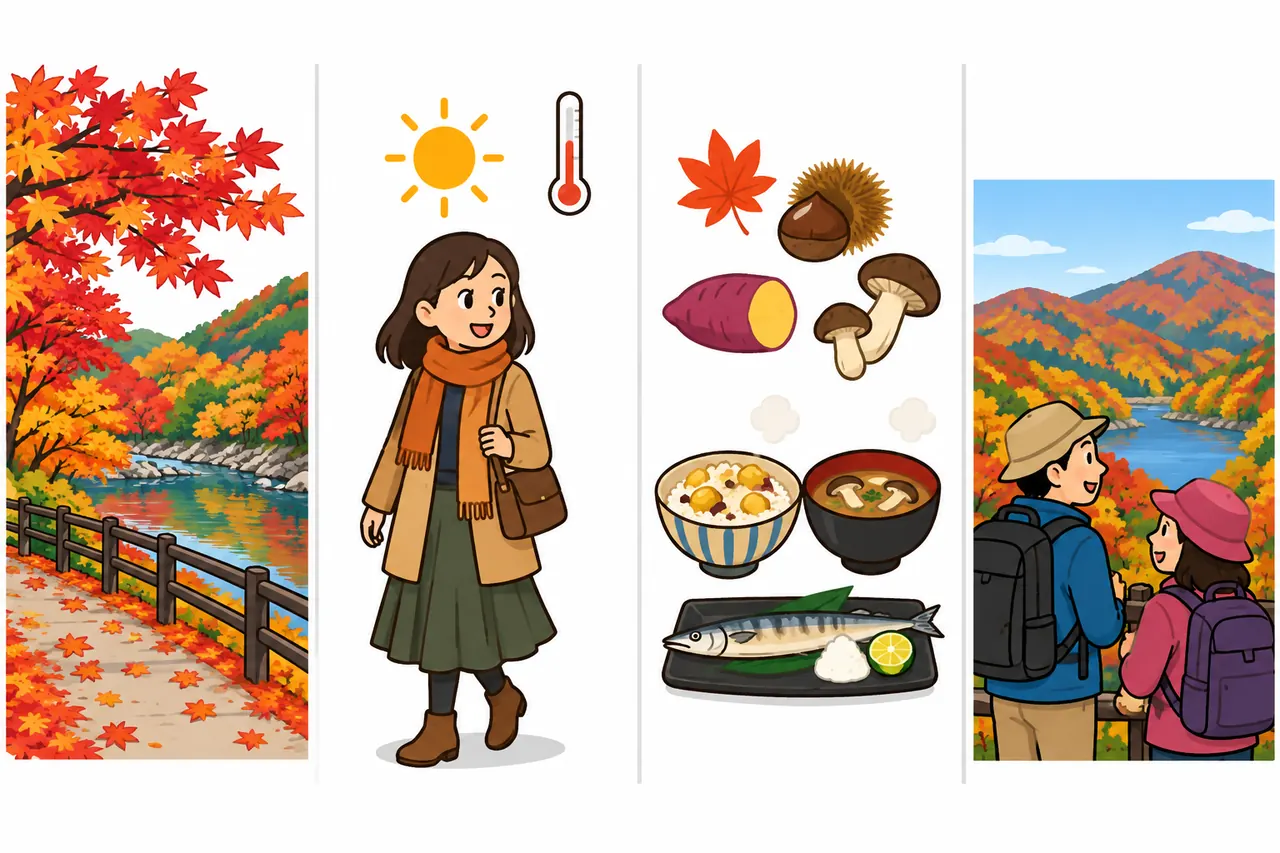
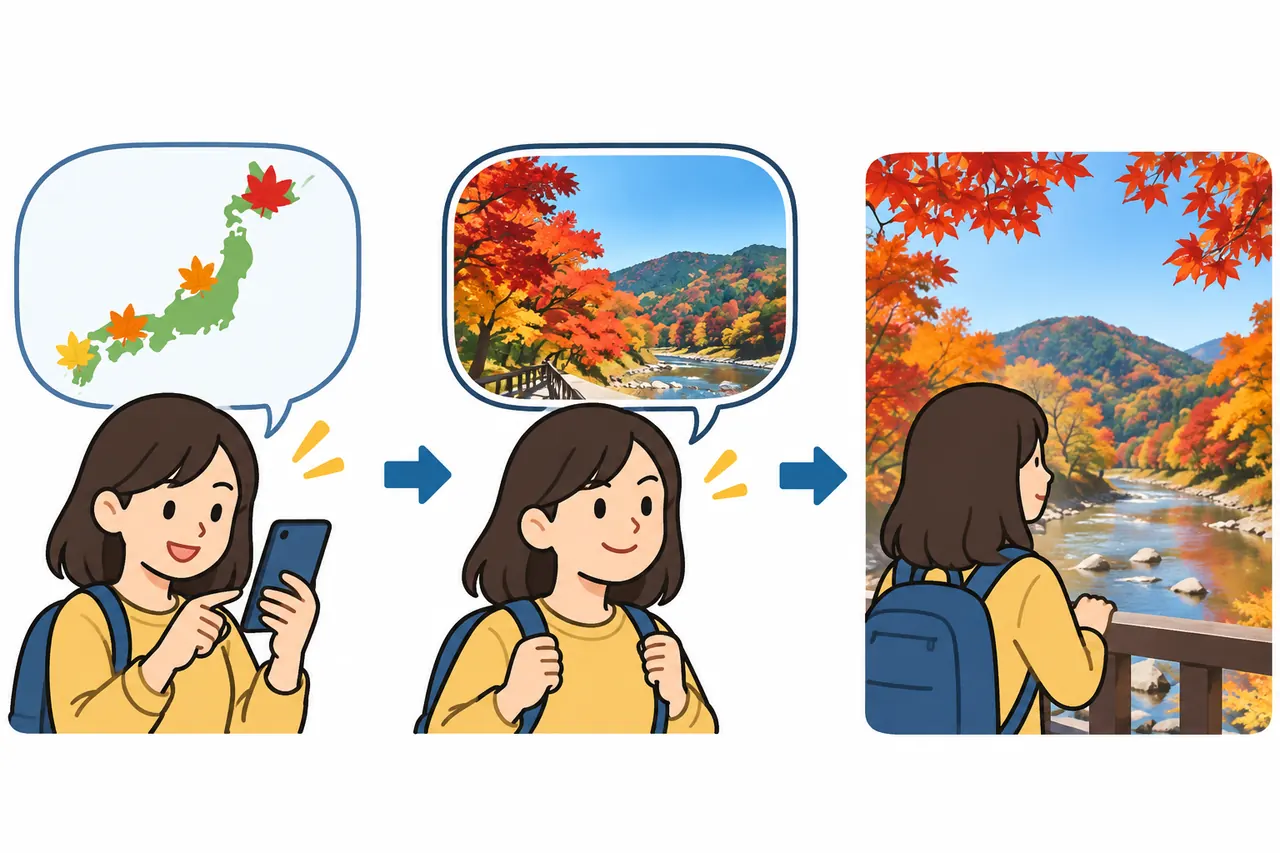
JR West’s foliage information distinguishes five stages: green leaves, starting to colour, peak colour, past peak and fallen leaves. Its entries have individual update dates, which are essential context for interpreting a condition. A report marked “starting to colour” may be useful as the last published observation for that place, but it does not establish that the same stage still applies several days later. View JR West’s Kyoto foliage reports.
| Information type | What it can tell you | What it does not establish |
|---|---|---|
| General seasonal guidance | When colour often develops in Kyoto | The exact peak at a particular temple on a future date |
| Previous-year calendar | What was recorded in that season | What will happen on the same dates this year |
| Dated condition report | The stage reported for a place on the listed date | The condition at every other place, or today’s condition if the report is older |
| Temple event schedule | When a special opening is scheduled | Peak leaf colour, ordinary ticket conditions or reservation requirements |
Kyoto’s official visitor FAQ gives broad seasonal guidance: colouring generally begins around late October, with around mid-November as a viewing-period guide, while also noting that timing varies from year to year. It identifies Hieizan, Ohara and Takao as places where colouring begins earlier. Treat these as general pointers for narrowing your choices, not as a promise about a specific location or date. Read Kyoto’s autumn-season FAQ.
A useful planning sequence is to start with the dates you can travel, use general guidance to identify a plausible period, and then compare the latest available reports for the places you are considering. If you have more than one possible day, keep the alternatives open until you can check those reports again. Do not use a previous-year peak window as if it were this year’s confirmed peak, and do not treat a temple’s special-opening dates as evidence that the foliage will be at its best then.
When saving a report for later, keep the place name, leaf stage and update date together. A screenshot that shows only a stage can become misleading if you forget when it was posted. The same applies when comparing two locations: compare their own dated entries rather than assuming that a report for one part of Kyoto describes another.
2. Kyoto autumn leaves: compare dated reports carefully
The JR West entries retrieved on November 4, 2026, did not all describe conditions on November 4. Each stage below belongs to the update date displayed for that particular location, so the table is a record of the retrieved entries—not a live field report for the day they were checked.

| Place | Stage in the retrieved report | Report date | Practical interpretation |
|---|---|---|---|
| Jingoji | Starting to colour | November 1, 2026 | Check for a newer entry before travelling |
| Kitano Tenmangu | Starting to colour | October 31, 2026 | Compare with a newer report for the same place |
| Tenryuji | Green leaves | October 28, 2026 | This is not a November 4 observation |
| Tofukuji Tsutenkyo | Green leaves | October 29, 2026 | Check the latest condition and the attraction’s admission information |
These are the conditions shown in the retrieved JR West page, with the dates attached to their individual entries. Search previews and opened pages sometimes displayed different update information, which is a reason to open the report and read the dated entry rather than relying on a search-result snippet. The source distinguishes leaf stages and places, but its entries should not be rewritten as if all were observed on the retrieval date. Check the dated entries on JR West’s report page.
For your own trip, note the update date beside each condition and recheck shortly before setting out. If a report has not changed, treat it as the latest available published observation, not proof that the leaves have remained exactly the same. The report can help you decide which places to investigate, while the attraction’s own visitor page is the place to confirm its access and admission details.
It is also useful to keep foliage information separate from event information. A location could have an event scheduled during a period when its foliage report is still at an earlier stage; those facts are not contradictory because they answer different questions. Check the current report for colour, then check the relevant temple notice for opening times, entrance arrangements and any conditions that affect your visit.
Japan Guide’s Kyoto autumn-colour locations feature provides another visual introduction to different sights. As with any general location guide, use it to consider places of interest rather than as a substitute for a current, dated foliage report or the official information for a particular temple.
3. Kyoto autumn leaves at Tenryuji: tickets and early entry
Tenryuji’s regular garden hours are 08:30–17:00, and regular garden reception ends at 16:50. For 2026, the temple listed special early garden entry from November 14 through November 30, with the garden reception opening at 07:30. The north-gate reception, however, remains scheduled to open at 08:30 during that early-entry period, so the entrance matters when planning an early visit. Confirm Tenryuji’s visitor information.
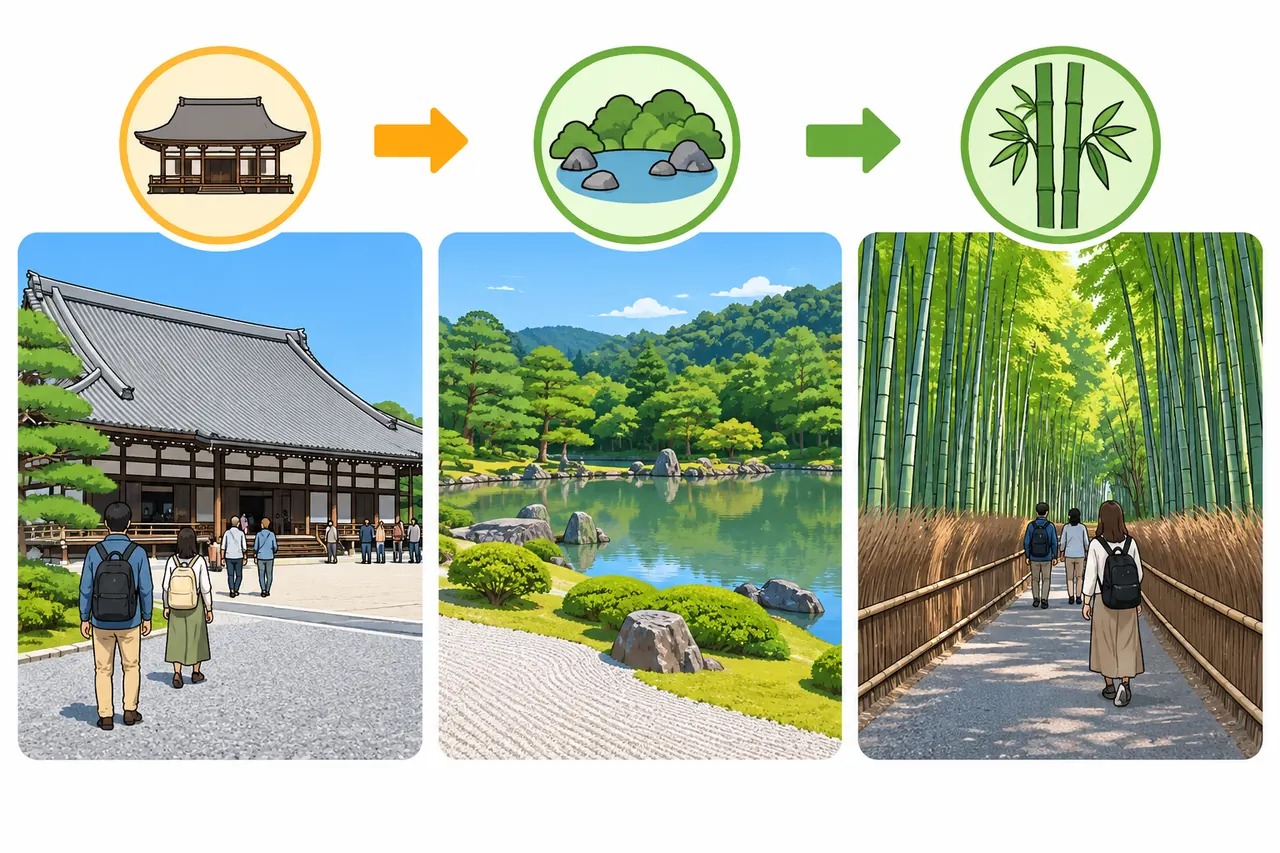
| Tenryuji area | Fee listed by the temple | Published timing and reception |
|---|---|---|
| Garden, high-school age and older | ¥500 | Regular hours 08:30–17:00; reception to 16:50 |
| Garden, elementary- and junior-high-school students | ¥300 | Same garden schedule |
| Garden, preschool children | Free | Same garden schedule |
| Temple buildings (諸堂) | Additional ¥300 | 08:30–16:45; reception to 16:30 |
| Cloud Dragon painting in Hatto | Separate ¥500 | Check the temple’s opening calendar |
The 2026 early-entry notice applies to the garden reception opening at 07:30; it does not change the north-gate reception time of 08:30. If your plan depends on arriving early, consult the temple’s visitor guidance to identify the appropriate entrance and avoid assuming that every gate opens with the garden reception. For a later-year trip, check whether the temple has published a new early-entry schedule.
Budget separately for the areas you plan to see. The garden has its own listed admission, the temple buildings carry an additional ¥300, and the Cloud Dragon painting in Hatto has a separate ¥500 fee. Do not assume that garden admission includes either of those additional areas; check the temple’s current visitor information for the admission arrangement that applies to your visit.
The Cloud Dragon painting normally opens on weekends and public holidays, with periods of daily opening in spring and autumn. Its calendar is the relevant source for checking whether it will be open on your chosen date. The temple also notes that visits to the temple buildings may be suspended for religious functions or other events, so a listed schedule should not be treated as a guarantee that every area will be accessible.
These distinctions affect both budget and timing. If you want only the garden, use the garden schedule and fee; if you also want the buildings or painting, check each area’s timing and charge separately. The earlier closing of reception compared with the garden’s published closing time is particularly important when deciding how late to arrive.
4. Kyoto autumn leaves at Kiyomizudera: day and night
Kiyomizudera’s 2026 access information lists hours of 06:00–18:00 through November 20. Its autumn special night opening is listed for November 21–30, with the temple closing at 21:30 and night reception ending at 21:00. The listed December schedule returns to 06:00–18:00. Check Kiyomizudera’s 2026 access information.
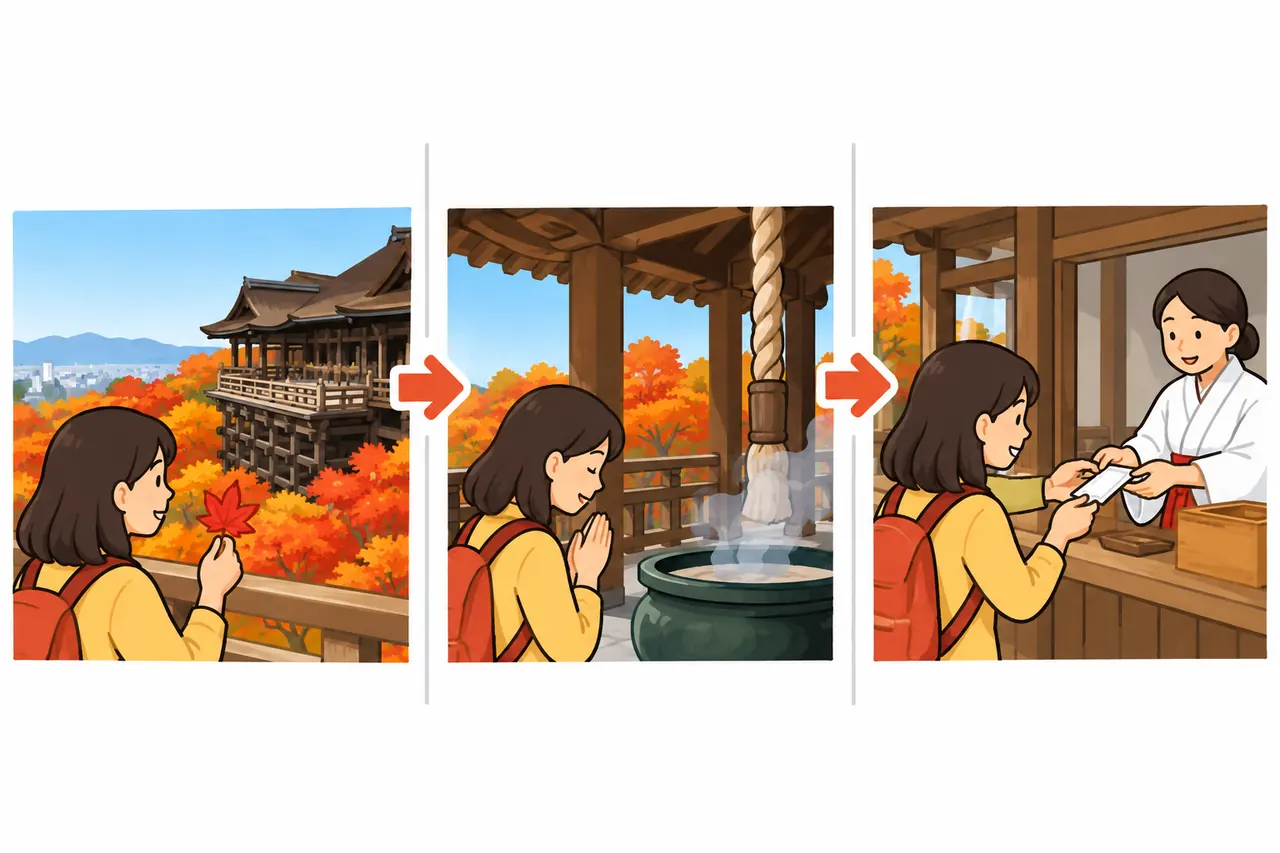
The reception deadline is earlier than the final closing time, so do not use 21:30 as your target arrival time for the night opening. You also need to allow time to reach the relevant entrance before reception ends. The published event dates tell you when the special night opening is scheduled; they do not establish peak leaf colour on those dates.
Kiyomizudera is at 1-294 Kiyomizu, Higashiyama-ku, Kyoto. The temple describes an approach via Kiyomizuzaka to the front of Niomon, and another via Chawanzaka and the disaster-prevention road. It warns that map applications may suggest routes that cannot be used, so a line shown on a map should not be taken as confirmation that a path is open to visitors. Use the temple’s official access guidance.
Before setting out, open the temple’s own access page and choose an approach from its described routes. This is especially useful when your schedule depends on arriving before the night reception deadline: decide on the approach before departure rather than relying on an app’s suggested shortcut at the last minute. The available information does not establish the current admission price, reservation requirements, special night fee or any entry limit, so confirm those points with the temple rather than borrowing a price or rule from an older article.
The November 21–30 night-opening dates apply to 2026 and should not be assumed for a later year. Kiyomizudera states that night-opening dates change by year, making the temple’s notice the appropriate source for a future visit. Check the schedule and route together: knowing the closing time is not enough if the approach you plan to follow is not usable.
5. Kyoto autumn leaves: questions for a workable day
The practical challenge is to keep three decisions separate: where the leaves are reported to be, which places are open when you can visit, and how you will get to the entrance. A foliage report can help with the first decision, but it cannot answer the other two. Checking the official visitor page for each chosen temple before you leave gives you a clearer plan than relying on a general seasonal calendar alone.
For a day with flexible dates, choose a small set of possible places and compare their latest dated reports before committing. If you have only one travel day, use the available report as an indication with a date attached, rather than assuming it guarantees the condition you will see. This approach also prevents an older observation for one location from being treated as a current update for the entire city.
Avoid building a route on the assumption that all Kyoto sights form one short walk. First choose a cluster of places that makes sense for your day, then check the transport and opening information for those actual locations. Add a second area only after you have checked the journey between them; the available sources here do not establish travel times or a single best route linking the listed places.
Opening times can shape the order of a visit as much as foliage reports do. At Tenryuji, garden reception and north-gate reception have different early-opening times during the 2026 special period. At Kiyomizudera, night reception ends before closing, and the approach route should be checked in advance. Those specific details are more useful for setting a realistic arrival target than a general statement that a temple is “open late.”
If you are travelling in another year, keep the same planning method but replace the dated schedules with current official information. A previous-year calendar and a previous-year event period can help explain what sort of information to look for, but neither confirms the next year’s dates. Kyoto’s general guidance also notes annual variation in the foliage season, so avoid treating a particular week as a guaranteed peak.
The embedded Ookini KYOTO, World Scenery 4K, Riri Travels and Travel Guide JAPAN videos offer visual or itinerary-oriented introductions to Kyoto foliage locations. Use those presentations to explore the character of different visits, while checking official reports and temple notices for dated conditions and practical rules. A scenic video or an itinerary example cannot establish the foliage stage or opening arrangements on your own travel date.
Frequently asked questions
Is mid-November guaranteed to be the best time to see autumn leaves in Kyoto? No. Kyoto’s official FAQ gives around mid-November as a general viewing guide and notes that timing varies by year. Compare the latest dated report for the specific place you want to visit rather than treating a broad seasonal guide as a confirmed prediction.
Can I use the 2025 calendar to plan a 2026 or 2027 visit? Use it as a reference for the previous season, not as a current observation or a confirmed forecast. The Kyoto City Tourism Association identifies its 2025 calendar as previous-season reference material, and its place-by-place information should be checked for the season you are actually visiting.
Does Tenryuji’s 07:30 early entry mean the north gate is open then? No. The 2026 special early opening applies to the garden reception at 07:30, while the north-gate reception remains listed as opening at 08:30. Check Tenryuji’s visitor guidance for the entrance that fits your plan.
What time should I arrive at Kiyomizudera for the 2026 night opening? Use the night reception deadline of 21:00, not the 21:30 closing time, as the important limit for entry. Check the temple’s access guidance before leaving, and confirm ticket or reservation conditions separately because they are not established by the schedule alone.
Is Kiyomizudera’s current admission price confirmed here? No. The official access information retrieved for this guide did not establish a current admission-price figure, so do not rely on an older article’s price. Check the temple’s current ticket information for the visit you are planning.


)](https://i.ytimg.com/vi/3J5VSdqPW4Y/mqdefault.jpg)


)](https://i.ytimg.com/vi/4NOXJydIPKk/mqdefault.jpg)