
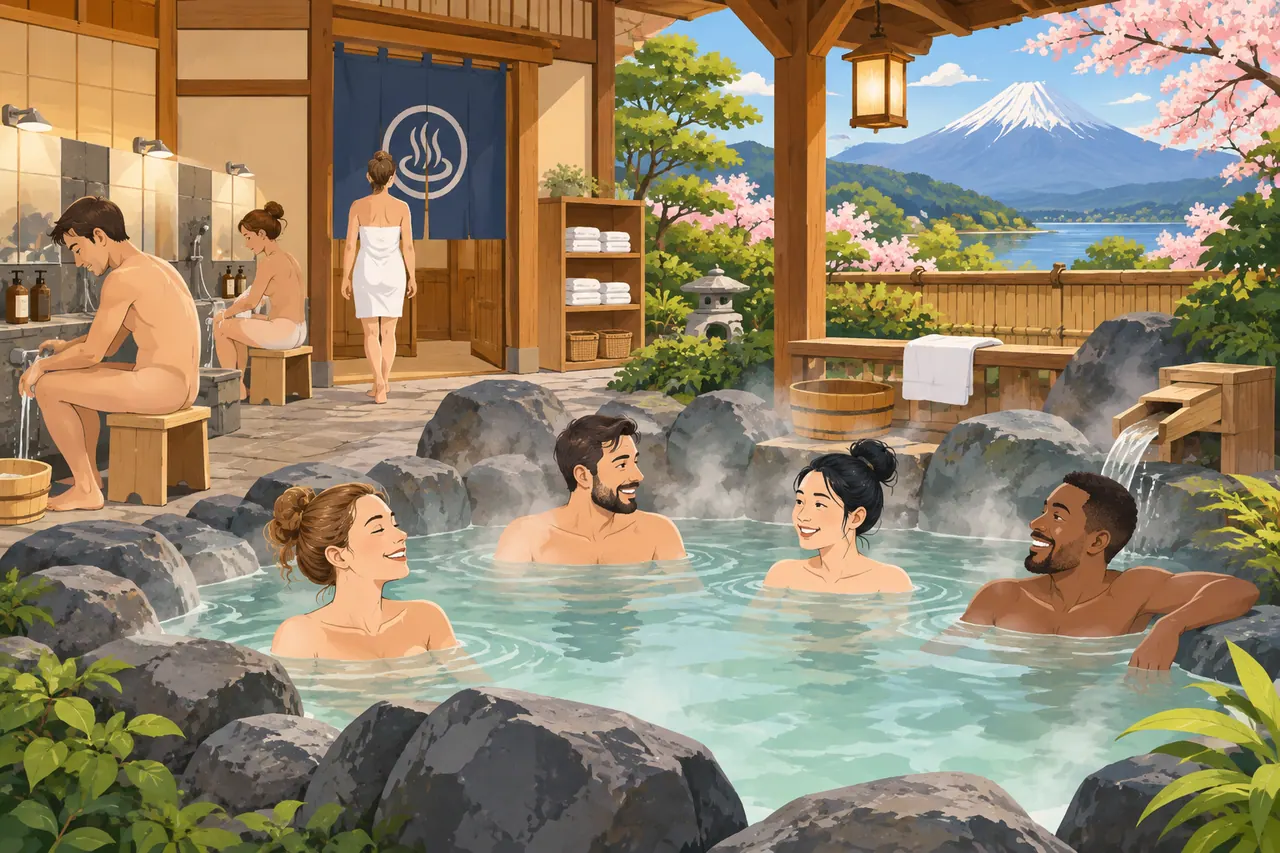
Japan Onsen Etiquette: 13 Steps for First-Timers
Contents
- 1. What Is an Onsen in Japan?
- 2. Planning an Onsen Day Visit: Tickets, Fees and Hours
- 3. Onsen Etiquette Step by Step: Entrance to Drying Off
- 4. Towels, Hair, Nudity and Photos
- 5. Onsen Safety in Japan: Alcohol, Bath Times and Seasons
- 6. Five Onsen Etiquette Tips First-Timers Miss
- 7. Tattoos, Private Baths and Mixed Baths at Japanese Onsen
- 8. Japan Onsen Etiquette FAQ
Japan onsen etiquette is easier to remember than it may seem: wash before entering the bath, keep your towel and hair out of the water, and bathe quietly. At most onsen, you bathe nude rather than wearing a swimsuit. If you are unsure about a local rule, check the facility’s signs or ask staff.
Feeling nervous about bathing nude with other people is common. This guide takes you through a visit from planning and paying to drying off, and explains alternatives such as private baths and foot baths. The etiquette details below are based on the official sources linked in the relevant sections; we did not visit or test any onsen for this guide.
Prices, opening hours, ticket arrangements and water temperatures vary by facility. The official sources used here do not provide fees, hours for specific onsen, or water temperatures, so this guide does not estimate them. Check the official website of the facility you plan to visit for current details.
What Is an Onsen in Japan?
An onsen is a Japanese hot spring. Under Japan’s Hot Springs Act, it is water, mineral water or steam from underground that meets at least one of two criteria: it is at least 25°C when collected, or it contains a qualifying amount of at least one of 19 listed substances. Natural gas is excluded from this definition. The Ministry of the Environment explains the definition and qualifying substances on its official onsen page.

One example of the substance test is a total of at least 1,000 mg of dissolved substances per 1 kg of water. Another is at least 250 mg of free carbon dioxide. These are examples, not a complete list of the qualifying substances. Some onsen waters are further classified as “ryoyosen,” or therapeutic springs, when they meet the relevant criteria for that designation.
The water’s mineral content is one practical reason to remove jewelry before bathing: minerals can alter its color. JNTO says onsen are said to relax tense muscles, help blood flow, calm the mind and help with sleep; these are described as effects onsen are said to have, not a guarantee for every bather. JNTO also recommends an outdoor bath with a good view as a memorable experience. See its beginner’s guide to onsen for general bathing guidance.
Words you may see at an onsen
Knowing a few words can make signs and directions easier to follow. The kanji on a changing-room curtain is especially useful because it is a more reliable guide than curtain color alone. If a sign or facility rule is unclear, ask staff rather than guessing.
| Word | Meaning |
|---|---|
| Noren | A fabric curtain hung over a doorway, often at the changing-room entrance |
| Kakeyu | Pouring hot water over your body before entering the bath |
| Rotenburo | An outdoor bath |
| Daiyokujo | A large shared bath at a ryokan or hotel |
| Ashiyu | A foot bath, where you soak only your feet |
| Ryoyosen | A therapeutic spring, as defined by the Ministry of the Environment |
Staying overnight or visiting for the day
The bathing etiquette is broadly the same whether you stay overnight or visit for the day, but payment, clothing and booking arrangements can differ. At ryokan and hotel onsen, overnight guests often bathe free, while day visitors pay a set fee; the official sources do not specify amounts. Confirm the details directly with the facility before setting out.
| Detail | Overnight guest | Day visitor |
|---|---|---|
| Payment | Bathing is often free for overnight guests at ryokan and hotels | A set fee is charged at ryokan and hotel onsen; the amount and payment method vary |
| Clothing on the way to the bath | Guests often wear the ryokan’s yukata and slippers | Wear your own clothes to the changing room and leave them there |
| Large shared bath | Usually does not need a booking; it is often open late and early except during cleaning | Hours vary by facility, so check its official information |
| Private bath | A room-attached bath comes with the room; ask staff about time-slot baths | Check availability and booking requirements with the facility |
Planning an Onsen Day Visit: Tickets, Fees and Hours
For a day visit, choose a facility and confirm its access information, fee, ticket and payment arrangements, hours, cleaning times and tattoo policy. The Japan Tourism Agency’s ryokan Q&A says day visitors at ryokan and hotel onsen pay a set fee, but it does not give a price or explain how a particular facility collects payment. Do not assume that a ticket machine, cash-only counter or card payment is available unless the facility confirms it.
A worked example area: Kannawa Onsen, Beppu
Kannawa is an area of Beppu that can serve as a starting point when planning an onsen visit. The map link shows the area, not a guarantee of access to any particular bath: Kannawa Onsen on Google Maps. Use the official website of the specific facility you choose for its address and access information, then save that location in your map app.
The existing Kannawa Onsen guide covers the area and how to get there, while the Beppu day trip from Fukuoka plan can help you think about fitting a bath around sightseeing and train travel. Those guides do not replace checking the facility’s own details. Access, day-visit availability and hours can differ from one onsen to another.
A five-step plan for checking a day visit
Start by searching for the facility’s official website and opening its access or map page. Save the exact facility location, rather than relying only on the name of a hot-spring area. If you cannot find clear information online, contact the facility or ask staff before entering.
Next, find the day-visit fee and note the date you checked it. Look for a page labelled fees, day use or how to use the facility, but do not assume that every site uses the same wording. Then check whether you need a ticket and how payment works; if the site does not say, ask the facility.
Finally, check opening hours and cleaning times, and ask about tattoo rules if relevant. A large shared bath at a ryokan is often open late and early except during cleaning, but that general pattern is not a promise about a specific bath. Time-slot private baths require a booking, so ask staff when you arrive or contact the facility in advance.
| What to check | Where to check | What the official sources establish |
|---|---|---|
| Location and access | Facility’s official access or map page | Access details are facility-specific |
| Day-visit fee | Facility’s official website or staff | Day visitors pay a set fee at ryokan and hotel onsen; no amount is specified here |
| Ticket and payment method | Facility’s official website or staff | Not specified by the sources used for this guide |
| Hours and cleaning times | Facility’s official website or staff | Large ryokan baths are often open late and early, except during cleaning |
| Private-bath booking | Facility’s website or staff | Time-slot baths need a booking; ask staff when you arrive |
| Tattoo policy | Contact the facility before visiting | Rules differ between facilities |
If you are deciding whether to carry cash or use a card, the Japan cash or card guide covers payment in Japan generally. It cannot confirm the payment options at a particular onsen, so check those with the facility.
Why some of the rules exist
Some etiquette rules are easier to remember when you know their purpose. Kakeyu helps your body adjust to the heat and is recommended to help prevent a sudden rise in blood pressure. Keeping phones and cameras out of the bathing area respects other guests’ privacy, while removing jewelry can help avoid mineral-related discoloration.
The Japan Tourism Agency also advises against bathing late at night or after drinking to help prevent accidents. These are practical reasons for the rules, not substitutes for the facility’s own instructions. Read posted signs and ask staff if you are uncertain about a local procedure.
Onsen Etiquette Step by Step: Entrance to Drying Off
A typical visit follows a simple order: remove your shoes, pay if needed, change, wash, do kakeyu, soak quietly and dry off before returning to the changing room. The exact entrance and payment process is not confirmed for every facility, so check its signs or ask staff. The Japan Tourism Agency’s ryokan Q&A and JNTO’s onsen guide support the core bathing steps.
Entrance, tickets and paying
Take off your shoes at the entrance and use the slippers provided. Slippers can also be worn on tatami mats, according to JNTO. If you are visiting for the day, check the facility’s instructions for payment rather than assuming there is a ticket machine or a particular payment counter.
Overnight guests at ryokan and hotels often bathe free, while day visitors pay a set fee. The amount, ticket procedure and payment method are not specified in the sources used here. If the signs are unclear, ask staff whether you need a ticket and how to pay before going farther into the facility.
Changing rooms: look for 女 and 男
The kanji are the clearest way to identify the changing room: 女 means women and 男 means men. Women’s rooms often have a red curtain or sign, and men’s rooms often have a blue one, but JNTO advises checking the kanji rather than relying on color alone. If you are uncertain, stop and confirm with staff.
Changing rooms usually have lockers or numbered baskets for clothes and belongings. Leave your clothes there and take only what is allowed into the bathing area. For overnight guests, a yukata and slippers are often provided for the walk to the bath, but follow your accommodation’s instructions.
| Sign | Meaning | Common color hint |
|---|---|---|
| 女 | Women | Red |
| 男 | Men | Blue |
What to bring, and what may be provided
JNTO lists a small towel, or washcloth, as the item to take into the bathing area. A large towel is for the changing room unless the facility says otherwise, and long hair should be tied up so it does not touch the water. Shampoo, body soap, conditioner and hair dryers are often provided, but the sources do not guarantee that every facility supplies them.
| Item | Where it goes | Practical note |
|---|---|---|
| Small towel or washcloth | Bathing area | The towel listed for use in the bathing area; keep it out of the water |
| Large towel | Changing room | Use it to dry off outside the bath unless the facility says otherwise |
| Hair tie | In your hair | Keeps long hair out of the bath |
| Shampoo, body soap and conditioner | Washing area, if provided | Often provided, but check the facility if you need to bring your own |
| Hair dryer | Changing room, if provided | Often available free in the changing room |
| Jewelry | Locker or room | Onsen minerals can change its color |
| Phone or camera | Locker | Leaving it there is a practical way to avoid taking photos in the bath |
| Swimsuit | Usually not used | Most onsen are nude bathing; check local rules |
| Alcohol | Outside the bathing area | Do not bring alcohol into the bath |
A water fountain is often available in the changing room, and vending machines are often outside. Those are common arrangements, not guarantees, so look around or ask staff if you need water. Avoid bringing food or alcohol into the bathing area.
The 13 bathing steps
Follow the signs and staff instructions at the facility, especially if a local procedure differs from this general sequence. At most onsen, the bathing area is for washing and soaking, not for wearing a swimsuit or taking photos. These steps bring the general etiquette together from the entrance to drying off.
- Remove your shoes at the entrance and put on the slippers provided.
- If you are a day visitor, check the payment instructions or ask staff how to pay.
- Enter the changing room marked 女 or 男, then place your clothes and belongings in a locker or basket.
- Remove jewelry and put it away.
- Take your small towel into the bathing area.
- Sit on a small stool at the washing area, between the changing room and the bath, and wash with a shower or bucket.
- Rinse off all soap before walking to the bath.
- Tie up long hair so that it cannot touch the water, even if you have just washed it.
- Pour hot water over your body as kakeyu before entering.
- Lower yourself into the bath slowly; the regional Hakuba guide says not to jump in.
- Keep your small towel out of the water by resting it on the bath edge or on your head.
- Soak quietly, keeping your voice low and not swimming or splashing.
- Wipe your body and dry off well before returning to the changing room.
You may hear suggestions about how many times to soak or how often to do kakeyu, but the official sources used for this guide do not confirm exact numbers. Follow the signs at your onsen instead of relying on an unverified rule of thumb. If you are unsure how to use a particular washing area or bath, ask staff.
Common mistakes and how to fix them
Most first-visit mistakes are easy to correct once you know what the facility expects. If you realize you have missed a step, do not panic; pause and follow the signs or ask staff. The table below summarizes practical alternatives to common slips.
| Mistake | What to do instead |
|---|---|
| Getting into the bath before washing | Sit at the washing area and rinse off all soap first |
| Putting the small towel in the water | Rest it on the edge or on your head |
| Wearing a swimsuit where it is not allowed | Bathe nude where that is the rule, or check whether a private bath is available |
| Taking photos in the bath | Refrain from taking photos and leave your phone in the locker |
| Keeping jewelry on | Remove it in the changing room |
| Skipping kakeyu | Pour hot water over your body before entering |
| Returning to the changing room while dripping | Wipe your body thoroughly first |
| Bathing after drinking or very late at night | Choose another time when you are sober and awake |
Towels, Hair, Nudity and Photos
Towels, hair and phones are common sources of uncertainty for first-time visitors. The simplest approach is to take only the small towel into the bathing area, keep it out of the bath water and leave your phone in the changing room. The rules about nudity and photography are supported by JNTO and the Japan Tourism Agency’s ryokan Q&A.
Towels
Keep your small towel with you rather than leaving it at the washing area. Do not soak it in the bath: rest it on the bath’s edge or place it on your head. The large towel is not listed as an item for the bathing area, so plan to use it in the changing room.
Hair
Tie up long hair before entering the bath so it cannot touch the water. JNTO and the Japan Tourism Agency both advise keeping hair out of the bath, even after washing it. Putting a hair tie on your wrist before leaving your room is a simple way to remember it.
Nudity and swimsuits
At most onsen in Japan, guests bathe fully nude. The Japan Tourism Agency’s ryokan Q&A says swimsuits are not worn, although some theme-park-style facilities are an exception to the usual practice. Check the facility’s own rules if you are visiting a bathing complex rather than a traditional onsen.
If bathing nude with other people feels uncomfortable, you do not have to force yourself into a shared bath. JNTO lists private baths, baths attached to guest rooms and foot baths as alternatives. The comparison under “Tattoos, Private Baths and Mixed Baths” explains the differences.
Photos
Do not take photos in the bathing area. The Japan Tourism Agency asks guests to refrain because other bathers may feel that photography invades their privacy. A regional guide for onsen at Hakuba Happo-one goes further and calls bath photography strictly forbidden, but that text applies to the facilities it describes rather than establishing a national rule.
Food, alcohol and noise
Do not eat or drink alcohol in the bathing area, and keep your voice low. The Hakuba Happo-one guide also says not to bring alcohol into the bath. Quiet behavior helps keep the bath comfortable for other guests.
That Hakuba guide is an official Japan Tourism Agency text created in FY2018 for onsen at Hakuba Happo-one, not a national rule. Its advice about swimsuits, photos, towels and drying off also appears in JNTO or Japan Tourism Agency material, while “do not jump in” and “do not swim or splash” come from the regional guide. Follow the facility’s own signs wherever you bathe.
Onsen Safety in Japan: Alcohol, Bath Times and Seasons
Three useful safety points appear in the official guidance: do kakeyu before entering, avoid bathing after drinking or very late at night, and treat JNTO’s roughly 30-minute maximum as a general upper guide. The Japan Tourism Agency says avoiding late-night and after-drinking baths helps prevent accidents. The JNTO guidance is not a promise that 30 minutes is safe for every person.
If you have doubts about bathing, ask staff or your doctor. The sources used for this guide do not confirm advice about bathing around meals or other specific health situations. Read posted signs at the facility, and do not treat an unverified number of soaks or a fixed bathing schedule as an official recommendation.
When to bathe
At a ryokan, the large shared bath usually needs no booking and is often open late at night and early in the morning, except during cleaning. Exact hours vary by inn, so ask at check-in or check the facility’s official website. Day-visit hours also vary, and should be confirmed before you travel.
“Open late” does not mean that a late-night bath is advisable: the Japan Tourism Agency advises against bathing very late to help prevent accidents. Choose a time when you are sober and awake. If you want to use a private bath, ask whether it is attached to your room or reserved for a set time; time-slot baths need a booking.
Visiting in winter or summer
The etiquette steps in this guide apply in any season, but opening hours and seasonal arrangements are facility-specific. The official sources used here do not provide seasonal calendars or rules for particular onsen. Check the facility’s official website for its current hours and seasonal information before you set out.
Access can matter especially for an outdoor or remote bath, so confirm the facility’s directions rather than assuming it will be straightforward to reach. If you hope to use an outdoor bath, check that it will be available on your planned date. JNTO recommends an outdoor bath with a view as a memorable experience, but that does not establish that a particular rotenburo is open whenever you visit.
Periods, pregnancy, health conditions and children
The official sources used for this guide do not provide specific advice about bathing during a period, during pregnancy, with a health condition or with small children. Ask the onsen staff about the facility’s rules and consult your doctor if you have a health concern. Do this before bathing if you are unsure whether the bath is appropriate for you.
Facilities may have their own guidance, so do not assume that one onsen’s answer applies everywhere. For questions involving a child, ask staff what the facility permits and what arrangements are available. This guide does not provide medical advice or a general rule for these situations.
Five Onsen Etiquette Tips First-Timers Miss
A little preparation can make the visit less stressful without needing to memorize extra rules. These tips focus on things that are easy to overlook before leaving your room or arriving at the bath. The facility’s signs and staff remain the best source for local details.
Put a hair tie on your wrist before you leave your room, so you have it ready when you reach the washing area. Ask two questions at check-in if you are staying overnight: when the large bath is cleaned, and whether a private bath needs a booking. That can help you plan without guessing at the schedule.
Consider leaving jewelry in your room rather than in a locker, so it is less likely to be forgotten when you leave. Keep your slippers on across tatami, as JNTO says slippers can be worn there. Also note where water is available: a fountain is often in the changing room, while vending machines are often outside.
Tattoos, Private Baths and Mixed Baths at Japanese Onsen
Most public onsen are separated by gender, though some are mixed. The usual color hints are blue for men and red for women, but check the signs: 女 means women and 男 means men. If you do not want to use a gender-separated shared bath or prefer more privacy, JNTO lists private baths, guest-room baths and foot baths as alternatives.
Compare bathing options
The options differ in how much privacy they offer and whether booking is needed. A time-slot private bath is not the same as a bath attached to your room, and the Japan Tourism Agency says the time-slot type needs a booking. Check details with the facility before relying on any option.
| Option | What it is | Booking | Note |
|---|---|---|---|
| Large shared bath, gender-separated | The main bath at a bathhouse, ryokan or hotel | Usually not needed at a ryokan | Guests bathe nude with others of the same gender |
| Mixed bath | Men and women bathe together; available at some onsen | Check with the facility | Confirm the facility’s rules first |
| Private bath attached to your room | A bath for the room’s guests | Comes with the room | An option if you prefer not to use a shared bath |
| Time-slot private bath | A bath reserved for a set period | Booking is needed; ask staff | An option if your room does not have a bath |
| Foot bath (ashiyu) | A place to soak only your feet | Check with the facility | Listed by JNTO as an alternative |
In Beppu, the Beppu sand bath guide covers a different kind of bathing experience. Check that guide and the relevant facility’s own information for details rather than assuming the same procedures apply to a conventional onsen bath. Sand baths are not a substitute for checking the rules of the facility you plan to visit.
Tattoos
Tattoo policies vary, so contact the onsen or inn before visiting. The official sources do not present a single consistent account of how common restrictions are: JNTO’s beginner’s guide says most onsen in Japan do not allow people with tattoos, while its tattoos-and-etiquette page says policies depend on the place and that many owners do not mind. The Japan Tourism Agency says policies differ significantly between ryokan and recommends asking ahead.
If you are considering covering a tattoo, ask the facility whether covering is accepted and what kind of cover it permits. There is no single national covering rule in the sources used here. You can also ask whether a private bath is available and whether you need to reserve it.
A useful email can be brief and specific: ask whether guests with tattoos may use the large shared bath, whether covering is accepted, and whether a private bath is available. If the facility confirms that covering is allowed, follow its instructions. If it says tattoos are not allowed in the shared bath, a private bath may be the simplest alternative; see the separate Tattoos in Japan Onsen guide or the guide to tattoo-friendly onsen in Beppu for more information.
Japan Onsen Etiquette FAQ
These answers summarize the general guidance, but individual facilities may have additional rules. Check the official website or ask staff if a policy affects your visit. The key points are washing first, keeping the bath water clean and respecting other guests’ privacy.
Do I have to bathe naked?
Usually, yes: at most onsen in Japan, guests bathe fully nude, and swimsuits are generally not worn. Some theme-park-style facilities are exceptions, so check the rules where you are going. If you prefer more privacy, look for a private bath, a bath attached to your room or a foot bath.
Can I wear a swimsuit?
The Japan Tourism Agency’s ryokan Q&A says swimsuits are not worn in the onsen bath. Some theme-park-style facilities are exceptions to the usual practice, but do not assume that a facility allows swimsuits without checking. Follow the posted rules or ask staff.
Can my towel go in the bath?
No: keep the small towel out of the water and rest it on the bath edge or on your head. Do not leave it lying at the washing area, and use the large towel in the changing room. This helps keep the bath water free of towels and follows JNTO’s bathing guidance.
Can I take photos in the bathing area?
Refrain from taking photos in the bath. The Japan Tourism Agency says other bathers may feel that photography invades their privacy, and the Hakuba Happo-one guide prohibits it at the facilities it describes. Leaving your phone or camera in the locker is a practical way to avoid an accidental photo.
Can I go to an onsen if I have a tattoo?
It depends on the facility. JNTO’s official pages differ in how they describe the prevalence of tattoo restrictions, and the Japan Tourism Agency says policies vary between ryokan. Contact the onsen before you go and ask whether tattoos are permitted, whether covering is accepted and whether a private bath is available.
How much does a day visit cost, and how do I pay?
At ryokan and hotel onsen, day visitors pay a set fee, while overnight guests often bathe free. The official sources used for this guide do not provide a fee amount or explain how a specific facility takes payment. Check the facility’s official website or ask staff whether a ticket is needed and how to pay.
When are the baths open?
Hours depend on the facility, and the sources here do not provide opening times for specific onsen. A ryokan’s large shared bath is often open late and early except during cleaning, but exact times vary. Check the facility’s official website or ask at check-in.
Is it safe to bathe after drinking or late at night?
The Japan Tourism Agency advises against bathing after drinking or very late at night to help prevent accidents. Choose a time when you are sober and awake, and follow any posted guidance. If you have a health concern or are uncertain about bathing, ask staff or your doctor.
Can I visit in winter or summer?
The basic etiquette remains the same, but a facility’s seasonal hours and arrangements may vary. The official sources used here do not give seasonal calendars, so check the facility’s website for the dates you plan to visit. For general weather and holiday planning by month, see the best time to visit Japan guide.
This guide was prepared by the JGO! editorial team from official sources; the team did not visit or test any onsen for this article. The official sources used are JNTO’s A Beginner’s Guide to Onsen, JNTO’s Onsen Hot Springs: On Tattoos and Etiquette, the Japan Tourism Agency’s Ryokan Q&A, the Ministry of the Environment’s definition of onsen, and the Japan Tourism Agency’s regional Japanese Hot Springs: Manners and Rules for facilities at Hakuba Happo-one. The regional guide was created in FY2018 and should not be treated as a national rule. Last checked: 2026-11-02.


