How to Get to Gunma: Trains, Buses and Onward Connections
Contents
Gunma is easy to reach from Tokyo, but the best arrival station depends on where you want to go next. Takasaki is the main rail hub; for hot-spring towns, you may prefer a train to a smaller station followed by a local bus, or a direct highway bus from Tokyo.
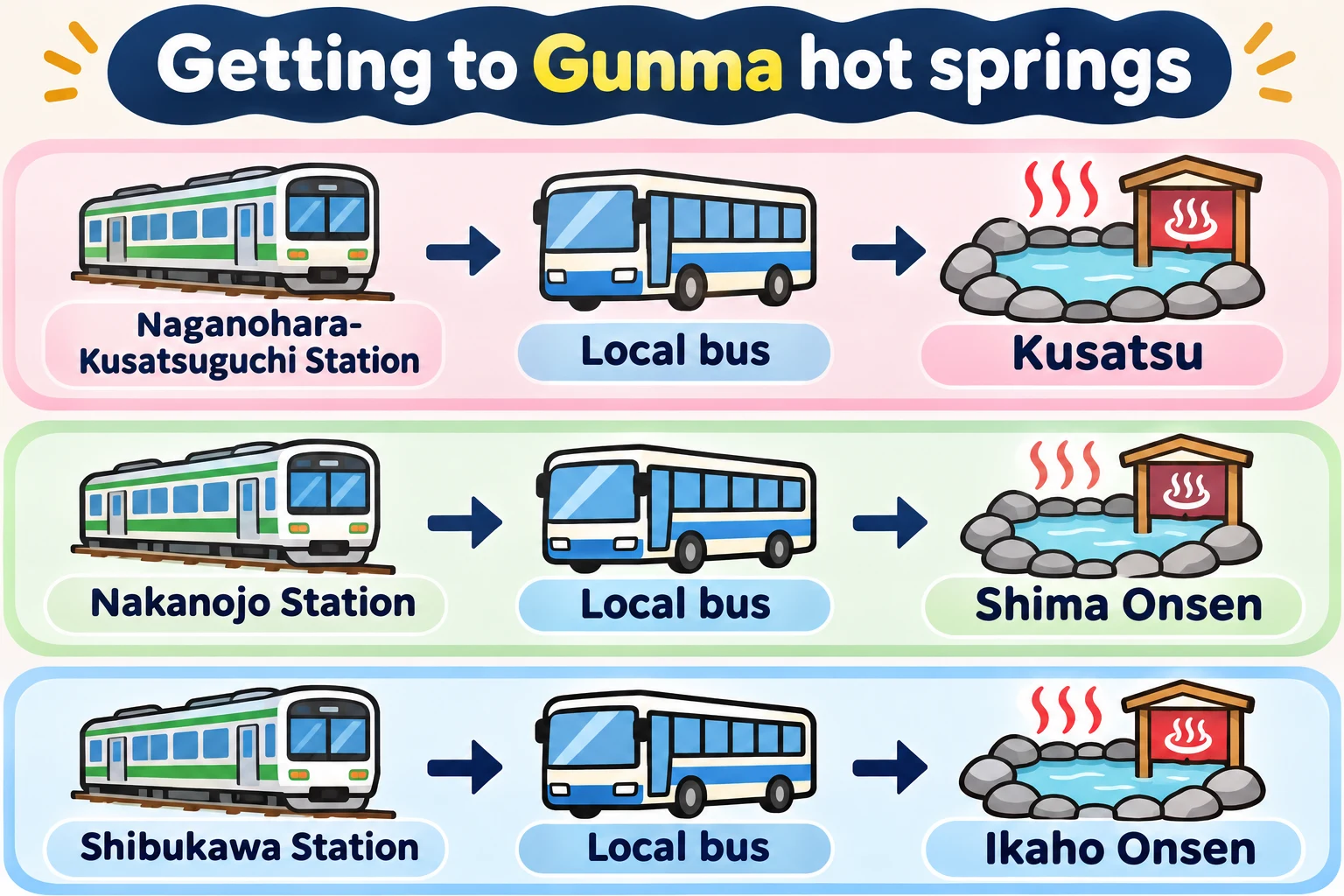
For Kusatsu, plan around Naganohara-Kusatsuguchi Station. For Shima Onsen, use Nakanojo Station; for Ikaho Onsen, use Shibukawa Station. Oze has a different route again, with seasonal buses to its trailhead areas.
Open Maebashi, Gunma, in Google Maps
Compare the main routes from Tokyo
| Journey | Approximate time | Best choice for |
|---|---|---|
| Tokyo Station → Takasaki by Shinkansen | 50 minutes | A fast start, with onward trains or a rental car |
| Tokyo Station → Takasaki by conventional train | 1 hour 50 minutes | A lower-cost rail journey |
| Tokyo Station → Jomo-Kogen by Joetsu Shinkansen | 1 hour 10 minutes | Minakami and seasonal access toward Oze |
| Shinjuku → Kusatsu Onsen by highway bus | About 4 hours | Reaching Kusatsu without a transfer |
| Tokyo Station → Shima Onsen by highway bus | About 3½ hours | A direct journey to the onsen town |
| Shinjuku → Ikaho Onsen by highway bus | About 2½ hours | Travelling directly to Ikaho |
The rail times to Takasaki and Jomo-Kogen end at the station. For an onsen or hiking trip, add the onward train or bus and the time between connections. A direct highway bus takes longer than the Shinkansen to Takasaki, but it may be simpler if you have luggage or want to avoid changing vehicles. (visit-gunma.jp)
Coming from Nagano, take a Hokuriku Shinkansen that stops at Takasaki, then continue on a local train or bus. Drivers can approach from the Nagano direction via the Joshin-Etsu Expressway. (visit-gunma.jp)
Travel by train: fares, tickets and passes
Shinkansen or conventional train?
For an adult travelling one way from Tokyo to Takasaki, JR East lists a ¥2,090 basic fare. On an ordinary conventional train, that is the rail fare for this section; you do not add a limited-express charge.
For an ordinary-class reserved Shinkansen seat in the regular season, JR East’s example adds a ¥3,040 limited-express charge, making ¥5,130 one way. The basic fare and the limited-express charge are separate parts of the price, even when purchased together. Seat type and travel season affect the charge. (jreast.co.jp)
As a transport-only planning example, an adult making a Tokyo–Takasaki return trip on ordinary conventional trains would spend ¥4,180 on those two rail legs. The equivalent regular-season reserved-seat Shinkansen example is ¥10,260. Add any local train, bus or taxi fares needed beyond Takasaki.
Buy individual tickets at a JR ticket office or use JR-EAST Train Reservation to search for services and reserve seats. If speed matters, choose a Shinkansen that stops at Takasaki; if cost matters more, compare the conventional-train journey.
Limited Express Kusatsu-Shima
From Ueno Station, the Limited Express Kusatsu-Shima is useful for travellers heading to several onsen gateways without first changing trains at Takasaki:
- Shibukawa for Ikaho Onsen: approximately 1 hour 40 minutes.
- Nakanojo for Shima Onsen: approximately 2 hours.
- Naganohara-Kusatsuguchi for Kusatsu Onsen: approximately 2 hours 20 minutes.
Seats are reserved, and the limited-express charge is additional to the basic fare when buying an individual ticket. For a conventional-train alternative, travel via Takasaki and change to a train serving your destination. The JR East Agatsuma Line timetable from Takasaki distinguishes weekday and weekend/holiday services and shows different train destinations. (visit-gunma.jp)
Which rail pass should you consider?
| Pass | Adult price and validity | Useful Gunma coverage |
|---|---|---|
| JR TOKYO Wide Pass | ¥16,000; 3 consecutive days | Eligible JR trains in its area, including the Shinkansen to Takasaki and the Kusatsu-Shima limited express |
| JR EAST PASS | ¥35,000 for 5 days or ¥50,000 for 10 days; consecutive days | JR East trains across a wider area, including eligible Shinkansen and limited-express services |
Both passes are available to travellers with a non-Japanese passport. They include eligible ordinary-car reserved seats; arrange the reservation for the train you want. The JR TOKYO Wide Pass does not cover the Tokaido Shinkansen. Some JR bus routes are included with the JR EAST PASS, while Kan-etsu local buses to Shima and Ikaho require separate payment. For the JR Bus Kanto connection to Kusatsu, use the pass conditions for that particular service when planning. (jreast.co.jp)
Compare a pass with the individual tickets for your whole trip. A Tokyo–Takasaki round trip alone costs less than the three-day JR TOKYO Wide Pass, but additional covered journeys within its validity period may make the pass useful. JR East’s current five- and ten-day JR EAST PASS replaced sales of the older regional JR EAST PASS products in March 2026. (jreast.co.jp)
Choose the right connection for Kusatsu, Shima, Ikaho or Oze
Kusatsu Onsen
For a rail-and-bus trip, take the Limited Express Kusatsu-Shima from Ueno to Naganohara-Kusatsuguchi, or travel to Takasaki and transfer to an Agatsuma Line train that stops there. Outside Naganohara-Kusatsuguchi Station, the bus stops are to the left.
The JR Bus Kanto ride to Kusatsu Onsen Bus Terminal takes about 25 minutes. Kusatsu’s tourism association lists an adult one-way fare of ¥780 for this station-to-terminal route. From the terminal, it is approximately six minutes on foot to Yubatake. Pay the local bus fare when leaving the bus, using cash or a supported transport IC card. (visit-gunma.jp)
For fewer transfers, choose the Joshu Yumeguri highway bus from Busta Shinjuku to Kusatsu Onsen Bus Terminal. This is particularly convenient when your accommodation is near the terminal or offers a pickup there.
Shima Onsen
Take the Limited Express Kusatsu-Shima to Nakanojo, then board the Kan-etsu Transportation bus for Shima Onsen from stop 1 outside the station. The local bus takes about 40 minutes and generally runs around once an hour. Sekizenkan’s access information lists the adult fare from Nakanojo Station to the Shima Onsen terminus as ¥1,150. Cash and transport IC cards are accepted on the local bus. (visit-gunma.jp)
From Tokyo Station, the Shima Onsen-go highway bus is the direct alternative. For the timetable period November 1, 2026 to May 5, 2027, the year-round service is listed at 8:50 from Tokyo Station Yaesu South Exit, arriving at Shima Onsen at 12:15. The return leaves Shima Onsen at 13:45 and reaches Tokyo Station Nihombashi Exit at 17:20. The operator has cancelled its additional winter and spring service for the 2026–2027 season, so use the year-round service or the Haneda-line alternative when comparing departures. (kan-etsu.net)
Ikaho Onsen
For Ikaho, travel to Shibukawa Station and take the Kan-etsu bus from stop 3 toward Ikaho Onsen. The ride to the stone-steps area takes about 25 minutes. For a destination-specific fare example, Hotel Tenbo lists ¥750 one way from Shibukawa Station to Miharashita, the stop for the hotel. (visit-gunma.jp)
If you plan several rides, compare single fares with Kan-etsu’s Ikaho Line free tickets: ¥1,100 for one day or ¥1,600 for two days for adults. They cover the specified Shibukawa Station–Ikaho area route. The operator sells them through smartphone services including GunMaaS and participating apps. (kan-etsu.net)
A direct highway bus from Shinjuku is another good choice, especially for a short stay near the stone steps.
Oze and Minakami
For Minakami, Jomo-Kogen is a useful Shinkansen arrival station; use the local bus or accommodation transfer that serves your final destination.
For Oze National Park, take the Joetsu Shinkansen to Jomo-Kogen and continue by seasonal bus toward Tokura or Oshimizu. Gunma’s tourism guide gives approximately two hours for the bus from Jomo-Kogen to those areas, with services described from late April to early November. It also lists a Shinjuku highway bus to Tokura and Oshimizu during the warmer hiking season. (visit-gunma.jp)
For the Hatomachitoge trailhead, continue from Tokura by shared bus or shared taxi. Gunma Prefecture lists the adult fare as ¥1,300 one way. The 2026 Tokura–Hatomachitoge shared service operated from April 18 through November 3; use the operator’s calendar to match the service pattern to your hiking date. (pref.gunma.jp)
Book highway buses and plan the return
Highway buses are worth comparing when you would rather stay on one vehicle than make a rail-to-bus connection. They also serve different stops within some towns, so match the stop name to your accommodation.
For Kusatsu, JR Bus Kanto sells a Kusatsu WEB tour ticket combining a round-trip Joshu Yumeguri bus journey with admission to one selected bathing facility. Adult prices are ¥8,560 for Otakinoyu, ¥8,320 for Gozanoyu, or ¥8,240 for Sainokawara Open-air Bath. The round trip is valid within seven days, with eligible services and seats specified by the operator. Purchase is through Kosoku Bus Net Plus after registering an account. Choose this package if its bath and return conditions fit your trip; otherwise compare individual bus tickets. (jrbuskanto.co.jp)
JR Bus Kanto has also published fares for departures from December 1, 2026: the standard adult fare from its listed Tokyo-area departure points, including Busta Shinjuku, to Kusatsu Onsen Bus Terminal is ¥3,700–¥4,300 one way, depending on the fare category. The corresponding standard range to the listed Ikaho stops is ¥2,800–¥3,400. Online and advance-discount fares have separate conditions. (jrbuskanto.co.jp)
For Shima Onsen, Kan-etsu Transportation lists online booking options, including Japan Bus Online, as well as the Busmori smartphone service. When booking, note that the Tokyo outbound stop is at the Yaesu South Exit, while the listed return arrival is at the Nihombashi Exit.
To make a busy travel day easier:
- Book both directions together when your itinerary is fixed, particularly for a weekend or holiday.
- Save the stop name in Japanese and match it to your hotel’s directions.
- Leave room for the final connection instead of choosing a train solely by its arrival time at Takasaki.
- If travelling with a large suitcase, ask your accommodation about a pickup from the bus terminal or its nearest stop. Gunma’s local transport guide notes that space for large luggage on local buses can be limited.
Useful questions at a station or bus terminal:
-
草津温泉行きのバスは、何番乗り場ですか?
Kusatsu Onsen-yuki no basu wa, nanban noriba desu ka?
Which platform is the bus for Kusatsu Onsen? -
このバスは四万温泉に行きますか?
Kono basu wa Shima Onsen ni ikimasu ka?
Does this bus go to Shima Onsen? -
渋川駅への最終バスは何時ですか?
Shibukawa-eki e no saishū basu wa nanji desu ka?
What time is the last bus to Shibukawa Station? -
交通系ICカードは使えますか?
Kōtsūkei IC kādo wa tsukaemasu ka?
Can I use a transport IC card?
Getting around Gunma and driving in the mountains
GunMaaS is useful for looking up local bus routes and buying smartphone tickets. Its listed products include tickets for Kusatsu, Shima, Ikaho and Minakami. Choose the product whose route and validity match your planned rides; a local bus ticket is separate from the train journey into Gunma. (visit-gunma.jp)
For other parts of the prefecture, consider the railway that serves the attraction rather than routing everything through an onsen town. Joshin Dentetsu runs from Takasaki toward the Tomioka Silk Mill area; Watarase Keikoku Railway runs from Kiryu toward the Nikko area; and Jomo Electric Railway connects Chuo-Maebashi and Nishi-Kiryu. Gunma also has Tobu Railway services. Build any transfer between these networks into your itinerary. (visit-gunma.jp)
A rental car is useful for visiting several dispersed locations or reaching places with infrequent buses. There are rental offices around Takasaki Station, making a Shinkansen-to-Takasaki, then rental-car itinerary practical. Bring the driving documents accepted for your licence’s country of issue and the rental company’s requirements. (visit-gunma.jp)
Mountain conditions matter when choosing a route. Gunma warns of winter snow closures around Kusatsu, Manza and Oze, as well as intermittent restrictions around Mount Kusatsu-Shirane. For Oze’s Hatomachitoge approach, private cars and motorcycles are restricted on the Tsunagi–Hatomachitoge section. Park in Tokura and use the shared bus or taxi; the prefecture lists Tokura parking for private cars at ¥1,000 per day. Do not park along the Tokura–Hatomachitoge road. (visit-gunma.jp)
Frequently asked questions
Can I visit Gunma as a day trip from Tokyo?
Yes. Takasaki is about 50 minutes from Tokyo by Shinkansen, leaving time for a visit before returning. For an onsen or Oze day trip, work backward from the return bus: the final local connection determines how much time you have at the destination. (visit-gunma.jp)
Is Takasaki the best station for every destination?
No. It is a useful hub, but Shibukawa, Nakanojo, Naganohara-Kusatsuguchi and Jomo-Kogen are more useful onward stations for Ikaho, Shima, Kusatsu and Oze respectively. A direct highway bus may avoid a transfer altogether.
Can I use the same bus ticket for Kusatsu and Shima?
Choose tickets for the actual routes: Kusatsu’s rail connection uses JR Bus Kanto from Naganohara-Kusatsuguchi, while Shima’s uses Kan-etsu Transportation from Nakanojo. GunMaaS lists separate products for the areas. (visit-gunma.jp)
Do Oze trailhead buses run in winter?
The hiking-season services have defined operating periods. For example, the Tokura–Hatomachitoge shared service ran through November 3 in 2026. Gunma also describes separate winter access for Katashina ski areas, so plan around the service for your actual destination rather than treating the hiking and ski routes as interchangeable. (kan-etsu.net)
Official sources
- Gunma Official Tourist Guide: Getting to Gunma
- Gunma Official Tourist Guide: Getting around Gunma
- JNTO: Gunma
- JR East: Tokyo-area fare revision information
- JR East: JR TOKYO Wide Pass
- JR East: Rail pass information
- JR East: Takasaki Agatsuma Line timetable
- JR Bus Kanto: Kusatsu WEB tour ticket
- JR Bus Kanto: Yumeguri fare revision
- Kan-etsu Transportation: Shima Onsen highway bus
- Kan-etsu Transportation: Local bus passes
- Gunma Prefecture: Oze traffic arrangements
- Kan-etsu Transportation: Tokura–Hatomachitoge timetable
Prices checked November 7, 2026; check current fares, timetables and road conditions before travel.