
Helicopter Transfer Tokyo: Routes, Quotes and Luggage
Contents
A Tokyo helicopter charter can be part of an airport journey, but a sightseeing flight, a helicopter-and-car transfer, and a direct airport landing are different products. The flight time alone does not tell you when you will reach your hotel or airline terminal: you also need to account for travel to the heliport, the transfer after landing, and any waiting or connection arrangements confirmed by the operator.
Start by identifying the actual departure and arrival points, then request a quote for those endpoints and your travel date. Send the passenger count and baggage details at the same time, and ask the operator to describe the ground transfers, price basis, and weather arrangements in writing. Keep the helicopter and any car or taxi journey in one plan, rather than assuming the flight covers the whole trip.
AIROS Skyview presents a Tokyo helicopter sightseeing experience. Sightseeing can be a reason to fly, but it should not be mistaken for an airport connection. Before choosing, decide whether the priority is an aerial view or getting between specific points.
1. Choose the right helicopter service
Aero Toyota offers private helicopter travel based on the requested date, origin, and destination. Its Tokyo departure and landing information names Tokyo Heliport in Shinkiba; that listing does not establish that a particular hotel roof or airport is available for your itinerary. The operator recommends contacting it at least 10 days before operation when plans are fixed, and it notes that landings outside airports or public heliports require an off-airport landing application. The stated estimate from application to permission is about three weeks, so a proposed landing point may require time and approval before it can be confirmed. See the Aero Toyota charter information.
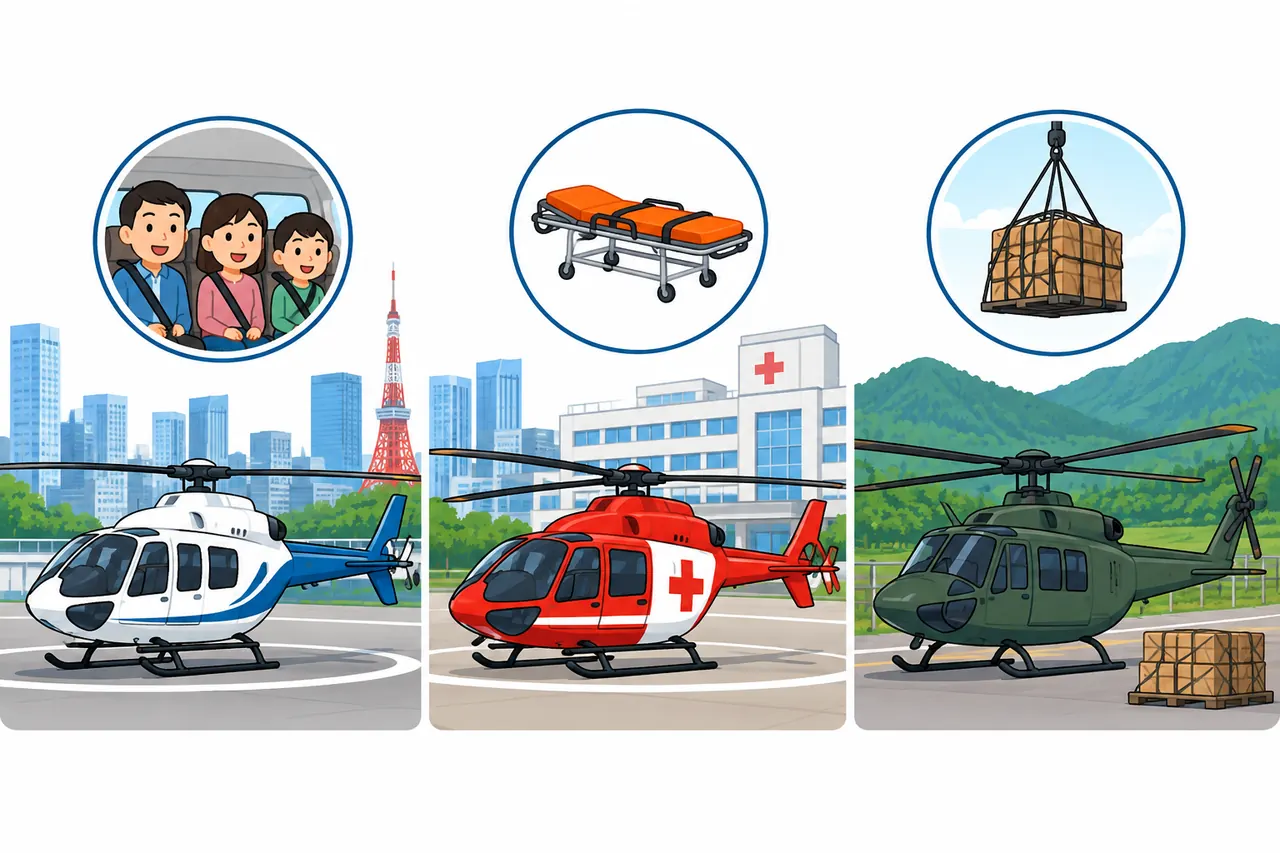
AIROS also describes its charter service as a private booking. A private charter is not automatically a per-seat ticket, and the aircraft, route, and price need to be confirmed for the requested date. Ask whether the quoted amount is for the aircraft or for each passenger, and whether it covers only the flight or also ground transport.
AirX publishes a specific plan between Tokyo Heliport and Shisui Premium Outlets. Its description gives around 20 minutes for the helicopter flight, followed by a car journey of around 15 minutes to Narita Airport. The plan is for a private group of up to three, and it is not evidence of a current direct helicopter landing inside Narita Airport. Weather can affect the flying time, and the two segments should be treated separately when planning a connection. See the AirX Shisui–Narita plan.
| Service | Published price basis | What the description covers | Time and booking details |
|---|---|---|---|
| Aero Toyota charter | Individual quote | Requested charter route and aircraft arrangements | The operator recommends contact at least 10 days before a fixed itinerary; off-airport permissions may take about three weeks |
| AIROS charter | Individual arrangement | Private helicopter charter; taxi or hired-car arrangements before or after the flight can also be requested | Meet at Tokyo Heliport 30 minutes before scheduled takeoff |
| AirX Tokyo–Shisui with Narita car transfer | Request a current quote; the displayed aircraft-price field shows “----円/機,” not a usable amount | Helicopter to Shisui, then a car transfer to Narita | Around 20 minutes flying and around 15 minutes by car; private group of up to three |
These descriptions are not interchangeable price offers. The AirX page’s displayed aircraft-price field does not provide a usable current amount, and historical launch prices should not be used as a present-day budget. Ask each operator for a current written total and a list of inclusions and exclusions, especially where the ground journeys begin and end.
A sightseeing flight is useful when the purpose is to see Tokyo from the air, but it does not automatically solve an airport transfer. Dave Brett presents a scenic helicopter flight over Tokyo booked through Klook, while Helicopter King presents helicopter types operating at Tokyo Heliport. These presentations can help readers understand the kinds of experiences and aircraft being shown, but neither establishes the landing permissions, baggage acceptance, or price for a separate charter. Lee Traveler presents a Korean-language account of riding a Tokyo helicopter, and Un Español en Japón presents a Spanish-language helicopter ride over Tokyo; these are ride accounts, not current operating terms.
2. Reach Tokyo Heliport
Tokyo Heliport is at 4-7-25 Shinkiba, Koto-ku, Tokyo. AIROS’s access information lists a journey of about five minutes from Shinkiba Station by Toei bus, getting off at Tokyo Heliport-mae; it also lists about five minutes by taxi from the station. Those estimates begin at Shinkiba Station, not at your hotel, airport arrival point, or accommodation. Check the route from your own starting point separately, and allow for the time needed to reach the station and board the helicopter. See the AIROS Tokyo Heliport access information.
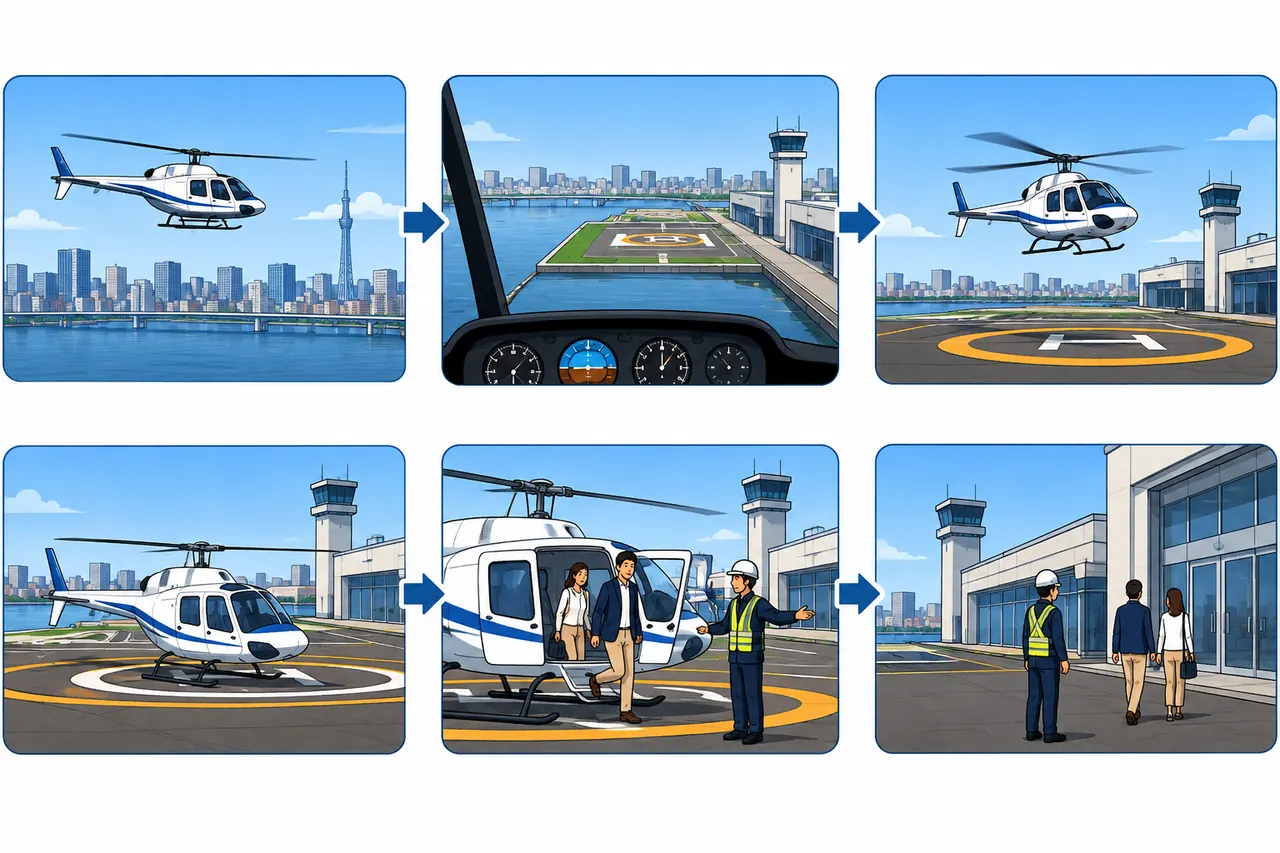
For a bus approach, travel to Shinkiba Station, take the Toei bus described by AIROS, and get off at Tokyo Heliport-mae. For a taxi approach, arrange or take a taxi from Shinkiba Station to the heliport; AIROS gives the journey as about five minutes. These are access options, not a guarantee of door-to-door timing from elsewhere in Tokyo. If you are travelling from an airport or hotel, compare that separate ground leg with the heliport journey before settling on a departure time.
AIROS states that passenger parking is free, but anyone arriving by car must submit the vehicle registration number in advance. Free parking therefore does not mean that you can arrive without arranging vehicle access. Its access page lists operations between 08:00 and 16:30, subject to sunset, so confirm how the published operating window applies to your intended flight date.
For an AIROS departure from Tokyo Heliport, meet 30 minutes before the scheduled takeoff. The operator’s process includes a boarding explanation and security check before passengers proceed to the aircraft; arriving at the heliport at the scheduled takeoff time would not meet the stated meeting instruction. If your itinerary includes a car or taxi, ask for the pickup point and meeting instructions as part of the same plan. AIROS says it can arrange a taxi or hired car before or after the flight; confirm the details directly through its charter FAQ.
If you are comparing the heliport journey with an airport ground transfer, plan both routes from the same starting point to the same destination. Our Haneda Airport to Tokyo guide and Narita Airport to Tokyo guide are relevant alternatives for planning ground travel, but the helicopter information here does not provide a complete comparison of their current routes or fares. Use the airport guides for the ground option and the operator’s quote for the proposed helicopter journey.
3. Calculate the whole journey, not just the flight
Compare complete journeys with the same start and finish. A helicopter segment beginning at Tokyo Heliport is not directly comparable with a ground route beginning at your hotel, and the flight time is not a door-to-door estimate. Write down each leg—travel to the departure point, the helicopter, and travel from the landing point—and ask the operator which legs it will arrange.
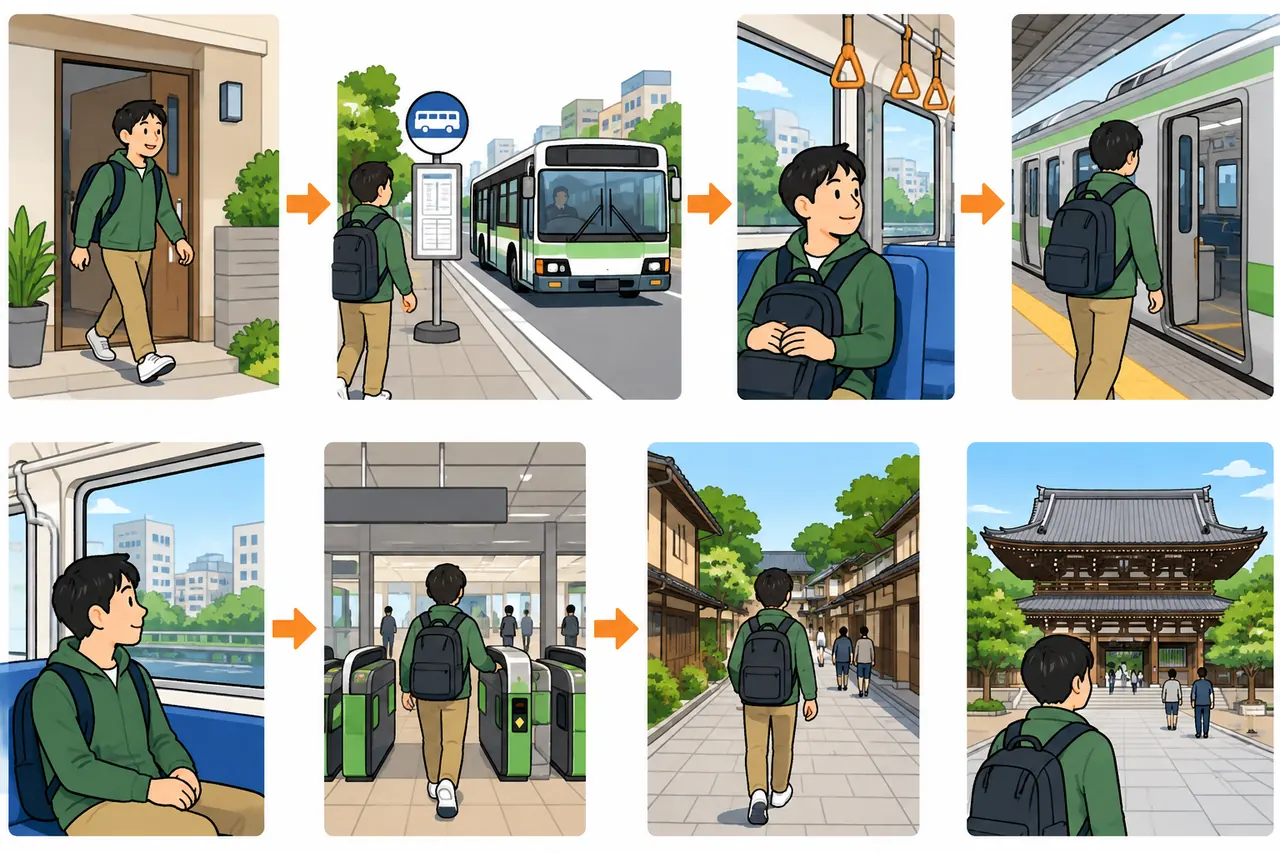
For the published Shisui plan, the sequence is Tokyo Heliport, helicopter flight to Shisui, and then a car journey to Narita Airport. The listed estimates are around 20 minutes for the flight and around 15 minutes for the car segment; the flight time may change with weather. These figures describe the two stated segments, not a guaranteed total from a hotel to an airline terminal. The available plan does not establish a current direct landing inside Narita Airport.
If you are arriving on an international flight, make any requested pickup conditional on when you can actually leave the airline terminal. The supplied plan does not give a terminal-to-helicopter connection time or confirm how a pickup changes if your arrival is delayed. Ask the operator to specify the pickup point, the meeting instructions, and what happens if your arrival timing changes. Do not assume the helicopter portion will wait or that the onward car transfer includes an airport-terminal pickup unless the written quote says so.
Use this order when requesting a whole-journey plan:
- Give the operator your travel date and the exact starting and ending points, including the airport and terminal if relevant.
- Provide airline arrival or departure details if the helicopter is intended to connect with a flight.
- Ask which heliport will be used at each end of the proposed helicopter route.
- Ask whether a taxi or hired car can be arranged before and after the flight, and request the pickup locations and meeting instructions.
- Request a written breakdown of the flight and ground-transfer segments, including the price basis for each.
- Ask what weather cancellation means for the ground plan and for any airline connection.
These questions help prevent a sightseeing reservation from being mistaken for an airport connection. If your purpose is a view rather than transport, compare it as a sightseeing purchase and arrange airport travel separately. If your purpose is transport, request a route-specific quote and judge it by the complete journey rather than the flying time alone.
Aero Toyota asks customers to provide their preferred date, route, and passenger count for a quote. It recommends contact at least 10 days before a fixed itinerary, while an off-airport landing application may take about three weeks from application to permission. Those are different planning considerations: giving notice does not itself mean that a special landing location has been approved. Confirm the proposed locations and permissions for your own route before treating a quote as a confirmed itinerary.
4. Check passenger capacity and luggage before booking
Capacity depends on the aircraft and the specific product. Aero Toyota describes aircraft carrying between five and eleven passengers, but warns that the usable passenger count may be reduced by the combined passenger and baggage weight. Baggage size and weight limits also vary by aircraft. A published seating figure should therefore not be read as confirmation that a particular group and its suitcases can travel together.
The AirX Shisui plan has its own limits: up to three passengers, a combined allowance of 220 kg including baggage, and no large luggage. Separately, AIROS’s booking-procedure page states a 120 kg condition including passenger weight. These figures apply to different products or conditions and should not be combined into one general rule for every charter. Ask the operator to confirm which aircraft and which limit apply to the route in your quote. The AIROS booking procedure also describes the information requested from passengers.
| Information to send | Why it matters | What to request in return |
|---|---|---|
| Number of passengers and each passenger’s weight | The usable capacity depends on the aircraft’s total loading | Confirmation of the aircraft and the accepted passenger list |
| Dimensions and weight of each bag | A bag can exceed a size limit even if total weight appears acceptable | Written approval for each bag |
| Number, dimensions, and weight of golf bags or other bulky equipment | AIROS asks for this information in advance | Confirmation that the equipment can travel |
| Any bags that will travel separately | A helicopter booking does not itself arrange separate baggage delivery | A separate transport plan and its delivery conditions |
AIROS notes that a large item may count as the equivalent of an adult passenger. Its booking procedure also prohibits dangerous or flammable goods and food or drinks. Check the operator’s packing instructions before leaving your hotel, and do not rely on a general suitcase allowance if your booking does not specify one. For bags that cannot fly, our Japan luggage forwarding guide explains a separate transport option; confirm its delivery timing and conditions before relying on it for an onward connection.
AIROS’s request for passenger information includes details such as name, date of birth, weight, and gender. Provide the requested information for the actual passengers, and ask the operator if you are unsure how to report a child or an item that may be treated as an extra passenger allowance. The available facts do not establish one universal baggage size or weight limit across all Tokyo charters, so obtain the decision for your aircraft and route in writing.
AIROS Skyview also presents a private helicopter trip from Tokyo toward a Mount Fuji winery in a Chinese-language listing. That is a separate experience listing, not a baggage policy for a Tokyo airport transfer. The practical rule remains to send passenger and luggage details for the specific product you plan to book.
5. Request a quote and understand payment and cancellations
Begin early when you need a particular destination. Aero Toyota recommends contacting it at least 10 days before operation when the itinerary is fixed. A landing outside an airport or public heliport requires an off-airport landing application, with about three weeks given as the estimate from application to permission. The application period concerns approval for the landing location; it is not a guarantee that an aircraft or route is available on your chosen date.

Do not assume that a rooftop mentioned by one service is available through another operator. An older AIROS FAQ names Akasaka Ark Hills as a possible Tokyo rooftop location, while Aero Toyota’s Tokyo departure and landing information names Tokyo Heliport. The descriptions have different scopes, and the older FAQ should not be treated as current confirmation for a new booking. Ask the operator to confirm the exact departure and landing points for your date and route.
AIROS distinguishes accepting a quote from confirming the arrangements. According to its booking procedure, accepting the quote completes the application, while confirmation of payment completes the arrangements. Aero Toyota generally secures the aircraft and crew after confirming payment in full. An inquiry or quote should therefore not be treated as proof that a flight is confirmed; ask the operator for the status of your own booking and for the payment deadline and conditions that apply to it.
Weather can prevent a flight. AIROS says the captain decides whether to operate based on conditions including cloud height and wind, and it allows rescheduling or cancellation in cases of bad weather or aircraft trouble. Its cancellation refund may have deductions, such as bank charges. Aero Toyota states that weather-related non-performance can be refunded, while costs already incurred may still be charged. These are operator-specific terms, not a single cancellation policy that can be applied to every charter.
Before paying, ask how and when the weather decision will be communicated, what options are available if the operator cancels, and whether a ground alternative can be arranged. If you have a fixed airline departure, ask how a cancellation affects the ground-transfer plan and whether costs already incurred may remain payable. The supplied information does not establish a common refund amount or a guaranteed replacement flight for all operators, so rely on the written terms for your booking.
When sending a quote request, include the requested date and time, both endpoints, passenger count, and baggage details. Include airline details and the exact terminal if the journey is intended to connect with a flight, and ask the operator to identify the heliport and any car-transfer locations. Aero Toyota uses the itinerary and group size for its quote; AIROS requests passenger details during booking. For an actionable comparison, ask for a written total, a clear list of included ground legs, the applicable passenger and luggage limits, and the weather and cancellation terms.
6. Frequently asked questions
Does a Tokyo helicopter transfer land directly at Narita Airport?
The published AirX plan flies between Tokyo Heliport and Shisui Premium Outlets, then uses a car for the final journey to Narita Airport. The page gives around 20 minutes for the flight and around 15 minutes for the car segment, with the flight time subject to weather. This plan does not establish a current direct helicopter arrival inside Narita Airport, so ask the operator to specify the exact route and terminal-side arrangements for any alternative it offers.
How much does a Tokyo helicopter transfer cost?
The supplied Aero Toyota information describes a quote based on the requested date, route, and passenger group, rather than providing one fixed fare for every journey. The AirX Shisui plan’s aircraft-price field displays “----円/機,” so it does not provide a usable amount for a current budget. Request a current written total and check whether it is priced per aircraft or per passenger and whether the car transfer is included; do not substitute historical launch prices for a current quote.
How many passengers and how much luggage can I bring?
The answer depends on the aircraft and product. Aero Toyota describes aircraft seating between five and eleven passengers but says passenger and baggage weight can reduce the usable passenger count, with size and weight limits varying by aircraft. The AirX Shisui plan allows up to three passengers and a combined 220 kg including baggage, excludes large luggage, and is separate from AIROS’s stated 120 kg condition on its booking-procedure page; send the dimensions and weights and obtain confirmation for your specific booking.
How early should I arrive at Tokyo Heliport?
AIROS says passengers departing from Tokyo Heliport should meet 30 minutes before scheduled takeoff. The operator conducts a boarding explanation and security check before passengers go to the aircraft, so the meeting time is not the takeoff time. Plan your separate journey to the heliport as well, using the access information from Shinkiba Station and confirming the pickup instructions if a taxi or hired car is arranged.
What details should I send for a quote?
Send your requested date and time, the precise departure and arrival points, and the number of passengers. Include passenger details and each bag’s size and weight, plus information about golf bags or other bulky items. If the flight connects with an airline journey, give the airline arrival or departure details and exact terminal, then ask which heliport, ground transfers, and cancellation terms apply.
What happens if the flight is cancelled because of weather?
The answer depends on the operator’s terms. AIROS says the captain assesses conditions including cloud height and wind, and that bad weather or aircraft trouble can allow rescheduling or cancellation; a refund may be reduced by bank charges or similar deductions. Aero Toyota says weather-related non-performance can be refunded while already incurred costs may still be charged, so ask for the conditions that apply to your booking and make a ground alternative part of your connection plan.
For a next step, use the Aero Toyota charter information, AIROS’s booking procedure, or the AirX Shisui–Narita plan to request route-specific details. Compare confirmed whole journeys, not just flight durations, and keep the written baggage and cancellation conditions with the quote. Operator information was last checked on 4 November 2026.