Dotonbori Osaka: Food, Neon Signs and River Cruises
Contents
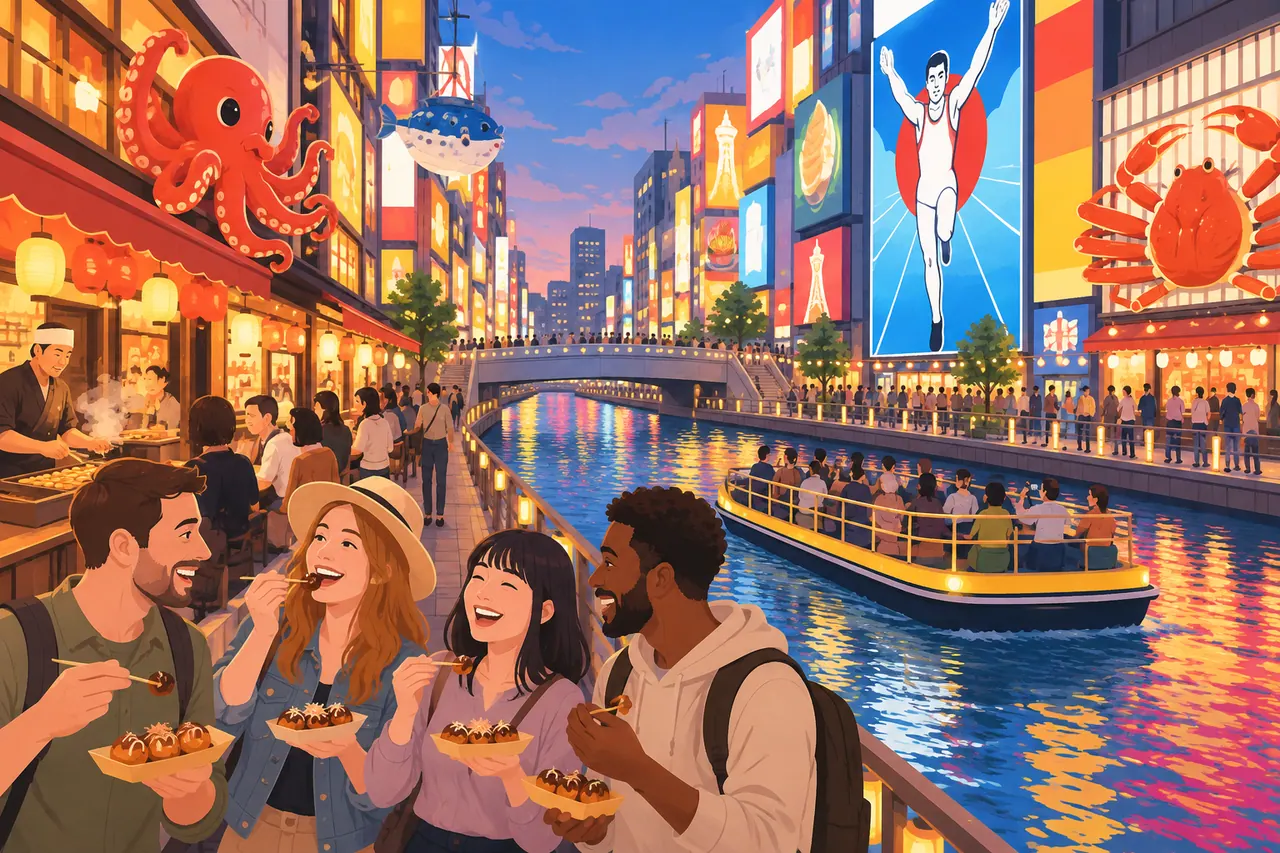
Dotonbori is a food and shopping district beside a canal in Osaka’s Minami area. Its landmarks include the Glico Running Man sign, Ebisu Bridge, large restaurant signs and the Tombori Riverwalk. For a first visit, start with the bridge and sign, then choose a meal; add a river cruise or the Ebisu Tower Ferris wheel only after checking whether it is operating.
There is no confirmed official total visit time for the district. A cruise takes about 20 minutes on the boat, but that does not include waiting, meals, getting to the pier or other stops. Shops and restaurants set their own hours and closing days, so check the places you want to visit before setting out.
1. How to get to Dotonbori
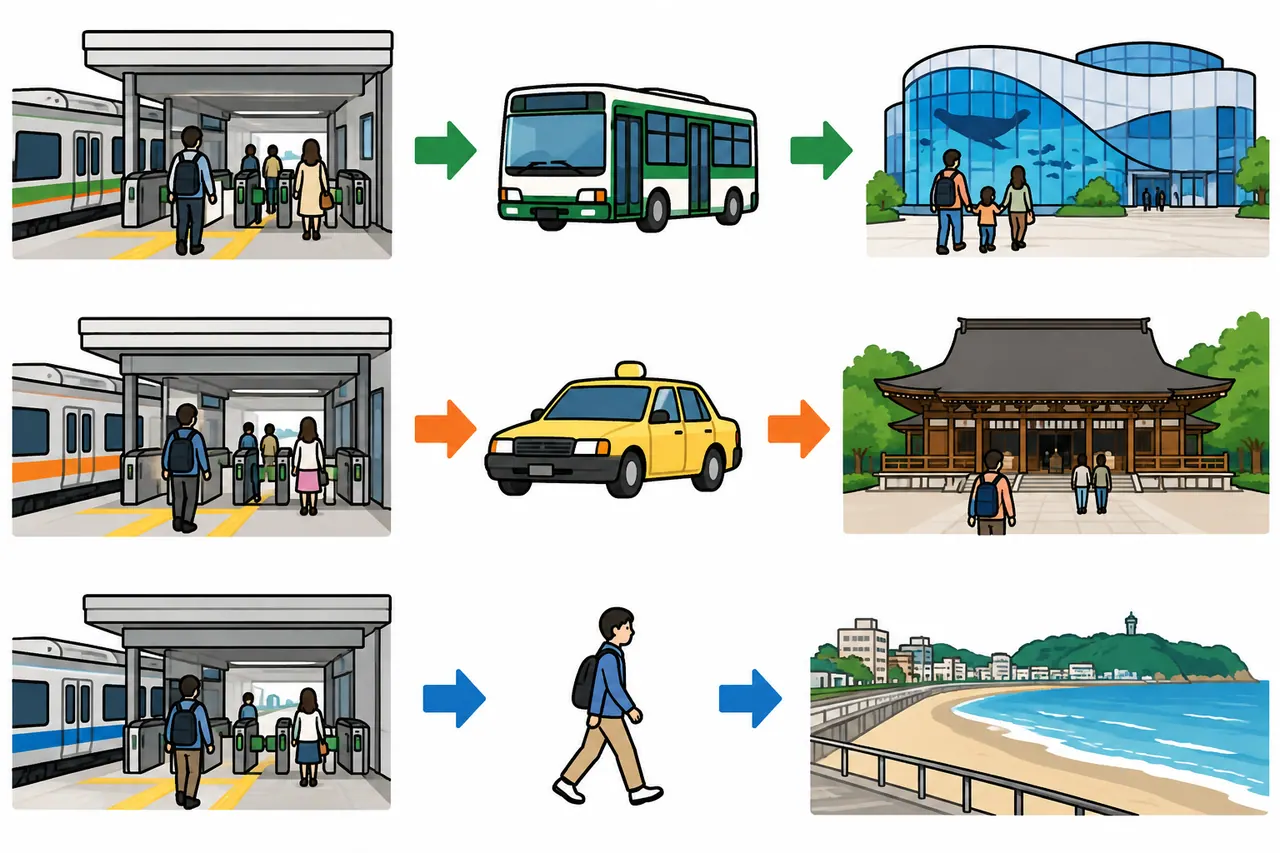
Several railway lines serve the Namba area, which is a practical starting point for Dotonbori. Osaka Metro lists the Midosuji, Sennichimae and Yotsubashi lines; the tourism bureau also lists Nankai and Kintetsu Namba stations. The walk estimates below are for named destinations, not a single route through the entire district.
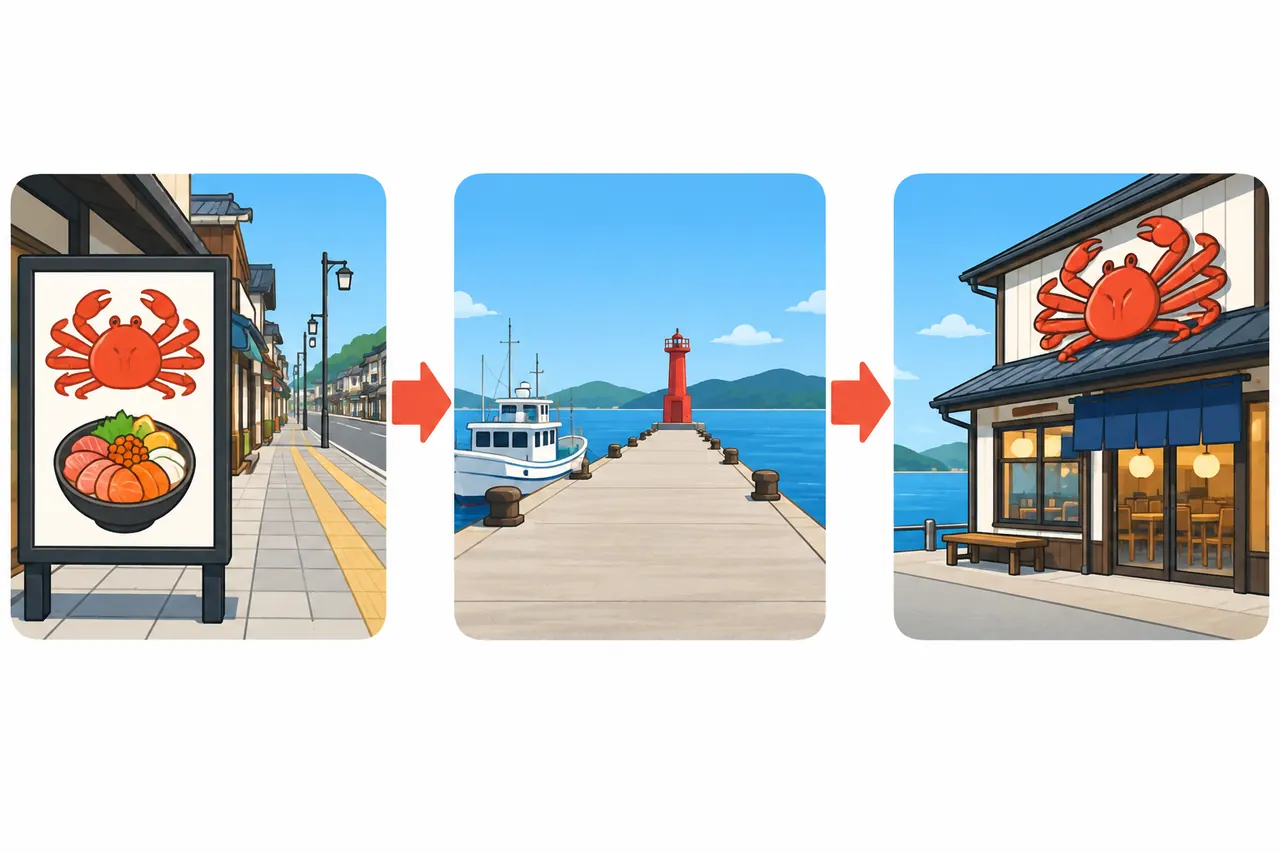

Choose a station
Osaka City says Ebisu Bridge is about 200 metres, or three minutes on foot, from Exit 14 at Osaka Metro Namba or Kintetsu Namba. This is a useful starting point, but it is not confirmed as the fastest exit for every visitor or destination. See the Osaka City Ebisu Bridge page for the bridge information.
| Starting point | Destination | Listed walk |
|---|---|---|
| Osaka Metro Namba or Kintetsu Namba, Exit 14 | Ebisu Bridge | About 200 m; 3 min |
| JR Namba | Tombori Riverwalk | 10 min |
| JR Namba | Nakaza Kuidaore Building | 9 min |
| Osaka Metro Namba | Nakaza Kuidaore Building | 5 min |
| Kintetsu Namba | Nakaza Kuidaore Building | 6 min |
| Nankai Namba | Nakaza Kuidaore Building | 7 min |
| Shinsaibashi | Nakaza Kuidaore Building | 10 min |
| Midosuji Line Namba, Exit 15A | Mizuno restaurant | 5 min |
The Nakaza Kuidaore Building estimates come from OSAKA-INFO, while the Mizuno estimate is from the restaurant’s shop information. The JR Namba estimate for the riverwalk is from the tourism bureau’s riverwalk guide; it is not an estimate for JR Namba to Ebisu Bridge. Walks and station layouts can feel different depending on your exit, luggage and pace.
For airport travel, consult a Kansai Airport-to-Osaka transport guide before choosing your onward route. For local rail and bus travel, a Japan IC card guide can explain rechargeable travel cards; do not assume that a rail pass covers every service to Namba.
Follow a flexible route
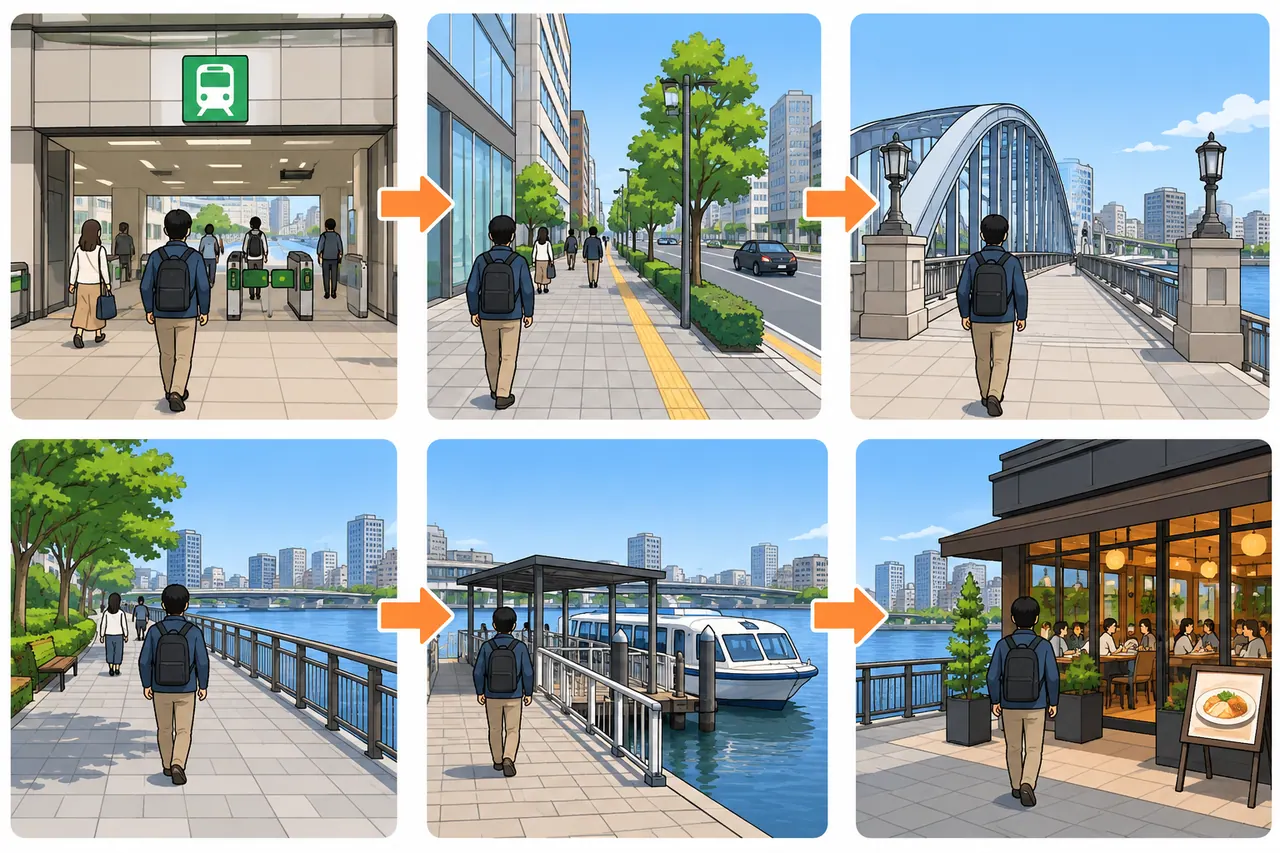
This suggested walk connects a major landmark, the canal and a meal, but it is not a measured shortest route. From Osaka Metro or Kintetsu Namba, follow station signs to Exit 14, then head to Ebisu Bridge and the Glico sign at 1-10-4 Dotonbori, Chuo-ku. Osaka City’s bridge page gives the exit-to-bridge estimate.
From the bridge, choose a route to the Tombori Riverwalk and, if you have confirmed a departure, Tazaemonbashi Pier. The cruise listing places the pier in front of Don Quijote Dotonbori; the store address is 7-13 Soemoncho, Chuo-ku. You could then walk to Ichiran Dotonbori Annex at 1-4-16 Dotonbori, but check your map because this suggested order does not guarantee the shortest route or a particular walking time.
Check hours before you go
Dotonbori is a district, not one attraction with a single opening schedule. The tourism bureau notes that shops have different operating hours and closing days, so confirm hours and last orders directly with each restaurant. For attractions, check entry costs and operating information before making them part of a fixed plan.
| Place | Check before setting out |
|---|---|
| Shops and restaurants | Opening hours, closing days and last orders |
| Glico sign | Lighting information |
| Tombori River Cruise | Departures, seats and how tickets are being sold |
| Ebisu Tower | Ride operation, price and hours |
| Hozenji | Visiting information and any entry rules |
2. Signs, bridges and Ebisu Tower
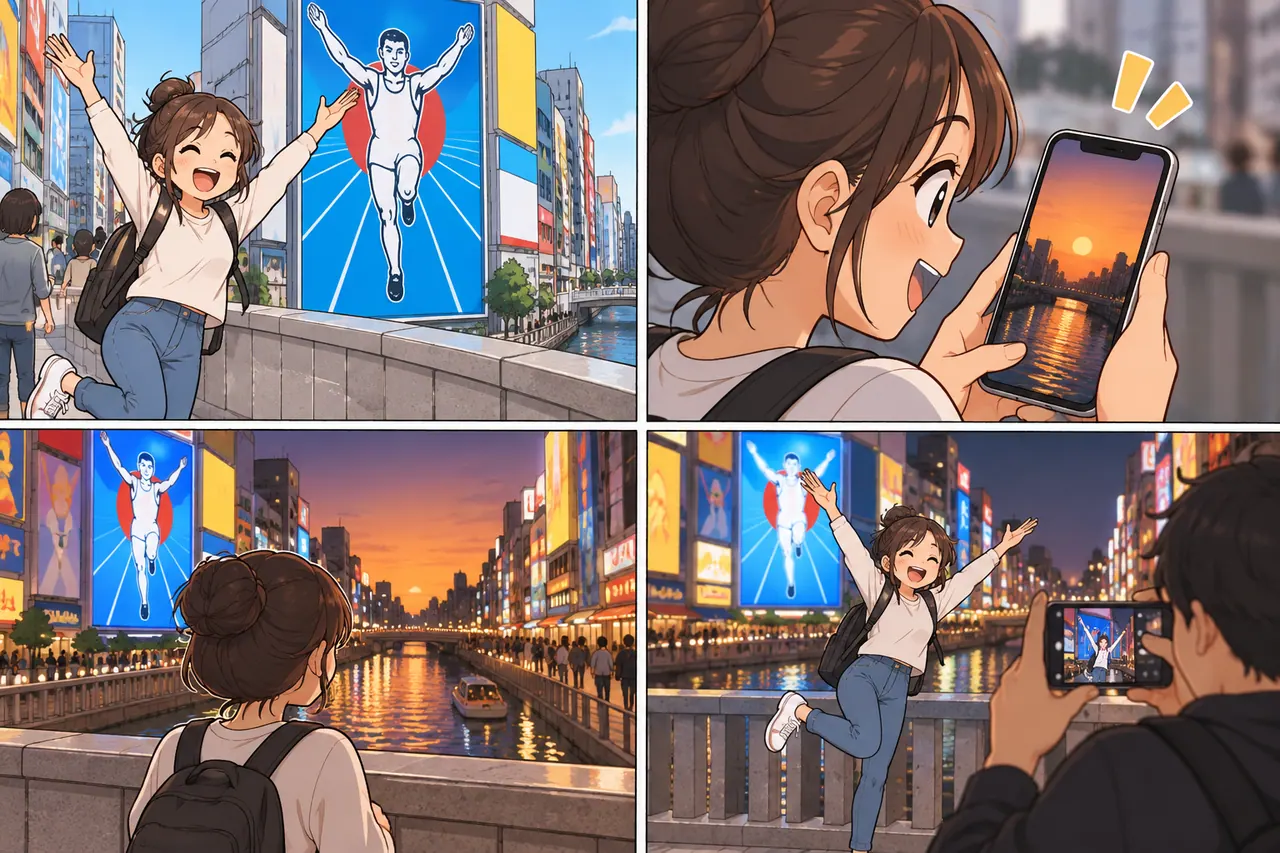
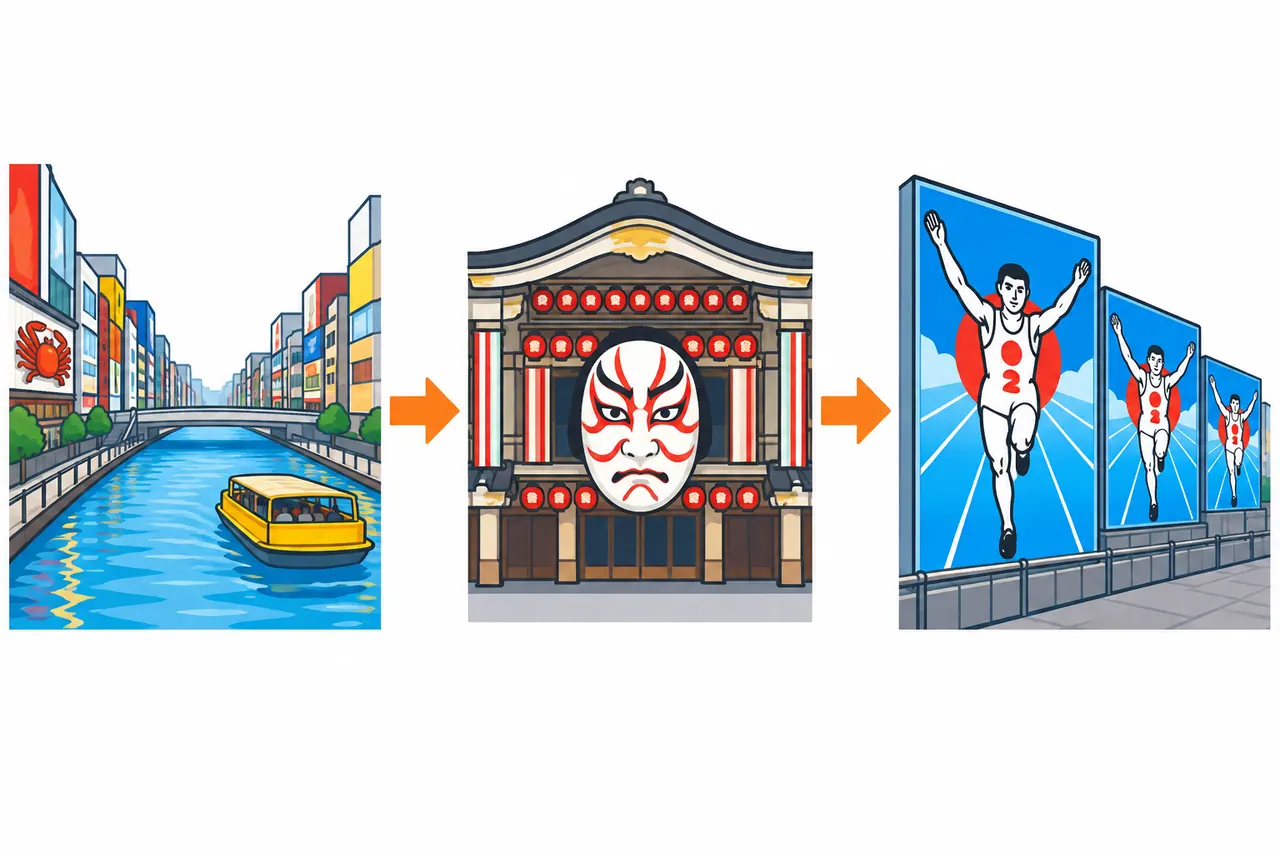
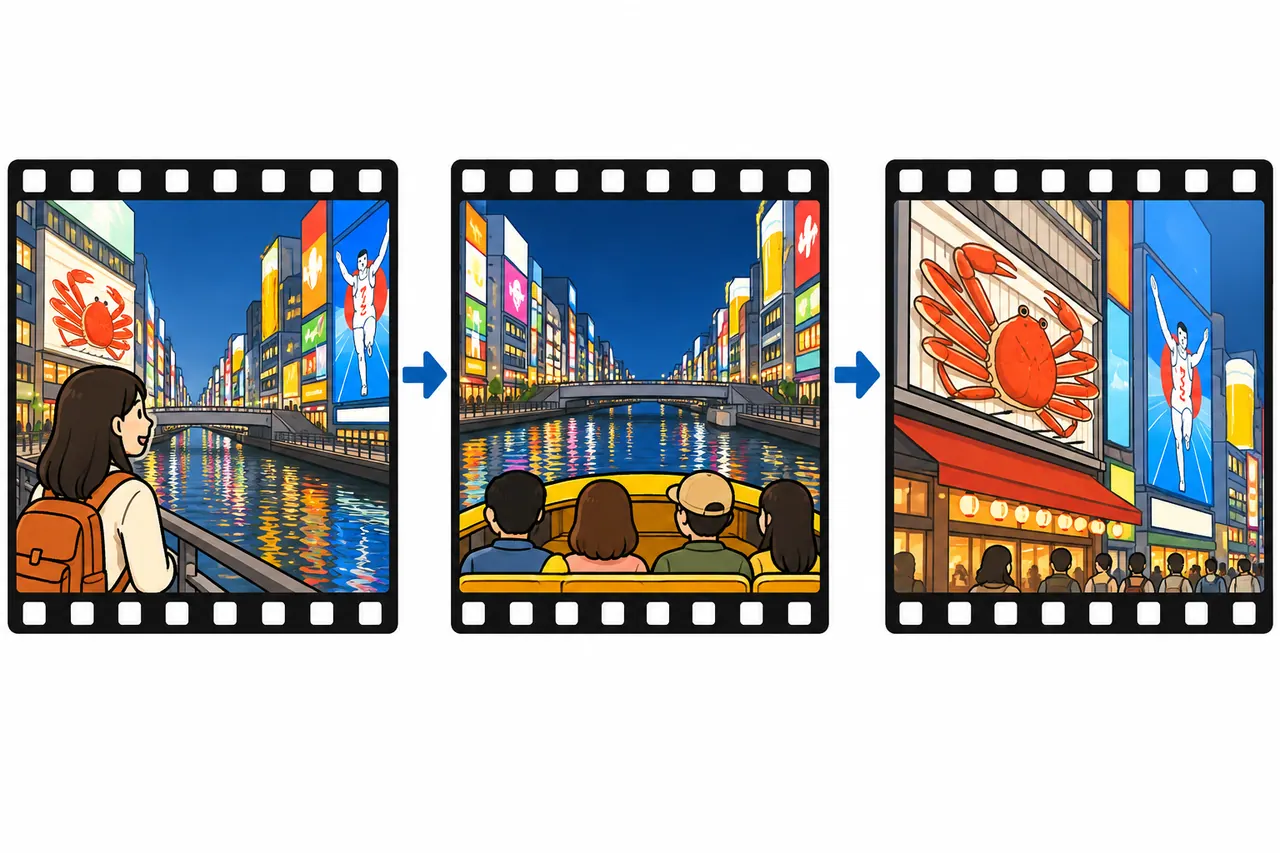
Dotonbori’s large signs are useful landmarks as well as part of its visual character. Ebisu Bridge is a popular place to see the Glico sign and look along the canal. If you have extra time, you can also look for other restaurant signs, cross several bridges or check whether the Ferris wheel is running.
See the Glico sign
Glico lists the sign’s lighting as starting after sunset and continuing until midnight, but says the lighting may end earlier depending on conditions. That information was checked on 3 November 2026; the sign’s daytime lighting status is not confirmed, so do not assume it is necessarily unlit during the day. The owner’s current information is on the Glico sign page.
The first Glico sign was built in 1935, and the sixth sign was installed in October 2014. It stands 20.00 metres high and 10.38 metres wide, uses about 140,000 LED chips and is at 1-10-4 Dotonbori, Chuo-ku. Glico says the sixth sign replaced neon with LEDs, which can display changing images; its 2014 announcement describes the new sign.
Glico’s historical information also records a fourth sign displayed from 1972 to 1996 and a fifth from 1998 to 2014. The fifth sign showed Osaka landmarks in its background, including Osaka Castle, Kaiyukan, Osaka Dome and Tsutenkaku. The upper Glico logo changed in June 2022, according to the sign information.
| Your main goal | A useful time to consider | What to check |
|---|---|---|
| See the streets and signs in natural light | Daytime | Your chosen shops’ hours |
| Aim for a lit-sign view | After sunset | Whether lighting ends early |
| Combine a photo and boat ride | Around a confirmed departure | Ticket and boarding arrangements |
Look for other signs and bridges
The district has more to see than the Glico sign. OSAKA-INFO introduces restaurants, large signs and Osaka Shochikuza, a theater in the area. Look for the large crab sign at Kani Doraku and the Daruma Daijin figure on the roof of the Kushikatsu Daruma building.
Dotonbori Konamon Museum is associated with an octopus sign described by Kukuru, and the museum is at 1-6-12 Dotonbori, Chuo-ku. Kukuru also describes a small-octopus sign at the shop and identifies the location as one with a “Nebutako” sign; the available information does not establish whether either is the same sign as the district guide’s large takoyaki sign. The museum’s takoyaki-making activity is described in the food section below.
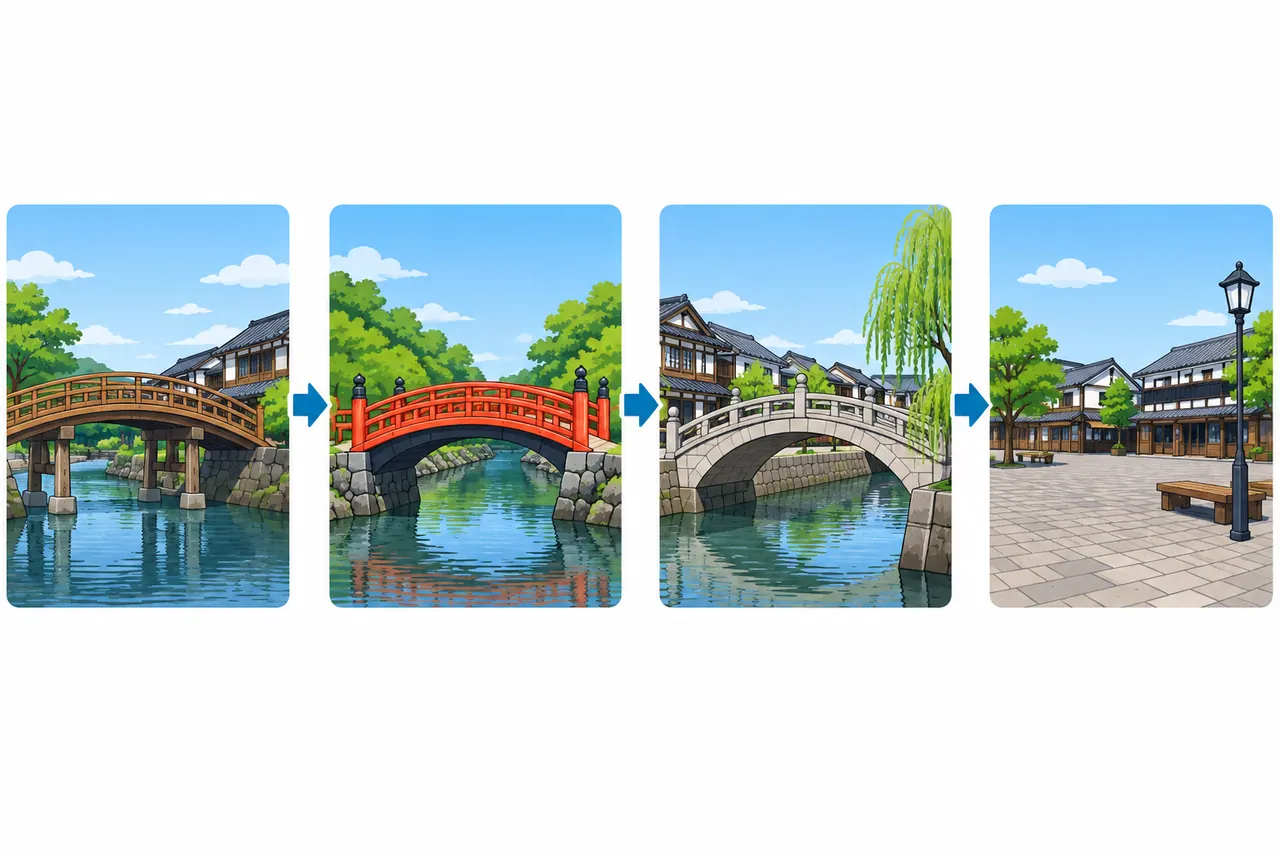
The bridges also have different histories. Osaka City says the present bridge structure at Ebisu Bridge was completed in November 2007; the bridge itself is thought to date from around the time the canal was dug. Tazaemon Bridge’s wood-based design refers to the area’s theater history, while Aioi Bridge dates to the 1680s and was widened with a plaza in 1983. See the city pages for Tazaemon Bridge and Aioi Bridge.
Consider Ebisu Tower
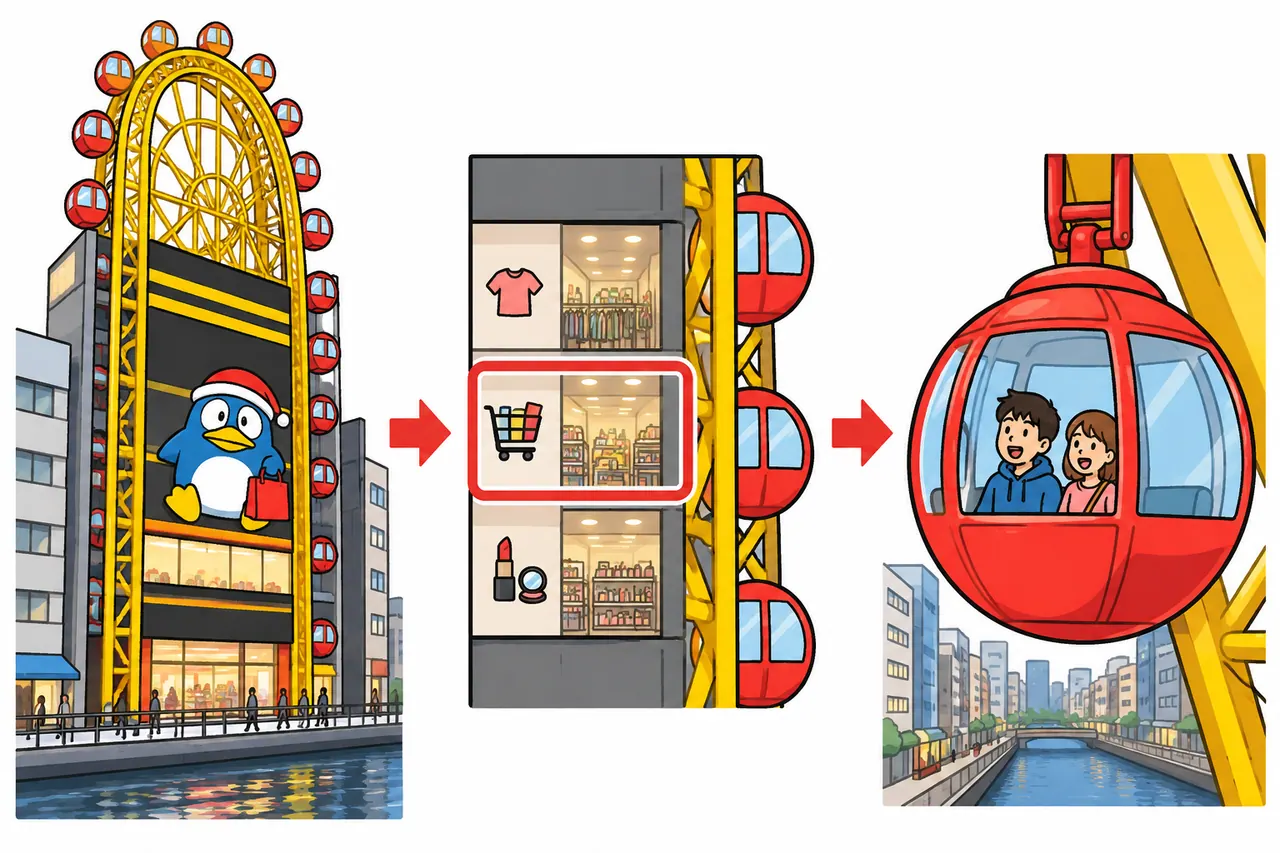
Ebisu Tower is the Ferris wheel at Don Quijote Dotonbori. OSAKA-INFO describes a ride of about 15 minutes in an enclosed gondola that carries four people. The tourism listing places the attraction at 7-13 Soemoncho, Chuo-ku, about five minutes on foot from Namba Exit 14, and lists boarding on the store’s third floor.
Current price and operating information are not consistent across the available listings. On 3 November 2026, OSAKA-INFO displayed a normal pass price of ¥600, while the facility operator’s page showed ¥1,000 in information that had been captured about five months earlier. OSAKA-INFO listed hours of 12:00–21:00, while that older operator display listed different hours, including a Tuesday start at 13:00; the hours and holiday arrangements for your visit are not confirmed. Check the tourism listing and the operator’s Ebisu Tower page, or ask staff about the ride’s operation and price for your date. Don Quijote store hours do not establish when the Ferris wheel operates.
A short history and film locations
The name Dotonbori comes from Yasui Doton, who invested his own money in digging the river in 1612, according to OSAKA-INFO. The district developed around theaters and kabuki, a traditional Japanese stage art, and restaurants grew to serve theater audiences. The canal, bridges and entertainment venues help explain why food and performance remain associated with the area.
The tourism bureau describes overseas visitor numbers growing from 2018, a quieter period during the pandemic and recovery from October 2022. That historical account is not a current visitor count or a month-by-month crowd forecast. OSAKA-INFO’s district guide also describes large signs, restaurants and the riverwalk.
An Osaka City-hosted tourism document names Dotonbori among the Osaka locations for John Wick: Chapter 4 and says the area’s bright night signs were filmed. The same document lists the Dotonbori River as a location for Josee, the Tiger and the Fish. These are named locations, not claims that either entire film was shot in Dotonbori.
3. Dotonbori food: shops, prices and booking
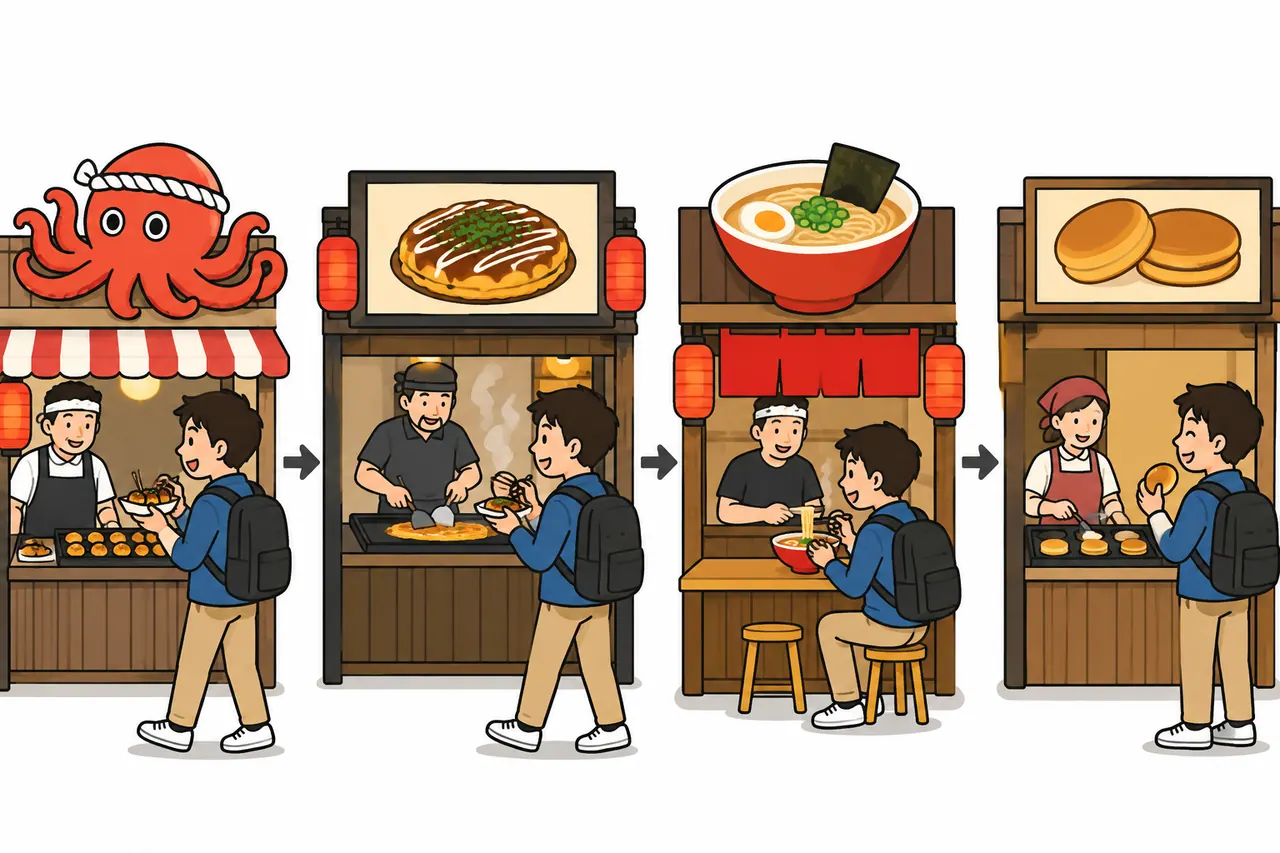
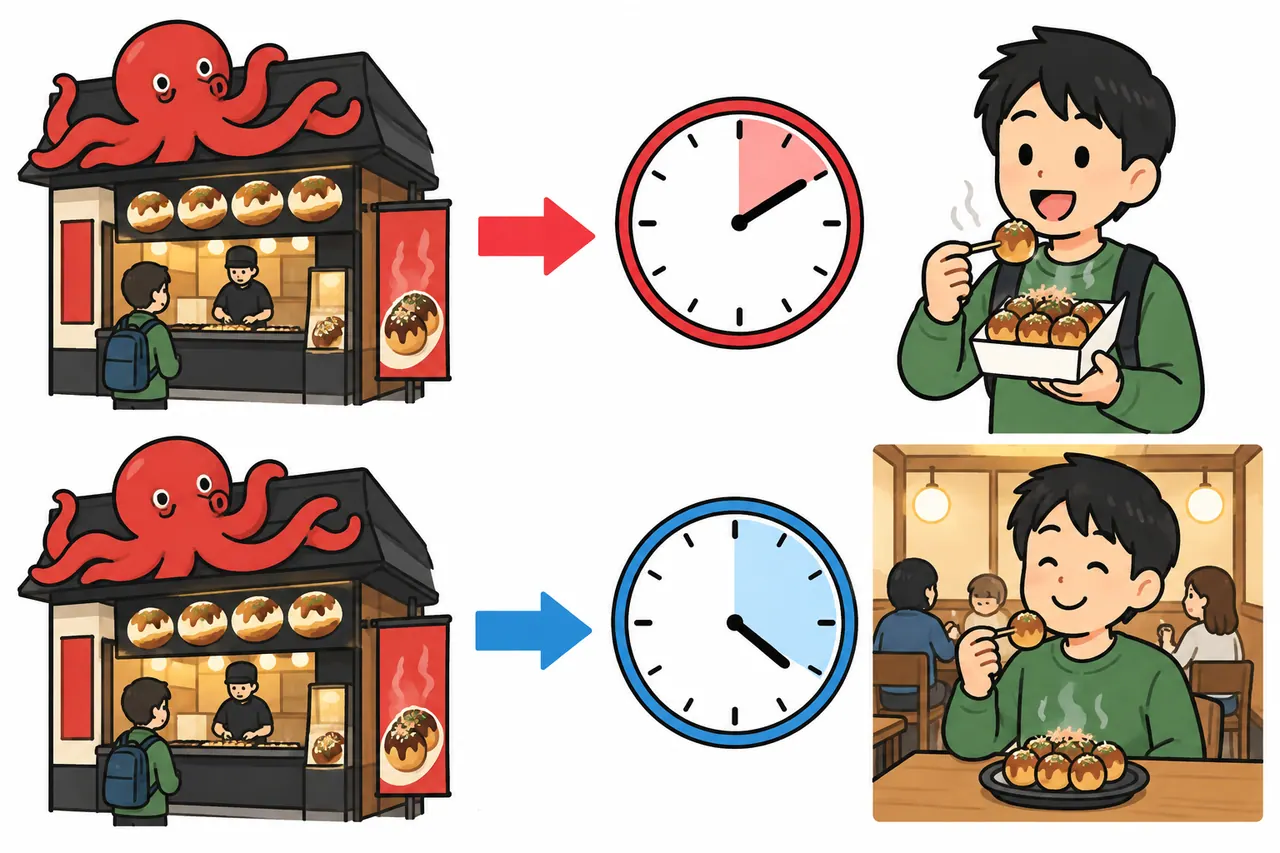
Dotonbori is a practical place to compare takeaway snacks, sit-down meals and a food-making activity. Takoyaki is a cooked snack made from batter with octopus inside; Kukuru says its version uses large pieces of octopus and is finished with white wine. Okonomiyaki is a grilled dish, often made with flour batter and chopped cabbage and topped with ingredients such as pork, although ingredients vary by dish.
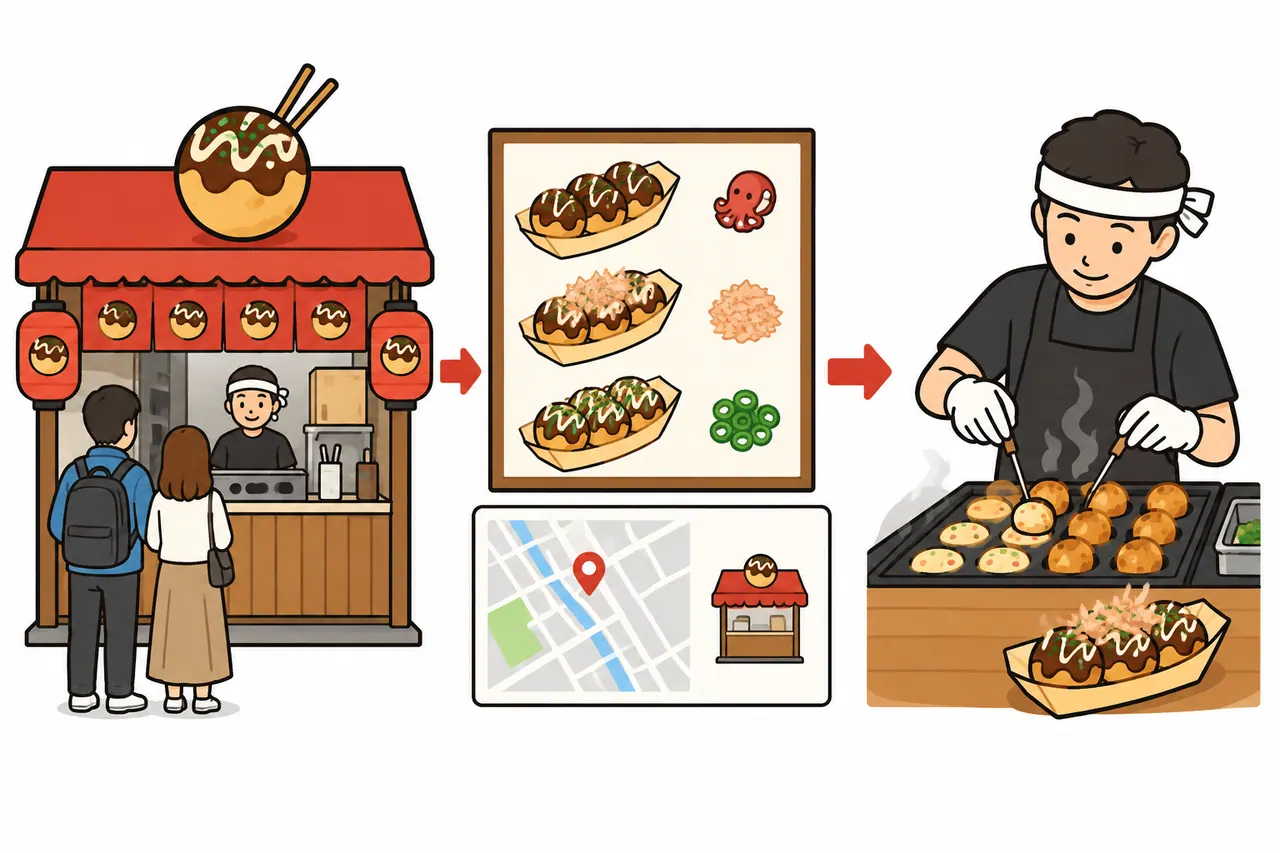
Compare four food stops
Prices below are those shown by the operators on 3 November 2026 where noted. Kukuru’s main-store takoyaki price was not confirmed, and Mizuno’s displayed prices may not apply on your visit. Check the linked operator pages for the current menu, availability and any changes before ordering.
| Shop | What to consider | Price or next step | Address |
|---|---|---|---|
| Kukuru Dotonbori main store | Takoyaki | Ask for the current price | 1-10-5 Dotonbori |
| Mizuno | Okonomiyaki and dishes made with grated yam | Confirm the current menu price | 1-4-15 Dotonbori |
| Ichiran Dotonbori Annex | Ramen | ¥1,180; extra noodles ¥210 | 1-4-16 Dotonbori |
| Dotonbori Konamon Museum | Takoyaki-making activity | Basic course ¥3,850, including tax; check availability | 1-6-12 Dotonbori |
All four addresses are in Chuo-ku, Osaka. Kukuru’s published ingredient information includes wheat, egg, milk, squid, soy, yam and apple among listed ingredients; ask about the specific item and any allergy needs before ordering. Mizuno’s menu describes yamaimo-yaki as a grilled dish made with a grated-yam mixture instead of flour, but ask the restaurant about all ingredients if you have an allergy.
Mizuno’s Chinese-language menu displayed ¥1,780 for yamaimo-yaki and ¥1,580 for Mizuno-yaki. The date of that menu’s pricing and the amounts that will apply on your visit are not confirmed, so check with the restaurant before ordering. Ichiran Annex displayed ¥1,180 for ramen and ¥210 for kaedama, an extra serving of noodles, on 3 November 2026; a late-night charge applies from 22:00 to 06:00.
Check shop hours
The published hours differ by shop and, for Kukuru, by service. The following details were displayed on 3 November 2026, but check the operator’s page for updates before visiting. In particular, a listed 24-hour counter does not mean every seating area is open 24 hours.
| Shop or service | Listed hours |
|---|---|
| Kukuru takeaway, weekdays | 10:30–21:30 |
| Kukuru eat-in, weekdays | 11:00–20:30 |
| Kukuru takeaway, weekends and holidays | 10:00–21:45 |
| Kukuru eat-in, weekends and holidays | 10:30–20:30 |
| Mizuno | 11:00–22:00; last order 21:00; listed as open daily |
| Ichiran Annex counter | Listed as 24 hours; may change |
| Ichiran Annex tables | 08:00–23:00; may change |
| Konamon Museum, weekdays | 10:30–22:30 |
| Konamon Museum, weekends and holidays | 09:00–22:30 |
Kukuru’s shop information separates takeaway hours from eat-in hours. Ichiran notes that staffing or other circumstances may change its hours, seating or closures. The former Ichiran Dotonbori Main Store and the Annex are different shops: the Main Store was shown as closed when checked on 3 November 2026, while the Annex listing is at 1-4-16 Dotonbori.
Book a meal or activity
Kukuru’s main-store page asks visitors to book seats only by the day before; its listed phone number is 06-6212-7381. For the main-store tako shabu, a dish listed by the restaurant, Kukuru asks for a booking at least five days ahead. Confirm the current conditions directly with the main-store page.
The Konamon Museum page lists a basic takoyaki-making course at ¥3,850 including tax and provides a booking contact. The available information does not confirm which dates the activity runs or whether places are available, so ask before planning around it. A practical booking check is to read the hours and closure notices, confirm the menu and price, ask about seats or activity dates, and save the exact address.
4. Dotonbori river cruise: fare, pier and tickets
The Tombori River Cruise is a guided boat ride on the Dotonbori River. OSAKA-INFO lists the ride itself as about 20 minutes, but that is not the total time to allow for ticket arrangements, waiting, walking or photos. The tourism bureau’s details concern a separate operator, so confirm current information for your date rather than treating a listing as a guarantee.
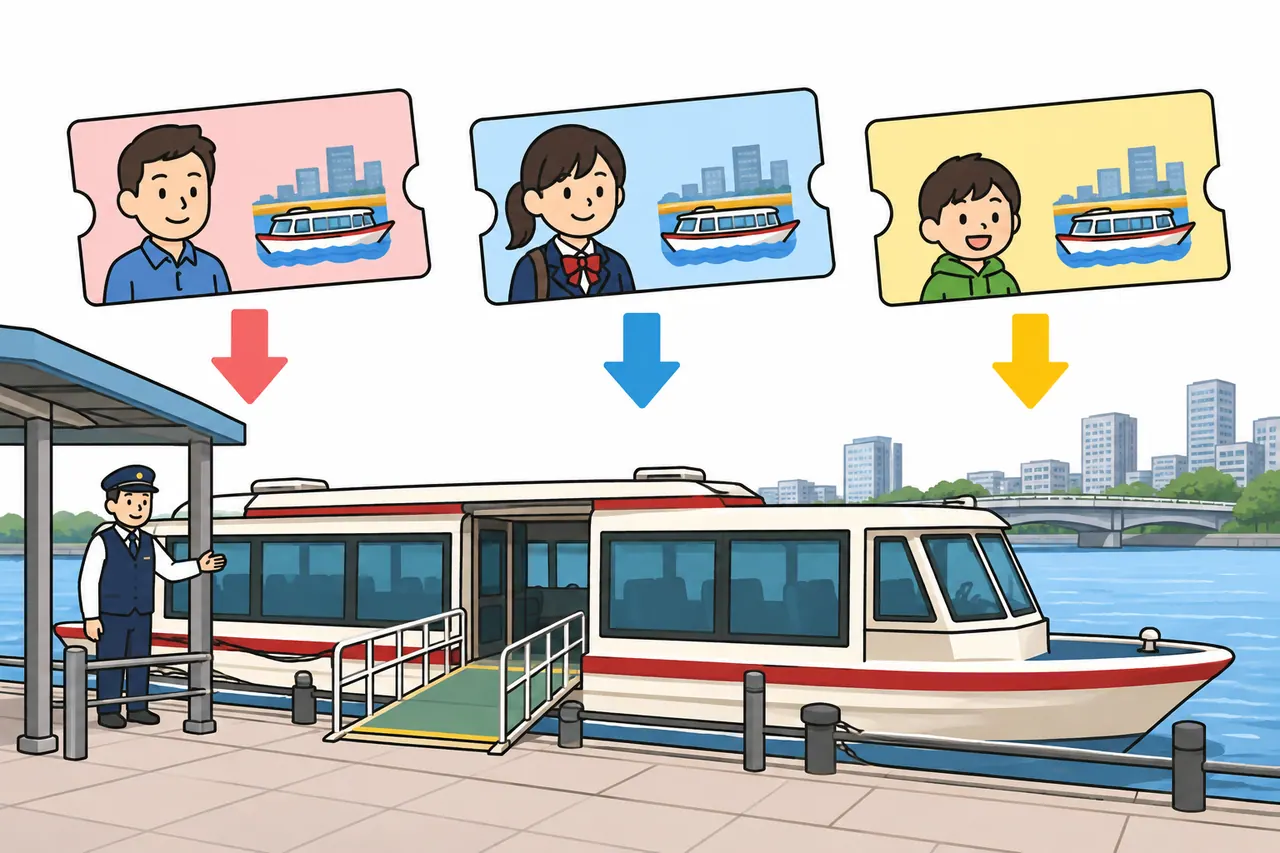
Fares and children’s tickets
The tourism-board listing showed an adult fare of ¥2,000 and a student fare of ¥1,000 for students of junior-high age or older on 3 November 2026. The Osaka Rakuyu Pass facility list also showed the normal adult fare as ¥2,000. These are listed amounts, not confirmation of the fare that will apply on your visit.
| Passenger | Listed information | What to confirm |
|---|---|---|
| Adult | ¥2,000 | Fare for your date |
| Student, junior-high age or older | ¥1,000 | Eligibility for the student fare |
| Child | Conflicting descriptions | Give the child’s age and ask for the fare |
The child-fare descriptions conflict across the tourism listings: they overlap between paid and free categories and differ in how they describe the number of preschool children covered per adult. The confirmed fare and eligibility rules are therefore not established here. Tell the operator each child’s age and ask for the total before paying. See the OSAKA-INFO cruise listing and the Osaka Rakuyu Pass facility information.
Confirm departures and ticket sales
On 3 November 2026, several listings showed operating hours of 11:00–21:00, with departures at :00 and :30. Another tourism listing showed a weekday start at 13:00, so the first departure for your date is not confirmed. Departures may change or be cancelled, and the pages do not establish that a boat will be available at a particular time.
The ticket information also differs. One listing describes web booking until 10 minutes before departure with advance payment, while another describes same-day tickets only. The listings say that telephone reservations are not accepted; a phone number shown for questions is not a phone-booking service. The pass page displayed 050-1807-4118, 09:00–17:00, for inquiries when checked on 3 November 2026.
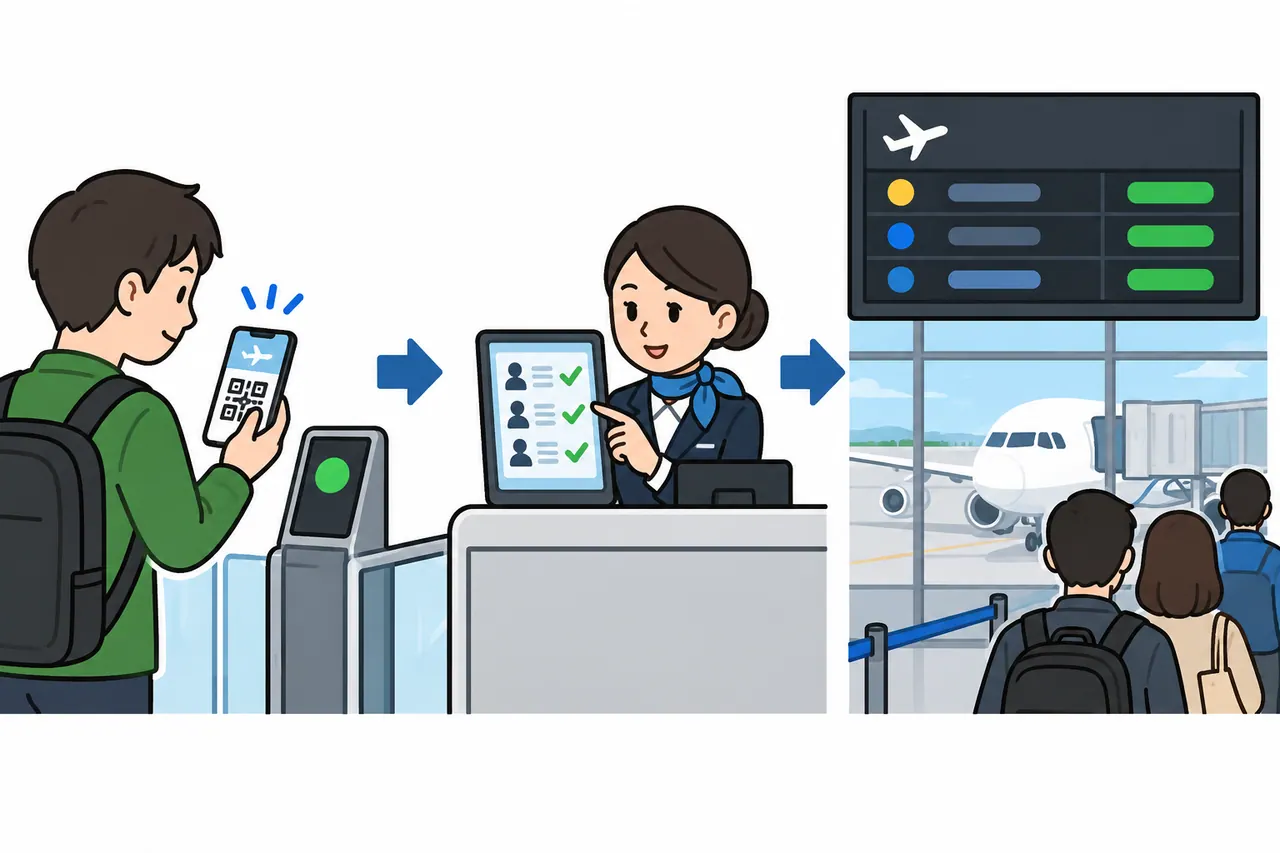
Osaka Rakuyu Pass holders are instructed to show a QR code at the counter and exchange it for a ticket for a specific boat. The pass page says a full boat cannot take additional passengers and that evening departures can sell out early. On 3 November 2026, the operator’s cruise page redirected to a website maintenance notice; that notice does not establish whether the boats themselves were operating. Check the operator’s current notice and ask about departures, space, ticket sales and child fares before setting out.
Find the pier
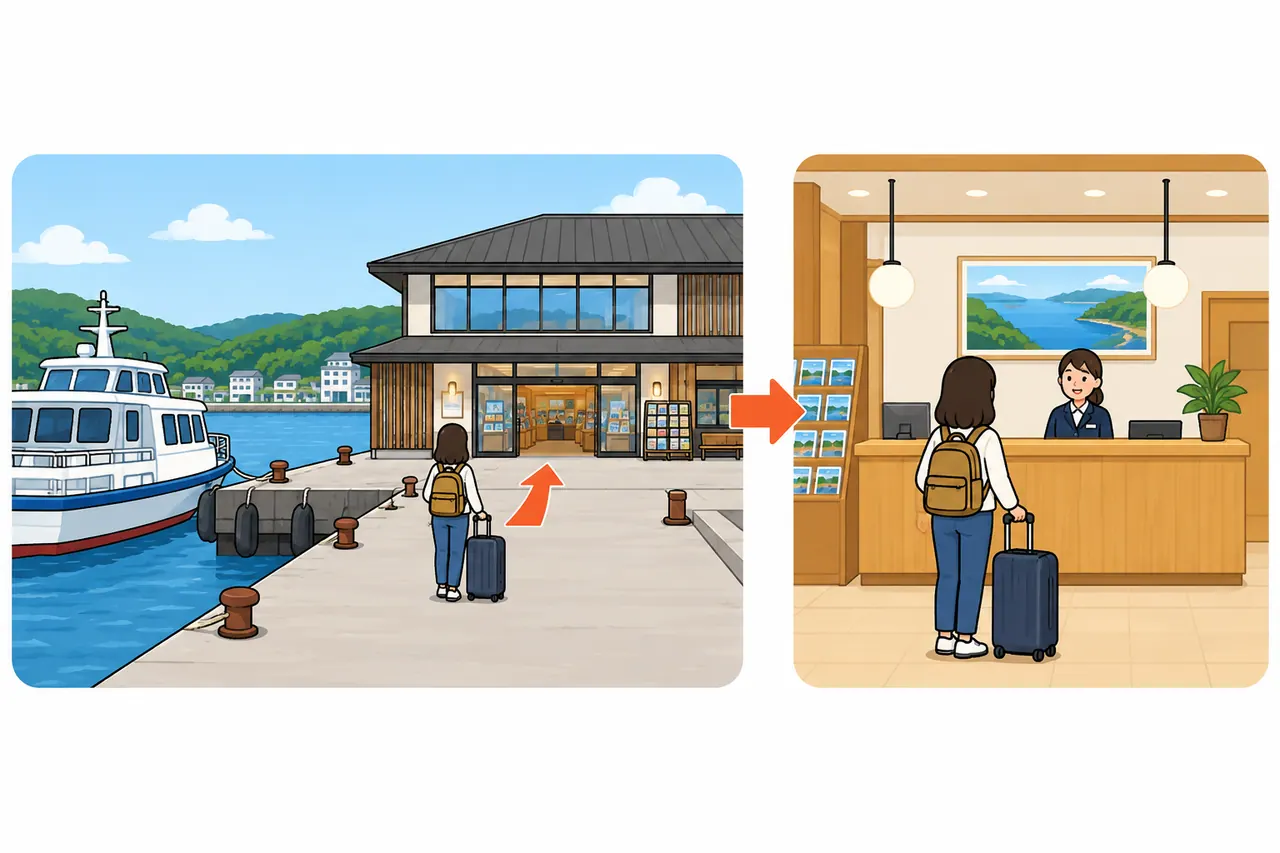
The pier is Tazaemonbashi Pier, in front of Don Quijote Dotonbori at 7-13 Soemoncho, Chuo-ku. OSAKA-INFO places reception on the store’s first floor, beside the north bank of the riverwalk. Its cruise listing also gives access information from nearby Namba, Shinsaibashi and Nipponbashi stations, but check a map from your own starting point.
Before leaving, confirm where to collect or show your ticket and which departure still has space. The pass listing says the cruise can operate in light rain, but weather, tide or river conditions can cause cancellations. Use the pier name and Don Quijote address as map landmarks, and leave enough flexibility to change plans if a boat is cancelled.
Bridges from the boat
An OSAKA-INFO experience listing names nine bridges associated with the cruise: Nipponbashi, Aioi, Tazaemon, Ebisu, Dotonbori, Shin-Ebisu, Daikoku, Fukari and Ukiwa. This is useful context for understanding the canal and its crossings. The list does not confirm the operator’s current route or which bridges a boat will pass on your day.
5. Plan your Dotonbori visit: timing and budget
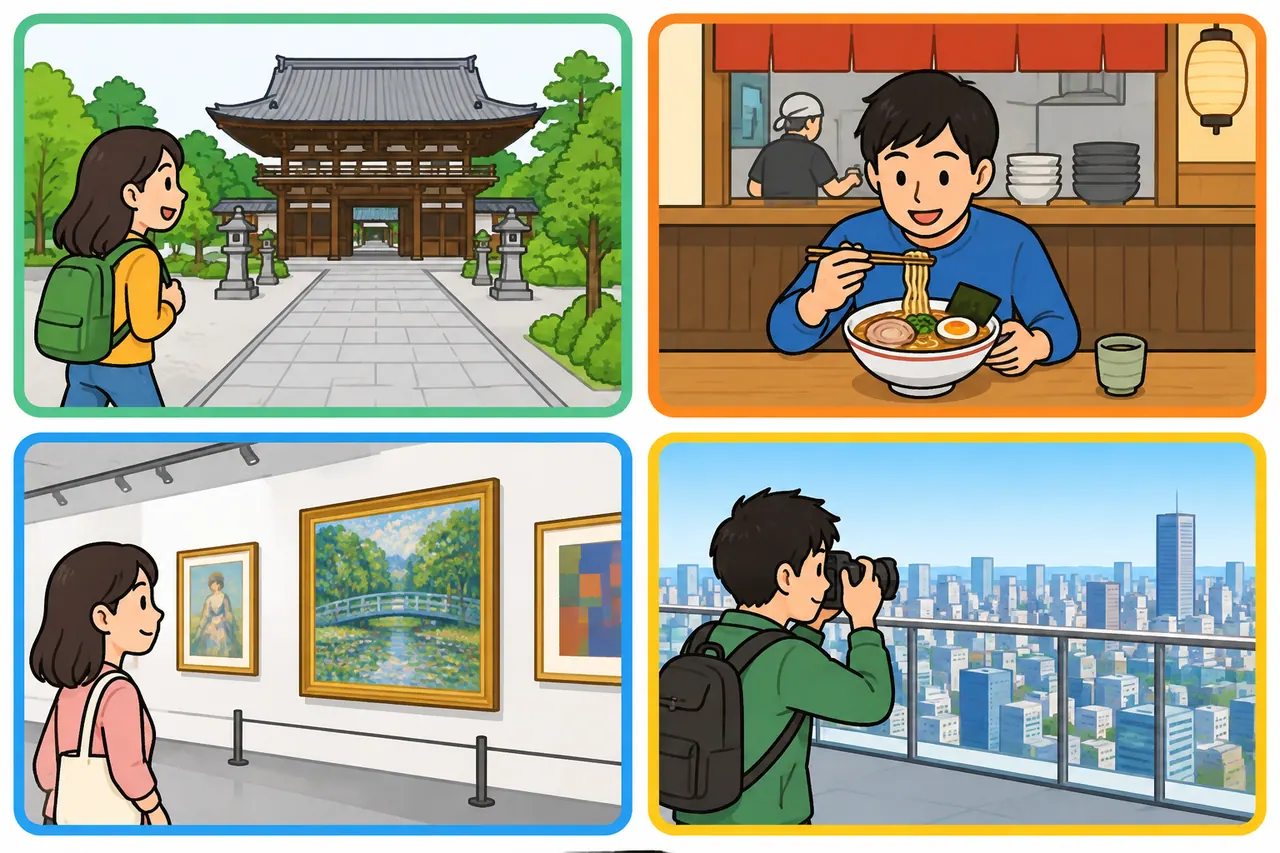
A simple first-visit plan is to see Ebisu Bridge and the Glico sign, choose a meal, and add the riverwalk or a cruise if conditions suit. The best order depends on your restaurant plans and any confirmed departure. Keep optional attractions flexible because their operation, ticket availability or hours may change.
Choose daylight or evening
Daylight gives you the streets and signs in natural light, while after sunset is a better choice if you want to aim for the Glico sign during its listed lighting period. Glico says lighting begins after sunset and continues until midnight, but may finish earlier. If a boat ride is part of the plan, choose a departure only after confirming that it is running and has space.
| Plan | Useful for | Main check |
|---|---|---|
| Daylight | Street views and food | Hours of your chosen shop |
| After sunset | Aiming for a lit Glico sign | Any change to the lighting |
| Around a confirmed boat | Combining the canal and a ride | Departure and seat availability |
| Any season | Fitting Dotonbori into a wider trip | Weather and chosen activities |
OSAKA-INFO describes Dotonbori as lively throughout the year, but does not provide current crowd counts by month, holiday or time of day. A video or a single visit shows one moment, not typical crowd levels for every date. For broader seasonal planning, consult a best-time-to-visit-Japan guide, and keep your schedule flexible if weather or queues affect your plans.
Use a flexible evening order
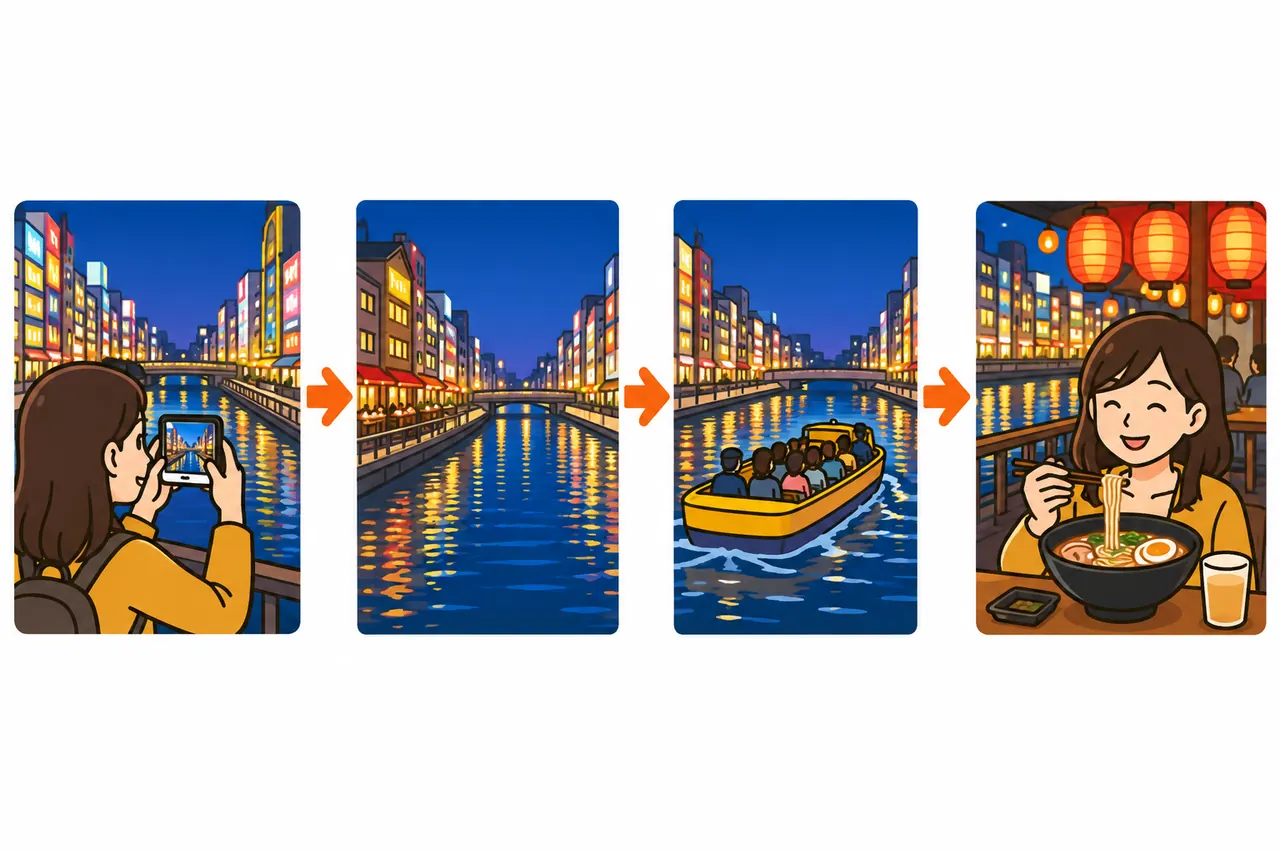
This is a suggested sequence, not a timed tour. Start at Namba Exit 14 and walk to Ebisu Bridge; Osaka City lists the distance as about 200 metres, or three minutes on foot. Look for the Glico sign after sunset, keeping in mind that its lighting may end before midnight.
From there, walk beside the canal and locate the pier if you have confirmed a cruise. The boat ride is about 20 minutes, but waiting, ticket arrangements and the rest of your visit take additional time that has no confirmed estimate. Eat before or after the cruise according to your booking and departure; if the boat is unavailable, keep the bridge, riverwalk and meal as the main plan.
Estimate a basic budget
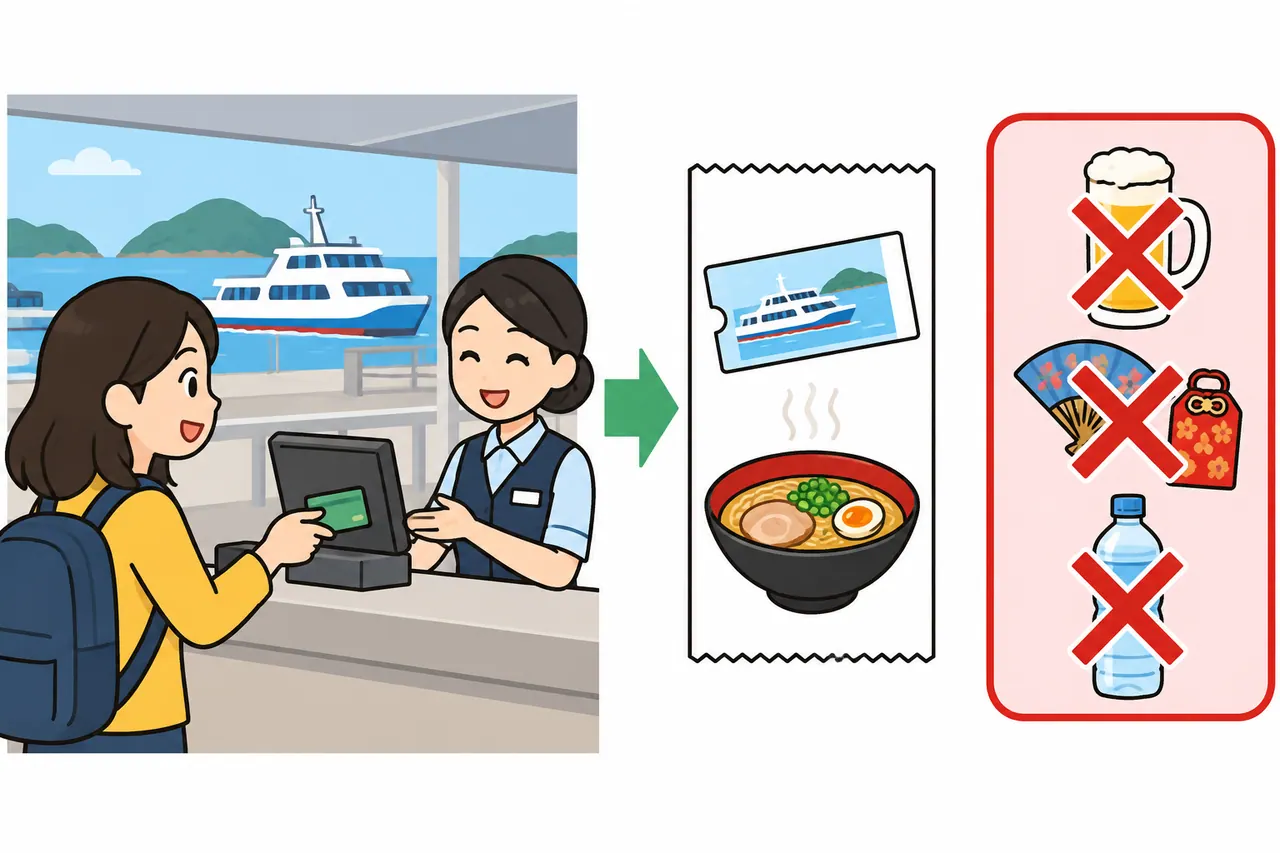
The example below combines one adult’s listed cruise fare with one bowl of ramen at Ichiran Annex. Both prices were displayed on 3 November 2026, but should be checked again for your visit.
| Item | Listed amount |
|---|---|
| Tombori River Cruise, one adult | ¥2,000 |
| Ichiran Annex ramen | ¥1,180 |
| Example total | ¥3,180 |
The total excludes transport, accommodation, any late-night charge, extra orders and Ebisu Tower. It also assumes the cruise is operating and the listed fare applies; neither is guaranteed for your date. Without the cruise, use the meal price as a starting point and add your own transport and other purchases.
Add nearby stops if they fit
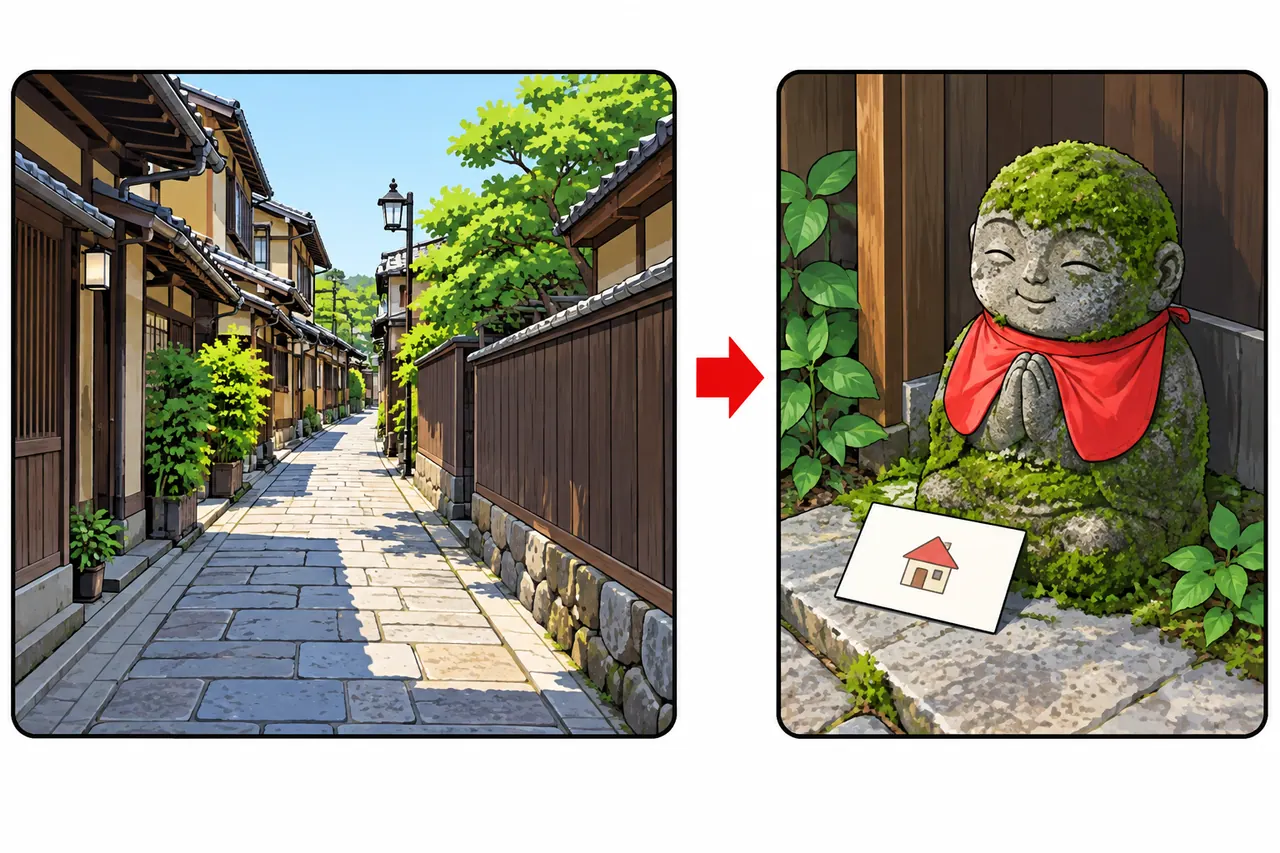
Hozenji is at 1-2-16 Namba, Chuo-ku. OSAKA-INFO describes its moss-covered Mizukake Fudo, a Buddhist figure, and the stone-paved Hozenji Yokocho lane. Its listing gives two different walking estimates from Namba stations—about 10 minutes in the text and 5 minutes in the access details—so check a map from your actual starting point rather than relying on one estimate.
| Extra stop | Why consider it | Planning detail |
|---|---|---|
| Hozenji | See Mizukake Fudo | Check visiting information and the map |
| Hozenji Yokocho | Walk along the stone-paved lane | Check the route from your current location |
| Nakaza Kuidaore Building | Add another named district stop | See station walks in the access table |
| Tombori Riverwalk | See the canal from beside the water | Check the route to the riverwalk |
The walking time between Hozenji and particular points in Dotonbori is not confirmed, nor are Hozenji’s visiting hours or entry costs in the available information. If you want a wider city itinerary, use an Osaka travel guide to connect Dotonbori with other stops. A meal or the riverside walk can also replace a paid ride if the weather, a closure or ticket availability changes your plans.
6. Accessibility, safety and local rules
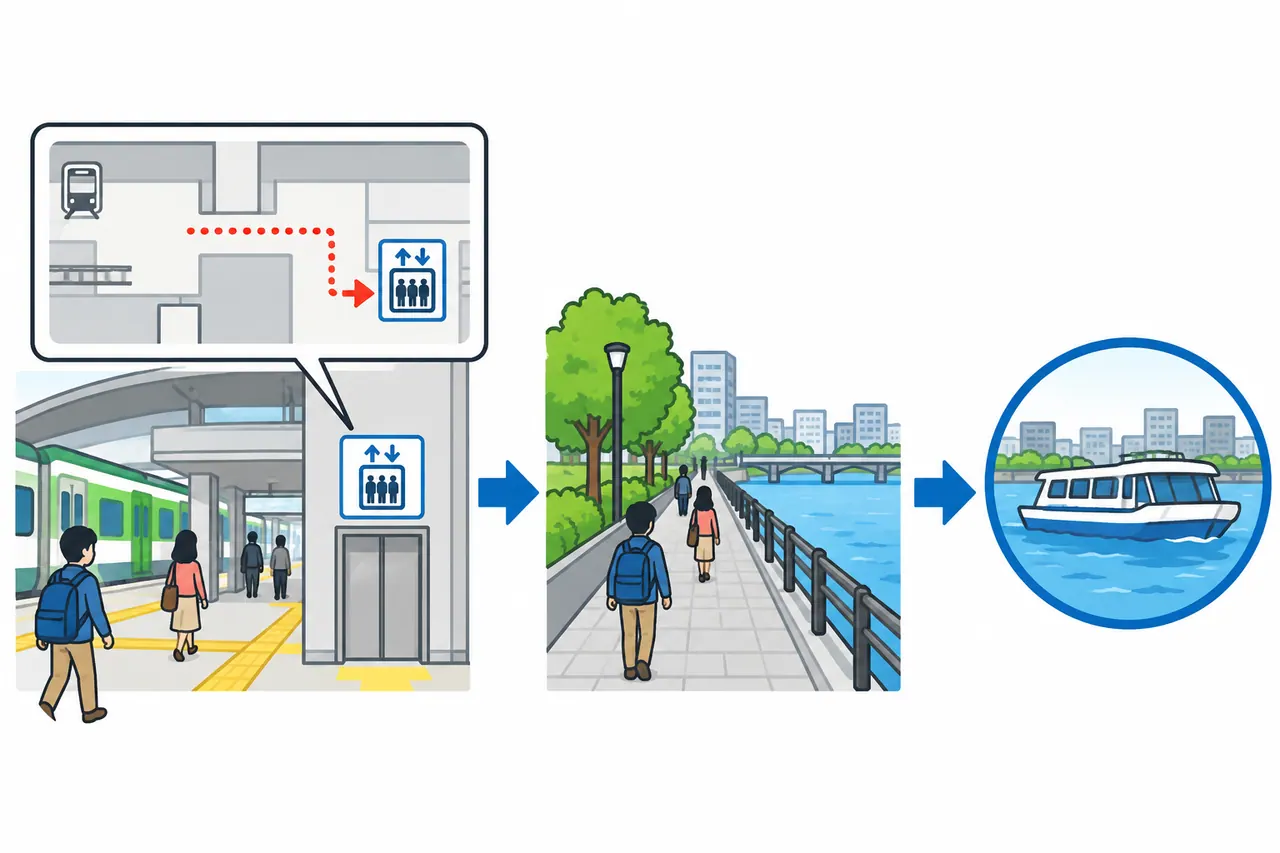
Plan station access and boat boarding separately. The tourism bureau says wheelchairs can use the Tombori Riverwalk, but that does not guarantee that every station-to-riverwalk route or the boat itself is accessible. If you are travelling with children, luggage or mobility needs, check the exact route and boarding arrangements before you go.
Check station and river access
The Namba accessible-travel guide warns that some station gates do not have elevators. Before travelling, identify the gate you plan to use and check how to reach street level from it. The riverwalk guide describes the riverwalk as wheelchair-accessible, but does not confirm every connecting route.
For a boat trip, contact the operator to ask about boarding for your group’s needs; riverwalk access does not establish boat access. If you are meeting others, agree on a named place such as a bridge or shop. If you have luggage, decide whether to carry it or send it ahead; a Japan luggage-forwarding guide explains that option.
Follow local rules and stay alert
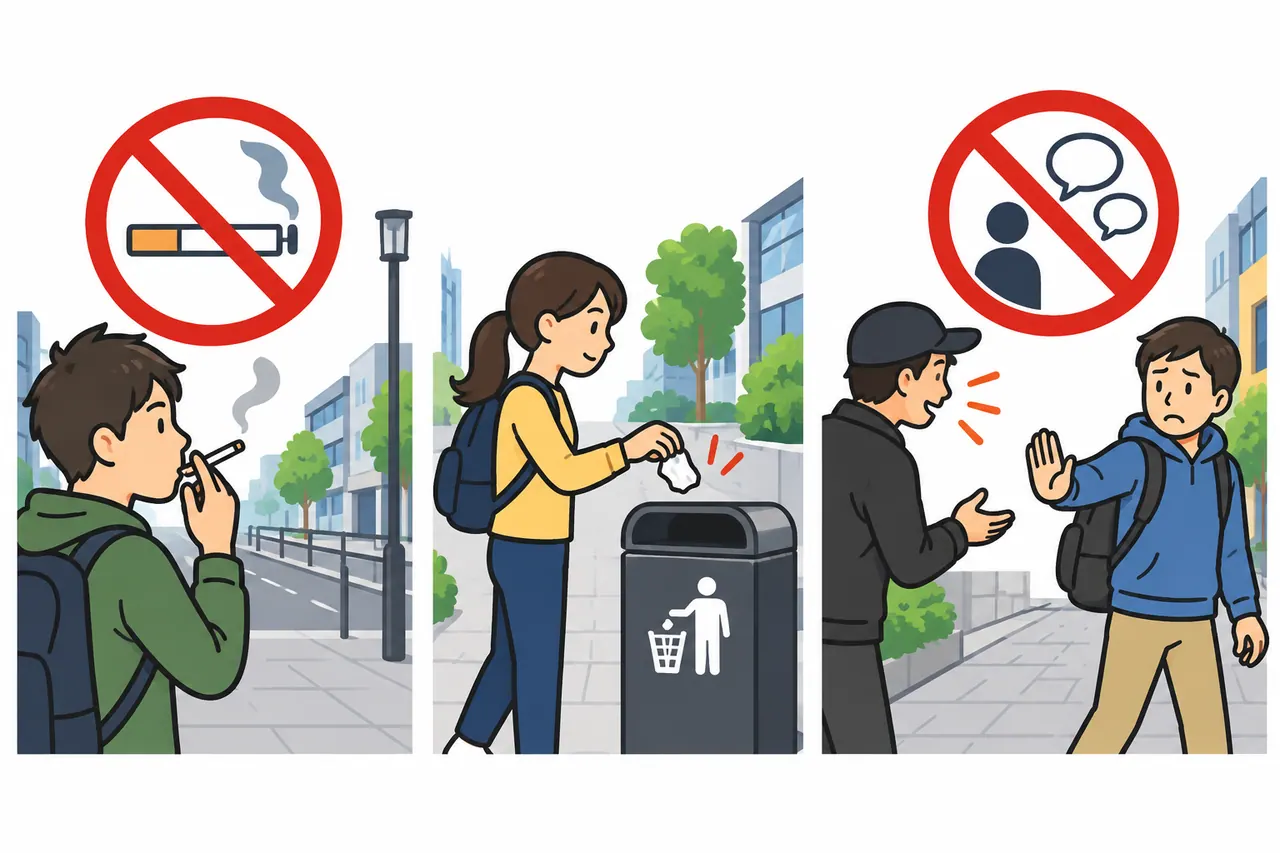
Osaka City expanded its street-smoking ban across the city on 27 January 2025. Heated tobacco is included, and the city lists a ¥1,000 penalty for a violation. The city’s information on street-smoking rules is the appropriate reference if you need details.
Minami is a designated area for rules against certain street solicitation and customer-approach practices. If someone pressures you to enter a shop or bar, you can decline and continue with your plan; Osaka City provides information on its measures. The city also asks people not to litter, including cans and paper, and to follow local rubbish-disposal rules. This is Osaka-wide guidance, not a Dotonbori-specific eating rule; ask a shop how to dispose of packaging from food you buy there.
7. Dotonbori FAQ
The answers below distinguish listed information from details that still need confirmation. Prices, hours, available seats and departures may change, so check the relevant operator before travelling. In particular, the cruise’s child fares and ticket sales differ across listings.
Which station exit should I use for Ebisu Bridge?
Exit 14 at Osaka Metro Namba or Kintetsu Namba is one useful starting point. Osaka City lists Ebisu Bridge about 200 metres, or three minutes on foot, from that exit. It is not confirmed as the fastest option for every traveller or every destination.
When is the Glico sign lit?
Glico lists lighting from after sunset until midnight, with the possibility that it ends earlier depending on conditions. The information was checked on 3 November 2026, so check the official sign page for current details. The available information does not confirm that the sign is always unlit during the day.
How much does the Tombori River Cruise cost?
The tourism listing showed ¥2,000 for adults and ¥1,000 for students of junior-high age or older on 3 November 2026. Child-fare descriptions conflict, and the fare that applies on your date is not confirmed. Give the operator each child’s age and check all fares before paying.
Can I book the cruise online?
The listings do not agree: one describes web booking with advance payment until 10 minutes before departure, while another says tickets are sold on the day. Telephone reservations are listed as unavailable. Ask about the current sales method, departure and seats; the displayed inquiry number is 050-1807-4118, 09:00–17:00, and is for questions rather than telephone bookings.
How long is the cruise?
The ride itself is listed as about 20 minutes. That does not include ticket arrangements, waiting, meals, photos or walking to and from the pier. No official total visit time for Dotonbori is confirmed.
Is Ebisu Tower operating, and what does it cost?
Its operation, current hours and visit-day price are not confirmed. The available listings show different prices and hours, including a tourism-board price of ¥600 and an older operator display of ¥1,000. Check the tourism listing, the operator page, or ask staff before planning a ride.
Is the riverwalk wheelchair-accessible?
The tourism bureau says wheelchairs can use the Tombori Riverwalk, but does not confirm every route from the station or the cruise’s boarding conditions. Some Namba station gates do not have elevators, so check your intended gate and street-level route. Ask the operator directly about boat access for your group.
What can I eat in Dotonbori?
Options in this guide include takoyaki at Kukuru, okonomiyaki and yam-based dishes at Mizuno, ramen at Ichiran Annex and a takoyaki-making activity at Dotonbori Konamon Museum. Check each operator for current prices, hours and availability; ask directly about ingredients if you have an allergy. The Ichiran Main Store was listed as closed when checked on 3 November 2026, so do not confuse it with the Annex.