
Best Time to Visit Japan: Weather & Holidays by Month
Contents
- 1. Japan by month: Tokyo weather and holiday guide
- 2. Spring in Japan: cherry blossoms and Golden Week 2027
- 3. Summer in Japan: rain, heat and typhoons
- 4. Autumn in Japan: leaves and the 2026 forecast
- 5. Winter in Japan: dry cities and freezing Sapporo
- 6. Choose your travel dates by goal
- 7. Common first-trip planning mistakes
- 8. Best time to visit Japan: frequently asked questions
For most travelers, spring (late March to May) and autumn (October to November) are good starting points: Tokyo’s temperatures are generally mild, and these seasons bring cherry blossoms or autumn leaves. The best dates depend on your priorities and route, since Hokkaido’s climate differs sharply from that of Kyoto and Osaka. If you want to avoid a major holiday cluster, note the 2027 Golden Week dates—29 April and 3–5 May—and consider avoiding August and September if heat and typhoon disruption are concerns.
| Your priority | A useful time or place to consider | What to keep in mind |
|---|---|---|
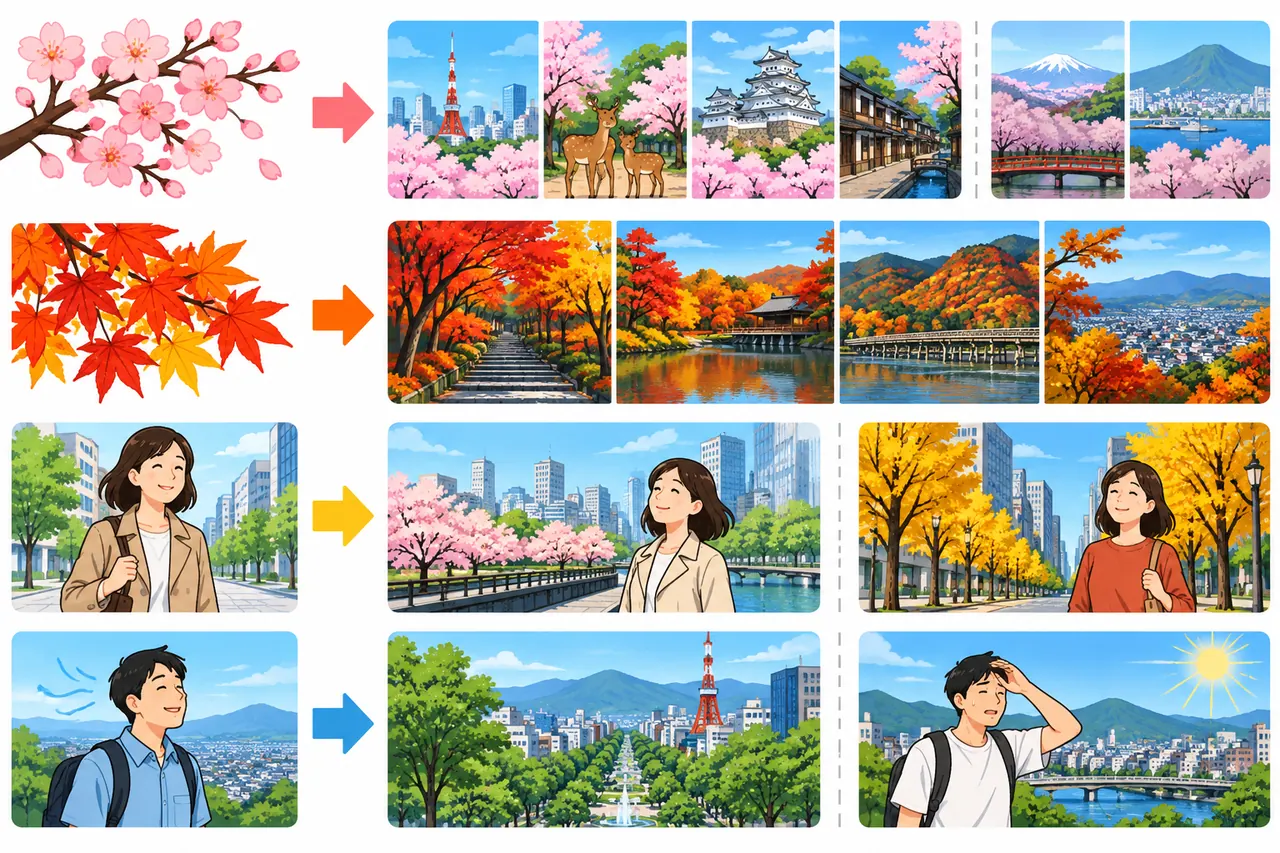
| Cherry blossoms | Late March to early April in Tokyo, Nara, Himeji and Kanazawa | Bloom timing changes each year; northern viewing windows continue later. |
| Autumn leaves | November in many areas | The 2026 forecast varies by city; Sapporo is forecast earlier and Fukuoka later. |
| Mild city weather | April or November in Tokyo, Kyoto and Osaka | These are climate-normal comparisons, not a prediction for a particular trip. |
| Cooler summer weather | Sapporo | Its August average high is 26.4°C, compared with 33.7°C in Kyoto and Osaka. |
| Cold winter weather | Sapporo | January’s average high is below freezing. |
| Budget | Compare accommodation rates for your dates | The sources used here do not provide comparable hotel prices or identify a cheapest month. |
A climate normal is a 30-year average. The Japan Meteorological Agency (JMA) climate figures in this guide cover 1991–2020, so they describe typical conditions rather than the weather you will necessarily encounter. A typhoon “approach” is a JMA category for a typhoon coming close to Japan; it is not the same as a landfall. The JMA typhoon statistics explain the statistics used here.
Japan by month: Tokyo weather and holiday guide
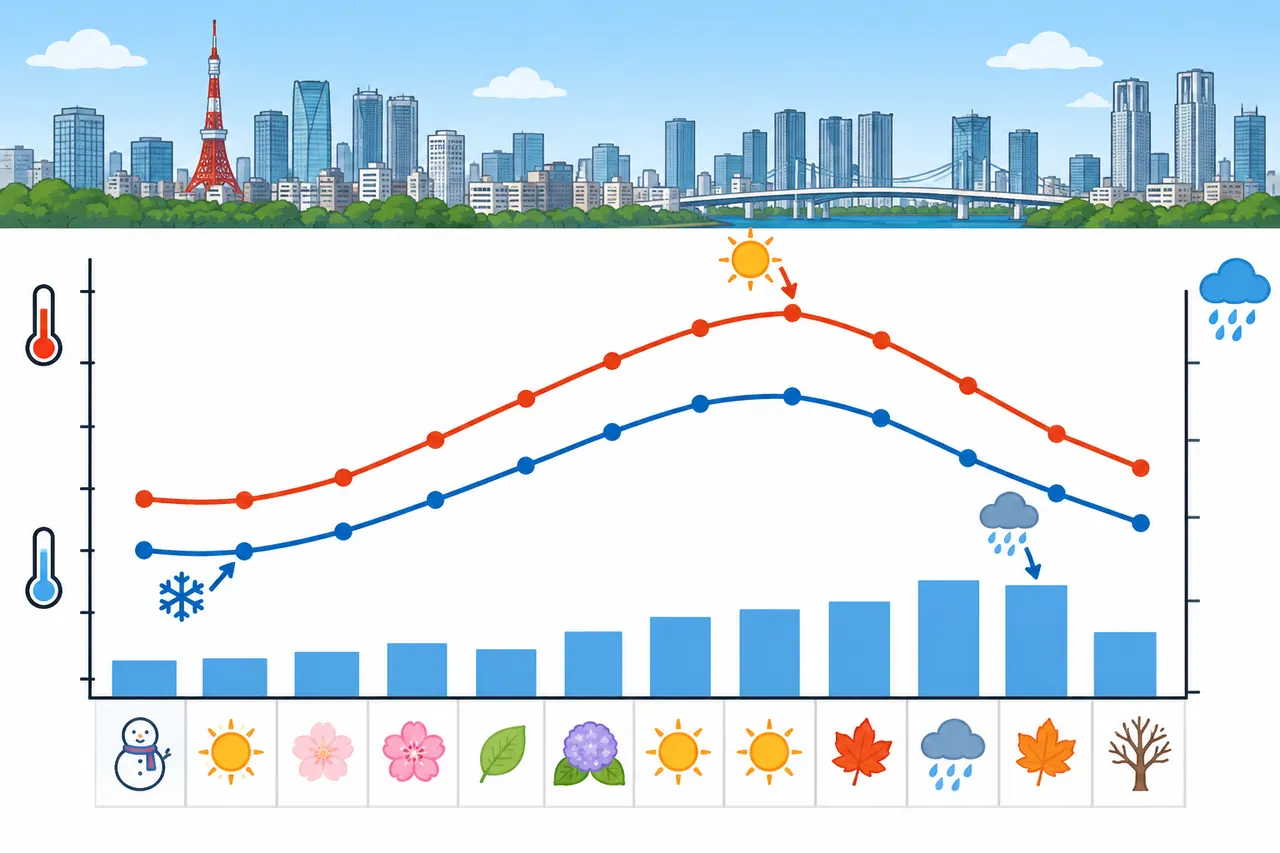
Tokyo is a useful reference for a first itinerary, but it should not stand in for the whole country. The figures below are JMA normals for Tokyo; highs and lows are monthly average daily maximum and minimum temperatures, and rainfall is monthly precipitation. Holiday flags identify dates, not measured crowd levels, and the 2027 holiday dates are taken from the Cabinet Office’s national-holiday list.
| Month | Avg. high | Avg. low | Rain | Holiday or seasonal note |
|---|---|---|---|---|
| January | 9.8°C (49.6°F) | 1.2°C (34.2°F) | 59.7 mm | 1 January is a national holiday; the wider year-end and New Year period is not defined as a holiday period in the Cabinet Office list. |
| February | 10.9°C (51.6°F) | 2.1°C (35.8°F) | 56.5 mm | Tokyo’s driest month; Kawazu’s cherry festival period is early to late February. |
| March | 14.2°C (57.6°F) | 5.0°C (41.0°F) | 116.0 mm | Rainfall rises from February; Tokyo blossom viewing begins late in the month in some years. |
| April | 19.4°C (66.9°F) | 9.8°C (49.6°F) | 133.7 mm | Mild; Tokyo’s typical blossom window continues into early April. Golden Week begins with Showa Day on 29 April. |
| May | 23.6°C (74.5°F) | 14.6°C (58.3°F) | 139.7 mm | Warm; national holidays fall on 3, 4 and 5 May in 2027. Hakodate blossoms can continue into early May. |
| June | 26.1°C (79.0°F) | 18.5°C (65.3°F) | 167.8 mm | Wet; check JMA for current-year rainy-season information. Average typhoon approaches: 0.8. |
| July | 29.9°C (85.8°F) | 22.4°C (72.3°F) | 156.2 mm | Hot; average typhoon approaches: 2.1. |
| August | 31.3°C (88.3°F) | 23.5°C (74.3°F) | 154.7 mm | Tokyo’s hottest month; Mountain Day is 11 August in 2027. Average approaches: 3.3. |
| September | 27.5°C (81.5°F) | 20.3°C (68.5°F) | 224.9 mm | Very wet; Silver Week is a named holiday period, but its dates are not provided here. Average approaches: 3.3. |
| October | 22.0°C (71.6°F) | 14.8°C (58.6°F) | 234.8 mm | Pleasant temperatures, but Tokyo’s wettest month. Average approaches: 1.7. |
| November | 16.7°C (62.1°F) | 8.8°C (47.8°F) | 96.3 mm | Cool and drier; Tokyo’s average autumn-leaf peak date is 28 November in the JNTO table. |
| December | 12.0°C (53.6°F) | 3.8°C (38.8°F) | 57.9 mm | Cold and dry; the wider year-end and New Year period has no dates specified in the Cabinet Office holiday list. |
Tokyo’s annual average temperature is 15.8°C, and its annual precipitation is 1,598.2 mm. September and October are its wettest months by these normals, while February is the driest. For the complete monthly figures and current climate-normal context, use the JMA Tokyo climate table.
How Tokyo compares with Kyoto, Osaka and Sapporo
A route that combines several cities can cross substantial temperature differences in the same month. Kyoto and Osaka are hotter than Tokyo in summer, while Sapporo is much cooler and has a lower annual average temperature. The city figures below come from the JMA Kyoto, Osaka and Sapporo climate tables.
| City | January high | April high | August high | November high | Annual average | Annual precipitation |
|---|---|---|---|---|---|---|
| Tokyo | 9.8°C (49.6°F) | 19.4°C (66.9°F) | 31.3°C (88.3°F) | 16.7°C (62.1°F) | 15.8°C | 1,598.2 mm |
| Kyoto | 9.1°C (48.4°F) | 20.1°C (68.2°F) | 33.7°C (92.7°F) | 17.3°C (63.1°F) | 16.2°C | 1,522.9 mm |
| Osaka | 9.7°C (49.5°F) | 19.9°C (67.8°F) | 33.7°C (92.7°F) | 17.8°C (64.0°F) | 17.1°C | 1,338.3 mm |
| Sapporo | -0.4°C (31.3°F) | 11.7°C (53.1°F) | 26.4°C (79.5°F) | October: 16.4°C (61.5°F) | 9.2°C | 1,146.1 mm |
Kyoto is hotter in summer than Tokyo, and July is Kyoto’s wettest month, with 223.6 mm of average precipitation. Its April and November average highs are 20.1°C and 17.3°C, respectively, which can be useful reference points when planning city walks. Osaka has the highest annual average temperature in this comparison, at 17.1°C.
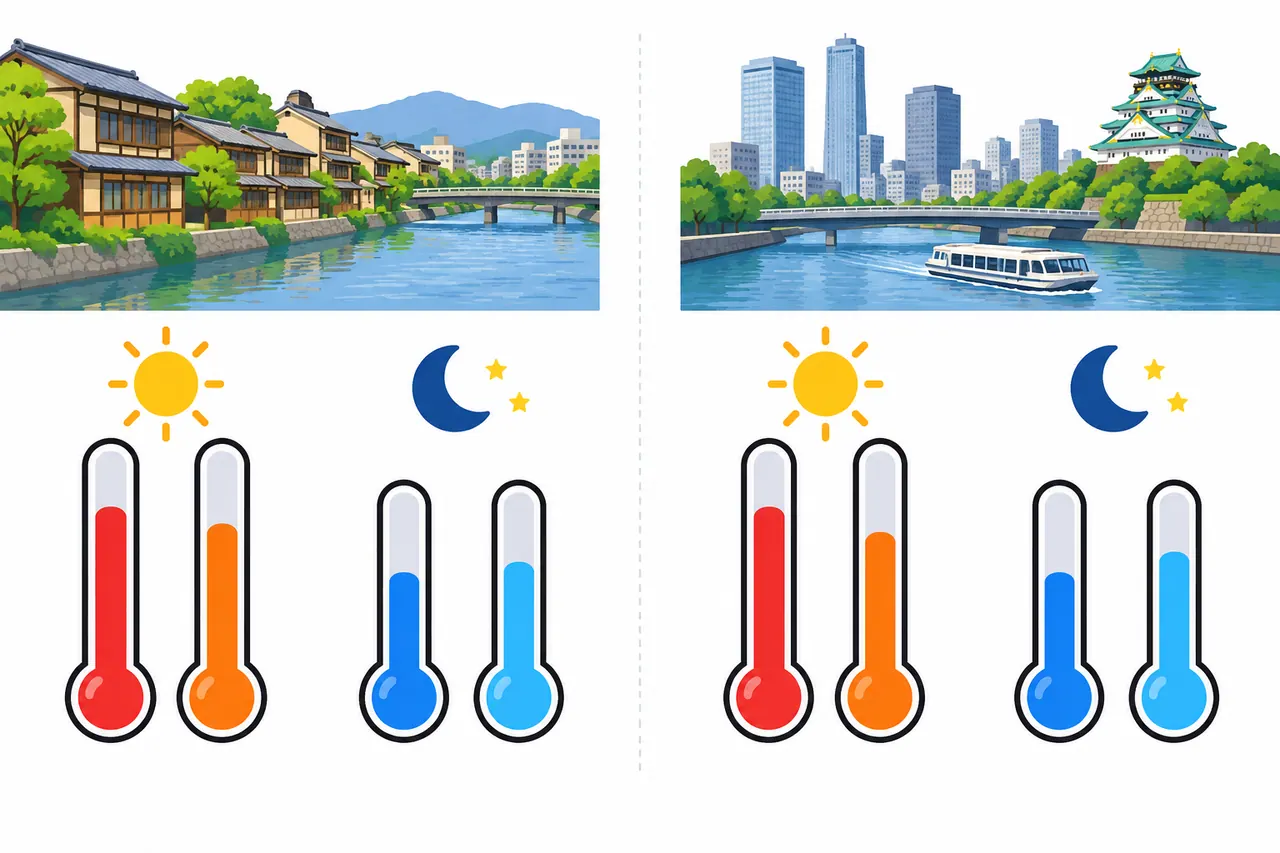
Kyoto and Osaka have the same August average high, 33.7°C, but Osaka’s average low is higher: 25.8°C against Kyoto’s 24.7°C. Sapporo’s August average high is 26.4°C, 7.3°C below Kyoto’s, while its January low averages -6.4°C. These differences make it worth planning clothes and outdoor activity around each stop, rather than packing for a single idea of “Japan.”
Spring in Japan: cherry blossoms and Golden Week 2027
Spring is a good choice for mild temperatures and blossom viewing, but the viewing window moves across the country. Late March to early April is the listed window for several central and southern locations, while northern viewing spots can remain in season into early May. Tokyo’s April average high is 19.4°C, and Kyoto’s is 20.1°C; Tokyo’s average April low is 9.8°C, so evenings can still feel cool. See the JNTO cherry blossom guide for the listed places and seasonal windows.
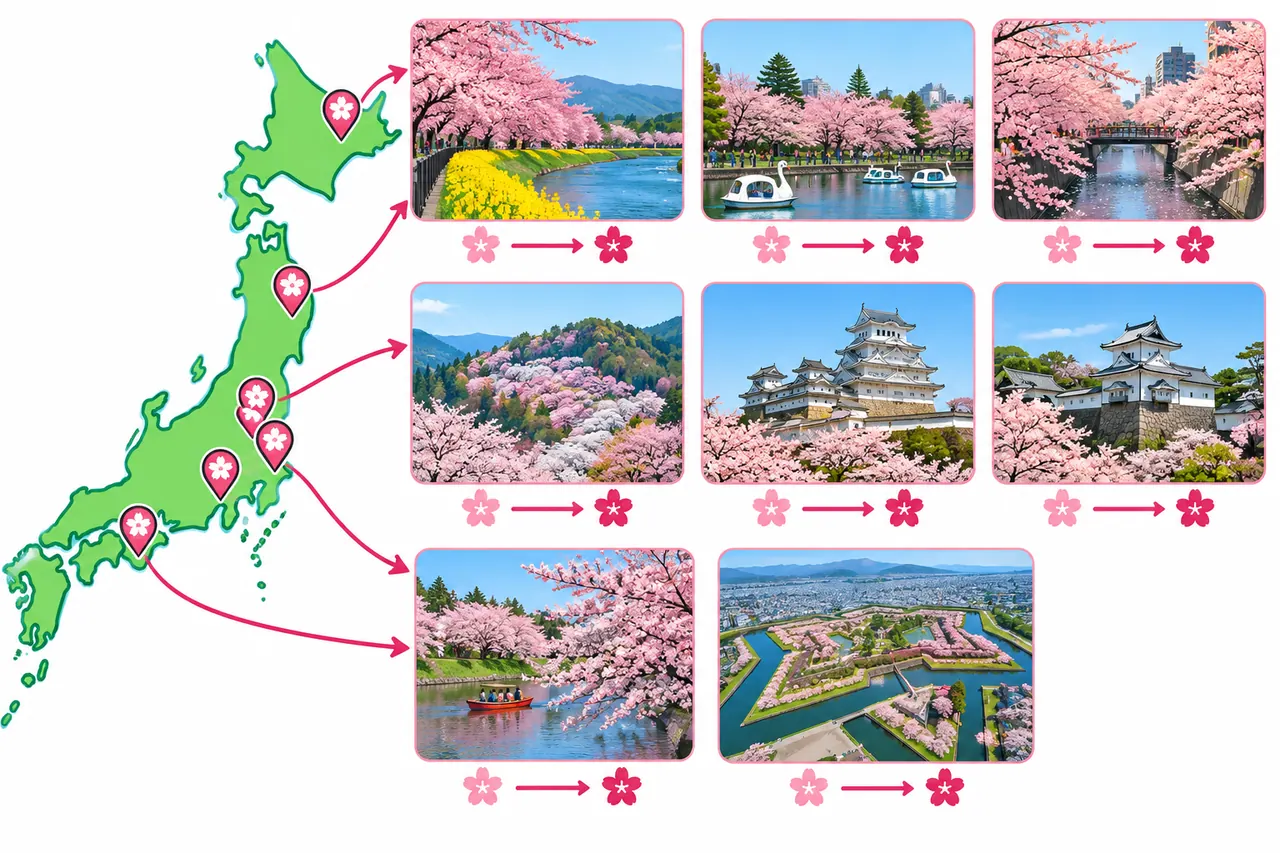
Cherry blossom windows by place
| Place | Listed viewing window |
|---|---|
| Kawazu, Shizuoka | Festival period: early to late February |
| Ueno Park, Tokyo | Late March to early April |
| Nakameguro, Tokyo | Late March to early April |
| Yoshino, Nara | Late March to early April |
| Himeji Castle | Late March to early April |
| Kanazawa Castle | Late March to early April |
| Hirosaki Park, Aomori | Mid-April to early May |
| Goryokaku Park, Hakodate | Late April to early May |
JNTO describes Ueno as one of Japan’s most crowded cherry-blossom viewing spots. If you plan to visit, an early-morning visit is one option to consider, although it cannot guarantee a less crowded experience. The listed dates are seasonal windows rather than fixed bloom dates, and the JNTO blossom page does not name a forecasting body; check an official forecast closer to departure. JMA also provides a page for seasonal observations and historical cherry and maple records, though the historical table values have not been used here.
Golden Week dates and planning
Golden Week is a cluster of national holidays from late April to early May, so check the calendar before setting travel dates. In 2027, the Cabinet Office lists Showa Day on Thursday 29 April, Constitution Memorial Day on Monday 3 May, Greenery Day on Tuesday 4 May and Children’s Day on Wednesday 5 May. These dates identify public holidays; they do not by themselves establish the crowd level on a particular train, at an airport or at a sightseeing spot.
The main late-March-to-early-April blossom windows in Tokyo, Nara, Himeji and Kanazawa end before the 2027 Golden Week dates begin. The northern windows at Hirosaki and Hakodate overlap with Golden Week, so those locations may suit a later spring itinerary if the annual blossom timing aligns. Official 2027 crowd forecasts from rail companies and airports were not available in the checked sources; look for operator notices nearer your travel date.
For comparison, the Cabinet Office lists 2026 Golden Week holidays on 29 April and 3–6 May, with 6 May shown as a holiday. Do not reuse that 2026 calendar for a 2027 trip: the listed dates differ by year. The official Cabinet Office holiday page is the place to check the applicable calendar.
Summer in Japan: rain, heat and typhoons
June, July and August pose different planning considerations: June is wet in the cited cities, while July and August are hot in Tokyo, Kyoto and Osaka. Hokkaido is cooler in the JMA city comparison, but its climate is not a guarantee of any particular day’s conditions. JMA’s monthly normals give a baseline; check current forecasts as your trip approaches.
June rain and the rainy season
Tokyo receives an average of 167.8 mm of rain in June, while Kyoto receives 199.7 mm. Kyoto’s July precipitation rises to 223.6 mm, its wettest month in the supplied climate data. The start and end dates of the rainy season change from year to year, and the normal start and end dates were not checked for this guide, so use JMA’s current information rather than relying on a fixed calendar date.
Rain does not mean every day of a trip will be wet, just as a monthly average cannot predict the weather for a specific excursion. Build flexibility into outdoor plans and consider having indoor alternatives for days when rain affects sightseeing. For Kyoto’s figures, consult the JMA Kyoto climate table.
July and August heat
Tokyo’s August average high is 31.3°C, and its average low is 23.5°C. Kyoto and Osaka both average 33.7°C for the August high, with average lows of 24.7°C in Kyoto and 25.8°C in Osaka. If your itinerary includes extended outdoor sightseeing, plan outdoor activities earlier in the day, allow for indoor breaks in the afternoon and drink water regularly.
Summer is not a poor choice for every traveler, but the city you choose matters. Sapporo’s August average high is 26.4°C and its average low is 19.1°C, notably cooler than the Kansai cities in this comparison. Mountain Day falls on 11 August in both 2026 and 2027; check transport providers’ current notices when arranging travel around a holiday.
Typhoon season and disruption planning
Typhoon approaches average 3.3 in both August and September, the highest monthly figures in the JMA 1991–2020 normals. The average is 2.1 in July and 1.7 in October, while May and June average 0.7 and 0.8 approaches, respectively. For the monthly approach, formation and landfall figures, use the JMA typhoon statistics page.
| Month | Typhoons formed | Approaches | Landfalls |
|---|---|---|---|
| May | — | 0.7 | — |
| June | — | 0.8 | — |
| July | 3.7 | 2.1 | 0.6 |
| August | 5.7 | 3.3 | 0.9 |
| September | 5.0 | 3.3 | 1.0 |
| October | 3.4 | 1.7 | 0.3 |
| November | 2.2 | 0.5 | — |
| Annual average | 25.1 | 11.7 | 3.0 |
A dash means the value is not included in the checked data. Monthly approach counts do not necessarily sum to the annual total because one typhoon can approach in two months, and rounding can also create small differences. Typhoons can delay flights, trains and ferries; if travelling in late summer, consider keeping a buffer day before your flight home and check your airline’s flight-status page when conditions may affect travel.
Autumn in Japan: leaves and the 2026 forecast
November is a useful month to consider for autumn leaves in many parts of Japan, but the season advances from north to south. JNTO describes the overall foliage period as late September to early December, with November the main month for many areas. September remains warm and very wet in Tokyo, and October is also wet there: the respective monthly rainfall normals are 224.9 mm and 234.8 mm. The JNTO autumn leaves guide explains the seasonal progression.
November is cooler and drier in the cited cities. Tokyo receives an average of 96.3 mm of rain, and Kyoto 73.9 mm; Kyoto’s average high and low are 17.3°C and 8.4°C. These are climate normals, not a forecast, so check current conditions and foliage updates when your travel dates are near.
2026 autumn-leaf forecast by city
JNTO’s 2026 forecast table uses Japan Weather Association (JWA) data. Forecast peaks are seasonal estimates, and the table’s “average date” is shown separately rather than being a promise of peak color on that date. Review the JNTO 2026 autumn leaves forecast again close to your trip.
| City | 2026 forecast peak | Average date |
|---|---|---|
| Sapporo | Early November | 28 October |
| Sendai | Late November, later than usual | 21 November |
| Tokyo (Chiyoda) | Late November, about average | 28 November |
| Nagoya | Late November | 28 November |
| Osaka | Late November | 1 December |
| Hiroshima | Late November, later than usual | 22 November |
| Fukuoka | Mid-December, later than usual | 1 December |
| Kagoshima | Early December | 15 December |
The JWA update dated 28 October 2026 reported that foliage timing was average or later than average nationwide. On that date, 118 observation points had reached peak color, compared with about 180 at the same point in 2022 and 2023. JWA described northern Japan as mostly around average timing, eastern Japan as average or later, and many western locations as average or later; see its 28 October 2026 update.
If you are travelling in late November or December 2026, the later timing reported for some places may affect which city fits your dates. Recheck the JNTO forecast a few days before visiting rather than treating the current table as a guarantee. Fukuoka’s forecast is mid-December, later than usual, while its listed average date is 1 December; those are distinct entries in the table.
Winter in Japan: dry cities and freezing Sapporo
Tokyo, Kyoto and Osaka are cold in winter, but their January precipitation normals are relatively low: 59.7 mm in Tokyo, 53.3 mm in Kyoto and 47.0 mm in Osaka. Tokyo’s average daytime highs from December to February range from 9.8°C to 12.0°C. The city figures and monthly comparisons are available in the JMA tables for Tokyo, Kyoto and Osaka.
January average lows are 1.5°C in Kyoto and 3.0°C in Osaka. Layers are useful for moving between colder mornings and daytime conditions, and a warm coat is appropriate for city visits during these months. The normal figures describe averages rather than daily minimum guarantees.
Sapporo is a much colder winter choice. Its January average high is -0.4°C and its average low is -6.4°C; average January precipitation is 108.4 mm, almost twice Tokyo’s 59.7 mm. JMA publishes snowfall and snow-depth normals on the same Sapporo climate page, which is worth checking before a snow or ski trip; bring warm layers and boots with good grip.
Only 1 January is listed as a national holiday by the Cabinet Office. Its holiday list does not define a wider year-end and New Year period, and the checked sources did not confirm official rail peak dates for year-end travel. Before booking, check the rail operator’s current information and the official opening-day information for each attraction you plan to visit, particularly for late December and early January.
Choose your travel dates by goal
Start with what matters most—blossoms, leaves, mild weather, a cooler summer or winter cold—then compare the places on your route. The steps below use official holiday and seasonal information, but they cannot produce a reliable crowd or price forecast. Use current operator updates for practical booking decisions.
A six-step planning method
- Choose your main goal. Pick a seasonal priority such as cherry blossoms, autumn leaves, mild city weather or a cooler summer destination. If your goals conflict, decide which one matters most before choosing exact dates.
- Compare the cities on your route. Check the city table above for the months you are considering; August highs, for example, differ substantially between Sapporo and Kyoto or Osaka. For winter, compare Sapporo’s sub-zero January high with the milder Tokyo, Kyoto and Osaka figures.
- Mark public holidays. Add 29 April and 3–5 May 2027 to your calendar using the Cabinet Office holiday list. Calendar dates are confirmed holidays, not a crowd forecast.
- Check seasonal disruption risks. If travelling in August or September, use the JMA typhoon normals as context and consider a buffer day before your flight home. Check current transport and airline notices close to departure.
- Bookmark seasonal updates. Save JNTO’s cherry blossom information and autumn-leaf forecast, then check again a few weeks before travelling. For a particular day, a forecast can change the plan even when the normal seasonal window looks suitable.
- Keep flexibility in the itinerary. Leave some room to move an outdoor visit if weather or seasonal timing changes. On travel days, check your airline’s flight-status information.
The key pitfall is locking a once-only trip to one predicted blossom or leaf date months in advance. Bloom and foliage timing shifts from year to year, so consider a second location with a later seasonal window if seeing blossoms is a priority. After setting your dates, compare accommodation rates directly rather than assuming one month is the cheapest.
What to pack for the cities on your route
Pack for the places you are actually visiting, not for a national average. In January, Tokyo, Kyoto and Osaka have average highs from 9.1°C to 9.8°C, while Sapporo’s average high is -0.4°C. A warm coat suits the larger cities, while Sapporo calls for heavier layers and warm footwear.
In April, Tokyo, Kyoto and Osaka have average highs between 19.4°C and 20.1°C, but Sapporo’s is 11.7°C. A light jacket is a reasonable starting point for the former cities; plan for a warmer coat in Sapporo. In August, Kyoto and Osaka average 33.7°C for the high, while Sapporo’s average low is 19.1°C, making breathable clothing and sun protection useful in the Kansai cities and a light evening layer worth considering in Sapporo.
For November, the average highs in Tokyo, Kyoto and Osaka range from 16.7°C to 17.8°C, so a sweater and light coat can suit those conditions. If visiting Tokyo in September or October, consider an umbrella: those are its two wettest months in the JMA normals. Check the forecast before departure because monthly averages do not describe the weather on a specific day.
Crowds and holiday periods
The confirmed dates in this guide are calendar facts, not measured crowd levels. For 2027, the Cabinet Office lists Golden Week holidays on 29 April and 3–5 May, and Mountain Day on 11 August; it lists only 1 January as a national holiday in the year-end period. The official holiday list does not supply dates for the wider year-end and New Year period or for Silver Week.
JNTO describes Ueno as one of the most crowded blossom-viewing spots in Japan, but the checked sources do not provide general crowd measures for other cities or dates. Official 2026 crowd forecasts from rail companies and airports were not found in the checked material, so consult the relevant operator before travel. NEXCO Central’s travel information page says that for its 2026 business year it will not apply the holiday toll discount during Golden Week, Silver Week and the year-end/New Year period to help reduce heavy traffic; check that page for exact periods if driving.
The same NEXCO page uses a Korean-language term that can be read as “Chuseok” for a summer period, so it has not been treated here as confirmed evidence about Obon. The Cabinet Office holiday list does not show Obon as a national holiday. Do not assume that a named travel or discount period is equivalent to a public holiday or a verified crowd forecast.
Accommodation costs and budget checks
The official sources used for this guide do not provide hotel-price data, so there is no evidence here to name the cheapest month. Rates can be checked for your own route and dates using the accommodation provider’s official booking page. Compare the same room type and conditions rather than comparing unlike properties or room categories.
For one practical comparison, select a Golden Week night such as 3 May 2027 and a night in mid-May at the same hotel, then compare the rates shown for the same room type. For an autumn trip, compare a November date with a late-November date when leaves are forecast in your destination. Treat the displayed prices as a comparison for those dates only; the sources here do not establish a general seasonal price index.
Seasonal events and destination choices
The dated seasonal information in the supplied sources covers the Kawazu cherry festival period, cherry-blossom windows and the 2026 autumn-leaf forecast. Kawazu’s festival period is early to late February, while blossom windows extend from Tokyo and other central locations in late March and early April to Hirosaki and Hakodate in late April and early May. Dates for other festivals change from year to year; check the organizer’s official website for the current schedule rather than relying on an undated list.
For a spring city base, Tokyo puts you near the listed Ueno and Nakameguro blossom window and has an April average high of 19.4°C. Kyoto or Osaka can also work as spring bases, with April average highs of 20.1°C and 19.9°C; Yoshino and Himeji Castle are listed for late March to early April. These comparisons describe climate and blossom windows, not travel times or guaranteed viewing conditions.
For summer, Sapporo’s August average high of 26.4°C contrasts with 33.7°C in Kyoto and Osaka. In autumn 2026, Sapporo’s forecast peak is early November, while Tokyo and Osaka are forecast for late November; Fukuoka’s is mid-December. A December stay in Fukuoka may therefore fit a late-season foliage itinerary, but recheck the forecast before setting a fixed viewing day.
Sapporo for winter cold and snow
Sapporo is the cold-weather option in this city comparison, with a January average high of -0.4°C and low of -6.4°C. Its January precipitation is 108.4 mm, compared with 59.7 mm in Tokyo, and its average high is 10.2°C lower than Tokyo’s. These figures are useful for packing and seasonal comparison, not a forecast of snowfall on your travel dates.
JMA provides snowfall and snow-depth normals on its Sapporo page, so check those data if your trip depends on snow conditions. Bring warm boots with good grip and several layers for outdoor winter plans. If the route also includes Tokyo, Kyoto or Osaka, pack for their milder winter temperatures separately.
Common first-trip planning mistakes
One common mistake is assuming June is Tokyo’s wettest month. The JMA normals show 167.8 mm in June, compared with 224.9 mm in September and 234.8 mm in October, so autumn travel also calls for rain planning. Check the climate data and the current forecast for the specific dates rather than treating one season as uniformly dry.
Another risk is booking a blossom visit around one exact date months ahead with no alternative. The listed windows are seasonal ranges, and the annual timing changes; Hirosaki and Hakodate have later windows than Tokyo, Nara, Himeji and Kanazawa in the supplied JNTO information. If blossom viewing is central to the trip, keep a later-window option in mind and recheck forecasts close to departure.
Do not plan a late-November Sapporo visit on the assumption that its leaves peak at the same time as Tokyo’s. The 2026 forecast lists Sapporo for early November and Tokyo, Nagoya and Osaka for late November. Similarly, do not pack one winter wardrobe for the whole country: Sapporo’s January average high is below freezing, while Tokyo’s is 9.8°C.
Finally, do not ignore typhoon-season flexibility. August and September have the highest average approach counts in the JMA normals, at 3.3 per month. Keep a buffer before a flight home if possible, and check current transport and flight information if a typhoon may affect your itinerary.
Best time to visit Japan: frequently asked questions
What is the best month to visit Japan?
April or November is a useful starting point for travelers who want mild weather in Tokyo, Kyoto or Osaka. In the climate normals, the average highs for these cities across those months range from 16.7°C to 20.1°C. April is associated with spring blossoms in several listed locations, while November is a key month for autumn leaves; neither season guarantees exact viewing conditions.
When are cherry blossoms in Tokyo?
JNTO lists late March to early April for Ueno Park and Nakameguro. Exact dates change each year, and the listed window should not be treated as a forecast for a particular trip. Check JNTO’s cherry blossom page and current forecasts a few weeks before departure.
What is the best time to see autumn leaves?
November is a useful broad target because JNTO describes it as the main month for leaves in many areas. The season progresses from north to south, from late September to early December overall, so the best dates differ by destination. For 2026, the forecast lists Sapporo in early November, Tokyo and Osaka in late November, and Fukuoka in mid-December.
When is Golden Week in 2027?
The 2027 national holidays in the Golden Week cluster are 29 April and 3, 4 and 5 May. Check the Cabinet Office holiday list when planning around public holidays, since dates differ between years. Those dates do not provide a measured forecast of transport or sightseeing crowds.
Which months have the most typhoon approaches?
August and September each average 3.3 approaches in the JMA 1991–2020 statistics. July averages 2.1 and October 1.7. The figures describe long-term monthly averages; they do not predict whether a particular trip will be affected.
Is summer a bad time to visit Japan?
Not for every traveler, but Tokyo, Kyoto and Osaka are hot in July and August, and June is wet in the cited climate data. Sapporo is cooler in the comparison: its August average high is 26.4°C, against 33.7°C in Kyoto and Osaka. If travelling in late summer, consider flexible outdoor plans and a buffer before an important flight.
Is winter a good time to visit Japan?
Winter can suit city walking and temple visits in Tokyo, Kyoto and Osaka, where January precipitation normals are under 60 mm in each city. Temperatures are still cold, especially in the mornings, so dress in layers. Sapporo is a much colder option, with a January average high below freezing and a low of -6.4°C.
What is the cheapest month to visit Japan?
The sources used here do not include comparable accommodation or travel prices, so they do not support naming a cheapest month. Compare rates on accommodation providers’ official booking pages for the same property, room type and booking conditions across your candidate dates. This gives you a date-specific comparison rather than an unsupported claim about the whole season.
About this guide: Prepared by the JGO! editorial team. We do not claim first-hand testing. Climate numbers are from JMA’s 1991–2020 normals, holiday dates are from the Cabinet Office, and seasonal forecasts are identified separately from climate averages. The 2026 foliage forecast uses JWA data presented by JNTO.
Last checked: 2 November 2026. Next review: 9 November 2026.


